Private Label Chino Trousers Manufacturing in Bangladesh: A Brand Owner's Guide
Private-label chinos from Bangladesh: twill, waistband and pocket branding, wash standards and label packs, and what to specify, sample and check before confirming an order.
Short answer
A private-label chino trouser order from Bangladesh starts with a written specification: cotton or cotton-blend twill, fit, waistband construction, pocket styling and branding, button, wash standard and label pack. Factories in the woven sector quote per colour and per size, so state the split, approve a washed pair and a pre-production sample in writing, and agree inspection and one delivery term before confirming.
On this page
Key takeaways
A private-label chino is defined by its twill, fit, waistband construction, pocket styling and branding, button, wash standard and label pack, and every one should be fixed in writing before bulk production.
Factories quote per colour and per size, so state the split per colour and per size; a total quantity alone cannot be answered with a usable minimum.
Approve the wash standard on a finished, dried, washed pair, with a recorded shade tolerance and after-wash measurements, across the lightest and darkest colours in the range.
Waistband labels, pocket branding and buttons are ordered in their own runs, so approve the physical pieces in hand and ask for their minimums apart from the garment minimum.
Exportain verification is a document and photo review, not a factory inspection, and a badge is not a guarantee of capacity, quality or delivery.
A chino trouser carries a brand in places a customer touches every day: the waistband that has to hold its shape through a working week, the pocket bags that must not tear at the corners, the button that has to stay fastened, and the wash that has to keep one colour steady across a whole range. A private-label chino order succeeds or fails on those four points more than on the cloth alone, because each of them is specified, sampled and approved separately, and a fault in one of them reaches the customer even when the rest of the pair is right.
Private label means the trouser carries your brand name, your labels and your packing, made to your specification rather than taken from a factory range with a hang tag added. The decisions that make the chino yours sit with you: the twill, the fit, the waistband construction, the pocket styling and branding, the button, the wash standard and the label wording. The factory executes those decisions. Put each one in writing before bulk production, including ownership of the pattern, the wash reference and the label artwork.
Bangladesh is a woven-garment source of real depth for this product. The Bangladesh Garment Manufacturers and Exporters Association (BGMEA) has around 4,500 member factories, of which about 60 per cent are woven garment manufacturers, and BGMEA member factories account for 100 per cent of woven garment exports.1 Bangladesh earned US$39.34 billion from ready-made garment exports in the last fiscal year (FY25), according to official data.1 Chinos fit that woven base: chino cloth is a twill fabric originally made from pure cotton, and today it is also found in cotton-synthetic blends.2
In the Harmonized System, heading 6203 covers trousers, bib and brace overalls, breeches and shorts for men or boys, not knitted or crocheted, with cotton trousers under subheading 620342.3 A women's chino falls under the parallel women's heading, so confirm the code for each style with your broker, since the code follows the wearer, the fibre and the construction.
Why this matters for buyers and sellers
For the buyer, a chino range lives or dies on repeat consistency. A customer who buys a second pair expects the same waistband height, the same leg shape, the same pocket depth and the same shade as the first pair, in every colour of the range. A waistband that rolls after washing, a pocket bag that splits at the bartack, or a stone shade that drifts between two deliveries will each produce returns, even if the twill itself was well chosen. Approvals must therefore test the trouser as worn and washed, not only flat on a table.
For the seller, a private-label chino order locks the factory into inputs it cannot sell to another buyer. Twill dyed to your colours, waistband labels woven with your name, pocket branding printed or woven to your artwork, buttons finished to your specification and cartons printed with your marks all belong to one order. That is why a factory asks for firm decisions on twill, waistband and pocket branding, wash and size quantities before it commits line time, and why a late change carries a cost even when the total quantity stays the same.
Step-by-step: how it works
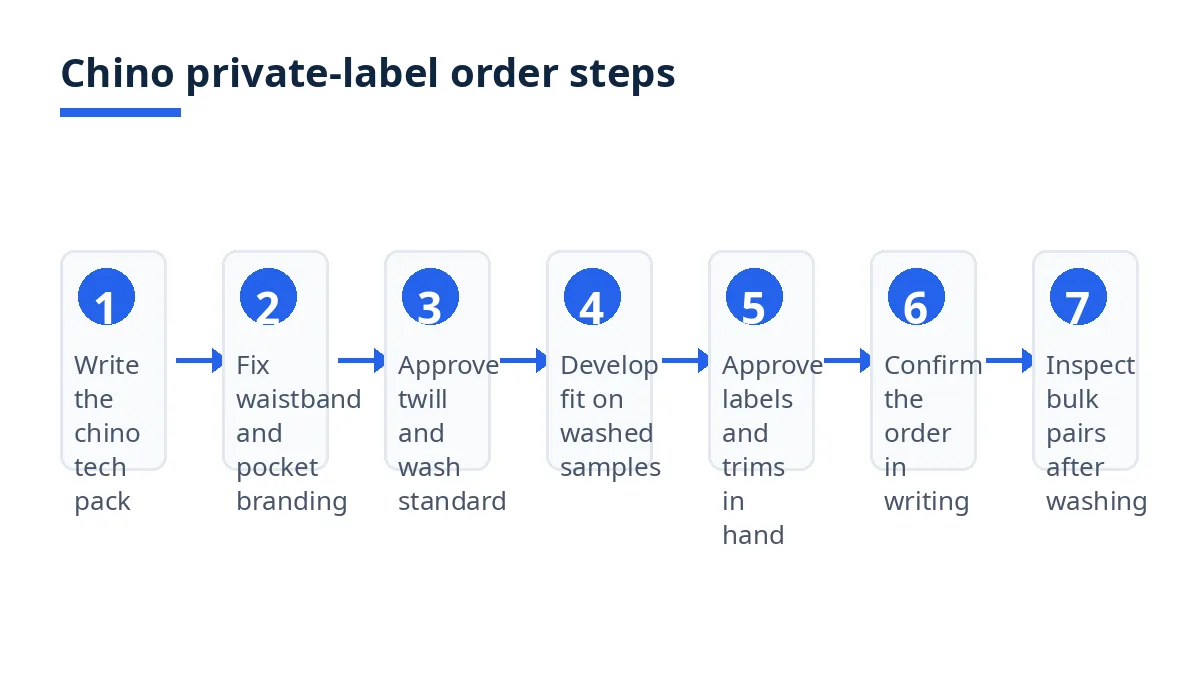
Write a chino tech pack. State the twill composition, weave and weight, whether the cloth is rigid or stretch, each colour reference, the fit (rise, waist, hip, thigh, knee, leg opening and inseam), the waistband construction and height, pocket style (slant front pockets, welt or patch back pockets) and pocket bag fabric, fly type, button type and finish, stitching and topstitching, the wash you want, label placements and packing. Name the size curve and the quantity per size and per colour.
Fix waistband and pocket branding before sampling. Send the woven main label for the waistband, the size label, any pocket branding (a woven label, a printed pocket bag or an embroidered mark), the button artwork and the hang tag. Ask for label, button and pocket-branding minimums apart from the garment minimum, since each is ordered in its own run. Approve the physical pieces in hand, not only as artwork files.
Choose the twill and set the wash standard. Ask whether each twill colour is stocked or dyed to order, and record the mill, weight, composition and shade reference. Then approve a fabric swatch for shade and a washed pair for the wash standard, judging both on a finished, dried pair rather than a wet one. Record the wash reference, the shade tolerance between pairs and between colours, and the measurements after washing, so the bulk wash has a written target.
Develop fit on washed samples across sizes. Order a fit sample in your twill and wash, measure it after laundering, and grade it across your size curve. Check waist, hip, thigh, knee, leg opening and inseam on more than one size, and confirm how the waistband behaves after washing, including stretch recovery where the twill contains elastane.
Approve the label pack and trims in hand. Hold the waistband label, size label, care label, hang tag, button and pocket branding against the washed trouser. Check that the button finish survives the wash you chose, that pocket branding stays legible after washing, and that the fibre composition wording matches the twill you approved. If you sell into the European Union, Regulation (EU) No 1007/2011 requires a textile product to be labelled or marked with the name and percentage by weight of all constituent fibres in descending order.4
Confirm the order in writing. Put the twill, wash reference, size curve, quantity per colour, waistband and pocket branding specification, inspection plan and delivery term on the purchase order. Approve a pre-production sample in the exact bulk twill, wash, labels and trims before cutting starts.
Inspect bulk pairs after washing. Check measurements on washed pairs, shade consistency across the lot and between colours, waistband shape and stitching, pocket bag strength and bartacks, button attachment, topstitching evenness and label placement. Agree the inspection level and acceptance quality limit (AQL) values before production, following ISO 2859-1, which defines a system of acceptance sampling plans for inspection by attributes, indexed by AQL for lot-by-lot inspection.5 State one Incoterm and named place for every quotation, since the Incoterms 2020 rules set out 11 rules with a clear allocation of cost, risk and obligations.6
Costs, timelines and documents
What are the typical costs and timelines?
There are no typical costs or timelines a guide can state as fact, because each factory prices your twill, colour count, waistband and pocket branding, wash level, size curve, inspection and delivery term for your specification. The table below shows what moves the price, not what the price is.
Driver | What moves it | State in your enquiry |
|---|---|---|
Twill | Composition, weight, stocked or dyed to order | Fibre, weave, weight, colour references |
Colour count | Dye lot per colour | Quantity per colour |
Waistband branding | Label weave, button finish, run size | Label and button spec, placements |
Pocket branding | Print, weave or embroidery set-up | Method, size, placement, pocket fabric |
Wash | Wash level, shade tolerance, rewash risk | Wash reference, tolerance, washed measurements |
Size curve | Grading, marker efficiency, small sizes | Size range, ratio per colour |
Delivery term | Cost and risk allocation | One Incoterm and named place6 |
Example figures: a range of 1,800 pairs split across three colours gives 600 pairs per colour (1,800 divided by 3 equals 600). Cutting one colour leaves 900 pairs per remaining colour at the same total (1,800 divided by 2 equals 900). The example shows structure only, not a typical MOQ, price or lead time. Ask for set-up costs for labels, pocket branding and wash development as lines apart from the unit price, so a shorter run can be priced honestly and the same set-ups serve the repeat order.
For timelines, sampling depends on twill availability, wash development and correction rounds, and bulk production on dyeing, trim delivery and line capacity. Ask for sampling, twill ready, production and inspection dates as separate lines, not a single delivery week.
Which documents are needed?
The order documents are the tech pack, the itemized quotation and the purchase order, with the twill, wash reference, waistband and pocket branding specification and quantity per colour on both. For shipment, confirm who prepares the export declaration and the accompanying export set with Customs before you agree the delivery term.7
Bangladesh-specific rules and tips
Confirm association claims at the source. If a supplier claims BGMEA membership, confirm it with the association itself. BGMEA states that it will not register a garment factory in a shared building housing other establishments, and that a woven or knit garment factory must have at least 100 machines and a minimum floor space of 15,000 square feet to qualify for membership.1 Membership signals an active woven business, not the MOQ on offer or capacity for your order.
Put one legal name on every document in the file. Customs and the bank compare the declaration against the trade licence, quotation, proforma invoice and payment account, so reconcile every name before the goods are ready, not at the port.
Ask which inputs are imported for your order. Buttons, zips, pocketing and some twills may be bought in for your specification, and an imported trim can set both the minimum and the earliest production date. Agree the size ratio per colour before production.
Write the wash standard for the whole range, not one pair. A chino range is sold in several colours, and the wash reference, shade tolerance and after-wash measurements must hold across all of them. Approve the lightest and darkest colours in the range, not only the middle shade, and record what counts as a rewash rather than an accepted variation.
Match the label to the market. Fibre composition wording, care wording and country-of-origin marking differ by destination, so send the label pack for each market with the tech pack.
Mistakes and red flags
What are the most common mistakes?
Approving the wash on an unwashed or wet pair. A chino judged wet or unwashed will measure and shade differently once dried and worn. Approve the wash standard on a finished, dried, washed pair, and record the reference.
Approving the waistband flat, not worn and washed. A waistband that lies flat on a table can still roll, gap or twist after laundering. Check it on a washed pair, on more than one size, with the button fastened.
Forgetting the pockets in the approval. Pocket bags, pocket branding and bartacks are checked last and fail first in wear. Inspect pocket depth, bag fabric, branding legibility after washing and bartack strength on the bulk sample, not only on the proto.
Comparing quotes on different twills or wash levels. A lower price on a lighter twill, a lower wash level, stock labels or a different term is a different offer. Compare only replies to the same tech pack on the same Incoterm.6
Accepting a verbal approval. Record any agreed wash reference, shade tolerance, label change or lower minimum on the quotation and purchase order, with the split and colours it applies to.
Treating a badge as capacity proof. A badge is not a guarantee of capacity, quality or delivery.8
Inspection is the control you do not cut for speed. Under ISO 2859-1, a sample drawn from the lot is checked against the agreed AQL, and that check is what stands between production and your stock.
Checklist
Before you confirm, every line should be answered in writing.
Tech pack sent: twill, fit, waistband, pockets, fly, button, wash, labels, sizes, packing.
Split stated per colour and per size, with one size ratio per colour.
Waistband label, pocket branding and button approved in hand, with their minimums apart from the garment minimum.
Twill status per colour recorded: stocked or dyed to order.
Wash reference, shade tolerance and after-wash measurements recorded from a dried, washed pair.
Fit approved on washed samples across the smallest, middle and largest sizes.
Label wording matched to the twill and to each destination market.4
Pre-production sample in bulk twill, wash, labels and trims approved in writing.
Inspection level and AQL values in the purchase order.5
Quotations compared on the same specification and Incoterm.6
Export set agreed: who prepares the declaration and the accompanying documents.7
How Exportain helps
On Exportain, browse suppliers and post a request for quotation (RFQ) on the RFQ board with your tech pack summary, split per colour and delivery term, so suppliers quote against the same specification. Ask each reply for its per-colour minimums and for its waistband, pocket branding and wash set-up lines. Read the badges for what they record: verification is a document and photo review by staff, not a factory inspection, and a badge is not a guarantee of capacity, quality or delivery.8 9 See how supplier verification works on Exportain and the MOQ definition.
FAQs
What should I know first about chino trousers?
Chino cloth is a twill fabric originally made from pure cotton, and today it is also found in cotton-synthetic blends.2 A private-label chino order therefore starts with the twill, the fit, the waistband and pocket construction, the button, the wash standard and the label pack, each fixed in writing before bulk production. Men's and boys' cotton trousers sit under HS subheading 620342, within heading 6203 for trousers not knitted or crocheted.3
What are the typical costs and timelines?
There are no typical figures a buyer can rely on, because each factory sets its price, MOQ and lead time for your specification. Twill, colour count, waistband and pocket branding runs, wash level, size curve and delivery term drive the price,6 and twill availability, wash development, trim delivery and line capacity drive the timeline. Ask for set-up lines apart from the unit price and for sampling, production and inspection dates as separate lines.
Which documents are needed?
The order documents are the tech pack, the itemized quotation and the purchase order, with the twill, wash reference, branding specification and quantity per colour on both. For shipment, confirm who prepares the export declaration and the accompanying export set with Customs before you agree the delivery term.7
What are the most common mistakes?
The most common mistakes are approving the wash on an unwashed pair, approving the waistband flat rather than washed and worn, forgetting pocket strength and branding in the approval, comparing quotes on different twills or terms,6 accepting changes verbally, and reading a badge as a guarantee of capacity or delivery.8
Next steps on Exportain
On Exportain, browse suppliers and post the chino tech pack summary, split per colour and delivery term as an RFQ on the RFQ board, asking each reply to state its per-colour minimums and set-up lines; before confirming, read how supplier verification works on Exportain and the chino trousers quality control checklist.
Sources
- BGMEA sets new membership criteria to ensure factory safety, operational standards. The Financial Express, (accessed )
- Chino cloth. Wikipedia (accessed )
- Men's or boys' suits, ensembles, jackets, blazers, trousers, bib and brace overalls, breeches and shorts (other than swimwear). GOV.UK (accessed )
- Regulation (EU) No 1007/2011 on textile fibre names and related labelling and marking of the fibre composition of textile products. European Union, (accessed )
- ISO 2859-1:2026 - Sampling procedures for inspection by attributes — Part 1: Sampling schemes indexed by acceptance quality limit (AQL) for lot-by-lot inspection. ISO (accessed )
- Incoterms® 2020. International Chamber of Commerce (ICC) (accessed )
- Customs Clearance Procedures for Export. Bangladesh Customs, National Board of Revenue (accessed )
- Trust & Safety Center. Exportain (accessed )
- Supplier verification: Earn trust badges buyers can see. Exportain (accessed )
About the author
Sourcing from Bangladesh?
Post a request for quotation and suppliers on Exportain can send you their quotes directly.
Post an RFQ