

Private Label Cargo Pants Manufacturing in Bangladesh: A Brand Owner's Guide
No single price or MOQ for private label cargo pants from Bangladesh: what pocket branding, knee standards and wash approval set, and how to specify and compare a brand order.
Short answer
Private label cargo pants manufacturing in Bangladesh means a factory makes your branded pair to your specification: your pocket map, knee construction, wash standard, trims and labels. Agree each of those in writing before sampling, approve the wash on a finished washed pair, and compare quotes only on the same pocket count, knee standard and delivery term.
On this page
Key takeaways
A private label cargo order turns on the pocket map, the knee standard and the wash standard, each approved separately before bulk production starts.
Pocket branding, knee reinforcement, wash process, branded trims and label runs drive the price and the minimums; no single typical price, MOQ or lead time applies.
Approve the wash only on a finished, washed pair with pockets closed and knees in place, and keep one sealed pair as the shade standard.
Record brand asset ownership, trim delivery dates and the inspection plan in writing, and compare quotes only on the same pocket map, knee standard, wash and delivery term.
Exportain verification is a document and photo review, not a factory inspection, and a badge is not a guarantee.
Cargo pants show a brand in places a customer handles every day. A bellows pocket that sags, a knee panel that sits off centre after washing, a flap label stitched at a different height on each size, or a wash shade that drifts between the leg and the pocket flap will all be noticed, because the customer touches those parts while wearing the pair. A private-label cargo order from Bangladesh therefore turns on a list of decisions: the pocket map, the knee construction, the wash standard for the whole range, the branded trims, and the label pack. Fix each of them in writing before sampling, and the repeat order has a reference it can match.
Private label here means the pair carries your brand name, your labels, your trims and your packing, made to your specification, rather than a factory range with a hang tag added. For classification, men's or boys' woven cotton trousers fall under heading 6203, which covers men's or boys' suits, ensembles, jackets, blazers, trousers, bib and brace overalls, breeches and shorts, other than swimwear.1 Women's or girls' cargo styles fall under the parallel heading 6204, so confirm the heading for each style in your range with your customs broker rather than assuming one heading covers the full range. If you sell into the European Union, Regulation (EU) No 1007/2011 states that a textile product shall be labelled or marked with the name and percentage by weight of all constituent fibres in descending order.2
What should I know first about private label?
Three facts shape the whole order. First, the brand assets are separate from the garment: artwork files, pocket label approvals, wash standards and trim samples must be named as yours in writing, or they stay in practice with the factory that holds them. Second, a cargo pair is an assembly of separate approvals: the pocket, the knee, the waistband, the hem and the wash are each approved on their own, and bulk cannot start until all of them are signed. Third, the wash is a brand decision, not a finishing afterthought, because the pocket flaps, knee panels and legs must match one another after laundering, not only on the cutting table.
Why this matters for buyers and sellers
For the buyer, the pocket map is the brand. Two bellows pockets placed a centimetre differently, a flap that closes with a button on one size and hook-and-loop tape on another, or a woven pocket label that sits upside down on the left leg will read as a different product to the customer, even when the cloth and colour are right. For the seller, the same details decide whether the line can run at all: each pocket style needs its own pattern piece, stitching sequence and press setting, and a knee panel adds a second fabric layer with its own cutting and bartack positions. A change to pocket depth after sampling can move the knee panel, the side seam and the hem in turn.
The table below sets out the decisions that carry the most brand risk in a cargo order, and what to pin down for each one.
Brand decision | Where the customer sees it | Fix in writing before sampling |
|---|---|---|
Pocket map | Number, size and position of bellows and flap pockets | A dimensioned sketch per style and size |
Pocket branding | Woven label, embroidery or print on the flap | Method, size, placement and thread or print colour |
Knee construction | Double-layer panel, darts or articulated shape | Panel size, stitch type and bartack positions |
Wash standard | Shade and hand feel across legs, flaps and knees | A sealed washed sample plus a shade tolerance note |
Branded trims | Buttons, buckles, cord locks, D-rings, drawcords | Material, colour, supplier sample and fixing method |
Waistband and hem | Fit at the waist, drawcord or elastic finish | Waistband construction, cord length and hem finish |
Label pack | Neck or waist label, care label, hang tag, carton mark | Artwork, size, position and print run per item |
Step-by-step: how it works
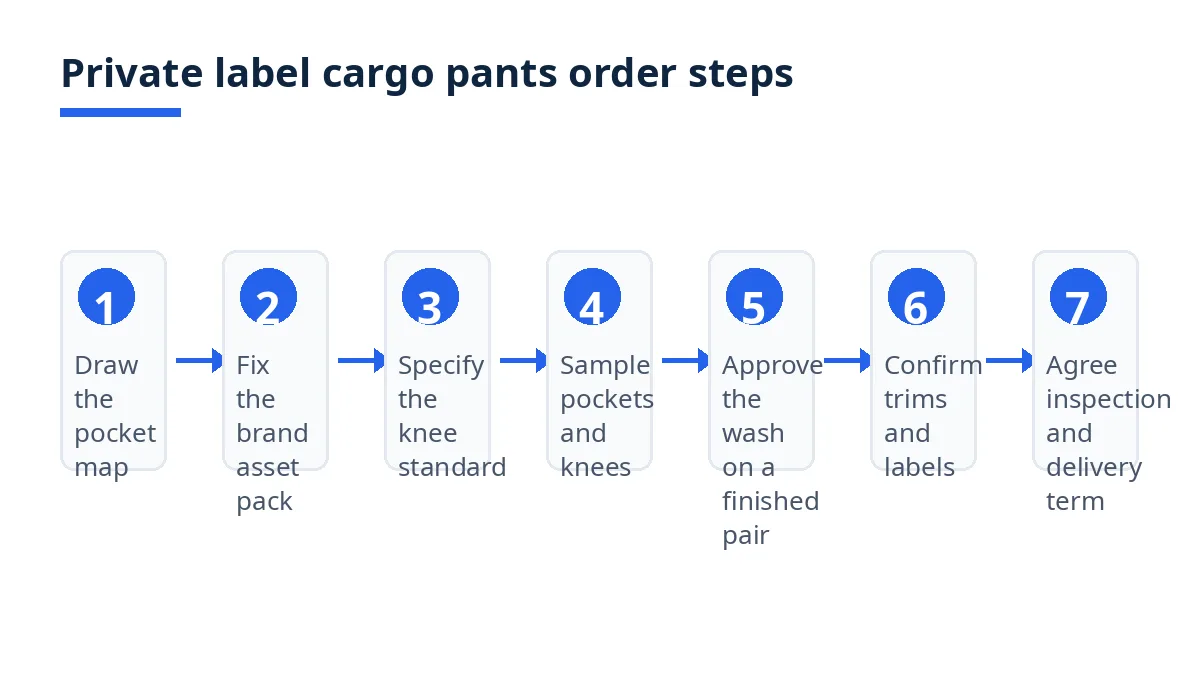
Draw the pocket map first. Send a dimensioned sketch showing every pocket: bellows depth, flap shape and size, closure type, stitch lines and the exact position of any brand mark. State which pockets are functional and which are decorative, since a decorative pocket still needs a stitching and pressing standard.
Fix the brand asset pack. Send artwork files, the woven label design, the hang tag design and the carton mark, with colours, sizes and positions. Record in writing that the artwork and label approvals belong to your brand and will be returned or transferred on request.
Specify the knee standard. State whether the knee is a double-layer panel, an articulated dart or a reinforced patch, with panel dimensions, stitch type and bartack positions. Ask for the knee to be measured on the sample after washing, since a panel can shift when the leg shrinks.
Sample pockets and knees before the full pair. Ask for a pocket sample and a knee sample in the actual cloth, then a proto sample, then a pre-production sample in the actual cloth, colour, wash and labels. Measure pocket positions and knee panels on each round and list corrections in writing.
Approve the wash on a finished pair. Agree the wash recipe in words the laundry can repeat: process type, shade target, softness and any fading at seams and pocket edges. Keep one sealed washed pair as the standard and note the shade tolerance you will accept between the leg, flap and knee.
Confirm trims and labels apart from the garment. Record each trim by material, colour and fixing method, and each label by size, position and print run. A branded button or cord lock bought in for your order can set its own minimum and delivery date, separate from the garment quantity.
Agree inspection and delivery term before confirming. Write the inspection level and acceptance quality limit (AQL) values into the purchase order. ISO 2859-1 defines a system of acceptance sampling plans for inspection by attributes, indexed by AQL for lot-by-lot inspection.3 AQL is the maximum average percentage of defective items considered acceptable during random sampling, and it determines sample sizes and acceptance or rejection thresholds.3 State one Incoterm and named place for every quotation: the Incoterms 2020 rules set out 11 rules with a clear allocation of cost, risk and obligations.4
Costs, timelines and documents
What are the typical costs and timelines?
There are no typical costs or timelines a guide can state as fact. Each factory prices your cloth, pocket count and construction, knee reinforcement, wash process, branded trims, label runs, finishing and packing, and the delivery term you choose.4 A pair with six bellows pockets, double-layer knees and branded metal trims is priced as a different garment from a pair with two flap pockets and standard buttons, even in the same cloth.
What drives the price, in order of effect on a cargo quote, is the pocket assembly time, the knee work, the wash process, the trim set and the label runs. Timelines follow the same structure: sampling depends on cloth availability and correction rounds, the wash depends on laundry slots and re-wash cycles, and bulk production depends on trim delivery and line capacity. Ask for sampling, cloth ready, wash approval, production and inspection dates as separate lines, not a single delivery week.
Example figures: a buyer orders 900 pairs across three colours at 300 pairs per colour. The pocket flap labels are printed in runs of 1,000, so the buyer covers the shortfall of 100 labels per colour run as a separate line, or reduces the range to two colours at 450 pairs each so each label run is covered. The arithmetic is 3 times 300 equals 900, and 2 times 450 equals 900. The example shows structure only, not a typical price, quantity or lead time.
Which documents are needed?
The order documents are the tech pack with the pocket map and knee standard, the brand asset pack, the itemized quotation, the purchase order with the inspection plan and delivery term, and the wash approval record with the sealed sample reference. Keep one legal name for your brand across the tech pack, quotation and purchase order, so the name on the order papers matches the name on the labels.
Export clearance follows the Bangladesh Customs export procedure for the Bill of Export.5
Bangladesh-specific rules and tips
Confirm association claims at the source. If a supplier claims membership of a trade association, confirm it with the association itself. Membership signals an active business in that sector, not capacity for your pocket construction, wash standard or delivery date.
One legal name, on every paper, without exception. The export declaration, trade licence, quotation, proforma invoice and payment account all name the exporter and the foreign buyer, and the order must use that same name.
Ask which trims are imported for your order. Branded buttons, buckles, cord locks and D-rings may be bought in for your specification, and an imported trim can set both the minimum and the earliest production date. Fix the trim delivery date before you fix the bulk start date.
Plan the wash around laundry capacity. A cargo wash standard that needs re-washing to match flaps and knees takes laundry slots, and a laundry running your range alongside darker or lighter goods can shift shade. Ask whether your range is washed in its own lot, and what happens if the first wash misses the sealed standard.
Agree the size ratio per colour before production. Pocket positions and knee panels are graded across sizes, and a size curve weighted to small sizes uses the pocket and knee standards differently from one weighted to large sizes. Record the ratio per colour on the purchase order.
Mistakes and red flags
What are the most common mistakes?
Approving the wash on flat cloth. A swatch cannot show whether the flap, knee and leg match after washing. Approve only on a finished, washed pair with pockets closed.
Leaving pocket branding to the sample maker. A woven label placed by eye will drift across sizes. Give a measured position from a fixed seam on every size, and check it on the pre-production sample.
Accepting a verbal wash standard. "Medium stone wash" means different things in different laundries. Record the process, the shade target and the tolerance against the sealed pair.
Forgetting who owns the brand assets. If the purchase order does not say the artwork, label approvals and wash standard belong to your brand, moving the range to another factory means starting those approvals again.
Comparing quotes with different pocket counts. A lower price on a four-pocket pair is not a lower price than a six-pocket pair with double knees. Compare only replies to the same pocket map, knee standard and wash on the same delivery term.4
Treating a profile or a badge as a production check. A profile is a starting point for enquiries. It does not test whether a factory can sew your bellows pockets, match your wash across flaps and knees, or hold its shade on a repeat order.
Skipping the knee check after washing. A knee panel measured before washing can sit off centre once the leg shrinks. Measure knees on the washed pre-production sample, not only on the unwashed proto.
Checklist
Before you confirm, every line should be answered in writing.
Pocket map sent: dimensioned sketch per style and size, closures and brand marks.
Knee standard fixed: panel type, dimensions, stitch type and bartack positions.
Brand asset pack sent: artwork, woven labels, hang tags and carton marks, with ownership recorded.
Wash standard agreed: process, shade target, tolerance and sealed washed pair reference.
Trims confirmed: material, colour, fixing method and delivery date per trim.
Label, tag and carton runs confirmed apart from the garment quantity.
Size ratio per colour recorded on the purchase order.
Pre-production sample measured after washing, pockets and knees checked, approved in writing.
Inspection level and AQL values in the purchase order.3
Quotations compared on the same pocket map, knee standard, wash and Incoterm.4
Export set agreed with the supplier before the bulk start date.
How Exportain helps
Post the brief as an RFQ: browse suppliers, then put your pocket map summary, knee standard, wash target and delivery term on the RFQ board so every supplier prices one identical cargo specification. Ask for pocket and trim minimums apart from the garment quantity in every reply; once you accept, Exportain turns the accepted terms into a single order and a single proforma invoice.6
Read each badge for what it records on the verification page, and remember verification is a document and photo review, not a factory inspection.6 7 Sample approval, wash approval and inspection therefore stay with you. See how supplier verification works on Exportain and the MOQ definition guide.
FAQs
What should I know first about private label?
Private label means the cargo pair carries your brand name, labels, trims and packing to your specification. The three things to settle first are the pocket map, the knee standard and the wash standard, because each is approved separately and each shows to the customer. Record ownership of the artwork and label approvals in writing before sampling, so the range can move factories without restarting those approvals.
What are the typical costs and timelines?
There are no typical figures a buyer can rely on, because each factory sets its price and lead time for your pocket count, knee construction, wash process, trim set, label runs and delivery term.4 Sampling, wash approval, trim delivery and line capacity drive the timeline, so ask for each stage as a separate dated line.
Which documents are needed?
The order documents are the tech pack with the pocket map and knee standard, the brand asset pack, the itemized quotation, the purchase order with the inspection plan and delivery term, and the wash approval record. Export clearance follows the Bangladesh Customs export procedure for the Bill of Export.5
What are the most common mistakes?
The most common mistakes are approving the wash on flat cloth instead of a finished washed pair, leaving pocket label positions unmeasured, accepting a verbal wash standard, forgetting to record brand asset ownership, and comparing quotes with different pocket counts or delivery terms.4 A badge is not a guarantee of capacity, quality or delivery.6
Next steps on Exportain
Browse suppliers, then post your pocket map summary, knee standard and wash target on the RFQ board so suppliers state their pocket and trim minimums separately. Before you confirm, read the cargo pants quality control checklist for the pocket, knee and wash points to check on your pre-production sample.
Sources
- Men's or boys' suits, ensembles, jackets, blazers, trousers, bib and brace overalls, breeches and shorts (other than swimwear). GOV.UK (accessed )
- Regulation (EU) No 1007/2011 on textile fibre names and related labelling and marking of the fibre composition of textile products. European Union, (accessed )
- ISO 2859-1:2026 - Sampling procedures for inspection by attributes — Part 1: Sampling schemes indexed by acceptance quality limit (AQL) for lot-by-lot inspection. ISO (accessed )
- Incoterms® 2020. International Chamber of Commerce (ICC) (accessed )
- Customs Clearance Procedures for Export. Bangladesh Customs, National Board of Revenue (accessed )
- Trust & Safety Center. Exportain (accessed )
- Supplier verification: Earn trust badges buyers can see. Exportain (accessed )
About the author
Sourcing from Bangladesh?
Post a request for quotation and suppliers on Exportain can send you their quotes directly.
Post an RFQ


