Private Label Bed Sheets Manufacturing in Bangladesh: A Brand Owner's Guide
Private label bed sheets in Bangladesh from the brand owner side: label and pack control, shade and wash consistency across a range, and the approvals to lock before bulk.
Short answer
Private label bed sheets from Bangladesh means a mill makes sheets to your specification under your brand name. You control the label wording, packaging, colour palette, weave, finish and size chart, and you answer for the label claims in your market. Lock the brand book, shade standard, label and pack artwork, and wash standard in writing, approve a bulk sample as a complete set, and hold the reorder file so repeat orders match the first.
On this page
Key takeaways
Private label means you own the brand decisions and answer for the label claims, while the mill makes the sheets to your specification.
A sheet range is judged as a range: one shade, one hand feel and one wash behaviour across every piece and size that carries your name.
Lock the brand book, shade standard, label and pack artwork, and wash standard in writing before bulk, and approve a bulk sample as a complete set.
In the EU, a distributor placing a product under his own name or trademark is considered a manufacturer for labelling purposes, and in the USA the label must list fibre content, origin and the responsible business.
Exportain verification is a document and photo review, not a factory inspection, and a badge is not a guarantee.
Private label bed sheets put your brand name on a sheet range that a Bangladeshi mill makes to your specification. You own the brand decisions: the name and logo, the label wording, the packaging, the colour palette, the weave and finish, and the size chart. The mill owns the production decisions behind those choices, such as which dye range and finishing line runs your fabric. This guide is written from the brand owner side of that split, for buyers in the USA, the UK, the EU and the UAE who sell sheets under their own name rather than reselling a mill label.
A sheet range is judged as a range, not as single pieces. A customer who buys a fitted sheet, flat sheet and pillowcases in one colour expects one shade, one hand feel and one wash behaviour across every piece and size. That expectation is the work of private label: one standard applied to every item that carries your name, and a written record that lets a repeat order match the first one. Bed sheets are bed linen in heading 6302, which covers bed linen, table linen, toilet linen and kitchen linen.1
Why this matters for buyers and sellers
For the buyer, private label is control over what the customer sees and can repeat. The label, the pack and the colour story are yours, so a repeat customer can buy the same sheet again and a retailer can list your range without carrying another supplier brand. The trade-off is responsibility: you answer for the claims on the label and the pack, including fibre content and care instructions, even though the mill made the sheet.
That responsibility is written into market rules. In the EU, Regulation (EU) No 1007/2011 states that a textile product shall be labelled or marked with the name and percentage by weight of all constituent fibres in descending order, and that a distributor shall be considered a manufacturer for its purposes where he places a product on the market under his name or trademark.2 In the USA, federal law requires that most textile and wool products have a label that lists the fibre content, the country of origin, and the identity of the manufacturer or another business responsible for marketing or handling the product, and under the Care Labeling Rule, manufacturers and importers must provide cleaning instructions.3 A private label buyer is therefore the business responsible for the label in both markets.
For the seller, private label is a different kind of order from a stock order. A mill cannot sell your branded sheets, printed packs or woven labels to another buyer, so the order depends on your artwork, shade standard and approval before bulk runs. A change after approval is a new decision with a new sample.
Step-by-step: how it works
Private label work runs in a fixed order, because each approval locks a decision the next stage depends on. Changing the shade after labels are printed costs a rework that an earlier approval would have avoided.
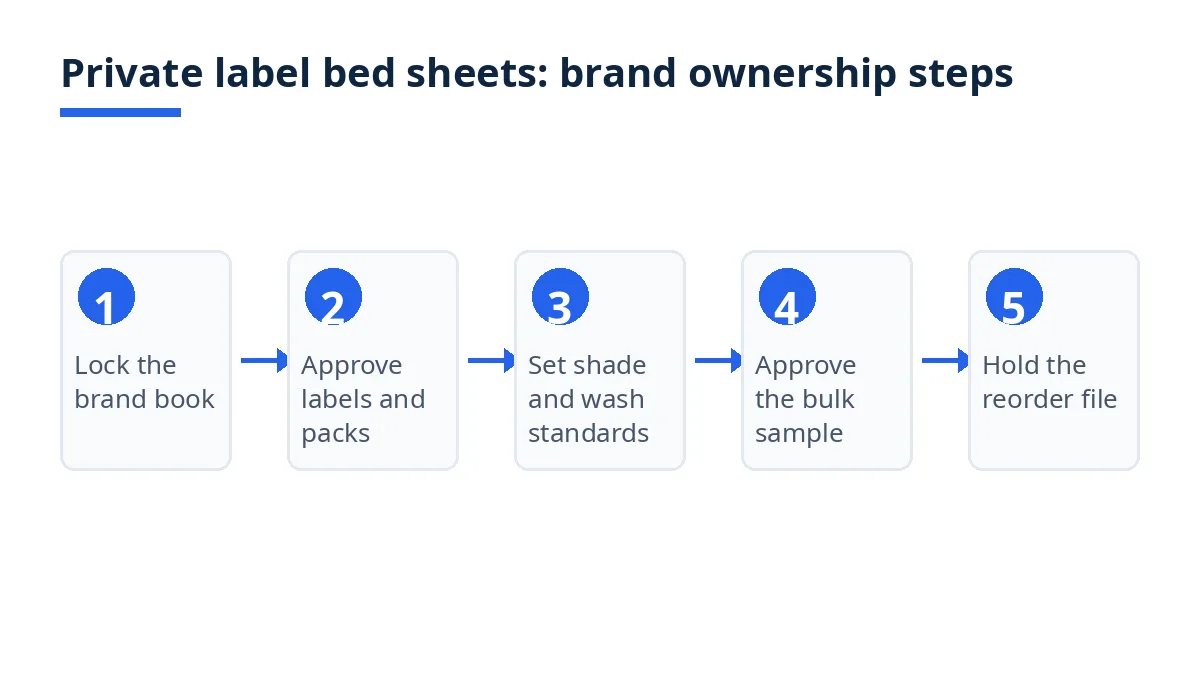
Write the brand book first. Record your brand name and logo files, the exact label layout, the pack design and text, the colour palette with a named shade standard per colour, and the size chart with pocket depth for fitted sheets. State which items belong in each set, such as flat sheet, fitted sheet and two pillowcases.
Lock the sheet standard across the range. Name the weave, such as percale or sateen, the thread count target and the finished weight you want quoted, and apply the same standard to every piece and size. A fitted sheet in one weave and pillowcases in another are not one range, even when the colour matches.
Approve labels and packaging as artwork, not as samples alone. Check the fibre wording, the care symbols, the size marking, the set contents and the country of origin marking on the artwork proof before any label is printed. ISO 3758 establishes a system of graphic symbols for marking textile articles, giving information on the most severe treatments that do not cause irreversible damage during care, in the sequence washing, bleaching, drying, ironing and professional textile care.4
Set the shade and wash standard in writing. Approve a lab dip or shade standard per colour, and agree how shade is judged across pieces, sizes and cartons. For wash behaviour, ISO 5077 specifies a method for determining the dimensional change of fabrics, garments or other textile articles in specified washing and drying procedures.5 Agree which wash procedure and measurement points apply, and record the result against the approved sample.
Approve the bulk sample as a set, not as pieces. Wash the sample set following your care label, measure it against your size chart, fit the fitted sheet to the mattress depth in your chart, and check shade, hem width and set completeness together. Approve in writing, and keep one sealed reference set.
Confirm the order file before bulk. The purchase order should carry the brand book version, the shade standard, the label and pack artwork version, the size chart, the inspection plan and one delivery term. The Incoterms 2020 rules give 11 rules with a clear allocation of cost, risk and obligations.6 Compare quotations only on the same term and specification.
Hold the reorder file. Keep the approved artwork, shade standard, size chart and measurement records in one file, with version numbers and approval dates. A repeat order that reuses the file without change is the point of private label.
Example figures: a range of three colours across four sizes, with two set types, carries 24 colour and size combinations before pillowcase variants are counted. The figure shows structure only, not a typical range size, price or minimum order.
Costs, timelines and documents
What structure sets the cost
There is no typical private label cost, because the cost follows your range decisions. Fabric is usually the main cost element, followed by dyeing or printing, cutting and sewing, finishing, label and pack production, testing and the delivery term you choose.6 Brand-specific elements sit apart from the sheet itself: woven labels, printed packs, shade standard work and artwork or plate charges are brand costs, and they should appear as their own lines rather than being folded into a unit price where you cannot see them again on a repeat order.
For timelines, work in stages rather than a single delivery week. Ask for separate dates for artwork, shade and sample approval, fabric ready, production, inspection and shipment. A delay in artwork approval moves every later date, while a delay in one colour moves only the sets that use it.
Which documents are needed
The order documents are the brand book, the approved artwork files, the shade standard, the size chart, the itemised quotation and the purchase order, with the label and pack version on both. The export set is separate: goods shall not be loaded for export unless an export declaration, the Bill of Export or Shipping Bill, is submitted to Customs and approved, and the enclosed documents include the export contract or purchase order where there is no export letter of credit, the commercial invoice, the packing list, the EXP form certified by an authorized dealer, and a certificate of origin issued by the EPB or a Chamber of Commerce and Industry.7
Bangladesh-specific rules and tips
Keep one legal name across every paper. The export declaration names the exporter and the foreign buyer,7 so the brand name on the label, the quotation, the proforma invoice and the payment account should be checked against each other. A name that differs from the buying entity name creates questions at payment and at customs.
Code each piece, not the range. Heading 6302 splits bed linen by construction, print and fibre: knitted or crocheted bed linen sits at 6302.10, printed woven bed linen at 6302.21 to 6302.29 by fibre, and other woven bed linen at 6302.31 to 6302.39 by fibre.1 A printed top sheet, a plain fitted sheet and pillowcases in one set can therefore sit on different lines. See the HS code for bed sheets guide, and keep the code per piece in the order file.
Treat shade as a range control, not a piece control. Sheets are dyed or printed in batches, so shade can drift between batches and between sizes cut from different rolls. Judge shade across the whole set and across cartons, under the same light, against the approved standard, and sort complete sets before packing rather than mixing pieces from different batches into one set.
Own your artwork files and your shade standard. Keep the original label and pack files, the font and colour references, and the approved shade standard in your own file, not only in the mill inbox. If you move a range to a second mill, or return to the first mill after a gap, those files are what make the new run match the old one.
Mistakes and red flags
Approving a label from a screen proof only. Colour, size and legibility change between screen and print. Approve a physical label and pack proof, check the small sizes, and check the barcode scans before bulk label production begins.
Approving one size and assuming the range. A fitted sheet in one size does not prove the pocket depth, elastic length or hem width in the largest size. Approve the size extremes in the range, and measure every size against the chart on the bulk sample set.
Letting the shade standard live in one sample. A single approved sheet fades, gets washed and gets handled. Keep a sealed reference set, a written shade standard and photographs taken under the same light, so a dispute about shade has more than one reference.
Changing the pack after labels are printed. Pack text, set contents and size marking must match the labels inside the pack. A pack change after label printing means reprinting one of the two, or shipping a mismatch that a retailer will return.
Treating a profile or a badge as brand protection. A profile is a starting point for enquiries. Exportain verification is a document and photo review, not a factory inspection, and a badge is not a guarantee of capacity, quality or delivery.8 Your brand protection is the brand book, the approvals and the inspection plan, not a badge.
Red flags in a supplier reply. A reply that will not name the shade standard, will not itemise label and pack costs, will not confirm the size chart in writing, or will not accept a packed-goods brand check is a reply to pause on. So is a reply that cannot show how a repeat order will match the first one.
Checklist
Before you confirm a private label bed sheets order, every line should be answered in writing.
Brand book version recorded: name, logo files, label layout, pack design and text.
Range locked: weave, thread count target, finished weight, size chart, pocket depth.
Shade standard approved per colour, judged across pieces and cartons.
Label artwork approved as a physical proof: fibre wording, care symbols, size, set contents, origin marking.
Pack artwork approved: design, set contents, size marking, barcode scan check.
Wash standard agreed: procedure and result recorded against the approved sample.5
Bulk sample approved as a set, washed and measured, sealed reference set kept.
Label and pack costs itemised apart from the unit price; paid artwork recorded.
Inspection plan covers brand items on packed goods; see the bed sheets quality control checklist.
Order file holds artwork, shade standard, size chart and approvals with version numbers.
Export set agreed: invoice, packing list, EXP form, certificate of origin, Bill of Export.7
Delivery term stated once, on every quotation, compared on the same term.6
How Exportain helps
On Exportain, browse suppliers and post a request for quotation (RFQ) on the RFQ board with your brand book summary, range standard, shade requirement and delivery term, so suppliers quote against the same brand specification. Ask each reply for its label and pack itemisation, its shade standard process and its repeat-order file. When you accept a quotation, Exportain creates one order and issues one proforma invoice from the accepted terms.8
Read the badges for what they record. Exportain Verified means Exportain has checked identity, phone, email and business registration, and Export Verified means it has checked the Export Registration Certificate (ERC).8 Factory Verified means it has reviewed photos of the manufacturer factory, while Trading Company Verified means it has reviewed photos of the trading company office or warehouse.8 Verification is a document review by staff, free, and never granted by membership plans.9 It is not a factory inspection,8 9 so label, shade and inspection decisions stay with you.
FAQs
What should I know first about private label?
Private label means you own the brand decisions and answer for the label claims, while the mill makes the sheets to your specification. The work that matters is the brand book, the shade standard, the label and pack approvals, and the reorder file that lets a repeat order match the first. Bed sheets are bed linen in heading 6302, split by construction, print and fibre.1
What are the typical costs and timelines?
There are no typical figures a buyer can rely on, because each mill prices your fabric, weave, finish, label and pack work, shade standard and delivery term for your range.6 Brand costs such as woven labels and printed packs should appear as their own lines. Timelines run in stages, from artwork and shade approval through sample approval, production, inspection and shipment.
Documents for the order and the shipment
The order documents are the brand book, approved artwork files, shade standard, size chart, itemised quotation and purchase order, with the label and pack version on both. The export set is the Bill of Export, commercial invoice, packing list, EXP form certified by an authorized dealer, and a certificate of origin issued by the EPB or a Chamber of Commerce and Industry.7
What are the most common mistakes?
The most common mistakes are approving a label from a screen proof only, approving one size and assuming the range, letting the shade standard live in one sample, and changing the pack after labels are printed. A further mistake is reading a badge as brand protection: verification is a document and photo review, not a factory inspection.8
Next steps on Exportain
Browse suppliers, then post your brand book summary, range standard and delivery term on the RFQ board so suppliers itemise label and pack costs and state how a repeat order will match the first. Before you confirm, read the HS code for bed sheets guide and the how to import bed sheets from Bangladesh guide.
Sources
- HS 2017 - Code 6302: Bed linen, table linen, toilet linen and kitchen linen. United Nations Statistics Division (accessed )
- Regulation (EU) No 1007/2011 on textile fibre names and related labelling and marking of the fibre composition of textile products. European Union, (accessed )
- Textile, Wool, Fur, Apparel and Leather Matters. Federal Trade Commission (accessed )
- ISO 3758:2023 Textiles — Care labelling code using symbols. International Organization for Standardization (accessed )
- EVS-EN ISO 5077:2008 - Textiles - Determination of dimensional change in washing and drying. EVS (accessed )
- Incoterms® 2020. International Chamber of Commerce (ICC) (accessed )
- Customs Clearance Procedures for Export. Bangladesh Customs, National Board of Revenue (accessed )
- Trust & Safety Center. Exportain (accessed )
- Supplier verification: Earn trust badges buyers can see. Exportain (accessed )
- supplier verification
- buyer guide
- woven garments
- Bangladesh sourcing
- home textiles
- Bed sheets
- Private label
About the author
Sourcing from Bangladesh?
Post a request for quotation and suppliers on Exportain can send you their quotes directly.
Post an RFQ