

Medical Scrubs Price in Bangladesh: FOB Cost Breakdown for Buyers
Hospital and distributor buyers: how a medical scrubs FOB quote from Bangladesh is built in five blocks, and how to compare quotes by cost per wash in service.
Short answer
There is no single typical FOB price for medical scrubs from Bangladesh. Each factory prices your specification in five blocks: fabric and trim, construction, laundering durability, size-run, and compliance documentation. Ask for the price in those five blocks, test a sample set on your laundry cycle, and compare quotes by cost per wash in service rather than by purchase price alone.
On this page
Key takeaways
A medical scrubs FOB quote has five blocks: fabric and trim, construction, laundering durability, size-run, and compliance documentation. Ask for each block as a separate line.
There is no single typical FOB price for medical scrubs from Bangladesh, because each factory prices a different fabric, pocket build, size range and document set.
Department colours are separate dye lots inside the fabric block, so cutting the colour count is the fastest way to cut that block without changing the garment.
Judge a quote by cost per wash in service: a set that leaves service early costs more per shift worked than a dearer set that survives the laundry cycle.
Verification on Exportain is a document and photo review, not a factory inspection, and a badge is not a guarantee of capacity, quality or delivery.
A hospital procurement team comparing two FOB quotations for scrub sets can find the cheaper figure hard to trust and the dearer figure hard to justify. Both quotes may say "scrub set, FOB" and still describe different garments: one cut from a lighter fabric with a single chest pocket, the other from a heavier blend with reinforced pockets, a drawstring waist and a size range covering petite through tall. The price gap is not a mystery once the quote is broken into its parts, and that breakdown is the comparison a buyer needs to defend a purchasing decision to a finance department or a ward manager.
Medical scrubs from Bangladesh are woven workwear, not a medical device order, and their FOB price is built in the factory before any freight, insurance or import duty is added. Bangladesh's ready-made garment exports reached $10.578 billion in July to September 2026, up 6.10 percent year on year, with woven garment exports at $4.614 billion, up 5.11 percent, according to Export Promotion Bureau (EPB) data.1 The subject here is the five blocks inside a scrub FOB quote: fabric and trim, construction, laundering durability, size-run, and compliance documentation. Ask for each block separately, and a quote stops being a single number to accept or reject.
Why this matters for buyers and sellers
For a hospital or distributor buyer, the FOB price per set is only the first half of the cost picture. The second half is how long the set stays in service. A set that loses colour, shrinks out of size or tears at a pocket corner after a short period in the laundry has to be replaced, and replacement sets carry their own FOB price, freight and handling. A buyer who compares FOB prices without asking about wash behaviour is comparing purchase prices while ignoring replacement frequency.
For the seller, the same five blocks explain why a low quote cannot simply be matched. Fabric bought in a small dye lot, a pocket design needing extra stitching, or a size range forcing many small cutting runs each carry a cost that does not fall because a buyer asks for a lower total. When a seller itemizes the blocks, the buyer can see which block to change: a stocked colour instead of a dyed-to-order shade, a simpler pocket, or a narrower size range. That conversation changes a cost rather than asking the seller to absorb one.
The Bangladesh Garment Manufacturers and Exporters Association (BGMEA) represents the readymade garment industry, including woven garments, and has around 4,500 member factories, of which about 60 percent are woven garment manufacturers.2 Membership signals an active garment business. It does not set the FOB price for a scrub order, nor guarantee that a factory runs the fabric, pocket construction or size range a hospital programme needs.
Step-by-step: how it works
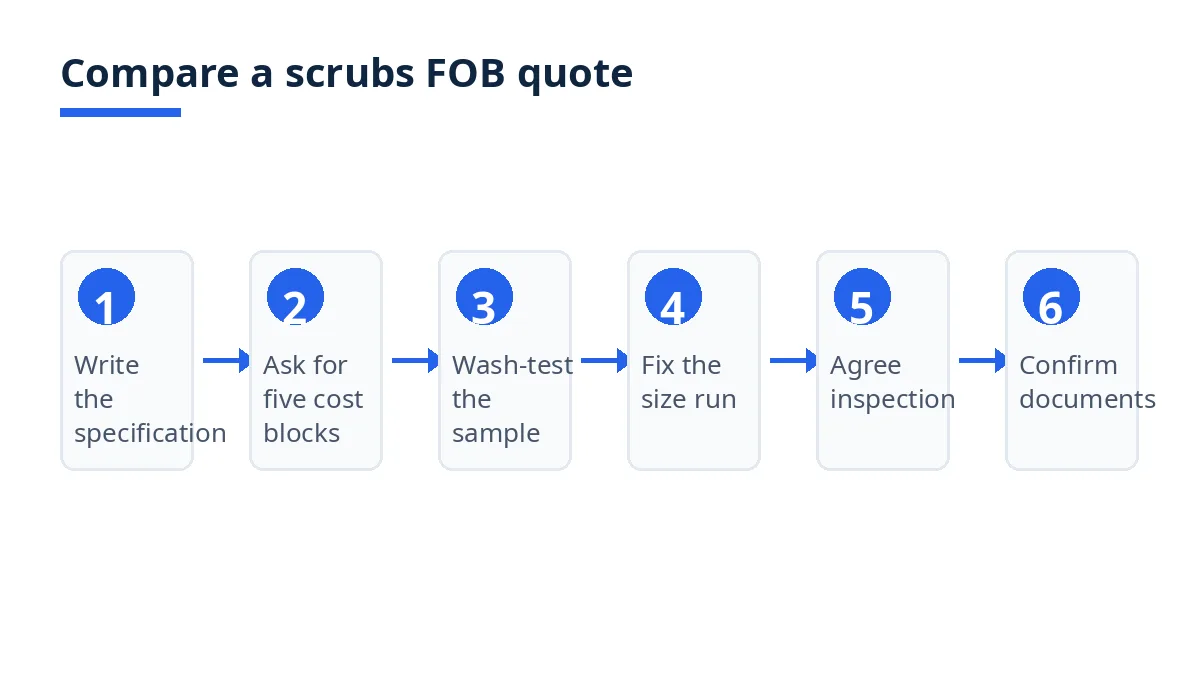
Write the scrub specification before asking for a price. State the top and the pant as one set: fabric composition, weight, colour per department, neckline and sleeve style, pocket count and placement, waistband and drawstring or elastic, size range and size ratio, and the wash standard the set must survive. A quote without this specification prices a different garment each time.
Ask for the FOB price in five blocks. Request fabric and trim, construction, laundering durability, size-run, and compliance documentation as separate lines, with the delivery term and named place stated on every quotation. The Incoterms 2020 rules allocate cost, risk and obligations for each rule, and FOB is only comparable when the named port and the included costs match.3
Test the fabric and the set together. Order a sample set in the actual fabric, colour, pocket build and size mix, then wash it on the hospital or laundry cycle it will face in service. Measure it before and after washing, and check pocket corners, drawstring casing and colour match between top and pant.
Fix the size run in writing. Confirm which sizes are included, the quantity per size, and what happens to the price if one size is dropped or added. A size run agreed late is a common reason a confirmed price moves.
Agree inspection before confirming the order. Write the inspection level and acceptance quality limit (AQL) values into the purchase order. ISO 2859-1 defines a system of acceptance sampling plans for inspection by attributes, indexed by acceptance quality limit for lot-by-lot inspection.4
Confirm the compliance documents with the price. List every certificate, test report and label declaration the order needs, who supplies each one, and whether its cost sits inside the FOB price or on a separate line. A document discovered after confirmation is a cost discovered after confirmation.
Costs, timelines and documents
What are the typical costs and timelines?
There is no typical FOB price for medical scrubs that a guide can state as fact, because each factory prices a different fabric, pocket build, size range and document set. What can be stated is the structure, and the table below shows how the five blocks move the price. All figures in this section are labelled Example figures and describe structure only.
FOB cost block | What sits inside it | What pushes it up |
|---|---|---|
Scrub fabric and trim cost | Woven fabric for top and pant, dyeing per colour, drawstring, elastic, thread, buttons or snaps, labels and cartons | Dyed-to-order colours, heavier fabric, imported trims bought for one order |
Scrub construction cost | Cutting, sewing, pocket and waistband assembly, pressing, finishing and packing | Extra pockets, reinforced stitching, jogger cuffs, contrast trim, small runs per style |
Scrub laundering durability cost | Heavier or blended fabric, colourfast dyeing, reinforced pocket corners and drawstring casing, wash testing | A wash standard the fabric must pass repeatedly, antimicrobial or fluid-resistant finishes where specified |
Scrub size-run cost | Pattern grading across sizes, marker making, cutting in each size, size labelling and assortment packing | A wide range from petite to tall, uneven size ratios, a size added after the marker is made |
Scrub compliance documentation cost | Fibre and care labelling, test reports, certificates and origin documents the buyer requires | A test report per colour or per fabric lot, a certificate with a scope that must be checked against the order |
Example figures: a distributor orders 2,000 scrub sets in three department colours. The factory quotes the fabric and trim block at $4.20 per set, construction at $1.80, laundering durability measures at $0.60, size-run work at $0.40, and compliance documentation at $0.30, giving an FOB price of $7.30 per set before freight and duty. The figures are Example figures only: they show how a total is assembled, not what any factory charges.
For timelines, ask for sampling, fabric ready, production, inspection and shipment dates as separate lines. Sampling depends on fabric availability and correction rounds, production on dyeing, trim delivery and line capacity, and inspection on the agreed sampling plan.4 A single delivery week hides those dependencies.
Which documents are needed?
The order documents are the scrub specification, the itemized FOB quotation in five blocks, the sample approval in writing, and the purchase order carrying the size run, inspection level and AQL values, and the delivery term.4 3 For export clearance, see the Bangladesh Customs export clearance page, which sets out the export declaration and its enclosed documents.5
Fibre labelling deserves its own line in the specification. In the Harmonized System, heading 6211 covers track suits, swimwear and other garments, not knitted or crocheted, including other garments of cotton and of man-made fibres for men, boys, women and girls.6 If the scrubs sell into the European Union, Regulation (EU) No 1007/2011 requires textile products to be labelled or marked with the name and percentage by weight of all constituent fibres in descending order.7 A scrub label that states the blend wrongly is a compliance cost that arrives after shipment, not before it.
Bangladesh-specific rules and tips
Check the classification with the garment, not the word medical. A scrub top and pant can sit under different headings depending on whether the fabric is woven or knitted, and on fibre content. Heading 6211 covers other garments, not knitted or crocheted, with separate subheadings for cotton and for man-made fibres.6 Confirm the heading with the factory and, where duty matters, with the buyer's customs adviser before the price is fixed, because a heading change can change the duty that sits outside the FOB price.
Confirm woven capacity for the fabric in the order. Around 60 percent of BGMEA member factories are woven garment manufacturers, and BGMEA member factories account for 100 percent of woven garment exports.2 That share describes the sector, not any one factory. Ask whether the factory cuts woven scrub fabric on its own lines and whether its dyeing and finishing route matches the wash standard in the specification.
Price the colour range as a set of dye lots, not as one colour choice. Hospital programmes often need a different colour per department, and each colour is dyed separately. A programme with five department colours carries five dye lots inside the fabric block, while a single-colour programme carries one. Cutting the colour count is the fastest way to cut the fabric block, and it is a decision the buyer controls without changing the garment.
Mistakes and red flags
What are the most common mistakes?
Comparing FOB quotes for different garments. A quote for a light single-pocket top and a quote for a reinforced multi-pocket set are not two prices for the same product. Compare only replies to the same specification on the same delivery term.3
Reading the lowest FOB price as the lowest cost per wear. A set that leaves service early costs more per shift worked than a dearer set that survives the laundry cycle. Divide the FOB price plus freight by the expected number of washes in service before ranking quotes, and use the sample wash test as the evidence for that number.
Leaving the size run out of the quotation. A price agreed for a narrow size range does not automatically hold for a range that adds petite and tall sizes. The size-run block exists because grading, markers and cutting change with the range, and a late addition reprices the order.
Accepting a verbal document promise. Record every certificate, test report and label declaration on the quotation and purchase order, with who supplies it and whether it sits inside the FOB price. A document promised verbally and charged later is a price increase, not an oversight.
Treating a profile or a badge as a cost guarantee. A profile is a starting point for enquiries. Verification on Exportain is a document and photo review, not a factory inspection, and a badge is not a guarantee of capacity, quality or delivery.8 9 Sample approval and inspection stay with the buyer.
Forgetting what FOB excludes. FOB stops at the named port of shipment. Freight, insurance beyond the FOB point, import duty and inland delivery sit outside it, so an FOB comparison that mixes in a delivered price is not a comparison at all.3
Checklist
Before you confirm a scrub FOB order, every line should be answered in writing.
Scrub specification sent: fabric, weight, colours per department, pockets, waistband, sizes and wash standard.
FOB price itemized in five blocks: fabric and trim, construction, laundering durability, size-run, compliance documentation.
Delivery term and named place stated on every quotation and identical across quotes.3
Sample set washed on the service laundry cycle, measured before and after, and approved in writing.
Size run fixed: sizes included, quantity per size, price effect of adding or dropping a size.
Inspection level and AQL values written into the purchase order.4
Fibre composition and care labelling agreed, with the EU fibre labelling rule checked where the sets sell into the European Union.7
Every certificate, test report and label declaration listed, with supplier and cost line named.
Classification confirmed for the actual woven or knitted construction and fibre content.6
Export set agreed with the factory, and legal names matched across quotation, invoice and payment account.5
How Exportain helps
On Exportain, browse suppliers and post a request for quotation on the RFQ board asking for the FOB price in the five blocks used in this guide, with the specification, size run and wash standard attached. Replies in the same five blocks can be compared line by line instead of total against total. For background on supplier checks, read how supplier verification works on Exportain, and for the minimum quantity behind a small colour or size run, read the MOQ guide. Verification is a document and photo review by staff, not a factory inspection, and it never replaces sample approval or inspection.8 9
FAQs
What should I know first about medical scrubs?
A scrub order is a two-garment set, top and pant, priced FOB in five blocks: fabric and trim, construction, laundering durability, size-run, and compliance documentation. The garments are woven workwear for classification purposes, with heading 6211 covering other garments, not knitted or crocheted, including cotton and man-made fibre options.6 The price that matters for a hospital programme is the cost per wash in service, not only the FOB price per set.
What are the typical costs and timelines?
There are no typical FOB figures a buyer can rely on, because each factory prices a different fabric, pocket build, size range and document set. Example figures in this guide show structure only: fabric and trim is usually the largest block, followed by construction, with durability, size-run and documentation as smaller but movable lines. Timelines should be quoted as separate sampling, fabric ready, production, inspection and shipment dates, not as a single delivery week.4
Which documents are needed?
The order documents are the scrub specification, the itemized five-block quotation, the written sample approval, and the purchase order carrying the size run, inspection level and AQL values, and the delivery term.4 3 For export clearance, see the Bangladesh Customs export clearance page for the declaration and its enclosed documents.5 Fibre labelling must state the composition in descending order where the sets sell into the European Union.7
What are the most common mistakes?
The most common mistakes are comparing FOB quotes for different garments on different terms,3 ranking quotes by purchase price instead of cost per wash in service, leaving the size run out of the quotation, and accepting a document promise verbally. A badge is not a guarantee of capacity, quality or delivery.8
Next steps on Exportain
Browse suppliers, then post your scrub specification, size run and wash standard on the RFQ board and ask every reply for the FOB price in the five blocks used here. Before you confirm, read how supplier verification works on Exportain so you know what a badge records and what it does not.
Sources
- Exports up over 6% to $13.1bn in Q1 of current fiscal. United News of Bangladesh (accessed )
- Bangladesh Garment Manufacturers and Exporters Association (BGMEA). Devex (accessed )
- Incoterms® 2020. International Chamber of Commerce (ICC) (accessed )
- ISO 2859-1:2026 - Sampling procedures for inspection by attributes — Part 1: Sampling schemes indexed by acceptance quality limit (AQL) for lot-by-lot inspection. ISO (accessed )
- Customs Clearance Procedures for Export. Bangladesh Customs, National Board of Revenue (accessed )
- Classification Detail — HS Code 6211. United Nations Statistics Division (accessed )
- Regulation (EU) No 1007/2011 on textile fibre names and related labelling and marking of the fibre composition of textile products. European Union, (accessed )
- Trust & Safety Center. Exportain (accessed )
- Supplier verification: Earn trust badges buyers can see. Exportain (accessed )
About the author
Sourcing from Bangladesh?
Post a request for quotation and suppliers on Exportain can send you their quotes directly.
Post an RFQ


