

Medical Scrubs Exporters in Bangladesh: Verified Supplier Checklist
A gate-by-gate checklist for hospital and distributor buyers vetting medical scrubs exporters in Bangladesh, covering identity, the factory, fabric and barrier claims, shift-wear design, laundry durability, sizing, documents and repeat terms.
Short answer
Use this checklist before paying a deposit on a medical scrubs program: confirm the exporter identity and factory, test scrub fabric and barrier claims against reports, wear-test the set, prove laundry durability, check the full size curve, verify certificates and labels, and agree repeat terms in the purchase order.
On this page
Key takeaways
Confirm identity, the actual factory and any subcontracting before comparing price, and record each gate as pass, conditional or stop with its evidence.
Separate everyday scrubs from barrier garments in the specification, and treat a barrier claim with no named test method, report and garment coverage as unproven.
Prove laundry durability on the route the hospital actually uses, with after-wash measurements, before bulk is approved.
Judge a supplier on repeatability: a graded size curve, held fabric and dye records, and written repeat and failure terms in the purchase order.
A hospital scrub program is a repeat order, not a single purchase. The same top and trouser must return in the same fabric, colors and sizes for new starters, replacement stock and new wards, and must survive the laundry the hospital actually uses. This checklist tests the exporter behind the program before a deposit is paid: whether the company is real, whether it makes the scrubs itself, whether its fabric and barrier claims hold up on paper, and whether it can repeat the same set months later. Keep the signed result with the purchase order. A scrub set is workwear for clinical staff, not a surgical gown: everyday scrubs are not automatically barrier garments. Where a barrier claim is genuinely made, ask for the test report behind it. ANSI/AAMI PB70 classifies protective apparel by liquid barrier performance in four levels, with Level 1 the lowest and Level 4 the highest.1
Why this checklist matters
A scrub failure rarely arrives as one bad garment. It arrives as a ward of sets that no longer match: a replacement batch in a different shade, a size curve that fits the sample size and no other, or a fabric that thins out after repeated washing. Each traces back to questions asked too late: who made the goods, what was in the fabric, and what evidence supports the quotation claims. Record each item as pass, conditional or stop, with the document or sample that supports the answer.
Before you start
Write down the program facts before contacting suppliers: wearer groups and size range, the laundry route, colors by department, and whether any barrier claim is required. If no barrier claim is required, say so in the inquiry, so suppliers do not add a claim you never asked for and then charge for it. Ask every candidate for the same pack: registration and export documents, production and quality contacts, the tech pack, fabric details and certificates relied on. Agree how samples will be judged, how a failed item will be handled, and the sampling plan for inspection, rather than letting the factory choose the pieces.2 ISO 2859-1 specifies an acceptance sampling system for inspection by attributes, indexed by the acceptance quality limit (AQL), for lot-by-lot inspection.2
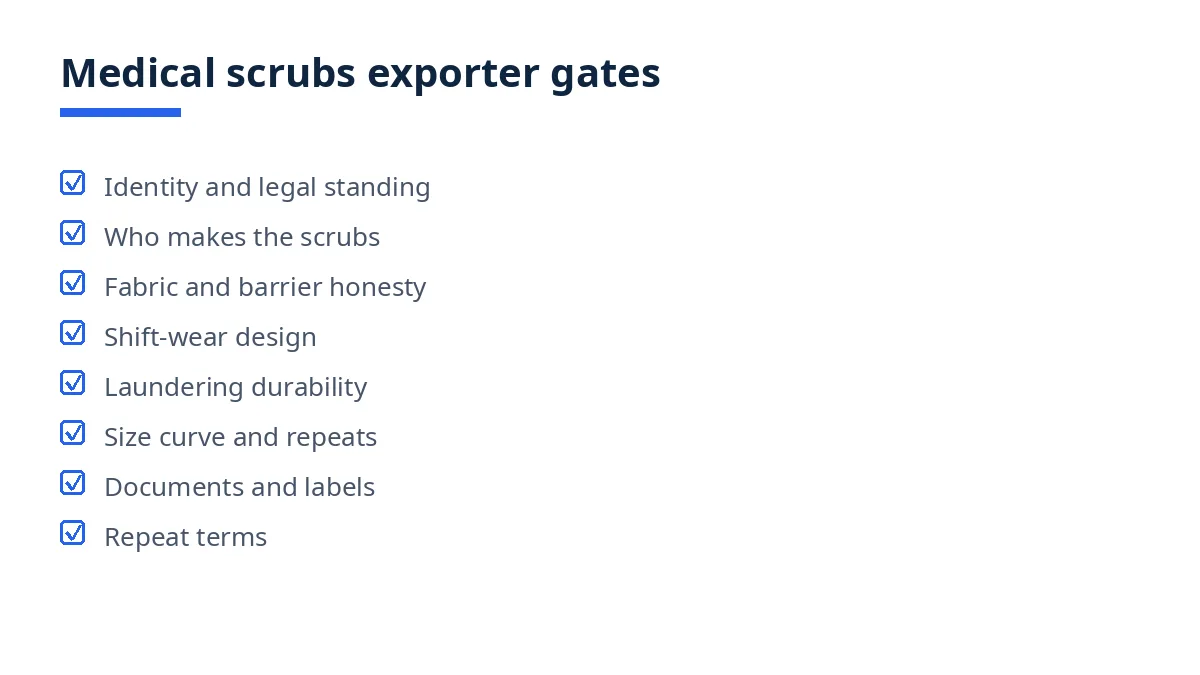
The full checklist (numbered, printable)
Gate 1: Identity and legal standing
Confirm the legal name on the quotation matches the registration, export licence and bank account, and that all three are current.
Confirm whether the supplier exports in its own right or acts for named factories, and record which factories will make the scrubs.
Ask for each factory address, and check it against the documents rather than a website.
Confirm who signs the contract and who handles production and quality problems, with a name and contact for each.
Gate 2: Who actually makes the scrubs
Ask whether cutting, sewing and finishing happen in-house, and name any subcontracted step, including embroidery, printing and packing.
Ask how many scrub sets the factory has made in the same construction, and request a recent production sample in the same fabric.
Check the factory can make the full size curve, smallest to largest, with grading from measured body data rather than scaling one sample.
Ask whether one size can be re-cut alone, and what minimum applies.
Gate 3: Scrub fabric and barrier honesty
Record fiber content, weave and weight, and compare with the fiber content that will appear on the label. Under Regulation (EU) No 1007/2011, a textile product shall be labeled with the fiber names and percentages that the regulation requires.3
Separate everyday scrubs from barrier garments in the specification. If fluid resistance is claimed, ask for the test method, lab report and exact fabric and garment covered.
Use PB70 levels only as a reference for gown-type barrier claims: Level 1 minimal water resistance, Level 2 hydrostatic resistance of at least 20 cm, Level 3 at least 50 cm, and Level 4 no blood or viral penetration at 13.8 kPa.1 A claim naming no level, method or report is not evidence.
Read any protective-clothing claim with its general requirements. ISO 13688 covers ergonomics, innocuousness, size designation, ageing, compatibility and marking, and is only to be used together with a standard for the specific protective performance.4
If a harmful-substances claim will appear on the product, check certificate scope and expiry. Under OEKO-TEX STANDARD 100, every thread, button and accessory of a labeled article is tested against over 1,000 harmful substances.5
Gate 4: Shift-wear design
Wear-test the sample through a full shift pattern: bending, reaching, sitting and walking, with pockets loaded as staff will load them.
Check pocket placement and corner strength, the trouser waist closure, and whether the top stays tucked or untucked in movement.
Check drawstrings, ties and elastic cannot pull out in washing, and that cord ends are finished so they do not fray into the laundry.
Check department color coding on the sample itself, not on a swatch card, and confirm each color uses the same fabric and construction.
Gate 5: Laundering durability evidence
Name the laundry route in the specification, home, commercial or industrial, with temperatures and chemicals, and ask for evidence matched to that route, not a gentler one.
Ask for dimensional change evidence after washing. ISO 5077 specifies a method for determining dimensional change in washing and drying.6
Wash the approval sample through the agreed cycle before bulk, then re-measure top length, trouser length, waist and chest against agreed tolerances.
Check color retention and seam condition after washing, and record any finish, such as soil-release or antimicrobial, with the wash count its claim is based on.
Confirm care symbols on the label match the laundry route. ISO 3758 establishes a system of graphic symbols for care labeling, based on the most severe treatments that do not cause irreversible damage.7
Gate 6: Size curve and repeat-program capacity
Ask for the full graded size chart with body and garment measurements, and measure the sample in every size offered, not only the sample size.
Ask how the supplier holds fabric, trims and dye recipes between orders, so a later repeat matches the first.
Ask for the lead time on a repeat at the program quantity, and whether a repeat uses the same factory and fabric source.
Confirm whether odd sizes can be added to a repeat without restarting the program.
Gate 7: Compliance documents and label accuracy
Collect each certificate relied on, and check scope, holder name and expiry date.
Check the label plan before bulk labels are printed: fiber content, size, care symbols and origin wording, for the market the sets will be sold or issued in.3 7
Ask how the supplier records a failed document, and whether it tells the buyer before shipment.
Gate 8: Commercial terms for a repeat program
Put the full program terms in the purchase order: fabric, colors, size curve, tolerances, test methods, acceptance numbers and laundry route.2
Agree what happens to a failed batch after delivery: sorting, rework, replacement or rejection, and who pays.
Agree the repeat price basis, including whether fabric price changes reopen it, and how long a quote stands.
Common failures and how to fix them
Shade drift between the first order and the repeat usually comes from a different fabric lot or dye recipe. Hold the approved lab dip and dye recipe with the order, and compare the repeat against the first batch, not a fresh swatch. A size curve that collapses at the extremes traces to grading from a single sample; measure every size on the approval sample before bulk. Barrier overclaim is found at audit, when no barrier report exists for the scrub fabric: remove the claim or obtain the report before the order. A laundry mismatch is fixed by naming the laundry route in the specification and wash-testing the sample through it. Where a gate returns a stop, pause the order.
Downloadable template / summary table
Gate | Proves | Evidence |
|---|---|---|
Identity and legal standing | Company is real and current | Registration, licence, bank details |
Who makes the scrubs | Named factory can make this set | Production sample, subcontract list |
Fabric and barrier honesty | Claims match reports for this fabric | Fiber content, test reports, scope |
Shift-wear design | Set works through a shift | Wear test, pocket and closure checks |
Laundering durability | Set survives its laundry route | Wash evidence, after-wash measures |
Size curve and repeats | Later orders match the first | Graded chart, fabric and dye records |
Documents and labels | Labels and certificates are accurate | Certificate copies, label plan |
Commercial terms | Repeats and failures are handled | Purchase order, repeat price basis |
How Exportain helps
Exportain is a B2B marketplace connecting buyers with Bangladeshi suppliers, so a scrub program inquiry can start with supplier profiles rather than a cold list. Browse suppliers and read how supplier verification works on Exportain to see which document and photo checks are recorded on a profile. Those checks are document and photo reviews, not factory inspections, and Exportain is not a party to the goods contract and does not inspect goods. For order quantities, read the MOQ guide.
FAQs
When should this checklist be used?
Use it before a deposit is paid on a scrub program, and again before a repeat order with a new factory or changed fabric.
Who should complete it?
The procurement buyer should complete it, with the laundry manager for the laundering gates and a wearer group for the shift-wear gates. An agent or inspector can collect documents and samples, but the decision stays with the buyer.
What are the most common failures?
Shade drift on repeats, a size curve that fails at the extremes, barrier claims with no report behind them, and a fabric approved for one laundry route and used on another.
Can a third party do it?
Yes, if the third party receives the program facts first: wearer groups, size range, laundry route, department colors and whether any barrier claim is required. Without them, a third party can collect documents but cannot judge fit.
Next steps on Exportain
With the gates recorded, compare suppliers on the same evidence rather than on price alone: post a free RFQ via RFQs, attach the tech pack and laundry route, and ask each supplier to answer the eight gates in writing. Keep the signed checklist with the purchase order.
Sources
- Standards and Specifications for Healthcare Protective Clothing. Centers for Disease Control and Prevention (accessed )
- ISO 2859-1:1999 - Sampling procedures for inspection by attributes — Part 1: Sampling schemes indexed by acceptance quality limit (AQL) for lot-by-lot inspection. International Organization for Standardization (accessed )
- Regulation (EU) No 1007/2011 on textile fibre names and related labelling and marking of the fibre composition of textile products. European Union, (accessed )
- ISO 13688:2013 — Protective clothing — General requirements. International Organization for Standardization, (accessed )
- OEKO-TEX Standard 100. OEKO-TEX (accessed )
- ISO 5077:2007 - Textiles — Determination of dimensional change in washing and drying. International Organization for Standardization (accessed )
- ISO 3758:2023 - Textiles — Care labelling code using symbols. International Organization for Standardization (accessed )
About the author
Sourcing from Bangladesh?
Post a request for quotation and suppliers on Exportain can send you their quotes directly.
Post an RFQ


