Live Eels Exporters in Bangladesh: Verified Supplier Checklist
A pre-order supplier gate for live eels from Bangladesh: species identity, holding-water and conditioning evidence, live grading, transit-time-rated packing, documents, and live-arrival terms, scored pass, conditional, or fail with an evidence file.
Short answer
Before ordering live eels from Bangladesh, score the supplier on six gates: species identity and origin, holding water and conditioning, live grading and vigour selection, packing rated for the full transit time, documents and health certification, and live-arrival terms. Mark each gate pass, conditional, or fail, and place no order while species identity, holding water, or documents fail.
On this page
A live-eel order is decided before loading, not at arrival. Use this gate to score a Bangladesh supplier before you pay: species identity, holding-water evidence, conditioning and vigour selection, live grading, packing rated for the full transit time, and live-arrival terms. Score every gate pass, conditional, or fail, keep the evidence in one file, and place no order while any gate controlling legality or survival fails.
Why this checklist matters
Live eels are moving cargo. A dead consignment cannot be reworked, a species error can stop a shipment at the border, and weak conditioning shows up only after the transit time has run out. The Codex code for fish and fishery products states that only healthy and undamaged fish should be chosen for live storage and transportation, and that damaged, sick, and dead fish should be removed before introduction to holding tanks.1
Species identity is the first legal risk. Eel species look alike, yet trade controls treat them differently. The European eel, Anguilla anguilla, was listed in Appendix II of the Convention on International Trade in Endangered Species of Wild Fauna and Flora at its 14th Conference of the Parties in 2007, with the listing in force from March 2009, while other traded Anguilla species are described in the same CITES work as non-CITES species.2 A supplier who cannot name the species in writing has not passed the first gate.
Water is the second risk. Holding and conditioning water must be clean, aerated before transfer, and similar to the water the fish came from, under the same Codex guidance.1
Before you start
Do not start scoring until four references are in writing: species and life stage, size band, destination entry rules, and the full door-to-door route with its planned transit time. The UK tariff shows live eels under heading 0301, subheading 0301.92 for eels of Anguilla species.3
Agree the scoring rule first. A fail in species identity, holding water, or documents stops the order. A conditional result allows a trial order only, with a dated fix and fresh evidence. Ask for the holding site address separately from any trading address.
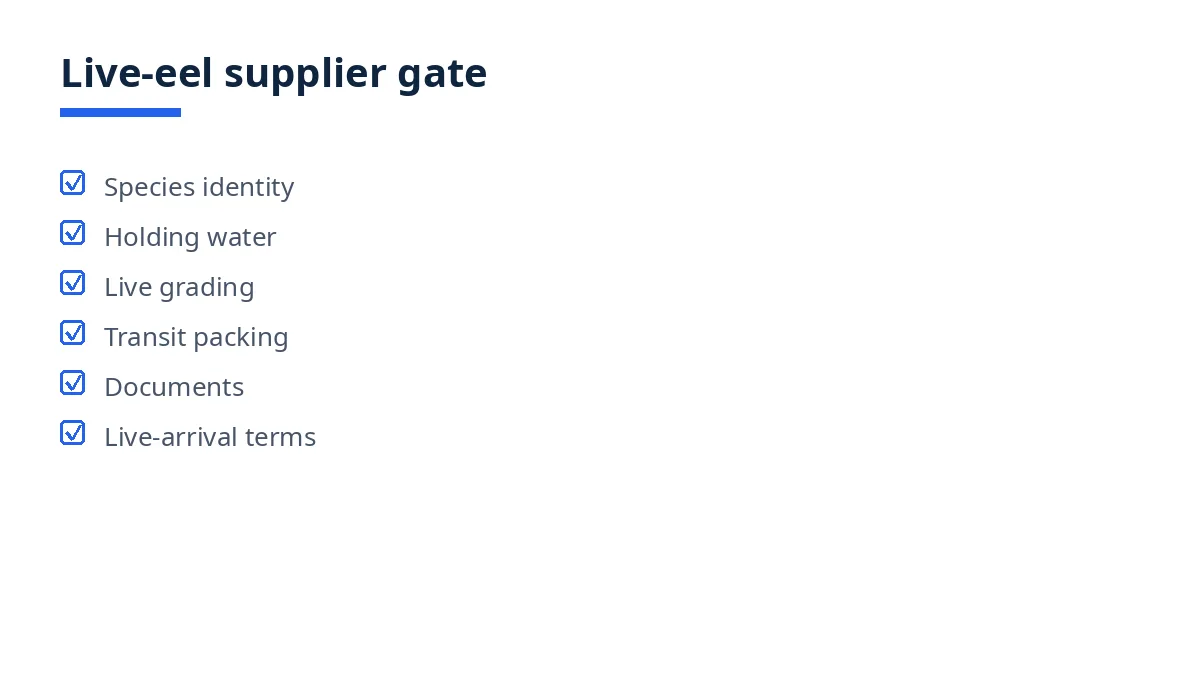
The full checklist (numbered, printable)
Gate A: Species identity and origin
Record the scientific name, life stage, and size band for each lot, and check them on the quotation, packing list, and health documents.
If the lot is Anguilla anguilla, confirm the CITES permits and destination rules for that species before loading, and file copies.2
If the lot is another Anguilla species, record that finding and still confirm the destination market rules.
Record the holding site name and address, whether the eels are farmed or wild-caught, and the source water body or farm.
Refuse mixed-species lots unless every species in the lot is declared in writing.
Gate B: Holding water and conditioning
Ask for the holding-water source and the steps taken to keep conditioning water similar to the water the eels came from.1
Confirm that holding and conditioning water is aerated before eels are transferred into it, and ask for the batch aeration log.1
Confirm that tanks are checked regularly, and that damaged, sick, and dead eels are removed immediately when found.1
Record the fasting window before transport in writing. Codex guidance states that no feeding should occur during storage and transportation of live fish, and that fish should generally not be fed in the 24 hours before transport.1
Ask for dated conditioning evidence of the actual lot: recent photos or video from the holding site showing active movement, intact skin, and no visible lesions.
Ask for the batch water log with the readings actually recorded, including temperature and oxygen, covering the conditioning period, not a single day.
Gate C: Live grading and vigour selection
Agree the size grade bands in writing, using length bands that match the tariff bands for the lot, and state how length is measured.3
Require grading to be observed at loading, by the buyer, an agent, or an inspector, not accepted from older stock photos.
Agree the count method before loading: by number, by weight, or both, and state who counts and who signs the count.
Confirm that rejected eels are removed before packing, not loaded to make up the count, and record the rejected number in the loading note.
Gate D: Packing matched to transit time
Ask the supplier to state the transit time the packing is rated for, covering the full door-to-door journey including waiting time and any delay, not only the flight time.
Confirm that containers are cleansed and disinfected before use, prevent the release of water, and are loaded with one species lot only.4
Ask for the packing method in writing: water volume, oxygen supply, and temperature control, with the basis for the rating stated.
Check that each container label links the consignment to its health certificate and states the species and count.
Confirm that eels are moved to the place of shipment without delay after health observation, and without contact with other susceptible aquatic animals lacking similar health guarantees.4
Gate E: Documents and health certification
Confirm that live aquatic animals for export are correctly identified and inspected under the WOAH Aquatic Code procedures, and that an international aquatic animal health certificate is provided by the competent authority or an approved certifying official.4
Check that the Bangladesh salubrity certificate application details match the order: commodity type, including live, species, quantity, packing, port of exit, and port of entry.5
Ask which Department of Fisheries e-certification documents will cover the shipment: licences, health certificates, additional health certificates set by the importing country, inspection, test reports, and certificate issuance.6
For a European destination, confirm the authorised border control post for live fish and the pre-notification route. Ireland's Fish Health Unit describes entry through an authorised border control post, with a Common Health Entry Document for Animals created on TRACES NT at least 24 hours before arrival.7
File every CITES permit, health certificate, and test report before loading, and check that names, species, counts, and dates match across documents.
Gate F: Commercial and live-arrival terms
Agree the minimum order in kilograms and count, and place a trial order first when the supplier is new.
Put price drivers in writing: species, life stage, size band, season, transit time, packing method, and certificates.
Agree live-arrival terms before payment: the count point at arrival, the evidence window for reporting weak or dead eels, and the remedy: credit, replacement, or price adjustment.
Agree a delay plan: who re-waters or re-oxygenates the consignment if a flight is missed, who pays, and how the buyer is notified.
Gate G: Score and file
Score each gate pass, conditional, or fail, and file the score sheet with the photos, logs, certificates, and correspondence. A fail in Gate A, Gate B, or Gate E stops the order. A conditional result allows a trial order only.
Common failures and how to fix them
The most costly failure is a species mismatch found at the border, usually because the quotation named only "live eels" and no scientific name. Stop, get the species in writing with its CITES position, and re-check the declaration before loading.2 Next is weak arrival after poor conditioning, where eels were held in unaerated water or fed close to transport. Ask for the conditioning log and the fasting window, and require a fresh conditioning period with dated evidence.1
Packing rated for the flight but not the door-to-door journey is another frequent cause of loss: the consignment waits at the airport while the packing clock runs out. Fix this by rating packing for the full journey plus a delay margin, stated in writing. Certificate mismatches are another common stop: a species name, count, or port that differs between documents. Reconcile every document against the order before departure.4
Mortality disputes without agreed terms are the hardest to settle. If the count point, evidence window, and remedy were not agreed before payment, both sides argue from memory. Fix this on the next order by writing those three terms into the purchase order.
Downloadable template / summary table
Copy the gates into one sheet, add the supplier name, lot, and date, and record a score per gate.
Gate | Checks | Evidence to file |
|---|---|---|
A: Identity and origin | Species, life stage, size band, holding site | Quotation, species note, CITES permits |
B: Holding water and conditioning | Water source, aeration, tank checks, fasting | Water log, conditioning photos |
C: Live grading | Size bands, observed grading, count method | Loading note, signed count |
D: Transit packing | Rated transit time, clean containers, labels | Packing note, container labels |
E: Documents | Health certificate, salubrity details, entry route | Certificates, permits |
F: Commercial terms | Minimum order, price drivers, arrival terms | Purchase order, delay plan |
G: Score and file | Pass, conditional, or fail per gate | Completed score sheet |
Example figures: a trial file for one lot might record one holding site, one species, one size band, and one rated transit time, with each gate scored before any larger order.
How Exportain helps
Exportain is a B2B marketplace connecting buyers with Bangladeshi suppliers, so the references behind this gate can be agreed at the enquiry stage. Browse suppliers, read the supplier verification explainer, and compare the live-eel import route in the live eels import guide. Supplier profiles show which document and photo checks have been recorded, not inspections. Exportain is not a party to the goods contract and does not inspect goods.
FAQs
When should this checklist be used?
Use it before the first order from a supplier, and again whenever the species, life stage, size band, destination market, or transit route changes.
Who should complete it?
The buyer, a local agent, or an independent inspector can complete it, provided the scorer sees the holding site evidence and the loading count.
What are the most common failures?
Species identity errors, weak conditioning, short-rated packing, certificate mismatches, and mortality disputes with no agreed count point or remedy are the failures buyers meet most often.
Can a third party do it?
Yes, if the third party is given the references, the scoring rule, and access to the holding site at grading and loading.
Next steps on Exportain
Before you approach a supplier, write down the species, size band, destination entry rules, and full transit time, then browse suppliers, read the supplier verification explainer, and post a free RFQ via RFQs with the gate attached.
Sources
- Code of Practice for Fish and Fishery Products (CXC 52-2003). FAO and WHO, Codex Alimentarius (accessed )
- Eels (Anguilla spp.): Thirty-second meeting of the Animals Committee, AC32 Doc. 36. Convention on International Trade in Endangered Species of Wild Fauna and Flora (CITES) (accessed )
- Live fish - UK Integrated Online Tariff, Heading 0301. GOV.UK (accessed )
- Aquatic Animal Health Code, Chapter 5.6: Aquatic animal health measures applicable before and at departure. World Organisation for Animal Health (WOAH) (accessed )
- Fisheries Inspection and Quality Control Rules 1997. Department of Fisheries, Bangladesh (accessed )
- Bangladesh rolls out online certification system to simplify fish and seafood trade. International Collective in Support of Fishworkers (ICSF) (accessed )
- Certification Requirements for Ornamental Imports. Marine Institute, Fish Health Unit (Ireland) (accessed )
About the author
Sourcing from Bangladesh?
Post a request for quotation and suppliers on Exportain can send you their quotes directly.
Post an RFQ