How to Find LEED green factory Certified Factories in Bangladesh
LEED certifies a factory building, not a manufacturer or product. This guide explains the BD+C and O+M systems, the four levels, the scorecard and directory checks, and the mistakes that break a building claim.
Short answer
A LEED-certified factory building is a building assessed under the LEED rating system, not a manufacturer, product, or labour-compliance approval. Ask for the exact building, the BD+C or O+M rating system and version, the Certified, Silver, Gold, or Platinum level, the final scorecard, the project directory entry, and the current status before you rely on the claim for an order from Bangladesh.

On this page
Key takeaways
LEED certifies buildings, not manufacturers, products, or labour and social compliance: a factory building certification says nothing by itself about product quality, labour practices, or export capability.
LEED levels are Certified at 40 to 49 points, Silver at 50 to 59, Gold at 60 to 79, and Platinum at 80 or more, after all prerequisites are met and GBCI review.
BD+C covers design and construction and O+M covers buildings already in operation, while ID+C covers interior spaces only, so the rating system must match the building in the order.
Verification means matching the exact building, rating system and version, final scorecard, and current status, and checking the LEED project directory entry under its registered name.
Exportain supplier verification is a document and photo review, not a factory inspection, and a badge is not a guarantee of capacity, quality, or delivery, so it does not replace a LEED record.
Start with the distinction that decides everything else in this guide. LEED, Leadership in Energy and Environmental Design, certifies buildings, not manufacturers, not products, and not labour or social compliance. A factory building can hold a LEED certification. That certification says the building was assessed under the LEED rating system. It does not by itself say anything about the manufacturer's product quality, labour practices, or export capability. The wording in the title reflects the words buyers commonly search for. It does not change that position.
LEED is a green building rating system from the U.S. Green Building Council (USGBC). A project must first complete all prerequisites and then earn points by satisfying credit requirements, through a verification and review process by Green Business Certification Inc. (GBCI).1
LEED level | Points earned |
|---|---|
Certified | 40 to 49 |
Silver | 50 to 59 |
Gold | 60 to 79 |
Platinum | 80 or more |
A higher level means a higher building score, not a stronger product or a safer workplace in the social-compliance sense. A Certified building has met every prerequisite and earned at least 40 points, while a Platinum building has earned at least 80 points.1
Two rating systems matter most for factory buildings. LEED for Building Design and Construction (LEED BD+C) covers design and construction, while LEED for Operations and Maintenance (LEED O+M) covers buildings already in operation.2 A new building or major renovation will normally sit under BD+C, and an existing, occupied building under O+M. LEED for Interior Design and Construction (LEED ID+C) covers interior spaces rather than whole buildings, so check that the scope matches the building you are buying from.2
Points come from credit categories. In the LEED v4 Building Design and Construction reference material, the categories are Integrative Process, Location and Transportation, Sustainable Sites, Water Efficiency, Energy and Atmosphere, Materials and Resources, Indoor Environmental Quality, Innovation, and Regional Priority.3 None of those categories, on their own, audit wages, working hours, freedom of association, or product testing.
Why this matters for buyers and sellers
For a buyer, a LEED claim is useful only when tied to a specific building, rating system, and level. A supplier may operate from more than one building, and a certification for one does not cover a different building on the same site or in another district. Ask for the building name, address, and project scope, and avoid paying a premium for a claim that belongs to a head office, warehouse, or sister unit.
For a seller, the same precision protects the sale. A building owner who can show the project name, rating system, version, level, and scorecard gives a buyer something checkable. A vague statement such as "our factory is green certified" gives a buyer nothing to check.
LEED does not replace product, quality, social-compliance, or export evidence. A buyer who needs material, chemical safety, or social audit evidence still needs it separately, even for a Platinum building.
Step-by-step: how it works
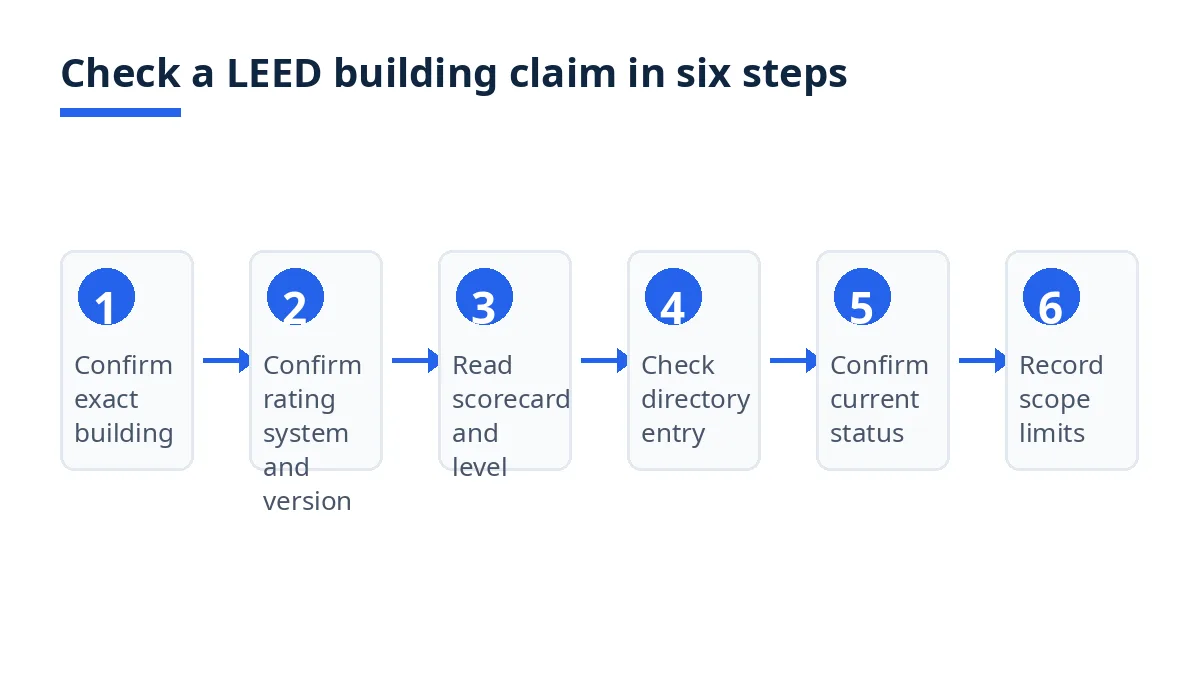
Confirm the exact building. Ask for the building name and address, the LEED project name, and the building that will make the order. A claim for a different building, a different unit, or a head office does not cover the production building.
Confirm the rating system and version. Ask whether the project is BD+C, O+M, or ID+C, and whether it is LEED v5, LEED v4.1, or LEED v4. USGBC lists those three versions in its certification process, with registration in Arc for LEED v5 and in LEED Online for LEED v4.1 and LEED v4.1
Read the scorecard and the level. Ask for the final scorecard showing prerequisites met, credits attempted and awarded, and the total points. Check the total against the level table above.
Check the project directory entry. The LEED project directory displays all certified non-confidential projects in the USGBC database.4 Search by the project name as registered, not only by the company or marketing name. If the project is marked confidential in LEED Online, or was certified through a paper submission or as a pilot, it may not appear, since only projects in the online database are visible.4 An absent entry is a question for the project team, not proof that a claim is false, and a present entry still needs a match on building, scope, and level.
Confirm the current status. Ask whether the certification is current, whether the building has been recertified under O+M, and whether any part of the building has changed since certification. For O+M, USGBC describes a 12-month performance period for LEED v4, v4.1, and v5, with a one-year period prior to submittal for v4.1 and v5.2 BD+C describes the building as designed and built, while O+M speaks to how it is operated, so do not read one as the other.
Record what LEED does not cover. Write into your own order file that the LEED record covers the building only. Keep product, social, quality, and export documents separate.
The diagram below summarises that check.
The commercial process follows four steps: register, apply with a completed application and review fee, receive GBCI technical review, and achieve certification.2 Registration is a statement of intent, not certification. A registered project, or a BD+C precertification holder, has not yet earned a LEED level. Ask for the final record and scorecard.
Costs, timelines and documents
GBCI fees are the only costs this guide states as figures, and they cover the building certification process only. They do not cover design work, energy modelling, documentation, consultancy, construction changes, or any product or social audit. The registration fee for Building Design and Construction is a flat fee paid upfront: 1,350 dollars for Silver, Gold, and Platinum level members and 1,700 dollars for organizational level members or nonmembers, on the fee schedule published at the time of registration.5 The certification fee is based on the project rating system and size, and it is calculated and paid when the project team submits documentation for review.5
For a combined BD+C design and construction review, the published rate for a building under 250,000 square feet, excluding parking, is 0.064 dollars per square foot for Silver, Gold, and Platinum level members, with a minimum of 3,200 dollars, and 0.076 dollars per square foot for organizational level members or nonmembers, with a minimum of 3,825 dollars.5 Larger buildings use lower rates with higher minimums, and buildings of 750,000 square feet or more are priced on calculation.5 Projects with at least 60 percent warehouse and distribution space receive 20 percent off standard fees.5 Check the schedule in force at registration and submission, because a change in floor area, rating system, or review type recalculates the fee.5
Timelines have two parts: the building work and the GBCI review. The building work depends on the project team and cannot be stated as a standard period. GBCI responds with its preliminary review within 20 to 25 business days, and the team is suggested to submit clarifications within 25 business days after receiving the preliminary results.2 An expedited review, where capacity allows, cuts review time to 10 to 12 business days per phase, with an additional charge.2 Do not promise a delivery date that depends on a LEED record until the building, scorecard, and current status are confirmed in writing.
Request the final record for the exact building, the final scorecard, and written confirmation of the current status and sharing position. A registration record, precertification worksheet, brochure, or plaque photograph is not a substitute.
Bangladesh-specific rules and tips
There is no separate Bangladesh LEED rulebook, and a buyer should be wary of any claim that one exists. LEED is a single system applied through USGBC and GBCI.2 In Bangladesh, the checks are about matching and building identity, not a local variant.
First, confirm the production building, not only the exporting company. Many exporters work from more than one building, and a record for one does not cover another used for cutting, sewing, finishing, or storage. Ask which processes happen in the certified building and which happen elsewhere. Second, confirm the project name as registered. The directory defaults to the name given in LEED Online, often different from the completed or marketing name.4 Search with the registered name the project team provides, and ask the team to confirm it in writing when the search returns no match. Third, treat a confidential project with care: it will not display in the directory, and the adjustment route runs through the project team administrator or owner contacting GBCI.4 The team can still show its own record, but the buyer cannot verify it through the directory alone. Fourth, do not let a building claim stand in for export, product, or social evidence, each of which needs its own check.
Settle the building, rating system, version, level, and current status in writing before the order. An O+M record is needed for an operating building, and a whole-building record is needed where an interior record will not suffice.
Mistakes and red flags
Treating a LEED building claim as a factory approval. LEED certifies a building. It does not certify a manufacturer, a product, or a labour or social position. A claim that moves from building to company, product, or workforce without separate evidence is a misreading, not a stronger claim.
Accepting a level without a scorecard. A level in a brochure, listing, or sales message proves nothing on its own. Ask for the final scorecard and check the total against the bands: 40 to 49, 50 to 59, 60 to 79, and 80 or more.1
Accepting a registration or precertification record as certification. Registration states intent and requires payment and agreement to the certification services agreement.2 BD+C precertification is an optional pathway focused on intended strategies, valid for three years.2 Neither is a final level.
Accepting evidence for a different building. A record for a head office, warehouse, sister unit, or different site does not cover the production building.
Reading a BD+C record as an O+M record, or an ID+C record as a whole-building record. BD+C covers design and construction, O+M covers operation, and ID+C covers interior spaces.2 Each answers a different question about a different scope.
Treating a directory absence as proof, in either direction. A certified non-confidential project displays in the directory, but a confidential, paper, or pilot project may not.4 Ask the team for the record and the registered name.
Treating an old record as current. Buildings and operations change, and O+M records sit in a recertification cycle. Ask for a current-status confirmation and, for O+M, the recertification position.
Using a LEED claim to skip product, social, or quality checks. A building score says nothing about fibre content, recycled content, chemical safety, product quality, wages, or working hours. Keep those checks in their own files.
Checklist
Before you rely on a LEED building claim, answer every line in writing.
Exact building: building name, address, and production unit that will make the order.
Project identity: LEED project name as registered, plus the marketing name where it differs.
Rating system and version: BD+C, O+M, or ID+C, and LEED v5, v4.1, or v4.
Level and scorecard: final scorecard on file, points checked against the bands.
Directory check: entry found under the registered name, or the reason for absence recorded.
Current status: certification current, recertification position stated for O+M.
Scope limits recorded: building only, with other evidence checked separately.
Building use confirmed: processes in the certified building named, and processes elsewhere named.
Fee and timeline position: fee schedule and review stage confirmed with the project team or GBCI.
How Exportain helps
Exportain supplier verification is a document and photo review, not a factory inspection, and not a check against any government database.6 A badge is not a guarantee of production capacity, product quality, or delivery.6 Verification is free, staff review every submission, and membership plans never grant a badge.7 An Exportain badge does not replace a LEED record, and a LEED record does not replace a badge. Each answers a different question.
Post a free RFQ and state the LEED building position you need: the exact building, rating system and version, level, final scorecard, directory position, and current status. Ask each reply to attach the final record and scorecard for that building, rather than a brochure, plaque photograph, or registration record. Read Seller Verification and Trust Center. The certification services category currently states "No services published in this category yet", so treat it as a category reference only, not as a listing of LEED firms.8
FAQs
What should I know first about LEED green factory?
Know first that LEED certifies buildings, not manufacturers, products, or labour and social compliance. A factory building can hold certification at Certified, Silver, Gold, or Platinum level, based on points earned after all prerequisites are met and GBCI review.1 Ask for the exact building, rating system, version, scorecard, and current status first.
What are the typical costs and timelines?
GBCI fees are the only figures stated here, and they depend on membership, rating system, building size, and review type. For BD+C, registration is 1,350 dollars for Silver, Gold, and Platinum level members and 1,700 dollars for organizational level members or nonmembers, and the combined review rate under 250,000 square feet is 0.064 dollars per square foot with a 3,200 dollar minimum for members, and 0.076 dollars per square foot with a 3,825 dollar minimum for nonmembers.5 GBCI responds with a preliminary review within 20 to 25 business days, and an expedited review, where capacity allows, cuts that to 10 to 12 business days per phase.2 Design, documentation, and consultancy costs sit outside GBCI fees and must be confirmed with the project team.
Which documents are needed?
You need the final record for the exact building, the final scorecard showing prerequisites, credits awarded, and total points, and written confirmation of the current status and the O+M recertification position.2 You also need the registered project name, so the directory entry can be checked, and a statement of which processes happen in the certified building.4 A registration record, precertification worksheet, brochure, or plaque photograph is not a substitute.
What are the most common mistakes?
The most common mistakes are treating a building certification as a factory, product, or social approval, accepting a level without a scorecard, accepting a registration or precertification record as final certification, accepting evidence for a different building, reading a BD+C, O+M, or ID+C record outside its scope, treating a directory absence as proof in either direction, and using a building claim to skip product, social, or quality checks.1 2 4 Each is avoidable by reading the final scorecard for the exact building before ordering.
Next steps on Exportain
Post a free RFQ at Post a free RFQ and state the building, rating system, level, scorecard, and current status you need. Read Seller Verification and Trust Center before you shortlist.
Sources
- LEED rating system. U.S. Green Building Council (accessed )
- Guide to LEED Certification: Commercial. U.S. Green Building Council (accessed )
- LEED Reference Guide for Building Design and Construction, LEED v4 Edition. U.S. Green Building Council (accessed )
- Why isn't my project visible in the LEED project directory?. U.S. Green Building Council (accessed )
- LEED registration and certification fees. U.S. Green Building Council (accessed )
- Trust & Safety Center. Exportain (accessed )
- Supplier verification: Earn trust badges buyers can see. Exportain (accessed )
- Compliance & Certification Bodies in Bangladesh. Exportain (accessed )
About the author
Sourcing from Bangladesh?
Post a request for quotation and suppliers on Exportain can send you their quotes directly.
Post an RFQ