Knit Dresses Exporters in Bangladesh: Verified Supplier Checklist
A supplier checklist for knit dresses from Bangladesh: legal papers, factory control, silhouette and drape evidence, print and embellishment checks, size-curve grading, stretch and wash evidence, and contract terms, with fixes for common failures.
Short answer
Use this checklist to check a knit dresses exporter in Bangladesh before ordering: confirm its legal papers and factory control, test silhouette and drape on a form, verify print and embellishment in bulk fabric, check grading across the full size curve, review stretch and wash evidence, and agree inspection and failure terms in writing.
On this page
Key takeaways
Check silhouette and drape on a dress form, not only flat measurements, because hem drop, pulling and twisting appear only when the dress hangs and is worn.
Require print and embellishment evidence in bulk fabric, stretched and washed, before approving bulk print or embellishment work.
Require a graded size set across the full curve and record actual measurements with tolerances, marking any out-of-tolerance size as a stop for that size.
Agree the stretch and wash test methods, laboratory and acceptance levels in the purchase order, and keep the full evidence file with the order for repeats.
Confirm legal papers, factory control and subcontracting in writing before a deposit, and contact at least one knit-dress buyer reference.
A knit dress is bought for how it hangs and keeps its shape, so a check that only covers price and delivery dates leaves the main risk unexamined. Work through this list before paying a deposit, and record each answer as pass, conditional or stop, with its evidence.
Knit dresses sit inside a large supplier pool. The Bangladesh Knitwear Manufacturers and Exporters Association states that it represents approximately 2,540 knitwear member factories.1 A pool of that size is the reason to run the same dress-specific checks on every candidate, and to keep a candidate that cannot produce the evidence out of the shortlist.
Why this checklist matters
A dress fails in ways flat fabric never shows: a hem that drops after hanging, a bodice that pulls, a print that cracks at the elbow, or a skirt that grows in wear. Those failures trace back to supplier capability: whether the factory cuts the quoted silhouette, whether print and embellishment survive handling, and whether grading holds across the curve.
This checklist therefore checks the exporter through the dress: legal papers and factory control first, then dress capability, silhouette, print, grading and stretch evidence, then commercial terms. A supplier that passes the paper checks but cannot show a graded, washed and hung sample has not passed the dress checks.
Before you start
Gather four references before contacting any exporter: the tech pack for one representative style, the size chart for the full curve, the fabric and trim specification, and the purchase-order terms, including inspection and acceptance. Without those, answers cannot be compared between suppliers, and a sample that looks good in one size proves nothing about the rest of the curve.
Ask each candidate for the same evidence set: a current Export Registration Certificate, a dated machine list, photographs of cutting, sewing and finishing, and two finished samples of one style in two sizes, in bulk fabric. Export Registration Certificates are issued by the Office of the Chief Controller of Imports and Exports.2 For the EU market, plan the label check early: a textile product shall be labelled with the name and percentage by weight of all constituent fibres in descending order.3
The full checklist (numbered, printable)
A. Identity and legal documents
Confirm the legal name on the Export Registration Certificate matches the quotation and bank account, and record its number and expiry date.
Confirm the factory address on the documents matches the factory photographs, and ask who owns the premises when it is rented.
Ask whether the dress will be made in the named factory or a subcontracted unit, and require any subcontracted unit to be named in writing before sampling.
Request two buyer references for knit dresses of a similar silhouette, contact at least one, and record what was delivered, not only that the reference exists.
B. Dress capability and factory control
Ask for a dated machine list, including cutting, overlock, coverstitch and buttonhole equipment, and check it against the tech-pack construction.
Confirm the factory can cut the tech-pack silhouette: ask for a cutting marker and check pattern pieces, grain direction and seam allowances.
Confirm capacity for each finishing step, such as pressing, steaming, hanging and folding, and ask how finished dresses are stored so hems are not creased.
Ask for the production plan for a repeat order: how cutting, sewing and finishing are sequenced, and what happens when one stage falls behind.
C. Silhouette, drape and hang evidence
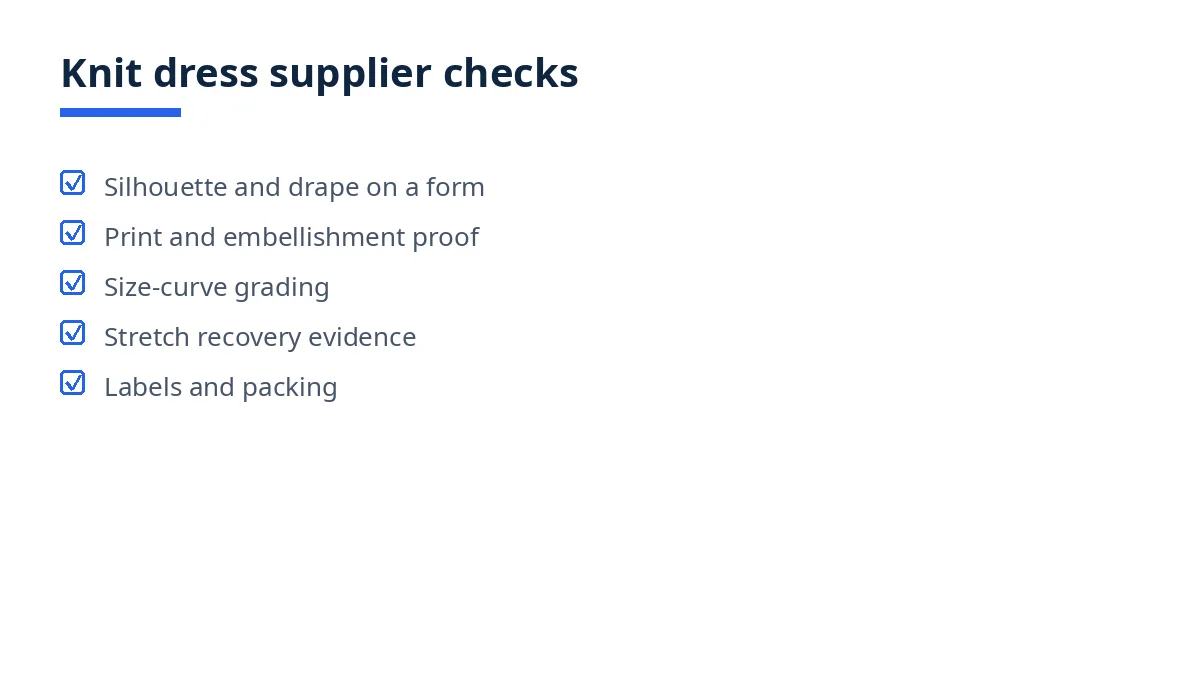
Hang each sample on a dress form, photograph front, back and side, and compare it against the tech-pack sketch.
Check drape where the dress changes direction, shoulder line, waist shaping and hem, and record any pulling, flaring or twisting.
Leave one sample hanging for the agreed period, then re-measure hem length at centre front, centre back and both sides, and record any drop before bulk is cut.
Check the dress on a fit model or form in at least two sizes, and require the supplier to explain any difference between form fit and flat measurements.
D. Print, embellishment and surface evidence
For a printed dress, ask for a strike-off in bulk fabric and method, check placement on front, back and sleeve, and check the print does not crack when stretched by hand at elbow and waist.
For an embellished dress, check each type separately and record how each is fixed, whether edges are secured, and whether any piece loosens in handling.
Wash one printed or embellished sample by the label care method, then re-check print adhesion and embellishment security before bulk approval.
Confirm that print and embellishment work is done in the named unit or by a named subcontractor, and require a fresh strike-off whenever that supplier changes.
E. Size-curve grading and measurement
Require a graded size set, not one sample size: the smallest, a middle and the largest size, measured flat and on the form.
Check grading at bust, waist, hip, shoulder width, armhole, sleeve length and total length, against the size chart rather than the sample size alone.
Check grading increments stay consistent: a jump that grows or shrinks between sizes points to an error at the ends of the curve.
Record every measurement as an actual figure with its tolerance, and mark any out-of-tolerance size as a stop for that size, even when the sample size passes.
F. Stretch recovery, wash change and labels
Ask for stretch and recovery evidence on the bulk fabric, naming the test method in the purchase order. ASTM D2594 covers stretch and growth of low-power knitted fabrics, and it is not recommended for acceptance testing of a commercial shipment because between-laboratory precision is known to be poor, so agree the laboratory in advance.4
Check dimensional change evidence on a washed garment, not only flat fabric. ISO 5077 specifies a method for determining the dimensional change of fabrics, garments or other textile articles when subjected to specified washing and drying procedures.5
After washing, re-check length, waist and hem shape, and require the supplier to state what changes when wash change moves a measurement outside tolerance.
Check the care label against the wash evidence: ISO 3758 establishes a system of graphic symbols for care labelling, based on the most severe treatments that do not cause irreversible damage.6
Check fibre, size and origin labels against the purchase order and market rules, and confirm placement before bulk labels are printed.
G. Compliance, certificates and commercial terms
Check any harmful-substances certificate by scope, product class and expiry date, and confirm it covers fabric, threads, prints and trims. Under OEKO-TEX STANDARD 100, the label is awarded only if all components meet the criteria, and a certificate is valid for 12 months.7
Agree quantity, price basis, payment terms, lead time and delivery terms in writing, and read the MOQ minimum order quantity guide before accepting a quantity that forces a size-curve compromise.
Agree inspection and acceptance in the purchase order: who inspects, at which stage, on what sample, and what happens to sizes or cartons that fail.
Agree what happens when a dress-specific failure appears in bulk: rework, sorting by size, partial acceptance or rejection, and who pays for re-inspection.
Keep the evidence file with the order, certificate copies, machine list, graded measurements, hang photographs, wash evidence and label approvals, so a repeat starts from the same record.
Common failures and how to fix them
The failure buyers meet first is a dress that fits the sample size and loses its shape across the curve, usually because grading was done from one size. Stop, measure the smallest, middle and largest sizes on the form, and re-grade before more fabric is cut.
The next failure is a hem that drops on one side after hanging, usually from uneven cutting or a hem finished before the garment had settled. Stop, re-measure the hung sample at four points, compare the marker, and re-finish a test dress after hanging before bulk hems are finished.
Print cracking and embellishment loss follow the same pattern: approval given on a flat strike-off that was never stretched or washed. Stop, stretch and wash a sample in the bulk fabric and bulk method, and require a fresh strike-off when the print or embellishment supplier changes.
Downloadable template / summary table
Turn the checklist into your working record: file it per supplier with the tech pack and tolerances attached, and note the result and the evidence for each item as you go.
Section | Checks | Evidence |
|---|---|---|
Identity | Certificate, address, subcontracting, references | Certificate copy, reference notes |
Dress capability | Machines, marker, finishing, plan | Machine list, marker |
Silhouette and drape | Form photos, drape points, hem drop | Hang photographs, measurements |
Print and embellishment | Strike-off, stretch, wash, supplier | Strike-off, washed sample |
Grading | Graded set, shape points, increments | Graded measurements |
Stretch, wash and labels | Recovery method, wash change, care label | Test evidence, label approval |
Terms | Certificate scope, quantity, inspection, failures | Purchase order, evidence file |
How Exportain helps
Settle the dress references at the enquiry stage on Exportain: tech pack, size curve, print method and inspection stage. Browse suppliers and read the supplier verification guide. Profiles record document and photo checks only, not factory inspections, and Exportain does not act as a party to the goods contract or inspect goods.
FAQs
When should this checklist be used?
Run it before signing a purchase order, and run it again whenever a new silhouette, print method or size curve enters the range.
Who should complete it?
You, a local agent or an independent inspector can each run it — whoever does works from the tech pack, size chart, graded samples and evidence file, and records actual measurements rather than pass marks alone.
What are the most common failures?
Grading errors across the size curve, hem drop after hanging, print cracking at stretch points, embellishment loss after washing, and a file that holds claims without graded, hung and washed evidence behind them.
Can a third party do it?
Yes, as long as the third party starts from your tech pack, size chart, tolerances, print method and acceptance levels, and returns the same evidence file you would build yourself.
Next steps on Exportain
Settle the tech pack, size curve, print method and inspection stage first, then read the supplier verification guide and the knit dresses quality control checklist, compare candidates on suppliers, and post a free RFQ via RFQs to compare quotes.
Sources
- BKMEA at a Glance. BKMEA (accessed )
- Export Import License in Bangladesh: Procedure, Requirements, and Legal Framework. Law Firm in Bangladesh, (accessed )
- Regulation (EU) No 1007/2011 on textile fibre names and related labelling and marking of the fibre composition of textile products. European Union, (accessed )
- ASTM D2594 - Standard Test Method for Stretch Properties of Knitted Fabrics Having Low Power. ASTM International (accessed )
- ISO 5077:2007 - Textiles — Determination of dimensional change in washing and drying. International Organization for Standardization (accessed )
- ISO 3758:2023 — Textiles — Care labelling code using symbols. International Organization for Standardization (accessed )
- OEKO-TEX STANDARD 100 for textiles tested for harmful substances. Hohenstein (accessed )
About the author
Sourcing from Bangladesh?
Post a request for quotation and suppliers on Exportain can send you their quotes directly.
Post an RFQ