

Knitted Underwear From Bangladesh to Canada: A Buyer's Import Checklist
Import knitted underwear from Bangladesh to Canada: CARM registration, HS 6107 and 6108 classification, LDCT origin, bilingual labels, MOQ, samples, shipping and landed cost.
Short answer
To import knitted underwear from Bangladesh to Canada, register your business in the CARM Client Portal, classify each style under heading 6107 for men and boys or 6108 for women and girls, and confirm the duty line and origin rule with your broker before pricing. Agree the bilingual fibre label and a pre-production sample in production fabric and elastic, set the inspection plan in writing, and build the landed cost style by style before bulk production.
On this page
Key takeaways
Knitted underwear for men and boys sits in heading 6107 and for women and girls in heading 6108. Subheadings split by fibre: cotton, man-made fibres and other textile materials.
In the schedule lines opened for this guide, the MFN rate for 6107.11, 6107.12 and 6107.19 is 18 percent, and LDCT is listed among the preferential tariffs. Confirm any LDCT rate and origin rule with your broker before pricing.
Register your business in the CARM Client Portal and enrol in the Importer Program before the goods ship. Customs brokers cannot register a client's business on the client's behalf.
Canadian textile labels must show the generic name and percentage of each fibre at 5 percent or more of total fibre mass, plus dealer identity, with fibre information in both English and French.
There is no single typical MOQ, price or transit time. Confirm each one in writing for your exact fabric, size curve, colour range, route and shipment date.
To import knitted underwear from Bangladesh to Canada, start with the Canadian side of the order, not with a supplier shortlist. Register your business in the CBSA Assessment and Revenue Management (CARM) Client Portal,1 2 confirm the tariff classification and the origin rule for each style, and settle the bilingual fibre label before bulk production. This guide covers suppliers, minimum order quantity (MOQ), pricing, samples, quality control, delivery terms, shipping from Chattogram, duty, taxes and documents, with a worked landed-cost example.
Knitted underwear is a fit and fabric order before it is a price order. Waistband elastic, leg opening, rise, size curve and fabric recovery decide whether a style sells again. Treat the first order as a controlled test of one supplier, one fabric and a narrow size range.
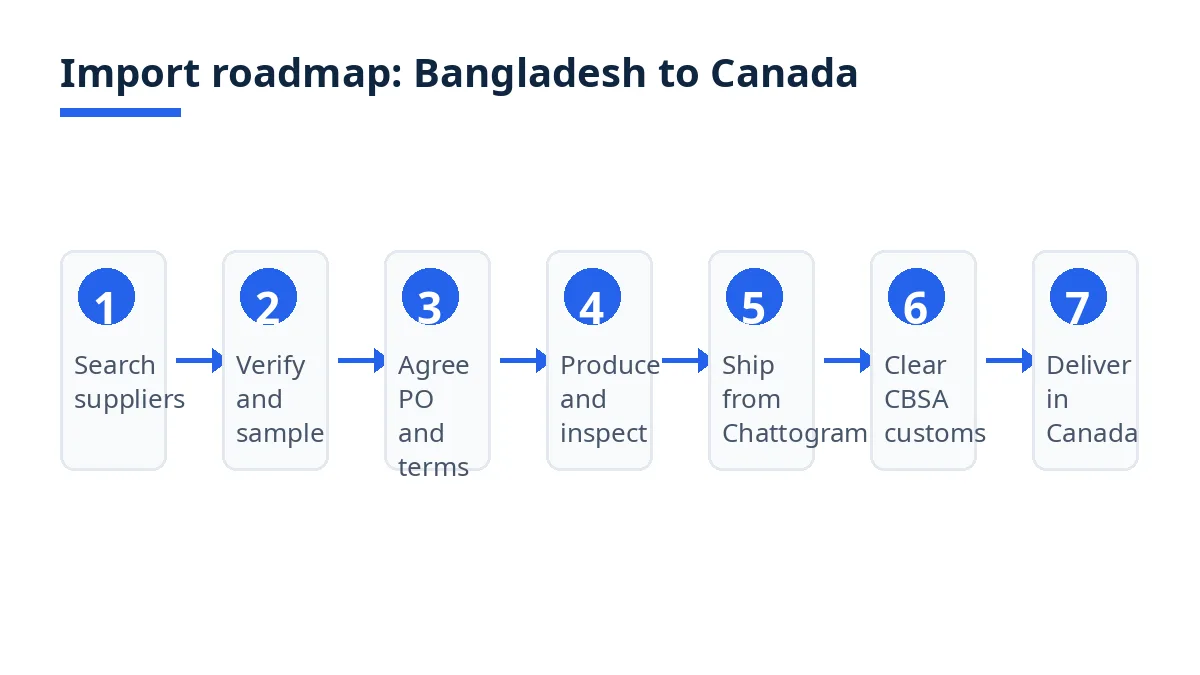
Canada checklist at a glance
Knitted underwear for men and boys sits in heading 6107 and for women and girls in heading 6108 in the Canadian tariff schedule lines opened for this guide. Subheadings split by fibre: cotton, man-made fibres and other textile materials. Confirm the full Canadian code for each style with your broker, because the code drives the duty line.
In the schedule lines opened for this guide, the most-favoured-nation (MFN) rate shown for the men's and boys' underpants and briefs lines 6107.11, 6107.12 and 6107.19 is 18 percent. The schedule also lists the Least Developed Country Tariff (LDCT) among its preferential tariffs. Do not price on an LDCT rate until your broker confirms the current LDCT rate and origin rule on the entry date.
Before importing, register your business in the CARM Client Portal and enrol in the Importer Program. Customs brokers cannot register a client's business on the client's behalf.1
Canadian textile labels must show the generic name and percentage of each fibre present at 5 percent or more of total fibre mass, plus dealer identity, and fibre information must appear in both English and French.
There is no single typical MOQ, price or transit time. Confirm each one in writing for your exact fabric, size curve, colour range, route and shipment date.
Why source knitted underwear from Bangladesh
Bangladesh has a knitwear sector organised around its own trade body. The Bangladesh Knitwear Manufacturers and Exporters Association (BKMEA) describes itself as an apex trade body representing the knitwear sector of Bangladesh, established in 1996, and states that it represents approximately 2,540 knitwear member factories.3 Knit fabric, circular knitting, dyeing and cut-and-sew capacity therefore sit in the same manufacturing clusters, and a supplier that already makes knitted underwear will already hold the machines and size curves the order needs. A factory making heavy knitwear or T-shirts is not automatically a good underwear factory, because underwear work turns on small-piece cutting, elastic application, narrow seams and consistent sizing across a wide size curve.
The advantage is range within one order: cotton briefs, cotton-blend trunks and women's briefs from related knit fabrics. A wide first order multiplies the points where fit, shade and elastic can drift, and a mixed entry needs a separate classification and label check for each style. Keep the first order narrow.
Chattogram is the port the order will almost certainly leave from. Chattogram Port handled about 92 percent of Bangladesh's total import and export trade and 98 percent of containerised cargo in 2025, with 3.4 million twenty-foot equivalent units handled in the year, according to Chittagong Port Authority traffic data reported in the press.4 Plan the inland move and port cut-off around Chattogram.
Find and verify suppliers
Where do I start to import knitted underwear from Bangladesh to Canada?
Start with a written specification. Write down every style first: men's briefs, trunks, boxer briefs, women's briefs, hipsters or boys' briefs, each with fibre blend, fabric weight, waistband type, rise, leg opening, size curve, colours, labelling and packing. Then shortlist factories whose current range already includes knitted underwear in the same fibres and constructions.
Send every candidate the identical specification and ask for the same reply format. Browse suppliers on Exportain at https://exportain.com/suppliers, read the guide on finding suppliers in Bangladesh at https://exportain.com/blog/find-suppliers-bangladesh, and the general guide at https://exportain.com/blog/how-to-import-from-bangladesh.
How do you verify a supplier before you pay?
Verification has three layers. The first is company documents: trade licence, export registration and association membership where applicable, checked so that name, address and bank account name agree across every document. Check BKMEA membership where a supplier claims it, and treat membership as a starting point, not as proof of capability or a guarantee. The second layer is capability: monthly underwear capacity, whether knitting and dyeing are in-house or bought in, fabric and elastic sources, and recent underwear styles from current production. A finished pack from current production shows more than a catalogue photograph.
Keep payments to the company account named in the documents, never to a personal account, and verify any change of bank details separately through a known contact. Read how supplier checks work on Exportain at https://exportain.com/blog/how-supplier-verification-works-on-exportain. On Exportain, supplier profiles carry document and photo review badges: a review of documents and photos, not a factory inspection or a guarantee. For a first order, add a video walkthrough during working hours, or a visit by a third-party inspector.
MOQ, pricing and samples
What is the typical MOQ for knitted underwear from Bangladesh?
There is no single typical MOQ. The minimum is set per style and usually per colour, because knit fabric is dyed in batches, elastic is bought by colour and width, and a cutting plan is set up per size curve. A single cotton brief in three colours will not carry the same minimum as a six-style programme with separate waistbands and prints. Ask each supplier how its minimum splits by style, colour, fabric and size curve, and whether a smaller first order is possible at a higher unit price.
State the size ratio in the specification and lock it in writing at order stage: if it changes after pricing, fabric use and unit price can both change.
How is the price built, and how should you compare quotes?
Fabric is usually the largest cost element, followed by cutting and sewing, elastic and waistband, dyeing, labelling, testing and packing. Two quotes can differ because one assumes a lighter fabric, a simpler waistband, fewer sizes or a different pack composition. Ask what each price is based on, in writing.
Compare quotes on the same basis: same style, fibre blend and fabric weight, same size curve and ratio, same waistband and trim, same pack composition, same delivery term and same packing. Ask each supplier to state what is excluded, for example testing or special packing. Keep the currency, price validity date and delivery term on every quote, and re-confirm the price if the fabric or size curve changes.
Which samples do you need, and how do you approve them?
Work in stages: a development sample, a fit sample in production fabric and middle sizes, and a pre-production sample in the actual fabric, colour, elastic and trim, which is the sample you approve for bulk. Fit, shade and elastic recovery cannot be approved from substitute fabric.
Test the samples as your customers will wear and wash them: measure waist, hip, rise and leg opening against your size chart after washing, check waistband recovery, and check shade consistency across the pack. Approve in writing, name the approved sample by style and colour, and keep one sealed counter-sample. No bulk cutting should start before the pre-production sample is approved in writing.
Quality control and certifications needed
Which quality checks are specific to knitted underwear?
Check fabric composition and weight, measurements for every size, and consistency across colours and packs. Then check waistband attachment and logo alignment, elastic tension, seam strength, stitch density, and whether each pack holds the stated sizes and colours.
Agree the inspection method before production. Sampling plans based on ISO 2859-1 use a code letter from lot size and inspection level to set sample size and accept and reject numbers, and AQL 2.5 is described as the most common choice for major defects on standard apparel, with General Inspection Level II as the usual starting point.5 Inspect in stages: an inline check during sewing, and a final random inspection on packed goods. See the acceptance quality limit guide at https://exportain.com/blog/aql-acceptance-quality-limit and the pre-shipment inspection guide at https://exportain.com/blog/pre-shipment-inspection. Require a needle-change and broken-needle record, and a metal-detection pass where your customer requires it.
Which label rules apply in Canada?
The Competition Bureau states that the label must show the generic name of each fibre present at 5 percent or more of total mass, its percentage, sectional disclosure where appropriate, and the dealer name and place of business or a CA Identification number.6 Fibre information must be factual, legible and accessible at purchase, and a permanent label must remain affixed and legible for at least 10 cleanings.6 Fibre information must appear in both French and English, while dealer identification and country of origin, when required, do not have to be bilingual.7
Settle the label as part of the specification. Agree the wording at sampling stage: fibre percentages matching the fabric bought, sectional disclosure where a style has a different-fibre waistband or gusset, and the dealer name or CA number. Check the label before bulk sewing begins and again at final inspection. If you sell in Quebec, confirm any additional language requirements before production.7 Confirm country-of-origin marking with your broker.
Which certifications do you actually need?
No single certificate covers every order. Name any retailer requirement in the specification, ask for the matching report or certificate, and check its scope, products, issuing body and date. A report for a different fabric does not cover your finished garment.
For OEKO-TEX Standard 100, the Hohenstein description states that Product Class II covers textiles whose surface comes into direct contact with the skin, including underwear, and that all components, including threads, dyes and accessories, must meet the criteria.8 Name Product Class II and check that the certificate is current and covers your exact styles.
Incoterms, shipping and transit time
Which delivery term should a first order use?
The Incoterms 2020 rules divide responsibility for delivery, risk, carriage, insurance and customs, and the named place matters as much as the three-letter rule. Under FOB, risk passes when the goods are loaded on board the vessel, and under FCA risk passes when the goods are delivered to the carrier named by the buyer, while under CIF the seller arranges carriage and minimum insurance but risk still passes on loading.9 The same guide notes the container point that catches first-time buyers: the sea-only rules FOB, CFR and CIF assume delivery on board a vessel, while a container is handed to the carrier at a terminal before loading, so FCA, CPT or CIP may better match container shipments.9
Weigh FOB Chattogram against FCA at the named terminal. Under FCA, delivery happens when the goods are handed to your carrier, which matches how containerised cargo moves from factory to terminal. State the rule, the named place and "Incoterms 2020" in the purchase order. See the knitwear delivery-term comparison at https://exportain.com/blog/best-incoterm-for-importing-knitwear-from-bangladesh.
How long does shipping take?
There is no single typical transit time. Sea freight is the standard route for bulk orders and takes weeks rather than days, varying by port pair, routing, transshipment, carrier schedule and season. Ask the forwarder for the routing in writing: port of loading, transshipment points, port of discharge, sailing frequency and cut-off dates. Keep production time separate from transit time: an order is ready only when every style has finished sewing, inspection, labelling and packing.
Choose the Canadian port by final destination. The Port of Vancouver is described as Canada's largest port and a primary Asia-Pacific gateway, while the Port of Montreal is described as a pivotal Eastern Canada container hub.10 Vancouver suits western Canada; Montreal suits Ontario, Quebec and eastern delivery.
Import duty, taxes and documents
How are knitted underwear styles classified for duty?
Heading 6107 covers men's or boys' underpants, briefs, nightshirts, pyjamas and similar articles, knitted or crocheted, with 6107.11 for cotton, 6107.12 for man-made fibres and 6107.19 for other textile materials in the schedule lines opened for this guide.11 Heading 6108 covers the corresponding women's or girls' articles. The subheading split inside 6108, for example 6108.21, 6108.22 and 6108.29, is indicative, verify it on the current tariff before pricing.
What import duty applies?
Your rate depends on classification, origin, origin rule and treatment in force on the entry date. The MFN rate shown for 6107.11, 6107.12 and 6107.19 in the schedule lines opened for this guide is 18 percent, with LDCT listed among preferential tariffs.11 Treat any LDCT rate as unconfirmed until your broker checks the current line and conditions, and do not price on a preferential rate until origin evidence is agreed.
Preferential treatment turns on origin evidence, not on shipment from Bangladesh alone. Finance Canada states that GPT preferences cover over 80 percent of tariff lines with the exception of most apparel and textile products, which is why the LDCT route is the one to check for apparel, and Bangladesh is listed among the beneficiaries.12 The CBSA origin memorandum states that for LDCT, origin criterion F means at least 20 percent of the ex-factory price was produced in the least developed country, and that the criterion must be shown on the proof of origin.13 Confirm with your broker whether that general criterion or an apparel-specific rule governs your styles, and agree the origin evidence at order stage.
What taxes apply at the Canadian border?
The CBSA guide gives a worked example: goods at CAN$137.00 with 4 percent duty carry CAN$5.48 of duty, the value for tax is CAN$142.48, and GST at 5 percent is CAN$7.12.14 The 4 percent is an illustration, not an underwear rate. GST is charged on the value for duty plus duty, at the exchange rate for the date the goods began their direct journey.14 Use the CARM duties and taxes calculator with your broker's confirmed codes, and confirm how HST and input tax credits apply to your business.
Which documents do you need for clearance?
The standard set is the commercial invoice, packing list, bill of lading, and proof of origin where a preferential rate is claimed. The invoice should name each style plainly, with fibre composition, waistband type, pieces per pack, quantities, unit prices and delivery term, on its own line. Quantities, weights and carton counts must agree across every document. Give the broker the full set while the goods are still at sea.
Landed cost example (table)
A landed cost is the full cost of one piece, ready to sell in Canada. Every number below is an example figure only, not a quote, using the MFN schedule line for the 6107 lines only.
Example figures: 12,000 men's cotton briefs, FOB Chattogram, sea freight to Vancouver, duty at the MFN example rate, GST at 5 percent.
Cost element | Example figures (per piece, CAD) | How to obtain your figure |
|---|---|---|
Product price, FOB | 1.85 | Confirmed pro forma invoice |
International freight | 0.28 | Forwarder quote divided by pieces shipped |
Insurance | 0.03 | Policy or forwarder quote |
Duty at MFN example rate, 18 percent of value for duty | 0.33 | Broker calculation from confirmed codes and rates |
Port, clearance and broker fees | 0.12 | Broker and port invoices divided by pieces |
Inland delivery to warehouse | 0.09 | Local carrier quote divided by pieces |
Total landed cost before GST | 2.70 | Sum of all lines above |
GST at 5 percent on value for duty plus duty | 0.11 | Broker calculation; confirm HST and credit treatment |
Total landed cost including GST | 2.81 | Sum of landed cost before GST plus GST |
GST here follows the CBSA method: charged on the value for duty plus duty.14 Work the calculation twice: at quote stage and again after shipment with actual invoices. See the full method at https://exportain.com/blog/landed-cost-imports-from-bangladesh.
Step-by-step import checklist
Register in the CARM Client Portal, enrol in the Importer Program, and delegate authority to your broker before the goods ship.1 2
Write the specification style by style: fibre, fabric weight, waistband, size curve and ratio, colours, label wording in English and French, pack composition.
Classify every style from headings 6107 and 6108; confirm each code, duty line and origin rule with your broker.
Shortlist factories whose range includes knitted underwear; request quotes on the identical specification and delivery term.
Verify the supplier: documents, capacity, fabric and elastic sources, grading, and a video or in-person factory check.
Sample in stages; wash-test and measure; approve a pre-production sample of each style in production fabric, colour and elastic.
Confirm in writing: purchase order, pro forma invoice, delivery and payment terms, inspection plan, labelling, packing, origin evidence and shipment date.
Inspect during production and on packed goods against the approved samples.
Ship, clear customs through CARM with the confirmed code for each style, and reconcile the actual landed cost.
How Exportain helps
Browse suppliers on Exportain at https://exportain.com/suppliers and compare their ranges against your style list. Then post your specification as a request for quotation and compare replies on the same terms. Exportain is a B2B marketplace where buyers post requests for quotation, receive quotations and message suppliers. It does not inspect goods, book freight or clear customs. Post your specification at https://exportain.com/rfqs.
FAQs
What is the typical MOQ for knitted underwear from Bangladesh?
There is no single typical MOQ. It is set per style and usually per colour, from fabric dye batches, elastic supply and the size curve. Ask how the minimum splits by style, colour, fabric and size curve.
How long does shipping take?
Production time and transit time are separate, with no single typical figure for either. Sea transit takes weeks and varies by port pair, routing, transshipment and season. Get the routing and cut-off dates in writing from the forwarder.
What import duty applies?
Duty follows classification, origin, origin rule and treatment on the entry date. The MFN rate for 6107.11, 6107.12 and 6107.19 in the lines opened for this guide is 18 percent, with LDCT listed among preferential tariffs.11 Confirm the LDCT rate, origin rule and 6108 lines with your broker. GST at 5 percent is charged on the value for duty plus duty.14
How do I verify a supplier?
Check company documents so name, address and bank account agree across the trade licence, export registration and invoices. Then check capability, keep payments to the company account, approve a pre-production sample, and add a video or in-person factory check for a first order.
Next steps on Exportain
Read how to import from Bangladesh at https://exportain.com/blog/how-to-import-from-bangladesh, then use the guide on writing a request for quotation at https://exportain.com/blog/how-to-write-an-rfq to set out your style list. When ready, post your specification at https://exportain.com/rfqs, and check the HS code guide for knitted underwear at https://exportain.com/blog/hs-code-for-knitted-underwear.
Sources
- Get started with CARM. Canada Border Services Agency (accessed )
- Register for or modify an import-export program account. Canada Border Services Agency (accessed )
- BKMEA at a Glance. BKMEA (accessed )
- 2025 container handling by Bangladesh's Chattogram Port up 4.07% YoY. Fibre2Fashion (accessed )
- 2.5 AQL Chart for the Fashion Industry. ApparelSearch (accessed )
- Textile labelling requirements. Competition Bureau Canada (accessed )
- Labelling textile requirements in a nutshell. Competition Bureau Canada (accessed )
- OEKO-TEX STANDARD 100 for textiles tested for harmful substances. Hohenstein (accessed )
- Incoterms 2020 Explained: FOB, CIF, EXW, DDP & More. Tide Signal Academy (accessed )
- Navigating Canada's Maritime Powerhouses: A Guide to the Biggest Ports. FreightAmigo (accessed )
- Customs Tariff, Chapter 61: Articles of apparel and clothing accessories, knitted or crocheted (2024). Canada Border Services Agency (accessed )
- Canada's unilateral tariff preference programs for imports from developing countries. Department of Finance Canada (accessed )
- Memorandum D11-4-4: Rules of Origin Respecting the General Preferential Tariff and Least Developed Country Tariff. Canada Border Services Agency (accessed )
- Select the duties and taxes that apply. Canada Border Services Agency (accessed )
About the author
Sourcing from Bangladesh?
Post a request for quotation and suppliers on Exportain can send you their quotes directly.
Post an RFQ


