

Importing Hotel Linen From Bangladesh to UK: Costs, Duties and Suppliers
Hotel linen from Bangladesh to the UK, costed by room set: DCTS duty and origin proof, 20% import VAT, par stock, laundry-trial samples, supplier checks and a worked landed-cost example for one double room set.
Short answer
To import hotel linen from Bangladesh to the UK, cost the order by room set and par stock, classify every piece under heading 6302, and confirm the commodity-level DCTS preferential rate, origin proof and 20 percent import VAT treatment with your broker before ordering. Specify fibre, weave, towel weight and shade item by item, run a laundry trial on a pre-production sample, and approve the room set in writing before bulk production.
On this page
Key takeaways
Hotel linen is classified piece by piece in heading 6302: bed linen at 630210, 630221 and 630231, cotton terry toilet and kitchen linen at 630260, other cotton toilet and kitchen linen at 630291, and cotton table linen at 630251.
The UK tariff page for heading 6302 shows a third-country duty of 12.00 percent, except 6.00 percent for nonwoven lines of man-made fibres, and VAT at 20 percent; Bangladesh is listed under DCTS Comprehensive Preferences at 0 percent for 99.8 percent of products, subject to origin rules and proof of origin.
VAT-registered businesses can account for import VAT on their VAT return under postponed VAT accounting, but the business must be VAT-registered, include its VAT registration number on the declaration, and cannot change the treatment once the declaration is submitted.
There is no single typical minimum, price or transit time for hotel linen: confirm each one in writing for the exact room set, par level, colour, hotel mark and shipment date, and run the laundry trial through the agreed commercial wash process.
Bed linen and towels fall in OEKO-TEX STANDARD 100 Product Class II and table linen in Product Class IV, and a STANDARD 100 certificate is valid for 12 months; check the certificate number, class, expiry and certified articles before ordering.
A hotel linen order is judged in the laundry room and on the bed, not at the port. This guide explains how to import hotel linen from Bangladesh to UK hotels, serviced apartments and hospitality wholesalers, with the room set, par stock and laundry process fixed before any price is compared. It covers UK duty and VAT first, then suppliers, samples, shipping, documents and quality checks.
A room set is the linen for one room change: sheets, pillowcases and any duvet cover for each bed, plus bath and hand towels for the guests. Cost the order by room set and by par stock, not by single pieces. Par stock is the sets a property holds across beds, laundry and store, and the par multiple decides the first order quantity more than the room count does.
Start from the room, not the catalogue
Begin with the beds, not a supplier catalogue. List every bed size, the number of beds at each size, and the guests each room sleeps. A sheet cut for one bed size does not fit another, and a towel programme sized for single occupancy will run short in double rooms. Record mattress depth for each size, because fitted sheets need a pocket depth covering the mattress and any topper.
Set par level with housekeeping before asking for prices: count sets on beds, in the laundry cycle, and held in store as a buffer, and fix the par multiple in writing, item by item. Agree the laundry process in the same document, since hotel linen is washed far more often, and usually hotter and with stronger chemistry, than home linen. The sample stage tests against that agreed process.
Room-set piece | Decide before quoting | Why it changes the cost |
|---|---|---|
Flat and fitted sheets | Bed sizes, mattress depth, pocket depth, fibre and weave | Cutting lengths, fabric weight and elastic work |
Pillowcases | Pillow sizes, closure type, shade match to the sheet | Matching dye batches and cutting |
Duvet covers | Duvet sizes, closure type, piping or plain edge | Extra fabric and finishing |
Bath towels, hand towels and bath mats | Sizes, towel weight, cotton or blend, hotel mark or plain | Towel weight drives fabric use |
Table linen | Table sizes and shapes, napkin size, colour or white | Cutting waste, dye batches |
How UK duty and VAT change the room-set price
Duty follows the classification of each piece in the UK tariff, not the word hotel on the invoice. Hotel linen sits in heading 6302, and the six-digit subheadings split it by linen group, construction, print status and fibre.1 Knitted or crocheted bed linen sits at 630210, printed cotton bed linen at 630221 and unprinted cotton bed linen at 630231, cotton terry toilet and kitchen linen at 630260, other cotton toilet and kitchen linen at 630291, and cotton table linen at 630251.1 Code the order piece by piece; a bathrobe is a garment, not linen.
The UK tariff page for heading 6302 shows a third-country duty of 12.00 percent, except 6.00 percent for nonwoven lines of man-made fibres, and VAT at 20 percent, with knitted or crocheted lines showing 20 percent or 0 percent.2 Treat the third-country rate as the fallback, and confirm the VAT treatment for a knitted piece with your broker.2
Bangladesh is listed under Comprehensive Preferences in the Developing Countries Trading Scheme (DCTS), the tier for least developed countries, with 0 percent import tariffs on 99.8 percent of products, all except arms and ammunition.3 That tier position does not settle the rate for a single shipment: the commodity-level rate, origin rules and proof of origin need confirmation for the exact code and entry date. Ask your broker to confirm the rate beside each code before you commit to a selling price, and keep the fallback rate in the costing until then. Confirm with broker for goods bound for Northern Ireland, where a separate tariff applies.
A preference claim needs proof of origin. Importers must claim preferential tariffs using an origin declaration or Form A, and must include all claims in the customs import declaration.4 An origin declaration states where a product originates, made out on an invoice or commercial document identifying the goods, and must contain exporter name and address, shipment date, consignee, origin, commodity specification, quantity, prices and weights.4 The declaration is valid for 2 years after the exporter provided it, and exporters must keep production records for 3 years where the UK government verifies a proof of origin claim.4 Agree at order stage who prepares the origin declaration and what records the supplier will hold.
Import VAT is separate from duty, at 20 percent on the heading 6302 lines.2 VAT-registered businesses can account for import VAT on their VAT return under postponed VAT accounting, declaring and recovering it on the same return instead of paying upfront.5 The business must be registered for VAT in the UK, must include its VAT registration number on the import declaration, and cannot change how it accounts for import VAT once the declaration is submitted.5 Where someone imports goods on the buyer's behalf, the buyer must tell that person in writing, before the declaration, that postponed VAT accounting is to be used.5 A business that is not VAT-registered cannot use it, and should price VAT as a cash cost at import. Confirm the VAT base with your broker: duty paid forms part of the value on which import VAT is charged.
Landed cost for one room set
A landed cost is the full cost of one room set, delivered to the hotel or its laundry, excluding VAT recovery. Every number below is an example figure only, not a quote. Example figures: one double room set for two guests — flat sheet, fitted sheet, two pillowcases, duvet cover, two bath towels, two hand towels, one bath mat — shipped FCA Chattogram, DCTS preference confirmed for every piece.
Cost element | Example figures (per room set) |
|---|---|
Product price, FCA Chattogram | £42.00 |
International freight to the UK | £3.60 |
Insurance | £0.30 |
Duty at the example preferential rate | £0.00 |
Port, clearance and broker fees | £1.80 |
Delivery to the hotel or laundry | £1.10 |
Total landed cost, excluding VAT | £48.80 |
VAT is a separate memo line. Example figures: on a VAT base of £45.90, import VAT at 20 percent would be £9.18 per room set. Confirm with broker. Without the preference, fallback duty at 12.00 percent adds £5.51, taking the example total to £54.31 before VAT. Confirm with broker. Build the same table for every room type, then multiply by the par level to reach the order value.
Finding and checking hotel-linen suppliers in Bangladesh
Start the search with the room-set specification, not with supplier names. Send every candidate the identical specification: the item list by room type, sizes, fibre and weave, towel weight, colour or shade, hotel mark treatment, label set, packing, and the par quantity. Ask for the same reply format: fabric assumed, items per pack, price inclusions, validity, and the minimum per item and per colour. A quote that changes the towel weight or drops the hotel mark is quoting a different room set, not a cheaper one.
Bangladesh has an established home textile base covering bed linen, towels and table linen. In 2024-25, Bangladesh Bank recorded home textile export receipts of USD 453.8 million, up 3.2 percent on the previous year, and terry towel receipts of USD 18.7 million, up 14.0 percent.6 Those figures describe banking-channel receipts, not capacity at any single mill. Shortlist mills and exporters whose current range already includes hotel or institutional linen, and ask which hotel programmes they supply, what sizes they already make, and what fabric widths they work with. Ask for a finished room set from current production, and check shade match across sheets, pillowcases and duvet covers.
Check a supplier in three layers before payment: documents, so name, address and bank account agree; capability, including weaving and terry capacity, dyeing route, shade control and replenishment of single items; and payment discipline, keeping payments to the company account named in the documents.
On Exportain, supplier profiles carry document and photo review badges: a badge is a review of documents and photos, not a factory inspection or a guarantee, and Exportain is not a party to the goods contract. For a first hotel order, add a factory check by video or in person. When your specification is ready, post it as an RFQ on Exportain and compare replies on the same room-set terms. Read how to buy on Exportain to check how RFQs, quotations and messages work.
Minimums, samples and the laundry trial
There is no single typical minimum order quantity for hotel linen from Bangladesh. The minimum is set per item and usually per colour, because sheeting and terry fabric are woven, bleached or dyed in batches. A white flat sheet, a dyed fitted sheet and a bath towel with a woven hotel mark will not carry the same minimum. Ask how each minimum splits by item, size, colour and hotel mark treatment, and whether it is counted in pieces, sets, dozens or cartons. For a small property, the towel minimum in a dyed colour often binds first, so test the quantity item by item against the par level.
Work samples in stages and approve in writing at each stage. A development sample shows whether the mill can construct each item and hold the finished size. A pre-production sample, made in the actual production fabric, weave, towel weight, colour and finish, is the sample you approve for bulk. Size, shade and hand feel cannot be approved from a sample in substitute fabric, because washing, bleaching and finishing change dimensions, shade and absorbency.
Run the laundry trial on the pre-production sample, through the exact wash process the property laundry will use. Agree in advance how many wash cycles the trial will cover, what is measured, and what pass mark applies to shrinkage, shade change, pilling, towel absorbency and linting, and fitted-sheet fit. Wash the room set together, and judge shade as a set: pieces can each pass on their own and still fail as a set if one comes from a different white or dye batch. Keep one sealed counter-sample of each item.
Shipping, delivery terms and the UK gateway
Name the delivery term, the version and the named place in the contract, for example FCA Chattogram, Incoterms 2020. The Incoterms rules define the place of delivery and the transfer of risk from seller to buyer, and each rule also covers the costs each party must assume, who contracts for transport, and who completes export and import formalities.7 Under FCA, the seller delivers the goods to the carrier the buyer names, at the agreed location, and FCA is suitable for any mode of transport, including multimodal shipments.7 Under FOB, the seller delivers once the goods are loaded onto the vessel at the named port of shipment, and FOB is to be used only for maritime or inland waterway transport.7
For a container shipment from Chattogram, FCA at the named terminal usually matches how the cargo moves, because the container is handed to the carrier before loading. FOB leaves a gap between terminal handover and loading that the contract should address in writing if FOB is used. If you accept a seller-arranged freight term, agree in writing who arranges carriage and insurance, what cover applies, and who carries out import formalities and pays duty and VAT.
There is no single typical transit time for hotel linen from Bangladesh to the UK, and this guide states none. Sea freight takes weeks rather than days, varying by sailing schedule, routing, transshipment and season. Work backward from the opening or refurbishment date, keep production time separate from transit time, and confirm the shipment date only after the laundry trial is approved. Choose the UK gateway by warehouse and laundry location and onward delivery cost, and confirm items per carton, carton dimensions and weight in the specification.
Documents, labelling and the import declaration
The import set is the commercial invoice, packing list, bill of lading, proof of origin where a preference is claimed, and the customs declaration. Name each piece plainly on its own invoice line, with linen group, fibre content, construction, finished dimensions, towel weight where applicable, quantities, unit prices and the delivery term. State printed or unprinted on the bed linen lines, because that wording decides the classification line. Quantities, weights and carton counts must agree across every document.
Give the broker the VAT registration number and EORI number for the declaration where postponed VAT accounting is to be used, and confirm in writing before the declaration is submitted whether it applies.5 For a DCTS claim, the origin declaration must be made out in English, bear the signature of the exporter, and may be sent electronically to the importer.4 Keep the classification file with the shipment documents: the description of each piece, the confirmed commodity code per piece, the origin evidence, and the broker confirmation of the duty and VAT lines.
Fibre labelling applies to every piece in the room set, and the labelled composition must match the fabric actually used. A textile product shall be labelled or marked with the name and percentage by weight of all constituent fibres in descending order.8 Agree the label wording at sampling stage and check the finished label before bulk label sewing begins. Add care, size and origin marking as your market and hotel group require, and check that the hotel mark sits in the agreed position on every item. A label that names the wrong fibre percentage is a classification problem as well as a labelling problem.
Quality checks that survive commercial laundry
Agree the inspection method and defect limits before production, and write them into the purchase order. ISO 2859-1:2026 defines a system of acceptance sampling plans for inspection by attributes, indexed by acceptance quality limit (AQL) for lot-by-lot inspection, and AQL is the maximum average percentage of defective items considered acceptable during random sampling.9 Set separate limits for critical, major and minor defects. Inspect in stages: an inline check during cutting and sewing, and a final random inspection on packed goods against the approved samples.
At final inspection, check the room set as a set. Measure finished sizes after washing against the agreed tolerances, check fitted-sheet pocket depth and elastic, hems and stitching, towel hems and selvedges, and table linen hems and corners. Check shade across the programme, towel weight and absorbency after washing, and that the hotel mark is in the agreed position and survives the agreed wash process.
No single certificate covers every hotel linen order: a hotel group may name a specific test in its supplier manual, and a certificate that does not name your product does not cover your order. Name any such requirement in the specification, and check scope, product, issuing body and date. One scheme UK hotel buyers ask about is OEKO-TEX STANDARD 100, a testing and certification system for textiles tested for harmful substances.10 Criteria and limit values depend above all on intended use, and the more direct the skin contact, the stricter the requirements.10 Bed linen and towels fall in Product Class II, for textiles in direct contact with the skin, while table linen falls in Product Class IV, for furnishing materials for decorative purposes.10 A STANDARD 100 certificate is valid for 12 months and can be renewed annually.10 Check certificate number, class and expiry, and confirm the certified articles include your exact constructions and colours.
Ordering sequence: import hotel linen from Bangladesh to UK
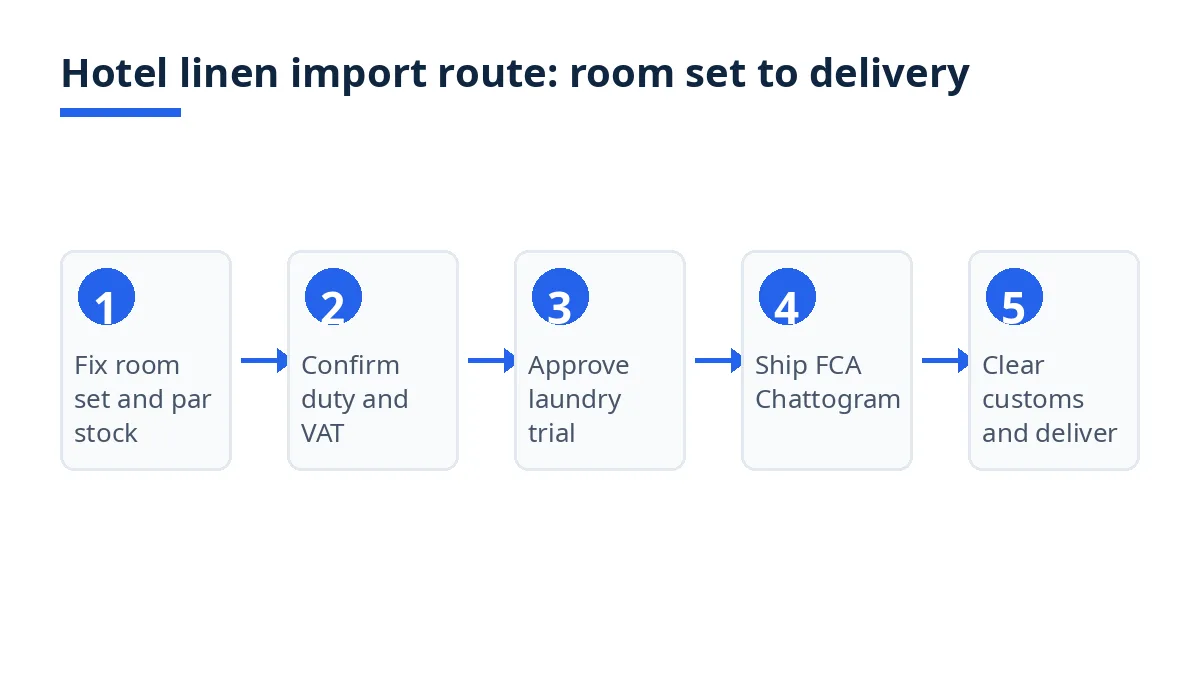
List beds, rooms and guest numbers, set the par level with housekeeping, and agree the laundry process.
Write the room-set specification item by item, with sizes, fibre, weave, towel weight, shade, hotel mark, labels and packing.
Classify every piece from heading 6302 and confirm each code, duty line, VAT treatment and DCTS claim with your broker.
Shortlist suppliers whose range includes hotel linen, send the identical specification, and compare quotes on the same room-set basis.
Verify the chosen supplier: documents, hotel programme capability, and payment discipline.
Order samples in stages, run the laundry trial on the pre-production sample, and approve each item in writing.
Confirm the order in writing: purchase order, pro forma invoice, delivery and payment terms, inspection plan, labelling, packing, gateway and shipment date.
Inspect during production and again on packed goods against the approved samples and defect limits.
Ship from Chattogram, clear customs with the confirmed code and origin evidence for each piece, and deliver the full par stock.
Reconcile the actual landed cost per room set, record shade and shrinkage results from the first laundry cycles, and set the replenishment quantity.
What is the typical MOQ for hotel linen from Bangladesh?
There is no single typical minimum. The minimum is set per item and usually per colour, because sheeting and terry fabric are woven, bleached or dyed in batches. Ask how it splits by item, size, colour and hotel mark treatment, and whether it is counted in pieces, sets, dozens or cartons. Test the quantity item by item against your par level.
How long does shipping take?
Production time and transit time are separate, and neither has a single typical figure. Sea freight from Chattogram to the UK takes weeks rather than days, varying by sailing schedule, routing, transshipment and season. Plan backward from the opening or refurbishment date, and confirm the shipment date only after the laundry trial is approved.
What import duty applies?
Duty follows the confirmed classification of each piece, the origin and the entry date. Hotel linen sits in heading 6302, split by construction, print status and fibre.1 The tariff page shows a third-country duty of 12.00 percent, except 6.00 percent for nonwoven lines of man-made fibres.2 Bangladesh is listed under Comprehensive Preferences, with 0 percent tariffs on 99.8 percent of products at tier level, subject to origin rules and proof of origin.3 Confirm the commodity-level rate with your broker before you price or ship. Confirm with broker. Import VAT at 20 percent is separate from duty.2
How do I verify a supplier?
Check company documents first, so name, address and bank account agree across the trade licence, export registration and invoices. Then check capability for a hotel programme: weaving and terry capacity, dyeing route, shade control, and a finished room set from current production. Keep payments to the company account named in the documents, and treat any profile badge as a document and photo review, not a factory inspection or a guarantee.
Next steps on Exportain
Read the general how to import hotel linen from Bangladesh guide, then check the HS code for hotel linen guide for the piece-by-piece classification behind each duty line. When your specification is ready, see how to buy on Exportain and post it as an RFQ so suppliers quote the same room set on the same terms.
Sources
- HS 2017 - Code 6302: Bed linen, table linen, toilet linen and kitchen linen. United Nations Statistics Division (accessed )
- Bed linen, table linen, toilet linen and kitchen linen - UK Integrated Online Tariff, Heading 6302. GOV.UK (accessed )
- Preference tiers under the Developing Countries Trading Scheme. GOV.UK (Department for Business and Trade), (accessed )
- How to claim preferences under the Developing Countries Trading Scheme (DCTS). GOV.UK (Foreign, Commonwealth & Development Office and Department for Business and Trade), (accessed )
- Check when you can account for import VAT on your VAT Return. GOV.UK (accessed )
- Annual Export Receipts of Goods and Services 2024-25. Bangladesh Bank (accessed )
- FCA & FOB Incoterms 2020 explained: Key differences. ICC Academy (accessed )
- Regulation (EU) No 1007/2011 on textile fibre names and related labelling and marking of the fibre composition of textile products, Article 9: Multi-fibre textile products. legislation.gov.uk (accessed )
- ISO 2859-1:2026 - Sampling procedures for inspection by attributes — Part 1: Sampling schemes indexed by acceptance quality limit (AQL) for lot-by-lot inspection. ISO (accessed )
- OEKO-TEX STANDARD 100 for textiles tested for harmful substances. Hohenstein (accessed )
- landed cost
- import duty
- quality control
- buyer guide
- Bangladesh sourcing
- home textiles
- OEKO-TEX Standard 100
About the author
Sourcing from Bangladesh?
Post a request for quotation and suppliers on Exportain can send you their quotes directly.
Post an RFQ


