

Hilsa Fish Price in Bangladesh: FOB Cost Breakdown for Buyers
No single hilsa price exists without a grade and a form. This guide shows how to read a hilsa FOB quotation line by line: size-grade bands, whole versus cut yield, glaze and net-weight arithmetic, seasonal availability, and the cold-chain and document costs inside and outside the price.
Short answer
A hilsa FOB quotation cannot be judged by its headline price. Compare quotations only after converting each to price per kilogram of net weight, on the same size-grade band and form, with glaze percentage, named port of shipment, validity period and document list stated. Under FOB, the seller covers costs up to loading on board, while the buyer pays ocean freight and all costs after loading.

On this page
Key takeaways
A hilsa FOB quotation cannot be judged by its headline price: compare quotations only after converting each to price per kilogram of net weight.
Size-grade bands and form decide what the price covers, so a quotation must state the band as a range and the form in full.
Glaze changes the comparison: where food has been glazed, the declared net contents must exclude the glaze, so ask for gross weight, glaze percentage and net weight.
FOB names a port of shipment and a validity period: check that validity covers the loading window and confirm availability separately, since seasonal restrictions can remove supply.
Exportain verification is a document and photo review, not a factory inspection, and a badge is not a guarantee of any shipment.
A hilsa quotation is not a single price. It is a set of linked decisions: a size grade, a form, a weight basis, a glaze percentage, a port, a validity period and a list of documents. The headline figure only means something once every one of those lines is stated. Two quotations that look close together can describe different fish and packs, and the cheaper headline can be dearer once the weight basis is corrected.
This guide reads a hilsa quotation line by line: size-grade bands, whole versus cut yield, glaze and net-weight arithmetic, seasonal availability, and FOB cost coverage. Worked-example prices and quantities are labelled as example figures.
Hilsa, Tenualosa ilisha, is the national fish of Bangladesh, and the hilsa fishery is the largest single-species fishery in the country, supporting around half a million people directly and a further 2.5 million indirectly in supply-chain work.1 The Bangladesh Department of Fisheries manages the fishery under the Hilsa Fisheries Management Action Plan, which includes sanctuary areas and fishing bans during certain periods.2
Why this matters for buyers and sellers
For a buyer, the quotation is where most hilsa disputes start. A buyer who orders "frozen hilsa" without a grade band, a form and a glaze percentage has ordered several different products at once. Headline-price comparison favors the heaviest glaze, smallest grade band or vaguest form, since each lowers the headline figure, not the real cost per kilogram of fish.
For a seller, an itemized quotation is protection: a processor that states the grade band, form, glaze percentage, carton weight, port and validity period gives the buyer nothing to reinterpret later.
Step-by-step: how it works
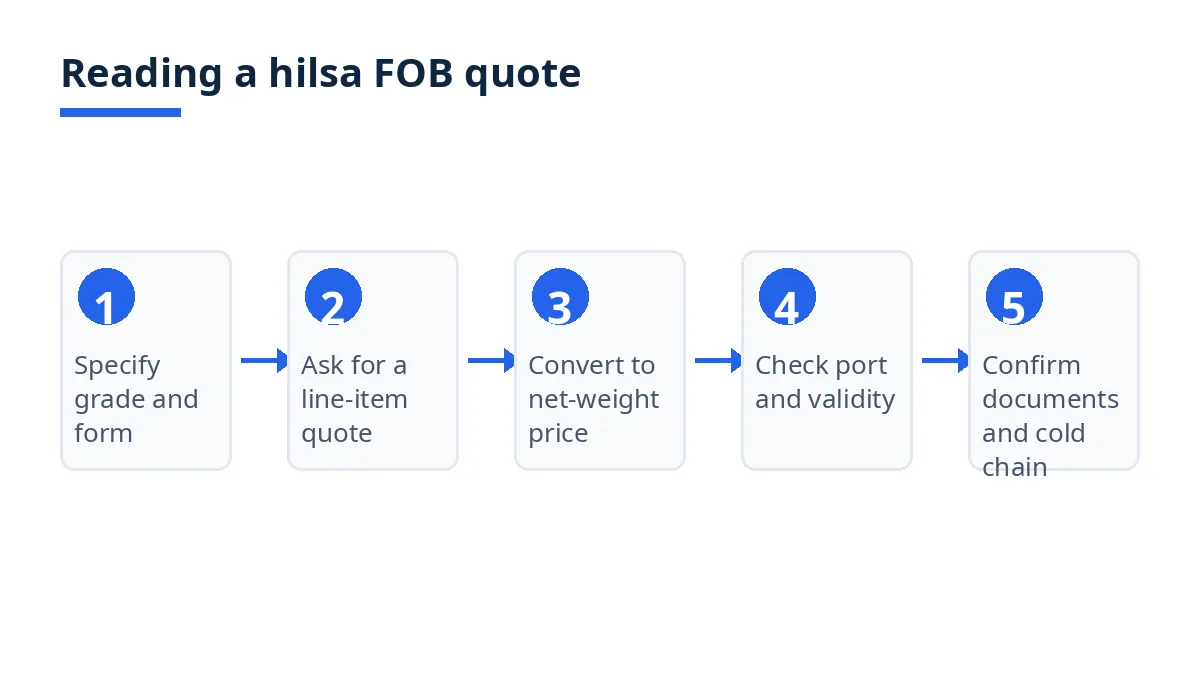
Work through a quotation in this order, and do not compare prices until step three is complete.
Write the specification before asking for a price. State the species, form (whole round, gutted, headless, fillet or steak cut), size grade band in grams per fish or pieces per kilogram, glaze percentage, inner pack and carton weight, and freezing method.
Ask for the quotation in lines, not as a single figure. Request separate lines for fish, processing and freezing, glazing, packing, inland transport, export clearance and documentation, and port handling and loading. The ICC publishes Incoterms 2020, the rule set that defines FOB and allocates cost, risk and obligations under each term.3 Under FOB, the seller covers delivery on board the vessel at the named port of shipment, including export clearance, and risk transfers to the buyer once the goods are on board.4
Normalize every quotation to price per kilogram of net weight. Divide the carton price by the net weight, not the gross weight. Hidden glaze looks cheaper until this step exposes it.
Check the port, the validity and the loading window together. FOB must name a port of shipment, and the named port decides which inland transport and port charges sit inside the price.4 Check that validity covers the loading window, and ask what happens if loading slips past it.
Confirm documents and destination requirements in the same message. Ask which export documents are included in the price and which certificates the destination market requires.
Confirm the cold chain in writing. Ask for storage temperature, reefer setting and temperature-record holder from cold store to loading. Quick frozen fish fillets must be stored at minus 18 degrees Celsius or colder, and the label must state that storage condition.5
Reading the size-grade bands
Size-grade bands are the first price driver in a hilsa quotation, because the band decides which fish the price covers. A quotation should state the band as a range, in grams per fish or pieces per kilogram. A band that reads "large" without a range is an opinion, and two suppliers will apply it differently.
Example figures: a quotation sheet that lists three bands for whole round hilsa, with the largest band priced highest per kilogram and the smallest band priced lowest, shows a normal grade structure. The level of any figure is not the point: large-band and mixed-band prices describe different products, and the comparison must be rebuilt band by band.
Reading whole versus cut yield
Form is the second price driver, because cutting changes how much saleable fish a kilogram of raw fish produces. Whole round, gutted, headless and fillet forms are four different yields from the same intake, with different processing costs and weight losses. A fillet quotation therefore reads higher per kilogram than a whole-fish quotation for the same intake: the fillet price covers the fish removed as well as the fish remaining.
Example figures: if 100 kilograms of whole round hilsa yields 70 kilograms of gutted fish after processing, then a gutted-fish price must be read against 70 kilograms of output, not 100 kilograms of intake. Ask the supplier to state the form and the expected yield basis.
Reading glaze and net weight
Glaze is the third price driver and the most common source of a false comparison. Glaze is the thin ice layer applied to frozen fish. Under the Codex standard for quick frozen fish fillets, where food has been glazed, the declared net contents must exclude the glaze, and net weight must be determined in the frozen state, exclusive of packaging material.5 A quotation therefore has to state whether its price is per kilogram of gross or net weight, and what glaze percentage applies.
Example figures: a carton quoted at 10 kilograms gross weight with 10 percent glaze contains 9 kilograms of fish. If the carton price is 90 currency units, the price per kilogram of gross weight is 9 units, but the price per kilogram of net weight is 10 units. A competing carton quoted at 10 kilograms net weight for 95 units is cheaper per kilogram of fish. Ask for gross weight, glaze percentage and net weight on every glazed line.
Costs, timelines and documents
An FOB quotation covers the seller's costs up to loading on board at the named port; the buyer pays sea freight and all costs after loading.4
Cost line | Inside an FOB price | Buyer checks |
|---|---|---|
Raw fish intake and grading | Yes | Grade band as a range |
Processing, freezing and glazing | Yes | Form, glaze, net weight |
Inner pack and carton | Yes | Carton weight, pieces |
Inland transport to the port | Yes | Named port stated |
Export clearance and export documents | Yes | Document list stated |
Port handling and loading on board | Yes | Validity stated |
Ocean freight and insurance | No, buyer pays | Quoted separately |
Destination port charges and import clearance | No, buyer pays | Checked before shipment |
Timelines in a hilsa quotation are supplier-stated, not standard. No fixed production or transit figure applies across suppliers, because intake depends on landing and processing capacity at the time of order. Ask for three dates in writing: price validity, the loading window, and the document-ready date. A quotation without a validity date is an indication, not a price commitment.
Seasonal availability changes the timeline question. Because fishing is banned in sanctuary areas and during certain periods under the management plan,2 a supplier may be unable to load a particular grade in a particular window even when the price is still valid. Ask the supplier to confirm availability for the stated window rather than assuming that a valid price means available fish.
Export documents for a hilsa shipment
Bangladesh Customs requires an export declaration, known as a Bill of Export or shipping bill, before goods may be loaded for export.6 The documents enclosed with the Bill of Export for all export consignments include the export letter of credit or, where there is no letter of credit, the export contract, purchase order or export guarantee approved by the negotiating bank; a signed commercial invoice; a packing list stating quantity, weight and packing information; an EXP form certified by an authorized dealer; a certificate of origin issued by the Export Promotion Bureau or a chamber of commerce; a VAT registration certificate; and a taxpayer identification number.6
For frozen fish specifically, Bangladesh Customs lists a quality control certificate by the Department of Fisheries as necessary where the destination country requires it.6 Ask, before agreeing a price, whether the destination market requires that certificate and whether its cost sits inside the FOB price.
Bangladesh-specific rules and tips
Seasonal rules are the most important Bangladesh-specific factor in a hilsa quotation, and the most important discipline is to avoid inventing them. The management plan uses sanctuary areas and bans during certain periods to protect juvenile and spawning hilsa,2 and the exact restricted areas and periods are set by current official notices. Ask the supplier to confirm whether any current restriction affects supply in the loading window.
Freeze the specification before documents are prepared, since the Bill of Export, the EXP form and the certificate of origin must agree on description, value and quantity, and a late change to grade, form or pack can force document changes as well as a price change.
A third point is temperature: the Codex storage requirement of minus 18 degrees Celsius or colder applies through transportation, storage and distribution,5 and a break in that chain affects quality before it affects paperwork, so ask for the temperature record across cold store, inland transport and loading.
A fourth point concerns the trade term itself. FOB is designed for sea and inland waterway transport, and risk transfers only when the goods are loaded on board the vessel.4 For containerized cargo, often delivered to a terminal days before loading, FCA is often more suitable because risk can transfer at the actual handover point.4 Ask whether FOB or FCA fits a reefer-container handover, rather than accepting FOB by habit.
Mistakes and red flags
Most mistakes in reading a hilsa quotation are versions of comparing unlike with unlike.
Comparing gross-weight prices. A gross-weight price always looks cheaper than the same fish at net weight. Convert first, compare second.
Accepting a grade without a range. A grade named in words, not in grams or pieces per kilogram, cannot be checked on arrival.
Accepting a form without a yield basis. Fillet and whole-fish prices are not comparable until form and yield basis are both stated.
Ignoring the validity date. A price that expired before loading is not a price. Check validity against the loading window.
Assuming documents are included. A low FOB figure that excludes a required certificate is not lower once the certificate fee is added.
Assuming availability follows price. Seasonal restrictions can remove supply while a price is still valid. Confirm availability separately from price validity.
Treating a quotation as a contract. A quotation states an offer. Confirm specification, price, port, validity, documents and cold-chain terms in a signed order before payment.
Red flags on the supplier side follow the same pattern. A supplier that will not state a grade range, glaze percentage or net weight withholds the numbers a comparison needs; one that will not name a port, validity period or document list withholds the terms a contract needs. A price far below comparable quotations without an explanation in grade, form or glaze should prompt a question, not acceptance.
Checklist
Use this checklist on every hilsa quotation.
[ ] Species and form stated (whole round, gutted, headless, fillet, steak cut)
[ ] Size grade as a range in grams per fish or pieces per kilogram
[ ] Gross weight, glaze percentage and net weight stated for glazed lines
[ ] Price converted to price per kilogram of net weight
[ ] Inner pack, carton weight and pieces per carton stated
[ ] Named port of shipment stated, with the agreed term written in full
[ ] Validity date and loading window stated, validity covering the window
[ ] Loading-window availability confirmed against current seasonal restrictions
[ ] Export document list and cost treatment stated
[ ] Destination-market Department of Fisheries certificate requirement checked
[ ] Minus 18 degrees Celsius or colder storage confirmed, with a temperature record agreed
[ ] Payment terms and change procedure agreed in writing
How Exportain helps
Exportain lists suppliers and lets buyers send requests for quotation. On supplier verification, Exportain staff review document and photo submissions in the seller verification centre, and approved checks earn trust badges shown on company pages, product listings and quotations.7 That review is a document and photo review, not a factory inspection, and a badge is not a guarantee of any shipment.7 Apply the checklist above to every quotation, including those from badged suppliers: it tests the quotation itself, not the profile behind it.
FAQs
What should I know first about hilsa fish?
Hilsa, Tenualosa ilisha, is the national fish of Bangladesh and the country's largest single-species fishery.1 It migrates between coastal waters and inland rivers to spawn, and its fishery is managed under the Hilsa Fisheries Management Action Plan, with sanctuary areas and fishing bans during certain periods.2 Availability is therefore seasonal and managed, so a quotation needs a validity date and a loading-window availability check.
What are the typical costs and timelines?
There is no single typical hilsa price or timeline: both depend on the grade band, form, glaze percentage, port and season. Under FOB, the seller covers costs up to loading on board at the named port, and the buyer pays ocean freight, insurance, destination charges and import clearance after loading.4 Ask for the validity date, loading window and document-ready date in writing.
Which documents are needed?
The export set enclosed with the Bill of Export includes the export letter of credit or an approved contract, purchase order or guarantee; a signed commercial invoice; a packing list; a certified EXP form; a certificate of origin; a VAT registration certificate; and a taxpayer identification number.6 For frozen fish, a Department of Fisheries quality control certificate is necessary where the destination country requires it.6 Check further destination requirements with the destination authority.
What are the most common mistakes?
The most common mistakes are comparing gross-weight instead of net-weight prices, accepting a grade without a numeric range, accepting a cut price without a stated form and yield basis, ignoring the validity date, assuming required documents are included in the price, and assuming that a valid price means fish are available in the loading window. Avoid them by requiring every quotation line to be stated, converting every price to net weight, and confirming validity and availability separately.
Next steps on Exportain
Compare supplier profiles on Exportain suppliers, read how verification works on How supplier verification works on Exportain, and send your specification as a request on Exportain RFQs. Include the grade band, form, glaze percentage, carton weight, named port and loading window above.
Sources
- Impact evaluation of hilsa fishery restoration in Bangladesh: money well spent?. Frontiers (accessed )
- Incentive-based hilsa fisheries management in Bangladesh. PANORAMA Solutions (accessed )
- Incoterms® 2020. International Chamber of Commerce (ICC) (accessed )
- FOB Incoterm (Free on Board). iContainers (accessed )
- Standard for Quick Frozen Fish Fillets (CXS 190-1995). Food and Agriculture Organization of the United Nations (accessed )
- Customs Clearance Procedures for Export. Bangladesh Customs, National Board of Revenue (accessed )
- Supplier verification: Earn trust badges buyers can see. Exportain (accessed )
About the author
Sourcing from Bangladesh?
Post a request for quotation and suppliers on Exportain can send you their quotes directly.
Post an RFQ


