Top Hilsa Fish Manufacturers in Bangladesh: How to Find and Verify Them
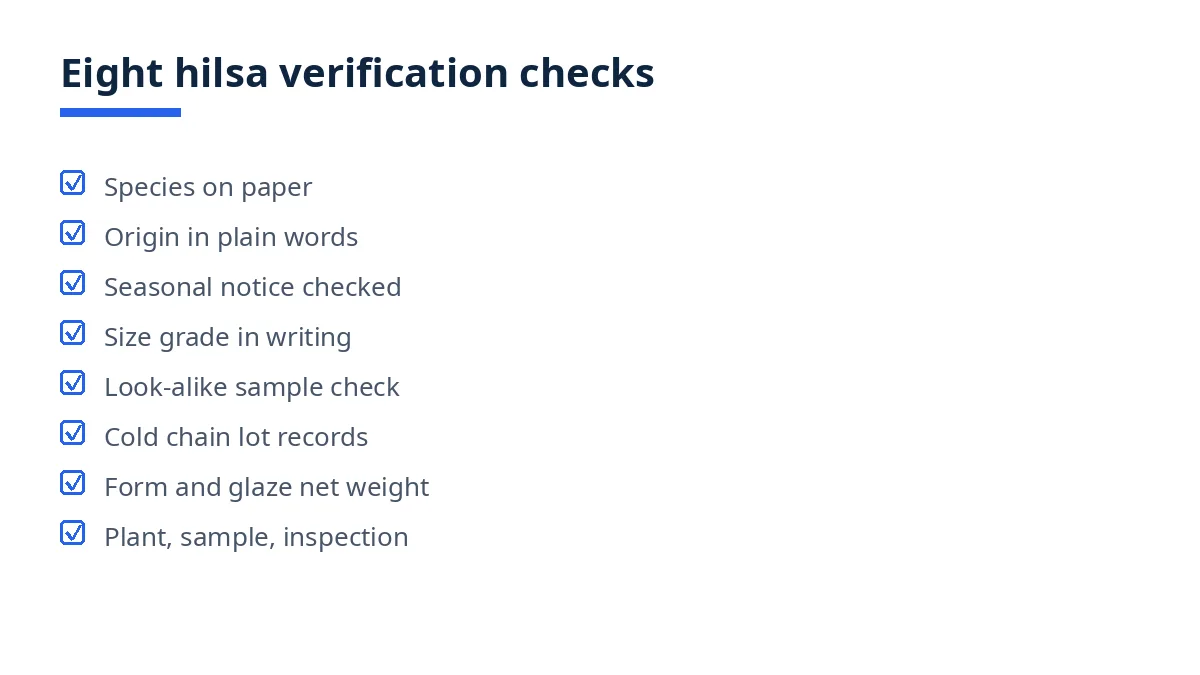
Hilsa fish sourcing in Bangladesh, checked the buyer way: eight verification checks covering species, origin, seasonal notices, grade, look-alike species, cold chain, form and glaze, and plant documents, with no company ranking.
Short answer
To find hilsa fish manufacturers in Bangladesh, run eight verification checks instead of trusting a ranking: confirm Tenualosa ilisha on documents, test the origin claim, check the current seasonal notice, define size grade, inspect a whole-fish sample for look-alike species, require lot cold-chain records at minus 18 degrees Celsius or colder, price form and glaze on net weight, and agree the plant, documents, sample, and inspection before payment.

On this page
Finding a hilsa fish supplier in Bangladesh is less about collecting names and more about testing one supplier against eight checks. Hilsa, known locally as ilish, is the fish sold as Tenualosa ilisha, and Bangladesh registered it as a geographical indication (GI) product in 2017.1 That GI status describes origin and reputation, but it does not, on its own, prove that a particular seller, plant, or shipment meets your specification. A GI sign identifies a product as originating in a given place with qualities due to that origin, and it does not give automatic legal protection beyond the country boundary.2 This article therefore gives no ranking and names no factory. It gives a verification sequence a buyer can run before paying, with the documents to request at each step.
Key takeaways
Put the species name, form, grade, glaze, packing, and delivery timing in writing before you compare prices. A quotation that leaves any of those out cannot be compared with another quotation.
Check the current seasonal restriction notice before you agree a shipment date. During a conservation window, catching, transport, storage, marketing, sale, and exchange of hilsa can all be prohibited, so timing is a compliance question, not only a logistics question.3
Confirm species identity and size grade separately. Hilsa shad is Tenualosa ilisha, a migratory fish found in marine, estuarine, and river waters, and related shads can resemble it closely enough to cause confusion.4 5
Require a cold-chain record from landing to packing, with frozen product held at minus 18 degrees Celsius or colder, as set out in the Codex standard for quick frozen finfish.6
Ask for the destination-market documents by name, and check who issued them. For frozen fish exports from Bangladesh, the Fish Inspection and Quality Control wing of the Department of Fisheries verifies HACCP compliance and issues certificates.7
Use Exportain to shortlist and to compare quotations, and read what each badge actually records before you treat it as proof of quality.8 9
The list
The eight checks below are written as a sequence. Each check states what to ask for, why it matters for hilsa in particular, and what to do when the answer is vague or missing. Work through them in order, and keep the supplier's written answers with the quotation so the sample and the inspection can be judged against the same specification.
1. Species name on every document
What to check: the scientific name Tenualosa ilisha on the quotation, proforma invoice, packing list, and label draft, alongside the common name hilsa or ilish. Why it matters: a generic fish name leaves room for a related shad to be supplied under the hilsa name, and a later dispute then turns on what was actually written. How to fix a gap: if a document says only "hilsa fish" or "shad", ask for the scientific name to be added in writing before you approve a sample. Do not accept a verbal assurance as a substitute for the corrected document.
2. Origin claim, stated in plain words
What to check: the exact origin wording the supplier will use, the landing area or river system it refers to, and the evidence behind it. Why it matters: GI status belongs to the product and its place of origin, not to one firm, so a supplier that displays a GI reference has not thereby proved its own shipment. How to fix a gap: ask the supplier to state, in one sentence, what origin evidence it holds for this lot, and to remove any GI wording it cannot support for that lot. ### 3. Current seasonal notice, checked before the shipment date
What to check: the government notice in force for your order period, and how the supplier's proposed catch, packing, and dispatch dates sit against it. Why it matters: Bangladesh runs mother-hilsa conservation measures, and during a restriction window the ban can cover not only catching but also transport, storage, marketing, purchase, sale, and exchange.3 A delivery date agreed without that check can become undeliverable even when the fish exists. How to fix a gap: ask the supplier to confirm, in writing and dated, which notice it checked, and what happens to the order if a restriction window covers the proposed dispatch date. If the supplier cannot name the notice, pause the order and check the notice yourself before you pay a deposit.
4. Size and grade, defined by weight and count
What to check: a grade table that states weight per fish or count per kilogram, the tolerance for fish outside the band, and how mixed sizes will be handled. Why it matters: hilsa prices move with size, and an undefined grade lets a supplier fill an order with smaller fish while still calling the shipment hilsa. A word such as large, medium, or premium is not a grade. How to fix a gap: write your own grade bands into the specification, require the sample to match the band you ordered, and state in the order that fish outside the tolerance are a defect, not a variation. Photograph the sample beside a scale reference and keep the photograph with the grade table.
5. Look-alike check, done on the sample
What to check: the whole-fish appearance of the sample, including body shape, spots or markings, and fin and scale features, compared with the Tenualosa ilisha description for the lot. Hilsa shad has a deep, laterally compressed body, and related species in the same family share enough features to confuse a quick visual check.4 Published discussion of hilsa nomenclature notes that closely related shads resemble each other, which is why a name alone is a weak control.5 Why it matters: substitution, when it happens, is most often a species problem, not a freshness problem, and it is hardest to prove after the fish has been cut, glazed, and packed. How to fix a gap: inspect whole fish before cutting where the form allows it, keep a retained sample photograph, and agree in advance what independent identification route applies if you dispute the species. State that route in the order rather than discovering it after delivery.
6. Cold chain, recorded lot by lot
What to check: icing at landing, time from landing to freezing, freezing method, storage temperature records, and transport temperature records for the lot. Why it matters: hilsa quality falls quickly when the cold chain breaks, and a single temperature reading at loading does not show what happened earlier. The Codex standard for quick frozen finfish requires the product temperature to reach minus 18 degrees Celsius or colder at the thermal centre after thermal stabilisation, and requires the product to be kept deep frozen during transport, storage, and distribution.6 How to fix a gap: require temperature records by lot, not by shipment average, and require the supplier to state what happens if a record shows a break. A supplier that can show only a warehouse thermometer reading has not shown a lot cold chain.
7. Form and glaze, priced on net fish weight
What to check: the exact form, such as whole, eviscerated, or cut, whether the head is on or off, and the glaze percentage, with net weight stated exclusive of glaze. Why it matters: form and glaze change the usable fish in the carton more than the headline price suggests. The Codex standard for quick frozen finfish covers uneviscerated and eviscerated presentations, so the form must be described on the label in a way that does not mislead the buyer.6 How to fix a gap: compare quotations on net fish weight only. Example figures: a carton quoted as 1,000 kilograms at 20 percent glaze contains 800 kilograms of fish, so a lower headline price on glazed weight can be the higher price on net weight. Require the glaze percentage and the net weight on the quotation, the packing list, and the carton label, and check all three against each other.
8. Plant, documents, sample, and inspection, agreed before payment
What to check: the name of the plant that will process your order, the destination-market documents that plant holds, a production sample judged against your written specification, and a pre-shipment inspection plan with a sampling basis agreed in writing. Why it matters: a trading name is not a plant, and a general food-safety document is not proof of eligibility for your market. For frozen fish exports, the Fish Inspection and Quality Control wing verifies HACCP compliance and issues certificates, so the certificate, the plant, and the market must line up.7 How to fix a gap: if the supplier will not name the plant, will not share the relevant certificate, or will not agree an inspection before shipment, treat that as a failed check and do not move the discussion to price. Price negotiation belongs after the plant, documents, sample, and inspection are agreed.
Capacity, minimum order quantity, and price drivers follow from the same specification. Capacity is a question about the named plant in your order window, not about the sector as a whole, so ask for the plant's available freezing and storage slots for your dates. Minimum order quantity is set by the plant's batch and packing run for your form and grade, so ask for the minimum batch per form rather than a single general figure. Price drivers for hilsa are season and availability, size grade, form, glaze, packing, cold-chain handling, freight, and payment terms, and each driver should be visible as a separate line in the quotation. When a quotation hides those lines inside one lump sum, ask for the breakdown before you compare it with another offer.
Summary table
Check | Document to request | Red flag |
|---|---|---|
Species name | Quotation, invoice, packing list, and label draft naming Tenualosa ilisha | A document that says only hilsa, shad, or fish |
Origin claim | One-sentence origin statement with evidence for this lot | A GI reference with no lot evidence behind it |
Seasonal notice | Dated written confirmation of the notice checked for the order period | A dispatch date agreed without any notice check |
Size and grade | Grade table with weight or count bands and tolerance | Grade described only as large, medium, or premium |
Look-alike check | Whole-fish sample record and an agreed identification route | A cut and glazed sample offered as the only species evidence |
Cold chain | Lot temperature records from landing to loading | A single loading temperature with no earlier records |
Form and glaze | Form, head and gutting state, glaze percentage, and net weight | A price quoted only on glazed weight |
Plant and inspection | Named plant, destination-market certificate, sample approval, and inspection plan | A trading name with no plant, certificate, or inspection agreed |
How Exportain helps
Exportain lists Bangladeshi suppliers and lets buyers compare profiles and quotations in one place, and its buying guidance sets out the steps from finding a supplier to agreeing terms.8 Supplier profiles carry badges that record document and photo checks reviewed by the Exportain team, and the seller-verification page explains what each badge covers.9 Those badges are a screening aid, not a factory inspection and not a quality guarantee, so a badge does not replace the eight checks above. Use the profile to shortlist, use the verification page to understand what was actually checked, and then run the plant, document, sample, and inspection checks directly with the supplier. Put the outcome of each check in the order itself, because the order, not the profile, is the document a later dispute will turn on.
FAQs
What is the biggest mistake?
The biggest mistake is ordering on price and the word hilsa alone, without species, grade, form, glaze, packing, and timing in writing. That mistake leaves the supplier free to fill the order with a different species, a smaller grade, a heavier glaze, or a dispatch date inside a restriction window, while still claiming to have supplied hilsa. Each of those outcomes is avoidable when the specification is written first and the sample is judged against it.
How can I avoid it?
Run the eight checks in order, keep the supplier's written answers with the quotation, approve a production sample against the same specification, and agree a pre-shipment inspection before you pay the balance. Check the seasonal notice for your dates, compare prices on net fish weight, and require lot temperature records rather than a single loading reading. If any check fails, pause the price discussion until that check is closed, because a lower price on an unchecked specification is not a saving.
Who is responsible?
The supplier is responsible for supplying the species, grade, form, glaze, and documents stated in the order, from the plant named in the order. The buyer is responsible for writing a specification that can be checked, for confirming the destination-market rules that apply to the shipment, and for agreeing the sample and inspection terms before payment. Exportain is not a party to the goods contract, and its badges do not inspect goods, book freight, or clear customs, so the buyer and supplier must settle those responsibilities in their own order.
Where can I get help?
Start with the supplier profile and the verification page, then use a written request for quotation that states species, form, grade, glaze, packing, destination market, and timing, so replies can be compared line by line. For market rules, check the destination-market authority and the certificate issuer for your shipment, and for the certificate itself, confirm that the plant, the product, and the market match. If a supplier cannot answer a check in writing, that silence is itself useful information, and the safer move is to shortlist another supplier rather than to pay first and investigate later.
Next steps on Exportain
Browse Bangladeshi suppliers and open each profile to read its badges and listed capabilities before you shortlist. Read how supplier verification works on Exportain so you know what each badge records and what it leaves unchecked. Then post a free RFQ that states species, form, grade, glaze, packing, destination market, and timing, and compare the replies against the eight checks in this article.
Sources
- Nutritional profiling and sensory evaluation of hilsa Tenualosa ilisha eggs roe from three different locations of Bangladesh. Scientific Reports (accessed )
- GI protection: Branding is all. The Financial Express (accessed )
- 22-day ban on hilsa fishing begins 8 Oct. The Business Standard (accessed )
- Hilsa shad, Tenualosa ilisha (Hamilton, 1822). BdFISH (accessed )
- Nomenclature of Bangladesh National Fish Hilsa. BdFISH (accessed )
- Standard for Quick Frozen Finfish, Uneviscerated and Eviscerated (CXS 36-1981). Codex Alimentarius Commission (accessed )
- Meeting global standards in hygienic exports. The Financial Express (accessed )
- How to source and buy from Bangladesh. Exportain (accessed )
- Supplier verification: Earn trust badges buyers can see. Exportain (accessed )
About the author
Sourcing from Bangladesh?
Post a request for quotation and suppliers on Exportain can send you their quotes directly.
Post an RFQ