Hilsa Fish Exporters in Bangladesh: Verified Supplier Checklist
A scored pre-order gate for hilsa fish exporters in Bangladesh: identity and ERC checks, species and size-grade evidence, look-alike substitution controls, seasonal-notice and cold-chain checks, plus a printable summary table.
Short answer
Use this checklist to score a hilsa fish exporter in Bangladesh before ordering: confirm its Export Registration Certificate and handling plant, require Tenualosa ilisha by name with size grade bands, check the current seasonal notice and the 25-centimetre juvenile-fish floor, review cold-chain logs, and reconcile species, grade, quantity and lot code across every document. Score each item Pass, Conditional or Fail, and order in bulk only after every condition closes.
On this page
If you buy hilsa from Bangladesh, the riskiest moment is not the shipment inspection. It is the week before you place the order, when you decide which exporter to trust. This checklist turns that decision into a scored gate: each item needs a document or record, and the supplier passes, passes with conditions, or fails before money moves.
Use it for a first order with a new hilsa exporter, for a new size grade or form from an existing supplier, and again when a supplier changes plant, cold store or sourcing area.
Why this checklist matters
Hilsa carries identity risks that a generic supplier form misses. The fish is registered as a geographical indication product of Bangladesh, with the certificate handed to the Department of Fisheries in 2017.1 Writing only "hilsa" on an order does not specify the product. This checklist forces species, form and grade into writing first.
Substitution is the second risk. Other shad can pass a casual glance, and a size mix can hide small fish in a large-fish lot. The United States Food and Drug Administration lists "Shad" and "Hilsa" as acceptable market names for Tenualosa ilisha.2 A Bangladeshi profile describes a deep, compressed body, 30 to 33 belly scutes, and a blackish blotch behind the gill opening.3
Season is the third risk. Bangladesh protects hilsa through seasonal controls, including a 22-day breeding-season ban under which transport, storage, marketing, buying, selling and exchange are also banned during the period.4 A supplier unable to explain its stock's lawful status should not pass. Confirm the current notice in writing each order.
Before you start
Do not score until four references are on file: specification, order terms, import conditions, and a named gate owner each side. For the European Union, products from outside the EU must satisfy at least EU requirements, demonstrated by the listing of authorised countries and establishments, and be accompanied by certificates.5
Agree and share the scoring rules in advance. Pass: every critical item evidenced. Conditional: trial quantity only, gaps owned and dated before bulk. Fail: a critical item missing, contradicted or refused.
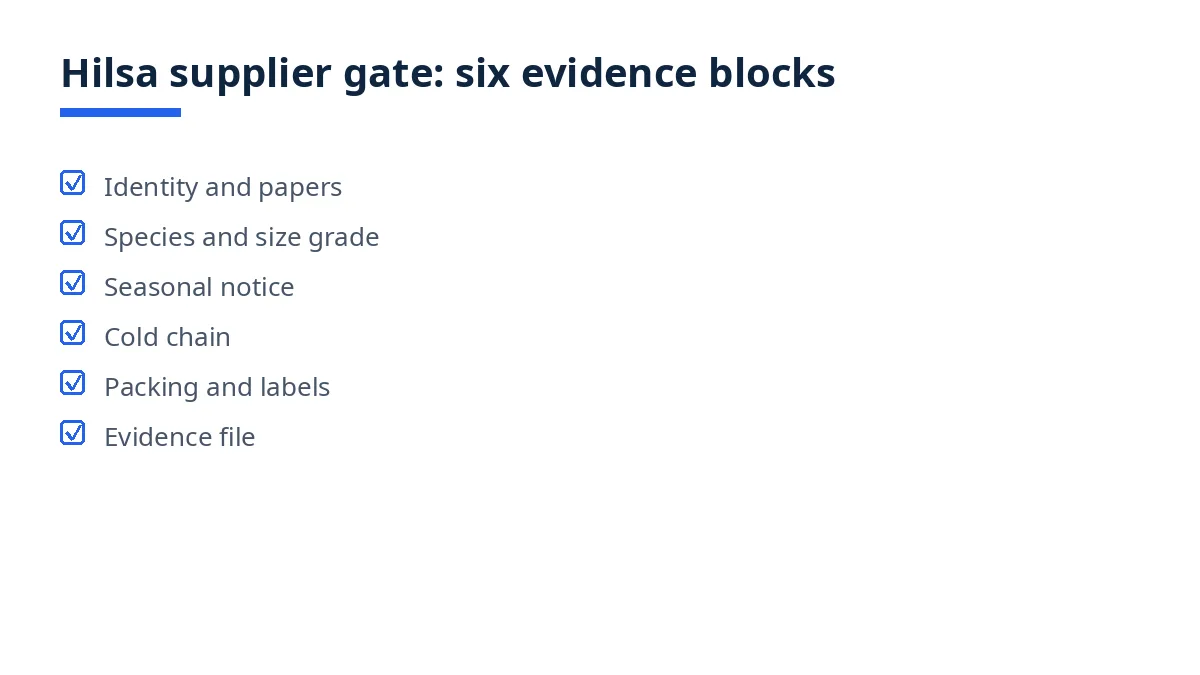
The full checklist (numbered, printable)
File the evidence behind each number. Where a supplier answers in words only, mark it "unevidenced".
A. Identity and legal standing
Confirm name, address and contacts match across trade licence, Export Registration Certificate (ERC) and bank details. The ERC is the base exporter registration from the Chief Controller of Imports and Exports.6
Confirm the ERC is current and covers exporting; record its number, expiry, and authorised dealer bank.6
Record whether the supplier is exporter, processor, trader or a combination, what it outsources, and the handling plant address.
B. Species and GI authenticity evidence
Require Tenualosa ilisha on the specification, quotation, packing list and invoice.2
Ask how the supplier distinguishes Tenualosa ilisha from other shad.
Write rejection and replacement terms for a mixed lot into the order.
Do not accept a GI claim alone. Hilsa's GI registration identifies it as a fish of Bangladesh origin.1 Origin still needs lot evidence.
C. Size grade verification
Agree size grade bands before pricing, defined by weight or length.
Require a count method, a recent grade record, and a pre-shipment sheet.
Agree the outcome for fish below the band: rejection, re-grade or removal, and who pays.
D. Look-alike substitution check
Ask the supplier to name look-alike species handled in the same plant, and how it separates them.
Require a lot code on the packing list linking to a receiving record.
Agree which test settles an identity dispute, who pays, and what happens to the lot meanwhile. Refusal to explain control is a critical fail.
E. Seasonal-notice check
Ask the supplier to confirm in writing, for your order dates, whether any restriction applies, citing the notice.
Check that answer against the current notice yourself or via your broker. The 22-day ban covers transport, storage and sale as well as catching.4
Build the juvenile-fish rule into your specification as a floor: catching, transporting, marketing, buying, selling and storing hilsa under 25 centimetres (jatka) are prohibited.7
Never accept verbal assurance that a ban does not apply to exports. Require the written basis before paying a deposit.
F. Capacity, MOQ and price drivers
Ask for current capacity for your form and grade, and the biggest single lot.
Ask for the minimum order quantity (MOQ) per grade and form, and the price effect of ordering between grades.
Ask for a price-driver breakdown, lead time by stage, and two recent comparable lots. No comparable lot means conditional at most.
G. Cold-chain records
Ask for the cold-chain path for your lot: receiving, freezing, cold-store and transport, each with a record.
For frozen product, check the temperature standard used. The Codex code states frozen products should be kept at minus 18 degrees Celsius or below.8
Ask for temperature logs on a comparable lot, how the chain is held during loading and delays, and what monitoring travels with your lot.8
H. Packing, labels and documents
Agree the pack specification: inner pack, outer carton, count or weight per carton, glaze, and markings.
Check the label draft against your market's naming rules before printing. The FDA point in item 4 suits the United States.2
Ask for the travelling set: invoice, packing list, certificate of origin, health or veterinary certificate, and listing evidence. For the EU, fishery products must meet rules on handling, freshness, wrapping, packaging, storage and transport.5
Confirm who issues the certificate of origin: the Export Promotion Bureau or the relevant chamber.6 Check every document names the same species, grade, quantity and lot code.
I. Trial order and evidence file
Start with a trial order sized to test the gate, with the same specification and rejection terms as bulk.
Build the evidence file as you go, indexed by item number, and score the trial item by item. Passing on quality but failing on documents is not a pass.
Set the bulk rule in advance: Pass proceeds, Conditional only after conditions close, Fail is not re-scored on the same evidence. Keep the file for the order's life.
Common failures and how to fix them
A quotation saying only "hilsa" leaves no standard to enforce. Fix it with the scientific name, form and grade bands on the specification and invoice.2 If a supplier resists naming the species, score item 4 as a fail.
A supplier quotes a large grade, then packs a wide mix with small fish at the bottom. Fix it with a written count method, a pre-shipment grade sheet, and an agreed outcome below the band (items 8 to 10).
A supplier offers fresh fish during a restriction period, or cannot explain how stored stock complies with the ban on transport, storage and sale.4 Fix it by requiring the written notice before any deposit.
A supplier states temperature was maintained, with no dates, logger data or excursion notes. Fix it with item 23: ask for the actual logs, and make a travelling logger a trial condition.8
The invoice says one grade, the packing list another, the label a third. Fix it with item 27 before release: one person checks species, grade, quantity and lot code, and any mismatch holds the shipment.
Downloadable template / summary table
Copy this table and score each block Pass, Conditional or Fail.
Block | File | Pass | Fail |
|---|---|---|---|
Identity | Licence, ERC, bank, plant | Names agree | Expired ERC |
Species and GI | Specification, check record, origin evidence | Tenualosa ilisha named | "Hilsa" only, no lot evidence |
Size grade | Bands, count method, lot sheet | Bands defined, sheet matches | Brochure grades, no sheet |
Substitution | Lot codes, separation, receiving records | Lot code traces | No lot code, no separation |
Seasonal notice | Written notice confirmation | Notice cited, checked | Verbal assurance only |
Capacity and MOQ | Capacity statement, MOQ, price breakdown | Comparable lots support claim | Claimed, no lot |
Cold chain | Temperature logs, transport record, logger plan | Logs dated, no gaps | Summary only, no data |
Packing and documents | Label draft, invoice, packing list, certificates | Species, grade, quantity, lot code agree | Documents disagree |
Trial and evidence file | Indexed evidence file, scored checklist | Conditions closed before bulk | Bulk ordered, conditions open |
Example figures: three suppliers might score Pass, Conditional, and Fail.
How Exportain helps
Exportain is a marketplace where buyers find Bangladeshi suppliers, post requests for quotation, receive quotations and message suppliers. Its seller verification is a document and photo review, not a factory inspection, and membership alone never grants a trust badge.9 A badge is one piece of identity evidence in block A, not a substitute for the rest of this checklist.
Start from the supplier's company page and listings, then run this checklist against evidence provided directly. Post a request for quotation containing your specification, grade bands, seasonal-notice question and evidence-file requirement. Score the supplier before agreeing bulk quantity.
FAQs
When should this checklist be used?
Use it before a first order with a new hilsa exporter, before a new size grade or form, and again when the supplier changes plant, cold store or sourcing area. Use it before money moves.
Who should complete it?
The buyer, or the buyer's sourcing agent acting on the buyer's written instructions, should complete it. The supplier provides evidence, but should not score its own gate. The buyer owns the decision.
What are the most common failures?
The most common failures are a loosely named species, grades drifting between quotation and packing, seasonal stock without a lawful basis, cold-chain summaries with no logs, and documents disagreeing. Each is a block in the table, with a fix above.
Can a third party do it?
A third party can collect evidence, check documents and inspect a lot, but cannot make the supplier's claims true. Use one to strengthen the evidence file, keeping the buyer as decision maker. Confirm in writing what it will check, what evidence it will leave, and who pays.
Next steps on Exportain
Browse suppliers to shortlist hilsa exporters, then read how supplier verification works on Exportain to use badges correctly in block A. When your specification is ready, post a request for quotation through RFQs containing your species, grade bands, seasonal-notice question and evidence-file requirement, and score each reply against this checklist before agreeing a quantity.
Sources
- Hilsa gets GI registration officially. New Age, (accessed )
- The Seafood List: Tenualosa ilisha. U.S. Food and Drug Administration (accessed )
- Hilsa shad, Tenualosa ilisha (Hamilton, 1822). BdFISH (accessed )
- 22-day nationwide fishing ban from Oct 8 to protect Hilsa breeding. The Daily Star, (accessed )
- Regulation (EC) No 853/2004 laying down specific hygiene rules for food of animal origin. European Union (accessed )
- Import/Export Licensing in Bangladesh: the licensing stack, ERC, BIN, AD banks, EXP/OEMS and certificates of origin. Tahmidur Rahman Remura Wahid (TRW Law Firm) (accessed )
- Govt to provide more financial support to fishermen to boost hilsa production. Bangladesh Sangbad Sangstha, (accessed )
- Code of Practice for Fish and Fishery Products (CXC 52-2003). FAO and WHO, Codex Alimentarius (accessed )
- Supplier verification: Earn trust badges buyers can see. Exportain (accessed )
About the author
Sourcing from Bangladesh?
Post a request for quotation and suppliers on Exportain can send you their quotes directly.
Post an RFQ