How to Find Higg Index Certified Factories in Bangladesh
The Higg Index is a self-assessment suite, not a certification. This guide explains FEM and FSLM, self-assessment versus verification, Level 1 section scores, and the checks that keep a facility record honest for Bangladesh orders.
Short answer
The Higg Index is a suite of self-assessment tools from Cascale, not a certification. To find a facility record in Bangladesh, ask for the exact facility, the FEM or FSLM module, the tool version and year, and whether the record is self-assessed only or verified by a Cascale-approved verifier. For FEM 2024, rely on verified Level 1 section scores, never a total score presented as verified.
On this page
Key takeaways
The Higg Index is a suite of self-assessment tools from Cascale, not a certification: a Higg score is self-reported until a Cascale-approved verifier has checked it, and verification is a separate, optional step.
Ask for the facility modules, not a generic claim: the exact facility, Higg FEM or Higg FSLM, tool version, assessment year, and verification status, with documents for the same facility and period.
For Higg FEM 2024, total scores are partially verified and must not be communicated publicly: rely on Level 1 section scores supported by third-party on-site verification and a posted verified module.
A Higg score belongs to one facility only, never to a product, and comparisons are sound only within the same tool version and facility type, with a named supplier's permission for brand communication.
Exportain supplier verification is a document and photo review, not a factory inspection, and a badge does not replace a Higg record, just as a Higg record does not replace a badge.
Start with the distinction that decides everything else in this guide. The Higg Index is not a certification, and a Higg score is not a certificate. The Higg Index is a suite of self-assessment tools owned and developed by Cascale, formerly the Sustainable Apparel Coalition, and available only on Worldly.1 The words in the title are the words buyers commonly search for. They do not turn a self-assessment into a certification claim, and this guide never uses them that way.
For a factory in Bangladesh, the two facility tools matter most. The Facility Environmental Module, known as Higg FEM, measures environmental performance at one facility. The Facility Social and Labor Module, known as Higg FSLM, measures social and labor performance at one facility. The other three tools serve different questions: the Brand and Retail Module covers brand and retail operations, the Materials Sustainability Index covers materials, and the Product Module covers a product across its life cycle.1
Higg Index tool | What it assesses |
|---|---|
Higg FEM | Environmental performance of one facility |
Higg FSLM | Social and labor performance of one facility |
Higg BRM | Brand and retail operations |
Higg MSI | Materials |
Higg PM | One product across its life cycle |
Self-assessment and verification are separate steps. A facility completes its own answers first, producing a self-reported assessment. Verification is a later step in which a Cascale-approved verifier checks the accuracy of those answers.2 Verification is not mandatory: a facility may stop at the self-assessment, and it may still publish and share that assessment with customers.3 A shared self-assessment is still a self-assessment, and a buyer should record it as such.
The current FEM verification position needs care. Cascale states that performance scores from Higg FEM 2024 are partially verified and that total scores are not permitted to be communicated publicly.1 What may be communicated, after third-party on-site verification and posting of the verified module, is Level 1 section scores, and users who have completed Level 1 verification are encouraged to share their verification certificate.1 A verified score in this cadence is called a partially verified score, calculated from the verified Level 1 questions plus the unverified score of the remaining applicable questions.3
Scores also have a scope limit. A Higg FEM score may only be communicated for the specific facility in question, never as a product sustainability indicator for a garment made in that facility.1 Comparisons are only sound within the same parameters and version of the tool, and only across directly comparable facility types.1 Where a brand wants to communicate a named supplier facility's performance, it needs that facility's explicit permission.1
Higg FEM covers seven categories: Environmental Management System, Energy and GHG, Water, Wastewater, Air Emissions, Waste, and Chemical Management.4 3 Each category has three levels: Level 1 covers awareness of sources and systems, Level 2 covers baselines, targets, and tracking, and Level 3 covers leading practices.4 Worldly states that completing the FEM takes about four to six weeks, depending on the quality and accessibility of data.4 Higg FSLM works on the same self-assessment logic for the social side. It is built on the Social and Labor Convergence Program's Converged Assessment Framework, known as CAF, and it uses a universal scoring system.5 It helps facilities document and share data covering working hours, wages, health and safety, and worker rights with multiple brand customers from a single platform.5
Why this matters for buyers and sellers
For a buyer, a Higg record is useful only when tied to one facility, one module, one tool version, and one stated status. A supplier group may run several facilities, and a FEM record for one site says nothing about a sister site that cuts, sews, washes, or finishes the order. Ask which facility will make the order, which processes happen there, and which happen elsewhere, and get the answer in writing.
For a seller, the same precision protects the sale. A facility that can state its module, tool version, assessment year, verification status, and Level 1 section position gives a buyer something checkable. A vague claim to hold a Higg certificate gives a buyer nothing to check. State the exact position instead: the module completed, the year, whether verification was completed, and which scores may be shared.
A Higg record also does not replace other evidence. A FEM record does not prove fibre content, recycled content, chemical compliance for a specific product, product quality, or export capability. Keep each evidence type in its own file.
Step-by-step: how it works
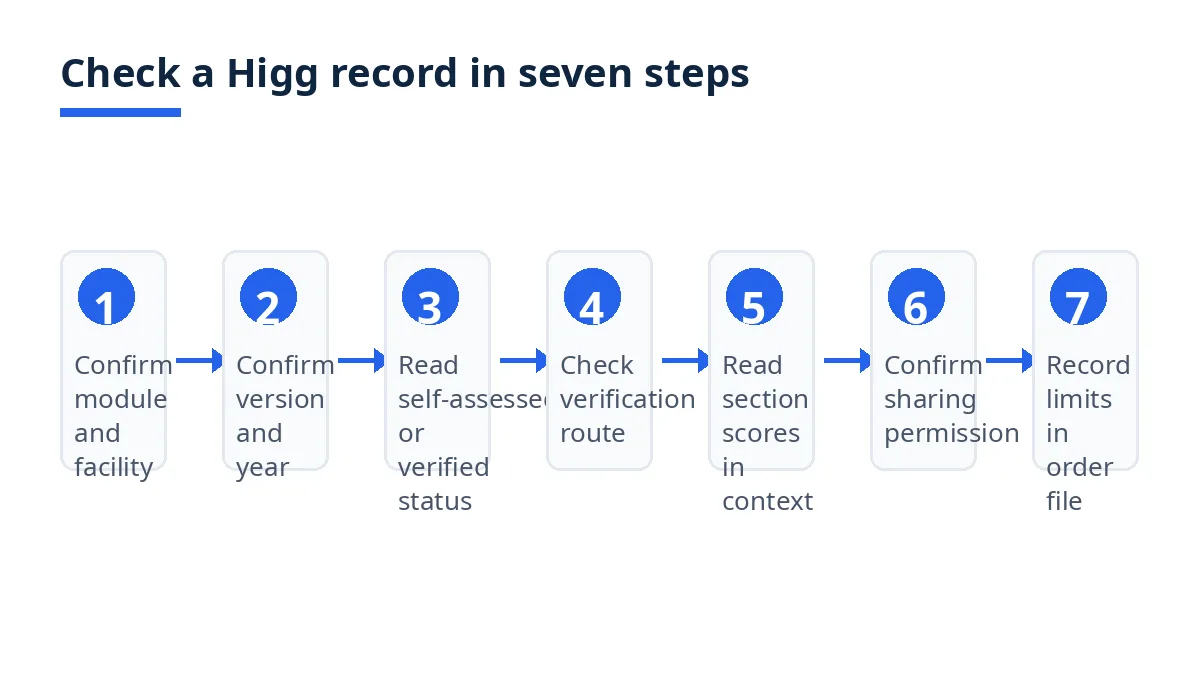
Confirm the module and the facility. Ask whether the record is Higg FEM, Higg FSLM, or both, and confirm the exact facility name and address that will make the order. A record for a different facility, a head office, or a subcontracted unit does not cover the production facility.
Confirm the tool version and assessment year. Ask for the version and the reporting year, because scores cannot be compared across different versions as if they were the same measure.1
Read the status: self-assessed or verified. Ask whether the facility stopped at self-assessment or completed verification, and if verified, which level and sections were verified. An unverified record is not a failed record, but it must be labelled as unverified.3
Check the verification route. Verification is carried out by a Cascale-approved verifier, as a third-party or second-party check.2 On-site verification involves a facility visit, while off-site verification is remote; public communication of scores needs on-site verification, and an off-site route should only be accepted where the buyer's own partners confirm it is acceptable.2 Ask for the verifier body name and certificate where one was issued.1 3
Read section scores in context. For FEM 2024 and FEM 2025, ask for Level 1 section scores where verification supports them, and do not accept a total score as a verified public claim.1
Confirm sharing permission. A facility may share its own assessment, but a brand communicating a named supplier's facility performance needs that facility's permission.1 Record who may share what.
Record the limits in the order file. Write down the facility, module, version, year, verification status, and section scores relied on.
The diagram below summarises that check.
A completion certificate differs from a verification certificate, so ask which document you are being shown. Facilities that post by 31 December receive a completion certificate, while inclusion in industry benchmarking requires posting by 30 April of that year.3
Costs, timelines and documents
This guide states no Higg fee figure, because none of the opened sources used here states a current fee schedule. Cascale's guidance refers to a verification access fee, but no source opened here gives an amount.3 Confirm the module fee, any verification access fee, and the verifier body's own fee in writing with Cascale, Worldly, or the chosen verifier body before budgeting.
Timelines have three parts. The assessment itself takes about four to six weeks where data quality and accessibility are good.4 Verification adds its own scheduling, site visit where applicable, and review time, which the verifier body confirms for the specific facility. Sharing and benchmarking depend on posting dates, with the April benchmarking cut-off and the December posting date noted above.3
Request documents that match the module. For FEM, Worldly's toolkit lists utility bills, meter and monitoring logs, discharge permits, lab test results such as BOD, COD, pH, and TSS, equipment and maintenance records, training records, and photographs of labelled waste bins, storage areas, and utility systems.4 For chemicals, add the inventory and safety data sheets. For FSLM, ask for the records behind the answers on wages, working hours, health and safety, and worker treatment, covering the same facility and period as the assessment.5
Bangladesh-specific rules and tips
There is no separate Bangladesh Higg rulebook. Higg FEM and Higg FSLM are global tools applied through Cascale and Worldly, and the checks in Bangladesh are about facility identity, process scope, and record quality, not a local variant.1
First, confirm the production facility and the subcontracted steps. Many Bangladeshi exporters work across more than one site, and washing, dyeing, printing, embroidery, or finishing may happen away from the main sewing site. A FEM record for the main site does not cover a subcontracted wet-processing unit, and a FSLM record for one site does not cover workers at another. Ask for a process-by-process site list.
Second, watch the sections where record gaps are most likely: water, wastewater, and chemical management for wet processes, and energy records where meters, fuel records, and production data sit with different teams. Worldly's toolkit spreads these records across several teams, so one person entering answers cannot complete a sound assessment alone.4
Third, treat the shared-assessment gain as a negotiation point. FSLM is designed so one assessment can be shared with several customers.5 That only saves the facility time when buyers accept the shared record. State in the order file whether the shared FSLM record is accepted as the social evidence for that order.
Fourth, keep local permits and Higg answers together. Wastewater answers should sit beside the discharge permit and lab results for the same period, and chemical answers beside the inventory and safety data sheets for the same facility.4
Mistakes and red flags
Calling a self-assessment a certification. The Higg Index is a suite of self-assessment tools.1 A completed assessment is not a certification, and a score is not a certificate.
Quoting a FEM 2024 total score as a verified public claim. Total scores from Higg FEM 2024 are partially verified and are not permitted to be communicated publicly.1 Ask for Level 1 section scores supported by verification.3
Accepting a score without a module, version, facility, and year. A number with none of those attached cannot be checked, compared, or relied on. Every score in your file needs all four.
Comparing scores across versions, facility types, or years as if they were equal. Comparisons are only sound within the same parameters and version of the tool and across directly comparable facility types.1
Attaching a facility score to a product. A Higg FEM score may only be communicated for the specific facility, never as a product sustainability indicator.1
Accepting evidence for a different facility. A record for a sister site, a head office, or a subcontractor does not cover the facility making the order.
Accepting an off-site check where public communication needs an on-site visit. Public communication needs the on-site route; an off-site check needs partner confirmation first.2
Treating a verified Level 1 result as a full verification. Verification is optional, and the current FEM verification scope is targeted at foundational Level 1 material.3
Sharing a named supplier's performance without permission. A brand communicating a supplier facility's performance needs that facility's explicit permission.1
Checklist
Before you rely on a Higg record, answer every line in writing.
Exact facility: facility name, address, and production unit that will make the order.
Module and version: Higg FEM, Higg FSLM, or both, with tool version and assessment year.
Status: self-assessed only, or verified, with the verification level and sections stated.
Verifier: Cascale-approved verifier body name, verification route, on-site or off-site, and certificate type shown.
Scores relied on: Level 1 section scores where verification supports them.
Scope limits recorded: facility only, never a product claim, with comparisons kept within the same version and facility type.
Process map: each production step matched to a named site, with subcontracted steps given their own record position.
Documents on file: utility and meter records, discharge permit and lab results, chemical inventory and safety data sheets, and wage and hours records for the same facility and period.
Sharing permission: who may share the record, and the facility's permission where a brand will communicate its performance.
Fee and timeline position: all fees confirmed in writing, with assessment, verification, and posting dates separated.
How Exportain helps
Exportain supplier verification is a document and photo review, not a factory inspection, and not a check against any government database.6 A badge is not a guarantee of production capacity, product quality, or delivery.6 Verification is free, staff review every submission, and membership plans never grant a badge.7 An Exportain badge does not replace a Higg record, and a Higg record does not replace a badge.
Post a free RFQ and state the Higg position you need: the exact facility, the module, the tool version and year, the verification status and level, the Level 1 section scores you will rely on, and the documents for the same facility and period. Ask each reply to attach the verification certificate where one was issued, rather than a brochure or a screenshot of a single score. Read Seller Verification and Trust Center. The certification services category currently states "No services published in this category yet", so treat it as a category reference only, not as a listing of Higg verifier bodies.8
FAQs
What should I know first about Higg Index?
Know first that the Higg Index is a suite of self-assessment tools owned and developed by Cascale, formerly the Sustainable Apparel Coalition, and available only on Worldly.1 It is not a certification. A facility completes its own FEM or FSLM assessment, and verification by a Cascale-approved verifier is a separate, optional step.2
What are the typical costs and timelines?
No fee figure is stated here, because none of the sources opened for this guide states a current Higg fee schedule. Confirm the module fee, any verification access fee, and the verifier body's fee in writing before budgeting.3 Completing the FEM takes about four to six weeks where data quality and accessibility are good, and verification and posting add their own time.4
Which documents are needed?
You need the module record for the exact facility, the verification certificate where verification was completed, and the records behind the answers for the same facility and period.1 3 For FEM, that means utility bills, meter logs, discharge permits, lab results, equipment records, training records, and chemical inventory and safety data sheets.4 For FSLM, it means the wage, working hours, health and safety, and worker treatment records behind the assessment.5
What are the most common mistakes?
The most common mistakes are calling a self-assessment a certification, quoting a FEM 2024 total score as a verified public claim, accepting a score without a module, version, facility, and year, comparing scores across different versions or facility types, attaching a facility score to a product, accepting evidence for a different facility, accepting an off-site check where public communication needs an on-site visit, and sharing a named supplier's performance without permission.1 3 2
Next steps on Exportain
Post a free RFQ at Post a free RFQ and state the facility, module, version, verification status, and section scores you need. Read Seller Verification and Trust Center before you shortlist.
Sources
- Higg Index Communication Guidelines V.21. Cascale (accessed )
- Higg FEM verification. TÜV SÜD (accessed )
- Higg FEM FAQ. Worldly (accessed )
- Worldly Facility Environmental Toolkit. Worldly (accessed )
- Higg FSLM: Social and Labor Assessment. Worldly (accessed )
- Trust & Safety Center. Exportain (accessed )
- Supplier verification: Earn trust badges buyers can see. Exportain (accessed )
- Compliance & Certification Bodies in Bangladesh. Exportain (accessed )
About the author
Sourcing from Bangladesh?
Post a request for quotation and suppliers on Exportain can send you their quotes directly.
Post an RFQ