How to Find HACCP Certified Factories in Bangladesh
How to find HACCP factories in Bangladesh: read the plan scope, control points and dates, check the assessing body, and verify before ordering.
Short answer
Finding a HACCP factory in Bangladesh means checking a food-safety management system, not a product certificate: ask for the plan for the exact product and site, read its scope, critical control points, limits and dates, and confirm the claim with the assessing body. A logo alone proves nothing, and a plan for one site or product does not cover another.
On this page
Key takeaways
HACCP is a food-safety management system, not a product certification and not a guarantee that any single shipment is safe.
Read the plan for the exact product and site: hazards, critical control points, critical limits, monitoring, corrective actions, scope and dates.
Verification means checking the plan scope and certification-body accreditation and expiry, never a logo alone.
ISO 22000 is related but distinct: a broader food safety management system that includes HACCP principles, while HACCP focuses on hazard control at critical control points.
Finding a factory in Bangladesh that can work to a HACCP plan starts with one test: can the factory show, in writing, how it controls the hazards in its own process, and can that claim be checked with the body that assessed it. HACCP stands for Hazard Analysis and Critical Control Points. The United States Food and Drug Administration describes it as a management system in which food safety is addressed through the analysis and control of biological, chemical, and physical hazards, from raw material production through manufacturing, distribution, and consumption of the finished product.1
HACCP is a food-safety management system, not a product certification, and it is not a guarantee that any single shipment is safe. A certificate or a plan describes a system for controlling hazards in a defined process. It does not certify a product, a brand, or a consignment, and a logo on a website does not replace the system behind it. ISO 22000 is related but distinct: it is a broader food safety management system that includes HACCP principles, while HACCP itself focuses on hazard control at critical control points.2
The system rests on seven principles. Under Regulation (EC) No 852/2004, food business operators must put in place, implement, and maintain a permanent procedure based on the HACCP principles: identifying hazards that must be prevented, eliminated, or reduced to acceptable levels; identifying the critical control points at the steps where control is essential; establishing critical limits at those points; establishing and implementing effective monitoring procedures; establishing corrective actions when monitoring shows a point is not under control; establishing procedures to verify regularly that the measures are working effectively; and establishing documents and records that demonstrate effective application.3 A supplier that cannot explain its hazards, its control points, and its monitoring in plain terms has not yet shown a working system.
Why this matters for buyers and sellers
For a buyer, the value of HACCP is prevention. End-product testing can only sample what has already been made, and a passed sample does not show how the next batch was handled. A HACCP plan names the hazards reasonably likely to occur for a specific product and process, names the steps where those hazards can be prevented, eliminated, or reduced to an acceptable level, and sets measurable limits and monitoring for those steps. Reading a plan therefore tells a buyer where food safety could fail and what the factory does to stop that failure.
For a seller, the same discipline protects the order. A factory that can show a current plan, monitoring records, corrective actions, and verification activity gives a buyer something checkable, and gives its own team a written routine to follow when a shift changes or a raw material lot changes. When monitoring shows a deviation at a control point, the corrective action is already defined, and the affected product can be held and assessed instead of shipped on hope.
Keep HACCP separate from other claims: it is not a quality grade, a social audit, or an environmental system, and a plan for one product or site says nothing by itself about another.
Step-by-step: how it works
Start with the product, not with a search for a certificate. Write down the exact product, its form, its intended use, and the process steps from receiving raw material to packing and storage. A plan for raw frozen shrimp differs from one for cooked frozen shrimp, because hazards and control points differ.
Next, ask for the documents in full, not as summaries: the HACCP plan with flow diagram, hazard analysis, control points, limits, monitoring, corrective actions, verification, and running records, plus the certificate or report behind any third-party claim, with legal name, site, scope, and expiry date.
Then read the scope line by line. Check that product, process, and site match the order, and whether the scope covers receiving, processing, packing, and storage, including subcontracted cold storage or transport. A scope naming a different product, site, or narrower process is not evidence for that order, even if the company name matches.
After scope, check the dates and the version. A plan should be current for the process as it runs now, and any change in product, process, or step should trigger a review, a point the European regulation states directly: when any modification is made in the product, process, or any step, food business operators shall review the procedure and make the necessary changes.3 Ask when the plan was last reviewed and whether monitoring records run up to a recent date.
Then check the body behind the claim. Note the name of the certification or assessment body, confirm that it is accredited for the scope it assessed where accreditation applies, confirm the claim directly with that body where a confirmation route exists, and keep the confirmation in writing. The United States approach to imported seafood shows why this matters: where no equivalence arrangement exists, importers must hold records demonstrating that foreign firms' products were processed in accordance with United States HACCP requirements, and such records may include a copy of the foreign firm's HACCP plan.4
Finally, file the evidence and set a re-check date before the first shipment and before any repeat order after a process change.
The route below summarises the verification sequence used in this guide.
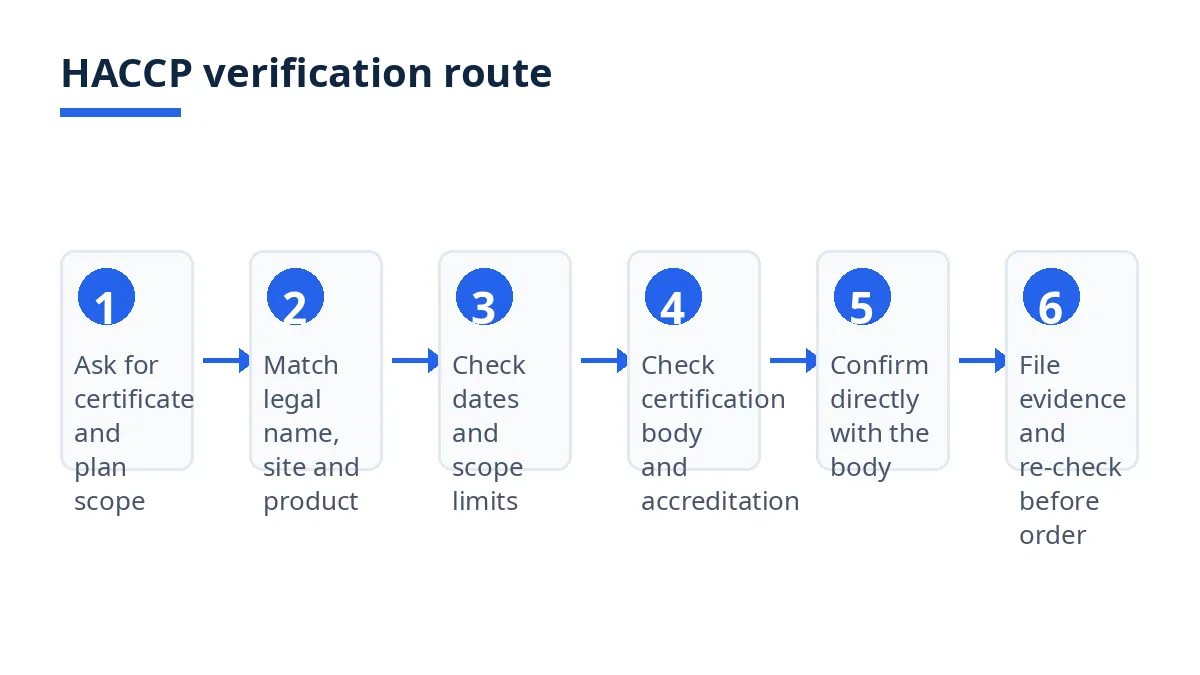
Treat each step as a gate: a mismatch, a scope gap, stale dates, or an unconfirmable body means the claim is unverified until that step passes, in writing.
Costs, timelines and documents
No reliable public figure can be quoted here for what HACCP assessment costs a Bangladeshi factory or how long it takes, because both depend on the size of the operation, the number of products and lines, the starting state of prerequisite programmes such as hygiene, pest control, and maintenance, and the body chosen. Ask the certification or assessment body for a written quotation and timeline based on the actual scope, and ask the factory for its own implementation timeline based on its current gaps.
Budget, as items rather than figures, for gap assessment, training, plan development, facility or equipment changes for prerequisite programmes, internal audit, assessment, and surveillance. Factories often underestimate internal time: running monitoring, keeping records, and acting on deviations takes time every week.
Timelines follow the same logic: a factory with strong hygiene practices moves faster than one that must first fix basic conditions and build records. Ask what stage it is at now, with evidence, and request the plan, recent records, the certificate or report with scope and expiry, accreditation details where applicable, and the deviation procedure.
Bangladesh-specific rules and tips
Bangladesh has a particular reason for buyers to take HACCP seriously in seafood, and that reason is historical. In July 1997, the European Union imposed a ban on imports of frozen shrimp and fish from Bangladesh after bacterial contamination was detected in exported shrimp, and advised the Bangladesh government to implement a HACCP system in shrimp industries for hygienically safe production of frozen food. The government promulgated Fish and Fish Products (Inspection and Quality Control) Rules in December 1997 to implement the programme, and the ban was lifted in 1998 after European experts inspected the arrangements made by Bangladesh.5 That history does not prove anything about a single factory today.
The domestic framework is separate from any buyer or destination-market requirement. The Bangladesh Food Safety Authority was established on 2 February 2015 under the Food Safety Act 2013, which repealed the earlier Pure Food Ordinance of 1959, with a mandate to coordinate food safety activities across ministries and agencies.6 That authority coordinates the domestic system; it does not, by itself, certify a factory's HACCP plan for export, and a buyer should not treat a domestic registration or licence as a substitute for reading the plan and its assessment evidence. Where a destination market has its own rules, confirm those rules with the importer and the relevant authority for that market, and record the answer for the specific product.
In practice, ask seafood suppliers to walk through their process from receiving and chilling through processing, freezing, packing, and cold storage, pointing to the control points. Watch cold-chain continuity: a plan covering processing but leaving storage or transport unclear has a gap where temperature control is most easily lost. Ask how raw material lots are traced, so a problem in one lot can be separated from others. Treat terms such as HACCP approved, HACCP certified, and HACCP compliant carefully, since marketing uses them loosely: ask what each term means in each case and record the answer with its document. Never accept a group or trading-company claim as a claim for the processing site, because the plan belongs to a process at a site.
Mistakes and red flags
The most common mistake is accepting a logo as evidence. A logo on a website, a brochure, or a product pack does not show the scope, the site, the dates, or the body. Ask for the underlying document every time, and treat a refusal or delay in producing it as information about the claim. A second mistake is matching the company name but not the site or product, since a plan for one site does not cover another, and trading companies may present a processor's documents as their own. Always match legal name, site address, and product to the order.
A third mistake is ignoring dates: an expired certificate, a plan predating a process change, or stale records all weaken the claim. A fourth is confusing a food safety system with other assurances, such as an export registration, an inspection visit, a single laboratory test, or a social or environmental audit. Red flags that should pause an order include a certificate with no scope or expiry date, a scope omitting the ordered product, a plan with no control points or no measurable limits, records showing no deviations over a long period, a refusal to share the plan or report, and an unidentifiable body.
Checklist
Use this checklist before a first order, and again before any repeat order after a change in product, process, or site.
Product, form, and intended use written down and matched to the plan.
Full HACCP plan received, including hazard analysis, flow diagram, and control points.
Critical limits, monitoring, corrective actions, and verification procedures read and understood.
Certificate or assessment report received, with legal name, site, scope, and expiry date checked.
Certification or assessment body identified, with accreditation checked where applicable.
Claim confirmed directly with the body, and the confirmation filed in writing.
Recent monitoring and verification records reviewed, with deviations and corrective actions noted.
Cold-chain steps from receiving to loading covered in the scope, or gaps recorded.
Raw material lot traceability explained for the ordered product.
Expiry and review dates noted, with a re-check set before shipment and before the next order.
Any gap, missing document, or unverified claim recorded in writing, with a decision on whether to proceed.
How Exportain helps
Exportain's own supplier checks are a document and photo review, not a factory inspection, and they do not replace a HACCP check. The Seller Verification page describes verification as a document and photo review in the seller portal, reviewed by Exportain staff, and the Trust Center states plainly that supplier verification is a document review, not a factory inspection and not a check against a government database, and that a badge is not a guarantee of production capacity, product quality, or delivery. Use those checks to confirm identity, business registration, export registration, and facility photos, while HACCP evidence is checked separately through the route in this guide.
For certification services, note the current position carefully: the certification services category page currently states "No services published in this category yet", so it cannot be used today to find a published certification service. In practice, a buyer can use Exportain to describe the product and process clearly, request the checklist documents, and keep the correspondence and evidence together for the order.
FAQs
What should I know first about HACCP?
Know first that HACCP is a preventive food-safety management system built on hazard analysis and control at critical points, not a product test and not a shipment guarantee. The European rules describe procedures based on the HACCP principles in line with the general principles of food hygiene of the Codex Alimentarius, covering hazard identification, critical control points and limits, monitoring, corrective actions, verification, and records.7 Before anything else, ask for the plan for the exact product and site, read its scope and dates, and check the body behind any assessment claim.
What are the typical costs and timelines?
There is no typical figure that fits every factory, so this guide gives items and questions instead of numbers. Costs depend on the size of the operation, the number of products and lines, the starting state of hygiene and prerequisite programmes, and the body chosen, and they include gap assessment, training, plan development, facility or equipment changes, internal audit, assessment, and surveillance. Timelines depend on the same factors and on how much record history must be built before assessment. Ask the body for a written quotation and timeline for the actual scope, and ask the factory for its current stage with evidence.
Which documents are needed?
The core set is the HACCP plan with flow diagram, hazard analysis, control points, limits, monitoring, corrective actions, and verification; recent records; and the certificate or report with legal name, site, scope, and expiry date, plus accreditation details where applicable. United States seafood rules underline the record point: importers without an equivalence arrangement must hold records showing foreign products were processed under United States HACCP requirements, which may include a copy of the foreign firm's HACCP plan.4 File plan, certificate, confirmation, and correspondence together, with expiry and review dates noted.
What are the most common mistakes?
The most common mistakes are accepting a logo as evidence, matching the company name but not the site or product, ignoring expiry and review dates, and confusing a food safety system with a quality grade, an inspection visit, a single laboratory result, or a social or environmental audit. Each has the same root, accepting a summary instead of the underlying document, and the same correction: read the plan, match scope, site, and product, check dates, identify the body, and record any gap in writing.
Next steps on Exportain
Start by describing the product and process precisely, then request the checklist documents and run the verification route before agreeing shipment dates. Post a free RFQ on Exportain with product, form, process, and site requirements stated, so suppliers respond with matching documents rather than general claims. For background, read the Seller Verification page and the Trust Center, keeping in mind those checks are a document and photo review and do not replace the HACCP check here.
Sources
- Guidance & Regulation (Food and Dietary Supplements). U.S. Food and Drug Administration (accessed )
- HACCP and ISO 22000 Difference. ISO Cert International (accessed )
- Regulation (EC) No 852/2004, Article 5: Hazard analysis and critical control points. legislation.gov.uk (accessed )
- Food Safety: FDA's Imported Seafood Safety Program Shows Some Progress, but Further Improvements Are Needed. U.S. Government Accountability Office (accessed )
- Introducing seal of quality for shrimp industries. The Daily Star, (accessed )
- Ensuring Food Safety. IBT Bangladesh (accessed )
- Food safety — from farm to fork. EUR-Lex (accessed )
About the author
Sourcing from Bangladesh?
Post a request for quotation and suppliers on Exportain can send you their quotes directly.
Post an RFQ