Top Frozen Shrimp Manufacturers in Bangladesh: How to Find and Verify Them
Find and verify frozen shrimp processors in Bangladesh: product specification, market listing, HACCP, traceability, cold chain, samples, and documents — without relying on a name ranking.
Short answer
Frozen shrimp processors in Bangladesh should be chosen by specification first, then checked for destination-market listing, a product-specific HACCP plan, lot traceability, cold-chain records, and a lot-tied sample and inspection, with price compared only on the same specification, packing, and delivery term.

On this page
A buyer searching for frozen shrimp processors in Bangladesh does not face a shortage of names. Directories return many companies, and several answer quickly. The hard part is telling a processor that can make your exact product, pass your market's food-safety checks, and ship it cold and documented, from a trader or a plant whose paperwork does not match its production.
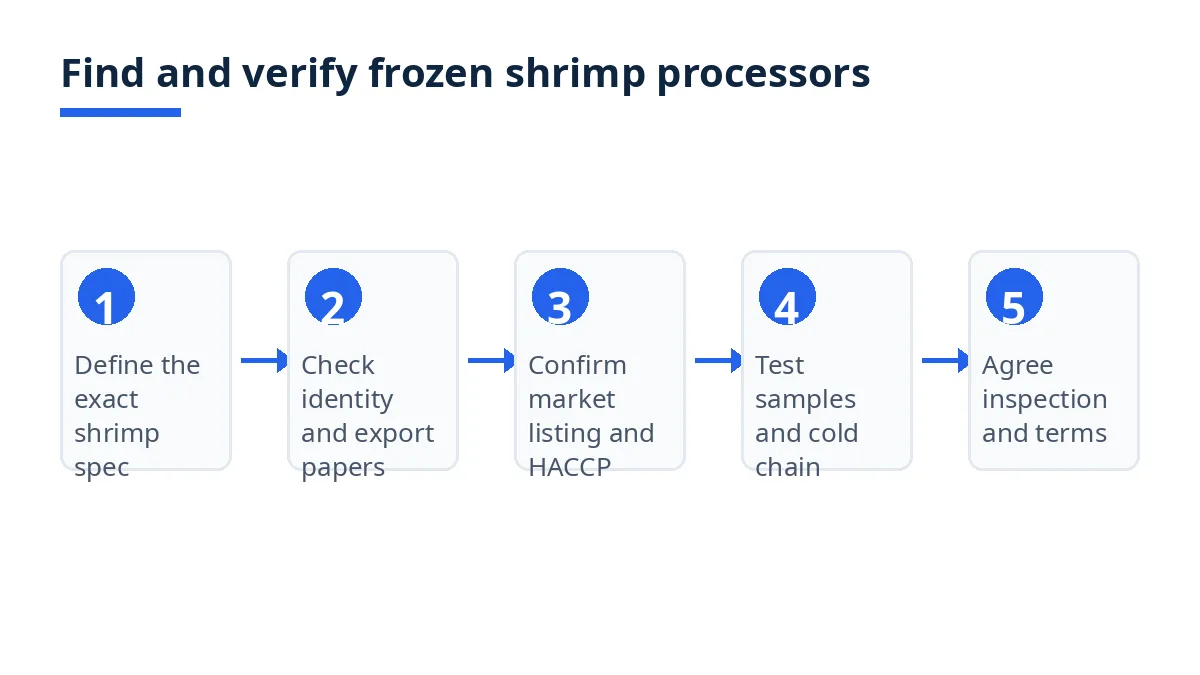
This guide does not rank companies or name a shortlist, because an unchecked ranking would mislead more than it helps. Instead, it gives a find-and-verify method: define the product first, then check identity, market listing, food safety, traceability, cold chain, samples, and documents in that order, and only then compare price and terms.
Frozen shrimp here means shrimp and prawns frozen in shell or not, raw, cooked, or peeled. Frozen shrimps and prawns other than cold-water varieties sit under subheading 030617.1 Other varieties and preparations sit on different lines, so first confirm code, species, and preparation on the quotation match your product.
Key takeaways
Do not start with a company name. Start with a written specification: species, form, size count, glaze, packing, and destination market.
Check the processor for your market, not in general: a plant accepted for one destination is not automatically accepted for another.
Match the legal name across registration, licence, health certificate, and invoice, and check certificate scope and dates.
A sample proves the sample only; a production-lot inspection and a lot lab report connect the sample to the shipment.
Price and minimum order are compared last, on the same specification, packing, and delivery term. Example figures in this guide show structure only and are never market rates.
The list
Work through the eight checks below in order, before you pay or confirm bulk production.
1. Exact product definition
What: A one-page specification naming the species, the form (head-on shell-on, headless shell-on, peeled and deveined, peeled tail-on, cooked, or another form), the size count, the freezing method (block frozen or individually quick frozen), the glaze percentage, the net weight, the inner and master carton packing, and the destination market.
Why: Shrimp is not one product. A quotation for a different species, form, or glaze is not comparable with yours, and a health certificate that describes a different preparation will not match the shipment at the border. Subheading 030617 already separates frozen shrimps and prawns from cold-water varieties and from prepared or preserved shrimp,1 so a vague product name invites a coding and certificate mismatch.
How to fix: Put the specification in writing first; require line-by-line replies; reject a renamed product or a blank glaze or count.
2. Legal identity and export standing
What: Proof that the company you are dealing with is the company that will export, including its registered legal name, its business registration, its Export Registration Certificate (ERC) where applicable, and its fish processing or exporter licence details.
Why: A trading name, a brand name, and a legal name are often different. If the contract name differs from the export-document name, customs and your bank may treat the shipment as coming from a different seller, and a later complaint becomes hard to pursue. In Bangladesh, fish processing plants, suppliers, and exporters operate under a licensing system administered through the Department of Fisheries inspection and quality control framework, with licence forms covering the establishment, its site, and its proprietor.2
How to fix: Compare legal names across registration, quotation, invoice, and packing list; if another company exports, name it in the contract and check its documents too.
3. Market listing for your destination
What: Confirmation that the specific processing establishment is listed or accepted for your destination market, and that the listing covers fishery products of the kind you are buying.
Why: Market access for food of animal origin is destination-specific. For the European Union, only goods of animal origin from countries authorised to export to the EU are admitted, and consignments must be accompanied by official certificates from the exporting country's competent authority, with documentary, identity, and physical checks at designated Border Control Posts.3 A plant that ships to one market may not be listed for yours, and a general claim of export experience does not replace a listing check.
How to fix: Name your destination market first, ask for the listing in writing with establishment details exactly as listed, and check it yourself through your market's official list or broker before ordering. Do not rely on a screenshot alone.
4. HACCP and food-safety system
What: A written Hazard Analysis Critical Control Point (HACCP) plan for the shrimp product and the plant where it is made, covering the hazards reasonably likely to occur for that kind of fishery product, the critical control points, and the monitoring and records for each one.
Why: Food safety for seafood is managed through the process, not by testing the finished carton alone. Under the United States seafood rule, every processor must conduct a hazard analysis for each kind of fishery product it processes, and must have and implement a written HACCP plan whenever that analysis reveals a hazard reasonably likely to occur.4 The plan is specific to each location and product, so a plan written for another product or plant does not cover your order.
How to fix: Ask for the plan summary, review date, responsible person, and missed-limit record for your exact product and plant.
5. Raw-material origin and traceability
What: A traceability chain from the finished carton back to the farm, landing site, or supplier lot: lot numbers, receiving records, processing dates, and the link between the raw-material lot and the finished carton.
Why: Shrimp quality, residue, and origin problems are traced lot by lot. Without lot linkage, a problem in one carton cannot be contained, and a claim about species, farming method, or origin cannot be checked. Traceability also protects you when a customer or border authority asks which raw material went into which shipment.
How to fix: Require lot numbers on the sample, inspection report, and packing list, and ask for one carton traced back to its raw-material lot in writing.
6. Cold chain and freezing method
What: A documented cold chain from receiving through processing, freezing, cold storage, stuffing, and transport, including freezing method, storage temperature, and the temperature record for the shipment.
Why: Frozen shrimp quality is lost silently. A carton that thaws and refreezes can look intact while its texture, glaze, and safety have changed, and a temperature gap during stuffing or transport may not show until arrival. Block-frozen and individually quick frozen shrimp also pack, thaw, and cook differently, so ordering one and receiving the other means a different product even at the same count.
How to fix: State freezing method and temperature in the specification, and ask for cold-store and container temperature records for your shipment, not a general assurance. A processor that cannot produce a record for a past shipment is unlikely to produce one for yours.
7. Samples, lab testing, and inspection
What: A sample made to your written specification, a lab report for the relevant lot where your market or your customer requires one, and an inspection of the production lot before shipment.
Why: A sample proves that a plant can make a good sample under attention. It does not prove that bulk production will match it. Lab reports and inspections close that gap only when they refer to your lot, specification, and packing, not to a general certificate or an earlier shipment. In Bangladesh, fish and seafood export certification covers licences, health certificates, additional certificates as required by the importing country, sample collection, inspection, test reports, and certificate issuance through the Department of Fisheries system.5
How to fix: Approve the sample against the written specification, with count, glaze, form, and packing recorded. Before bulk production, agree who inspects the lot and what a failed check means: rework, reselection, or rejection. Ask for the lab report number, laboratory, and lot it covers. Never accept a certificate whose scope, product, or date does not match your order.
8. Commercial terms, packing, and documents
What: One order file holding the agreed specification, the itemised quotation, the delivery term, the packing and marking, the payment terms, and the full export document set: commercial invoice, packing list, health certificate, certificate of origin where required, and the export declaration documents required by Bangladesh Customs.
Why: Most shrimp disputes are document disputes: a different count, glaze, carton weight, or delivery term from the one the buyer assumed. Comparing quotations on different delivery terms is meaningless, because the term decides who pays for freight and insurance and when risk passes. The Incoterms 2020 rules set out the delivery terms used for this allocation.6
How to fix: Compare quotations on the same specification, packing, and delivery term, with price, freight, and insurance as separate lines. State carton count, net weight, glaze, and marking on the purchase order, and list the export documents required, with the name on each one. Example figures: comparing three processors on one load at the same count, glaze, and packing allows a direct per-carton comparison; comparing different counts, glazes, or terms does not. The example shows structure only, not a price or market figure.
Summary table
Check | What you ask for | What a good answer looks like | Red flag |
|---|---|---|---|
Product definition | Written specification with species, form, count, glaze, packing, market | Line-by-line reply against your specification | Renamed product, blank glaze or count |
Identity and export standing | Legal name, registration, ERC, plant or exporter licence | Same legal name on every document2 | Different names across documents, missing licence |
Market listing | Listing or acceptance for your destination, for fishery products | Establishment details matching the official listing3 | General export claim, no market named |
HACCP system | Product- and plant-specific HACCP plan and records | Named critical control points and monitoring records4 | Plan for another product or plant, no records |
Traceability | Lot linkage from carton to raw-material lot | One carton traced back in writing | Mixed lots without records |
Cold chain | Freezing method, storage and transport temperature records | Temperature record for the shipment | General assurance, no record |
Samples and inspection | Sample to specification, lot lab report, lot inspection | Report and inspection tied to your lot5 | Certificate for another lot or product |
Terms and documents | Same specification, packing, and delivery term for every quote | Itemised quote and listed export documents6 | Different terms, lump-sum price only |
How Exportain helps
On Exportain, browse suppliers and post a request for quotation (RFQ) on the RFQ board with your full specification: species, form, size count, glaze, freezing method, packing, destination market, and delivery term, so replies quote against the same product and terms. Ask each reply for its legal name, market listing for your destination, HACCP summary for your product and plant, and lot traceability method, and compare the answers before discussing price.
Read the badges for what they record. Exportain Verified means Exportain has checked identity, phone, email, and business registration, and Export Verified means it has checked the Export Registration Certificate (ERC).7 Factory Verified means it has reviewed photos of the manufacturer factory, while Trading Company Verified means it has reviewed photos of the trading company office or warehouse.7 Verification on Exportain is a document and photo review, not a factory inspection, so the HACCP, listing, sample, and lot-inspection checks stay with you even with a badge.
When you accept a quotation, Exportain creates one order and issues one proforma invoice from the accepted terms.7 Keep your specification, sample approval, inspection plan, and document list attached to that order, so a later question about count, glaze, or packing can be settled against the agreed file rather than memory.
FAQs
What is the biggest mistake?
The biggest mistake is choosing a processor from a name list or a fast reply, then discovering at the border, laboratory, or customer that the plant is not listed for your market, the HACCP plan covers a different product, or the shipment's count, glaze, or packing differs from your order. A ranking cannot prevent that, because it does not check the plant against your specification and market. This sequence catches those mismatches before bulk production, when they are still cheap to fix.
How can I avoid it?
Write the specification first, then check identity, market listing, HACCP, traceability, cold chain, samples, and documents in order, and compare price only on the same specification, packing, and delivery term.6 Ask for the listing for your destination by name,3 the HACCP summary for your product and plant,4 and a lot-tied sample and inspection.5 Record every approval in writing, and do not let a good sample, a badge, or a low price replace a missing listing, a mismatched name, or an uninspected lot.
Who is responsible?
Responsibility is shared and should be written into the order. The processor makes the product to specification under its HACCP plan, keeps the cold chain, and provides matching documents. The buyer states the specification and market clearly, checks the listing and documents, and agrees the inspection plan before bulk production. For the United States, seafood importers also carry verification duties under the seafood HACCP importer provisions: products in compliance with that rule are treated differently under the broader foreign supplier verification framework, but importer verification for seafood still applies.8 Confirm your duties with your broker or authority before ordering.
Where can I get help?
Start with the official sources for your market: the competent authority listing for your destination, your customs broker, and your food-safety authority. For Bangladesh-side certification, the Department of Fisheries system covers licences, health certificates, inspection, and test reports for fish and seafood exports.5 On Exportain, browse suppliers, post your specification on the RFQ board, and compare replies against the checks in this guide before committing to a processor.
Next steps on Exportain
Browse suppliers, then post your full shrimp specification on the RFQ board so processors quote against the same species, form, count, glaze, packing, and delivery term. Before you confirm, read how supplier verification works on Exportain for what each badge records and what still needs your own check.
Sources
- Classification Detail — HS Code 030617. United Nations Statistics Division (accessed )
- Fisheries Inspection and Quality Control Rules 1997. Department of Fisheries, Bangladesh (accessed )
- Import controls of food and feed Q&As. European Commission (accessed )
- 21 CFR 123.6 — Hazard analysis and Hazard Analysis Critical Control Point (HACCP) plan. FindLaw (accessed )
- Bangladesh rolls out online certification system to simplify fish and seafood trade. International Collective in Support of Fishworkers (ICSF) (accessed )
- Incoterms® 2020. International Chamber of Commerce (ICC) (accessed )
- Sell Bangladeshi Products to Global Buyers | Exportain. Exportain (accessed )
- FSMA Final Rule on Foreign Supplier Verification Programs (FSVP) for Importers of Food for Humans and Animals. U.S. Food and Drug Administration (accessed )
About the author
Sourcing from Bangladesh?
Post a request for quotation and suppliers on Exportain can send you their quotes directly.
Post an RFQ