Frozen Fish Price in Bangladesh: FOB Cost Breakdown for Buyers
Frozen fish FOB prices in Bangladesh explained: species, cut, glaze, freezing and cold chain inside a quote, and how buyers compare quotes fairly.
Short answer
A frozen-fish FOB price bundles species, cut, glaze, freezing, packing and port handling into one figure, so two quotes can describe different fish at different weights. Fix species, form, size grade, glaze percentage and weight basis first, compare quotes only on the same specification, and check the cold chain and destination certificates before confirming an order.
On this page
Key takeaways
A frozen-fish FOB price is a bundle of species, cut, size grade, freezing method, glaze, packing, cold storage, inland transport, port handling and export documents, not a single comparable number.
Glaze is ice, not fish: state the glaze percentage and whether the price is per net kilogram excluding glaze or per gross kilogram, and restate every competing quote onto the same weight basis before comparing.
Whole fish, gutted fish, fillets and steaks have different yields and labour, so a fillet price per kilogram will sit above a whole-fish price for the same catch, and the two are not comparable.
Confirm the weight basis on every document, the listed establishment and destination certificate for your market, the HACCP scope for your species and form, and the cold chain and rejection rule in writing before confirming an order.
A frozen-fish FOB price is not one number. It bundles decisions about the fish, how it was cut, how it was frozen, how much ice glaze protects it, how it was packed, and how it reached the port. Two quotes that look close can describe different fish, different weights, and different factory work. This guide is for buyers in the USA, the UK, the EU and the UAE who need to read a Bangladeshi frozen-fish quote line by line.
Fix the product first and the price second. Species, form, size grade, glaze level, freezing method, pack weight and the named port all change what a kilogram means. Until those lines are fixed, a price difference is only a guess.
Why this matters for buyers and sellers
For a buyer, the risk is paying for weight that is not fish, or for a cut that does not suit the end use. A whole fish, a gutted fish, a fillet and a steak yield different saleable weight and need different labour and packaging, so a quote that does not state the form invites a false comparison.
For a seller, the risk runs the other way: a buyer who compares only the headline price per kilogram may push toward a thinner glaze, a lighter pack or a lower grade, then find the delivered product does not match the intended use. A clear specification turns a price argument into a product discussion.
Glaze is where this matters most. Glaze is the thin ice coating applied to frozen fish to protect it from dehydration during storage. The Codex standard for quick frozen fish fillets sets out how net weight of a glazed product is determined, by removing the glaze and weighing the product itself.1 Food and Agriculture Organization guidance states the same principle: information on the glaze applied should be kept and used in determining net weight, which is exclusive of the glaze.2 A buyer who does not know whether a price is per kilogram of fish, per kilogram including glaze, or per carton cannot compare two quotes at all.
Step-by-step: how it works
Work through a quote in this order, fixing one variable at each step.
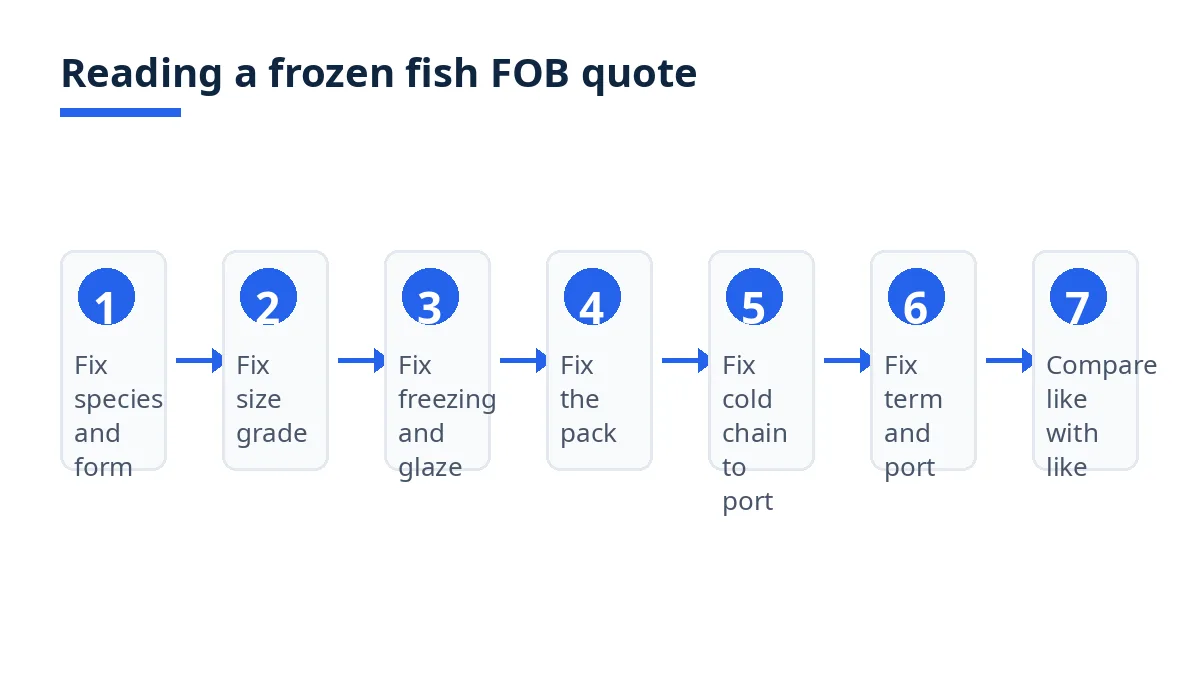
Fix the species and form. State whether the fish is whole, gutted, headed and gutted, filleted, or cut into steaks, and whether skin, bones and belly are included.
Fix the size grade and count. State the size range, for example fish per kilogram or fillet weight range, and how mixed sizes are handled.
Fix the freezing method and glaze. State whether the fish is block frozen or individually quick frozen, the glaze percentage, and whether the price is per net kilogram excluding glaze or per gross kilogram including glaze.1 2
Fix the pack. State the carton weight, the inner bag or liner, the pieces or blocks per carton, and the carton labelling, including species, form, size grade and net weight.
Fix the cold chain to the port. State the storage temperature, how cartons move from factory cold store to the port, and who checks carton condition and temperature at loading.
Fix the delivery term and named port. State the Incoterms rule and the named port in full, for example FOB Chittagong, rather than a bare term. The Incoterms 2020 rules provide 11 rules with a clear allocation of cost, risk and obligations.3
Compare only like with like. Rewrite every competing quote onto the same specification sheet before comparing prices.
Costs, timelines and documents
What sits inside a frozen-fish FOB price
An FOB price for frozen fish is built from work done before the goods are loaded at the named port: raw fish, cutting and preparation labour, freezing, glazing, packing materials, cold storage, inland transport, port handling and loading, and export documentation. Food-safety work sits inside the factory cost. In the USA, processors of fish and fishery products must conduct a hazard analysis and, where hazards are reasonably likely to occur, hold and implement a written HACCP plan specific to each location and each kind of fish and fishery product.4
Species and cut move the price more than any other line. Whole fish needs the least preparation, gutted and headed fish needs more labour and loses weight, and fillets need the most labour and lose the most weight, so a fillet price per kilogram will sit above a whole-fish price per kilogram for the same catch. That gap is yield, not margin.
Freezing method moves the price next. Block freezing packs fish into a solid block for bulk buyers who thaw a whole block, while individually quick freezing freezes pieces separately for buyers who need pieces one at a time, at more handling and packing cost.
Glaze moves the effective price in a way that is easy to miss. Consider a carton stated as 10 kilograms gross with a 10 percent glaze. Example figures: the carton holds 9 kilograms of fish and 1 kilogram of ice glaze, so a price quoted per gross kilogram charges for 1 kilogram of ice in every carton, while the same fish quoted per net kilogram excluding glaze charges only for the 9 kilograms of fish.
Example figures: how the FOB build-up reads
The figures below show structure only. They are not market rates, and no line should be used as a price expectation.
Example figures, in index units per kilogram of finished product: raw fish 52, cutting and preparation 18, freezing and glazing 9, packing materials 7, cold storage, inland transport, port handling and export documents 14, giving an index total of 100. Ask for the breakdown, and ask which lines change if the form, size grade or glaze changes.
Cold chain costs deserve their own question. Frozen fish must stay frozen from factory to port, and a break in that chain affects quality even when cartons look unchanged on arrival. Ask how temperature is recorded, what happens if it moves out of range, and who bears the cost of rejected cartons, and put the answers in the order.
Timelines and documents
There is no single frozen-fish timeline to rely on, because production depends on raw material availability, the cut, the freezing method and the order size. Ask for separate dates for raw material confirmation, production, freezing and packing, cold storage, inspection and loading, and ask what changes each date if raw material is delayed.
The export document set follows the customs clearance procedure for export. Goods may not be loaded unless an export declaration, the Bill of Export or Shipping Bill, is submitted to Customs and approved, with enclosed documents including the export contract or purchase order where there is no export letter of credit, the commercial invoice, the packing list, the EXP form certified by an authorized dealer, and a certificate of origin issued by the EPB or a Chamber of Commerce and Industry.5 For frozen fish, a quality control certificate by the Department of Fisheries is necessary as per the requirements of the country of destination.5 Confirm which destination-market certificates your shipment needs before production, not at the port.
Heading 0303 covers fish, frozen, excluding fish fillets and other fish meat of heading 0304.6 Fillets therefore sit on a different line from whole frozen fish, so the code on the invoice and packing list must follow the form actually shipped, and the same form, code and description should appear on the invoice, packing list and certificate of origin.
Bangladesh-specific rules and tips
State the weight basis on every document. Put net weight excluding glaze, gross weight, glaze percentage, carton count and total net weight on the quotation, proforma invoice, packing list and commercial invoice. If one document uses a different basis, customs and the buyer will read different quantities for the same cartons.
Match the certificate to the destination. EU rules for products of animal origin from third countries require that the third country of dispatch appears on a list of third countries from which imports of that product are permitted, and that the establishment of dispatch appears on a list of permitted establishments where applicable.7 Ask which establishment will process your order and whether it is listed for your market, and confirm it before production.
Match the HACCP scope to your product. A HACCP plan written for one kind of fish does not automatically cover another, because the plan must be specific to each location and each kind of product processed, with grouping allowed only where hazards, critical control points, critical limits and procedures are identical.4 If your order changes species or form, ask whether the plan covers the new product.
Check parasite rules for your end use. In the EU, fishery products intended to be consumed raw, or treated in a way insufficient to kill viable parasites, must undergo a freezing treatment to kill viable parasites that may be a risk to health.7 If your fish is for raw consumption, settle the treatment and its documentation before ordering.
Use the port name, not only the country. A quote that says FOB Bangladesh leaves the loading port open, and inland transport and port handling differ by port. Name the port and the container loading point so the FOB price has one clear endpoint.3
Mistakes and red flags
Comparing a whole-fish price with a fillet price. Compare quotes only after restating each one to the same species, form, size grade, glaze and pack.
Accepting a price without a weight basis. A quote that does not state net weight excluding glaze, glaze percentage and carton weight cannot be compared with any other quote.
Treating glaze as free protection. Glaze protects frozen fish, but glaze is ice, not fish. State the maximum glaze you will accept, and check it on samples by the Codex method of removing the glaze and weighing the product itself.1
Approving a sample on appearance only. Thaw a sample, weigh it with and without glaze, check the cut and size grade, and process it as your customer will. A sample that looks right frozen and yields less fish after thawing was not approved on the right basis.
Leaving the cold chain to chance. A quote that says nothing about storage temperature, transport records or rejection of warmed cartons leaves the most fragile part of a frozen-fish order unpriced. Ask for the temperature record and the rejection rule in writing.
Red flags in a supplier reply. A reply that will not state the glaze percentage, the weight basis, the freezing method, the size grade, the processing establishment or the destination-market certificate is a reply to pause on, as is a reply that quotes one price for every form.
Checklist
Every line should be answered before you confirm an order.
Species, form and cut fixed, with skin, bones and belly stated.
Size grade fixed, with the size range and the handling of mixed sizes stated.
Freezing method fixed: block frozen or individually quick frozen, with the reason tied to your end use.
Glaze percentage fixed, with the price stated per net kilogram excluding glaze or per gross kilogram, and the maximum glaze stated.1 2
Pack fixed: carton weight, inner packing, pieces or blocks per carton, and carton labelling.
Cold chain fixed: storage and transport temperature, temperature records, and the rule for warmed or damaged cartons.
Delivery term fixed: Incoterms rule and named port in full, with the loading point stated.3
Documents fixed: Bill of Export, invoice, packing list, EXP form, certificate of origin, and the Department of Fisheries certificate where the destination requires it.5
Destination rules fixed: listed third country and establishment for the EU where applicable, and the freezing treatment document for raw-consumption product.7
HACCP scope fixed: the plan covers your species and form at the processing establishment.4
Code fixed: heading 0303 for whole frozen fish or heading 0304 for fillets, matching the form shipped.6
Sample approved on thawed weight, cut, size grade and end use, not on frozen appearance alone.
How Exportain helps
On Exportain, browse suppliers and post a request for quotation on the RFQ board with your specification sheet: species, form, size grade, freezing method, glaze percentage, weight basis, pack and named port. Suppliers then quote against the same product.
Read badges for what they record. Exportain Verified means Exportain has checked identity, phone, email and business registration, and Export Verified means it has checked the Export Registration Certificate (ERC).8 Factory Verified means it has reviewed photos of the manufacturer factory, while Trading Company Verified means it has reviewed photos of the trading company office or warehouse.8 Verification is a document and photo review by staff, not a factory inspection, and a badge is not a guarantee of capacity, quality or delivery.8 Your protection is the specification sheet, the sample approval on thawed weight, and the inspection and payment terms agreed in writing.
FAQs
What should I know first about frozen fish?
Start with the product, not the price. Species, form, size grade, freezing method, glaze percentage and weight basis together decide what a kilogram means, and a price per gross kilogram including glaze is not comparable with a price per net kilogram excluding glaze.1 2 Fix those lines first, then compare prices.
What are the typical costs and timelines?
There are no typical figures to rely on, because each supplier prices your species, form, size grade, glaze, pack and delivery term for your order. The FOB build-up covers raw fish, cutting and preparation, freezing and glazing, packing, cold storage, inland transport, port handling and export documents, with food-safety work inside the factory cost.4 Ask for timelines as separate dates for raw material confirmation, production, packing, inspection and loading.
Which documents are needed?
The export set is the Bill of Export, the commercial invoice, the packing list, the EXP form certified by an authorized dealer, and a certificate of origin issued by the EPB or a Chamber of Commerce and Industry, with a Department of Fisheries quality control certificate where the destination requires it.5 Keep species, form, code, net weight excluding glaze and carton count identical across the invoice, packing list and certificate, and confirm the heading with your customs broker: heading 0303 covers frozen fish excluding fillets, while fillets fall under heading 0304.6
What are the most common mistakes?
The most common mistakes are comparing a whole-fish price with a fillet price, accepting a quote without a weight basis or glaze percentage, approving a sample on frozen appearance without a thawed-weight check, and leaving the cold chain and destination certificate unsettled until shipment. A further mistake is reading a badge as product protection: verification is a document and photo review, not a factory inspection.8
Next steps on Exportain
Browse suppliers, then post your species, form, size grade, glaze and weight basis on the RFQ board so suppliers quote the same product. Before you confirm, read how supplier verification works on Exportain and the MOQ guide for badge meanings and minimum-order mechanics.
Sources
- Standard for Quick Frozen Fish Fillets (CXS 190-1995). Food and Agriculture Organization of the United Nations (accessed )
- Regulatory Environment — Food Loss and Waste in Fish Value Chains. Food and Agriculture Organization of the United Nations (accessed )
- Incoterms® 2020. International Chamber of Commerce (ICC) (accessed )
- 21 CFR Part 123 — Fish and Fishery Products. United States Food and Drug Administration (accessed )
- Customs Clearance Procedures for Export. Bangladesh Customs, National Board of Revenue (accessed )
- Classification Detail — HS Code 030351. United Nations Statistics Division (accessed )
- Regulation (EC) No 853/2004 laying down specific hygiene rules for food of animal origin. European Union (accessed )
- How Supplier Verification Works on Exportain. Exportain, (accessed )
About the author
Sourcing from Bangladesh?
Post a request for quotation and suppliers on Exportain can send you their quotes directly.
Post an RFQ