

Top Frozen Fish Manufacturers in Bangladesh: How to Find and Verify Them
Frozen fish manufacturers in Bangladesh, checked the buyer way: define the product, name the plant, check documents, market eligibility, and the HACCP plan, then approve samples and inspect before shipment.
Short answer
To find a frozen fish manufacturer in Bangladesh, define species, form, grade, glaze, packaging, and destination market first, then name the plant that will process your order. Check business documents, market eligibility, and the product-specific HACCP plan before discussing price. Approve a sample line by line, inspect before shipment on an agreed sampling basis, and put quantity, price basis, and payment terms in writing.
On this page
Finding a frozen fish manufacturer in Bangladesh is not hard. Finding one whose plant, documents, and cold chain will stand up in your market is the real work. A long supplier list, a polished catalog, and a low first quote tell you almost nothing about whether a shipment will clear inspection, arrive at the right temperature, and match the sample you approved. This guide gives you a checking order instead of a ranking: eight checks, so you can shortlist processors on evidence rather than on claims.
Bangladesh already ships frozen and live fish abroad: in fiscal year 2022-23, exports of frozen and live fish amounted to 422 million dollars, down from 532 million dollars in the previous fiscal year.1 Volumes move and plants change hands, so use the checks below for every candidate, including one you have bought from before.
Key takeaways
Start with the product, not the supplier: species, form, size grade, glaze, packaging, and destination market decide which plants are even eligible.
Separate processors from traders early, and ask which plant will actually process your order.
Check documents, market eligibility, and the HACCP plan before you discuss price in detail.
Judge a sample only against a fixed specification, including glaze, grading, and temperature.
Inspect before shipment, agree the sampling basis in writing, and match payment terms to the risk you still carry.
The list
Work through the eight checks below in order. Each states what the check is, why it matters, and how to fix a gap. A candidate that fails an early check should not reach the later ones.
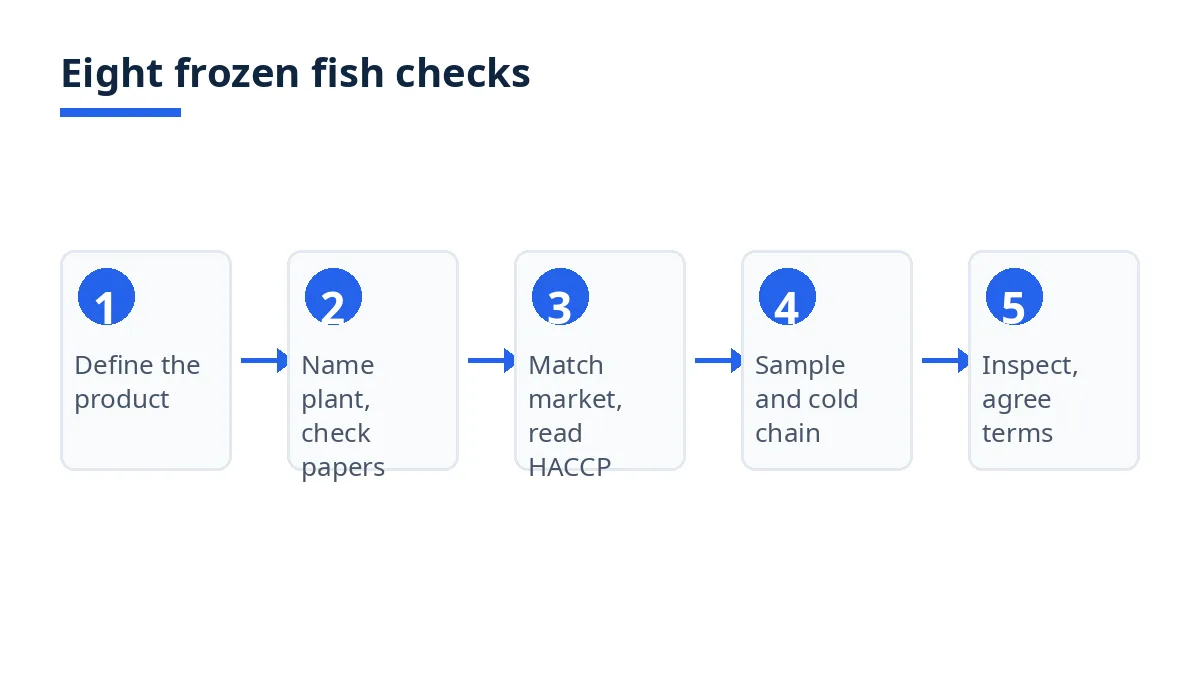
1. Define the exact product before you search
What: Write a one-page specification before you contact anyone: species, whole or fillet form, gutted or ungutted, size grade, glaze percentage, packaging type, carton weight, labeling, and destination market. State whether you need block-frozen or individually quick frozen product, and what you mean by each term in your order.
Why it matters: Frozen fish is not one product. A plant set up for whole block-frozen fish may not run the fillet line you need, and a size grade that suits one market may not suit another. Searching with only the words "frozen fish" collects candidates that cannot make your product.
How to fix it: Send the same specification sheet to every candidate and ask for a line-by-line reply: what they can match, what they cannot, and what they would change. A candidate that answers in general terms, or rewrites your specification without flagging the change, has not yet earned a sample order.
2. Separate a processor from a trader
What: Ask directly whether the company owns or operates the processing plant, and which plant will process your order. Ask for the plant name, location, and approval or registration details that apply to that plant, not only to the selling company.
Why it matters: Many seafood sellers are trading companies buying from several plants. That is not a defect on its own, but it changes the check: with a trader, check both the seller and the plant, and find out whether your order could move between plants.
How to fix it: Ask for the arrangement in writing: the named plant, whether substitution is allowed, and who holds responsibility if the plant changes. On Exportain, facility badges come from reviewed photos of a factory or of a trading company's office or warehouse, and the badge type tells you which one was reviewed.2 Do not assume a facility badge means the seller owns the plant.
3. Check the business documents first
What: Ask for the documents that show the seller is a real, export-ready business: business registration, trade license, and Export Registration Certificate (ERC), with company name and address matching across the quotation, the invoice, and the documents. Ask for the same consistency from the plant where one applies.
Why it matters: Document mismatches are cheap to catch and expensive to fix after shipment. A name that differs between the quotation and the export documents can stall clearance.
How to fix it: Request copies early and compare them yourself, line by line. On Exportain, Export Verified records that staff reviewed a seller's ERC, and Exportain Verified covers identity, phone, email, and business registration.2 Treat any badge as a record of what was reviewed, not as a guarantee of capacity, quality, or delivery.2 If a document is missing or mismatched, pause the commercial discussion until it is resolved.
4. Match the plant to your destination market
What: Confirm that the plant and the product are eligible for your destination before you approve a sample. For the European Union, importation of products of animal origin from third countries is permitted only if the third country appears on the permitted list, the establishment of dispatch appears on the permitted establishments list where applicable, and the product satisfies the hygiene and identification-marking requirements and the certificate and document requirements.3 For the United States, the importer carries the verification duty, which is covered in the next check.
Why it matters: Market eligibility is a gate, not a detail. A plant that serves one destination well may not be listed for yours. Discovering this after production means rework, delay, or a shipment that cannot enter.
How to fix it: Ask the candidate to state, in writing, which markets the named plant currently serves and to show the listing or approval supporting that statement for your market. Then check it yourself against the current official list. Do not accept "we export to Europe" as a substitute for a plant-level answer.
5. Read the HACCP plan, not just the certificate headline
What: Ask for the plant's HACCP plan for your product and process, and read it against your specification: hazards identified, critical control points, monitoring, corrective actions, and records. Ask which sanitation controls sit behind it and how the plant handles temperature control, glazing, and storage.
Why it matters: A certificate headline tells you a system exists; the plan tells you whether it covers your product. In the United States, every importer must either source under an active memorandum of understanding covering the product or have and implement written verification procedures, including product specifications and affirmative steps such as obtaining the processor's HACCP and sanitation records for the lot, obtaining a continuing or lot-by-lot certificate, regularly inspecting the plant, holding an English copy of the HACCP plan with a written guarantee, or periodically testing the product.4 Without that verification, the product may appear adulterated and be denied entry.4
How to fix it: Request the plan in English, since United States importer verification records must be kept in English.4 Check that it names your product form and process, not only a generic seafood process. If the supplier shares only a certificate page, treat that as an open gap.
6. Test the cold chain and the sample properly
What: Judge the sample against the specification you wrote in check one, including glaze, size grading, appearance, odor, packaging, and temperature on arrival. Ask how the plant holds temperature from processing through cold storage to loading, and what records it keeps for each stage.
Why it matters: Frozen fish quality is decided as much by temperature history as by the fish itself. A sample graded loosely, glazed beyond the agreed percentage, or packed in the wrong carton shows the plant's controls differ from your specification. Approving it locks in the wrong standard for bulk.
How to fix it: Approve a sample only in writing, against each specification line, and keep a retained sample or dated photo record where practical. State the temperature condition you will accept on arrival and what happens if it is not met. If the sample fails on glaze or grading, ask for a corrected sample, not a verbal promise that bulk will differ.
7. Inspect before shipment and agree the sampling basis
What: Arrange an independent pre-shipment inspection that checks the finished goods against your order: species and form, size grade, glaze, carton count and weight, labeling, packaging condition, and temperature. Agree the sampling basis in writing before production, so both sides know how many cartons will be opened and what counts as a pass.
Why it matters: Inspection after arrival is too late to fix a full container, and inspection without an agreed sampling basis invites argument about whether the cartons checked were representative. A written basis protects both sides.
How to fix it: Put the inspection clause in the order: who inspects, when, against which specification lines, and what happens on failure, including rework, rejection, or a second inspection. Do not rely on a supplier's own final check when the order is new or large.
8. Put quantity, price basis, and terms in writing
What: Close with a written order that states quantity and unit, price basis, packaging, labeling, inspection, shipment terms, payment terms, and validity. Read the minimum order quantity as the supplier counts it: per order, per style or product, or per colour or size group, because the same number means a different total under each counting method.5
Why it matters: Most frozen fish disputes are not about fish at all. They are about a quantity counted differently, a price basis, or a payment term that left one side carrying all the risk.
How to fix it: Use example figures to test the arithmetic before you sign, labeled as examples, not market rates. Example figures (structure only): if a minimum of 500 cartons is counted per size grade, and you order two size grades, your smallest order is 1,000 cartons. If the same minimum were counted per order, it would be 500 cartons. Confirm the result in writing, and keep the signed quotation as the record both sides work from.
Summary table
Check | What you ask for | If it is missing |
|---|---|---|
Exact product specification | Species, form, grade, glaze, packaging, market | You collect candidates that cannot make your product |
Processor or trader | Named plant for your order | You approve a seller, not the plant that ships |
Business documents | Registration, trade license, ERC, matching names | Clearance and payment problems after shipment |
Market eligibility | Plant listing or approval for your destination | A shipment that cannot enter your market |
HACCP plan | Product-specific plan in English, with records | United States entry risk and unverified controls4 |
Cold chain and sample | Sample judged line by line, temperature on arrival | Bulk locked to the wrong standard |
Pre-shipment inspection | Independent check, agreed sampling basis | Disputes with no agreed evidence |
Written terms | Quantity, unit, price basis, inspection, payment | Disputes over counting, freight, and risk |
How Exportain helps
Exportain's supplier pages and trust badges can shorten the early part of this checklist, if you read them for what they record. Each badge names its checks: identity, phone, email, and business registration for Exportain Verified; ERC for Export Verified; reviewed factory photos for Factory Verified; reviewed office or warehouse photos for Trading Company Verified; completed orders with no disputes for Trusted Trader.2 Verification is a document and photo review by staff, not a factory visit, and membership never grants a badge.2
Use that correctly. Start from a supplier profile, read its trust and verification checklist, and note which checks are approved and which are simply not shown. A missing badge means a check has not been approved; it does not mean the supplier failed one.2 Then run the checks no badge covers: the named plant, market eligibility, the HACCP plan, the sample, and pre-shipment inspection. Samples, inspection, and payment terms matched to risk remain your work.2
Bangladesh's export paperwork has also moved online. Licenses and product inspection certificates for fish and seafood trade, including health certificates, additional health certificates for importing-country requirements, inspection, test reports, and certificate issuance, are available through the Department of Fisheries e-certification system, which is connected to customs.1 Ask which certificates your order needs, in time for your market's entry requirements, not after loading.
FAQs
What is the biggest mistake?
Buying on a list position, a catalog, or a first quote. The biggest mistake is treating a supplier's presence on a list as proof that its plant, documents, and cold chain fit your product and your market. Let a candidate earn the sample round by passing the document and market checks first.
How can I avoid it?
Write the specification before you search, name the plant for your order, and check documents, market eligibility, and the HACCP plan before you discuss price in detail. Approve the sample line by line, inspect before shipment on an agreed sampling basis, and put quantity, price basis, and payment terms in writing.
Who is responsible?
Responsibility is shared, and the split depends on your market. In the United States, the importer must have and implement written verification procedures, including product specifications and an affirmative step for each product.4 In the European Union, the importing food business operator must ensure the third country and the establishment are listed and the product meets the hygiene, marking, and certificate requirements.3 The supplier must make the product to the agreed specification. Exportain, as a marketplace, is not a party to the trade and does not inspect goods, book freight, or clear customs on your behalf.2 Your contract, inspection clause, and payment terms allocate the remaining risk.
Where can I get help?
Start with the official sources for your market: the European Union hygiene rules and establishment lists for EU entry, and the United States seafood HACCP regulation for United States entry.3 4 For Bangladesh-side paperwork, ask about Department of Fisheries e-certification, including health certificates and test reports for your destination.1 For shortlisting, use Exportain's supplier profiles and trust checklists as a starting record, then confirm the plant-level facts yourself before you commit money.2
Next steps on Exportain
Browse Bangladeshi suppliers and open each profile's trust and verification checklist before you shortlist. Read how supplier verification works on Exportain so you know exactly what each badge records and what it does not. Then post your specification through Exportain RFQs, with species, form, grade, glaze, packaging, and destination market stated, so replies can be compared line by line.
Sources
- Bangladesh rolls out online certification system to simplify fish and seafood trade. International Collective in Support of Fishworkers (ICSF) (accessed )
- How Supplier Verification Works on Exportain. Exportain, (accessed )
- Regulation (EC) No 853/2004 laying down specific hygiene rules for food of animal origin. European Union (accessed )
- 21 CFR 123.12 — Special requirements for imported products. GovRegs (accessed )
- MOQ Meaning (Minimum Order Quantity). Exportain (accessed )
About the author
Sourcing from Bangladesh?
Post a request for quotation and suppliers on Exportain can send you their quotes directly.
Post an RFQ


