

Frozen Fish Exporters in Bangladesh: Verified Supplier Checklist
A 30-check pre-order gate for frozen fish exporters in Bangladesh: exporter and plant identity, market listing, raw material origin, glaze and net weight, HACCP, cold chain, samples and loading, scored pass, conditional or fail.
Short answer
Before a first order, score a frozen fish exporter in Bangladesh on evidence, not on a quotation: confirm the legal exporter and the processing plant behind it, market listing for your destination, a product-specific HACCP plan, lot traceability to raw material, an unbroken cold chain at minus 18 degrees Celsius or colder, and agreed samples and inspection. Hold the order until every fail is closed.
On this page
A quotation for frozen fish states the species, the form and the price. It does not show whether the exporter behind it can ship that fish, in that form, to that market, with the documents the destination requires. This checklist closes that gap before a first order: it treats the exporter and the processing plant as two separate subjects, scores each check as pass, conditional or fail, and holds the order until every fail is closed with evidence.
Why this checklist matters
Frozen fish fails in ways a price list cannot show: species identity, cut form, glaze counted as fish, a cold chain break invisible on the carton, or a plant listed for one market and not for yours.
This gate is built around the evidence file, not a sales call. Each check names the document to ask for and what a pass looks like. A conditional needs a dated closure action, and a fail stops the order.
The Department of Fisheries states that it enforces quality control measures and issues health certificates for exportable fish and fish products, and it runs inspection and quality control stations at Khulna, Chattogram and Dhaka.1 A buyer who knows which authority signs the certificate can check the paper trail instead of accepting a general assurance.
Before you start
Define the order in writing first: species by scientific and common name, form, size grade, glaze rule, pack size, destination market and delivery term. For fillets, the Codex standard defines quick frozen fillets as slices removed from the carcass of the same species by cuts parallel to the backbone, with freezing complete only when the thermal centre reaches minus 18 degrees Celsius or colder.2
Build one evidence folder per exporter and plant, with a cover sheet recording the exporter legal name, plant name and address, plant approval or listing number, species and form, and each document date. A document without a date cannot be scored.
Set the scoring rule before the first document arrives. In this gate, a fail on exporter identity, market listing, the HACCP plan, lot traceability or cold chain control stops the order outright. Example figures: an evidence file with 30 checks might show 24 passes, 4 conditionals and 2 fails, and the outcome is a hold until both fails are closed.
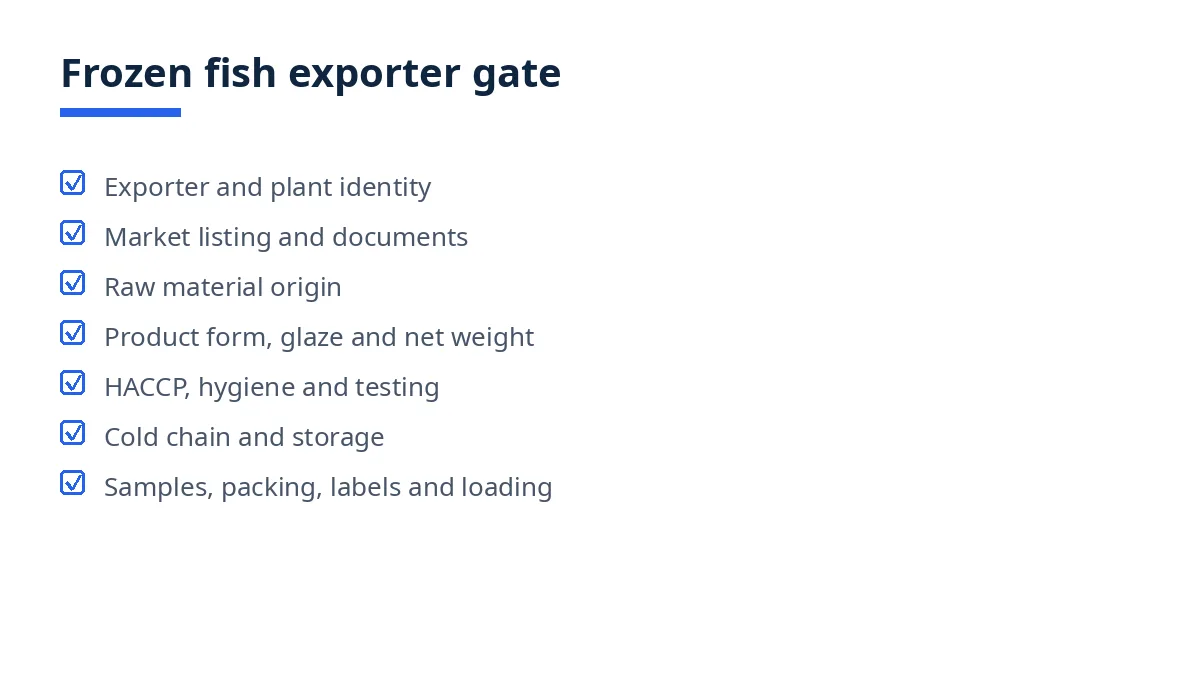
The full checklist (numbered, printable)
Score each check as pass, conditional or fail, and record the evidence reference beside the score. A check with no evidence is a fail.
Exporter identity and the plant behind the order
Confirm the exporter legal name, registration and trading address, and check the name matches across the quotation, proforma invoice and company documents.
Confirm whether the exporter owns the plant, contracts it, or buys finished stock from it.
Obtain the plant name, address and approval or listing number, and confirm it belongs to the plant processing this order.
Ask for the plant layout and process flow for this species and form, from intake through freezing, glazing and packing.
Confirm plant capacity for this form in the order window, including cold storage space.
Market listing and destination documents
Confirm that Bangladesh is listed for fishery products for the destination market. For the European Union, Bangladesh appears in the authorised third-country list for certain fishery products.3
Confirm that the specific plant is listed for the destination market where a plant list applies, and re-check it on the day of scoring. The European Commission notes that the accuracy of non-EU establishment lists is the responsibility of the non-EU country competent authority.4
Ask which health certificate the shipment will carry, who signs it, and which plant and lot details it names.
Ask for the full document set for one past shipment of the same species and form, with commercial details removed if needed, to see the real paper trail.
Raw material origin: wild catch or farmed fish
Record the raw material source, wild catch with landing details or farmed fish with farm details, and confirm it can supply the order volume.
For wild catch, ask for the landing centre or vessel information the plant records, and how landings are kept separate.
For farmed fish, ask for farm identification and the feed and veterinary treatment records the plant holds, and how treated lots are kept apart.
Ask how the plant handles a mixed order from more than one source, and confirm the lot code still traces to each source.
Product form, glaze and net weight
Confirm the exact form in writing: whole, gutted, headed and gutted, fillet, steak or portion, with size grade and trimming, skin or bone rule stated.
Confirm the glaze rule before pricing. For glazed quick frozen fillets, the Codex standard states that the declaration of net contents shall be exclusive of the glaze.2
Ask for the glaze method and the de-glazed net weight check the plant uses, and agree how the buyer will repeat that check.
Confirm the species on the label against the species in the order, because a substituted species is a different product.
HACCP, hygiene and testing
Ask for the HACCP plan for this exact product and plant, not a generic company plan. The Codex code of practice for fish and fishery products covers harvesting, processing, transport and sale, including HACCP analysis.5
Ask for the most recent hygiene audit or inspection outcome, and evidence that each finding was closed.
Ask which laboratory tests the plant runs for this product, how often, and obtain one recent report for the same species and form.
For species in the families where histamine is controlled, ask how the plant controls time and temperature from landing or harvest to freezing. The Codex fillet standard sets histamine limits only for the Clupeidae, Scombridae, Scombresocidae, Pomatomidae and Coryphaenedae families.2
Cold chain and storage
Ask for the cold chain record from freezing to loading: freezing method and time, cold store logs, and the loading temperature check. The Codex code states that frozen products should be maintained at minus 18 degrees Celsius or below in transportation.5
Confirm whether the cold store is the plant store or a named third-party store, and ask for its recent temperature records.
Ask how the plant handles a temperature excursion, who is told, and what happens to the affected lot.
Confirm the reefer container specification, including set point and pre-cooling, and who records the loading temperature.
Samples, packing, labels and loading
Agree a pre-production or pre-shipment sample of the exact species, form, glaze and pack, and record the approval with pack photographs.
Confirm the carton, inner pack and pallet specification, including carton count, net weight per carton, and markings for species, form and lot code.
Check the label proof against the order and destination rules. For quick frozen fillets, the label must indicate storage at minus 18 degrees Celsius or colder.2
Agree the inspection plan before production: who inspects, at which stage, and what happens to a rejected lot.
Confirm the loading check: lot codes on cartons match the packing list and health certificate, and the container is pre-cooled.
Common failures and how to fix them
The most common failure is a plant mismatch: the quotation comes from one exporter, the documents name a different plant, and the buyer finds the gap only when the health certificate arrives. Fix it with check 3.
The second failure is glaze confusion. A buyer compares two prices without checking whether both are quoted on de-glazed net weight, and the cheaper quotation is simply the more heavily glazed one. Fix it with checks 15 and 16.
The third failure is a cold chain gap between plant and port. The plant cold store holds temperature, but transfer, staging or loading does not. Fix it with checks 22 and 24.
The fourth failure is a traceability break on mixed lots. Fish from two sources enter one lot code. Fix it with check 13.
Downloadable template / summary table
Copy the seven sections into a scoring sheet, add one row per check, and record a pass, conditional or fail.
Section | Checks | Evidence to file |
|---|---|---|
Exporter and plant | 1 to 5 | Company documents, plant listing, process flow |
Market listing and documents | 6 to 9 | Destination and plant listing, certificate sample |
Raw material origin | 10 to 13 | Landing or farm records, source separation note |
Form, glaze and net weight | 14 to 17 | Product specification, glaze method |
HACCP, hygiene and testing | 18 to 21 | HACCP plan, audit closure, lab report |
Cold chain and storage | 22 to 25 | Temperature logs, excursion procedure |
Samples, packing, labels and loading | 26 to 30 | Approved sample, label proof, loading record |
Close the gate when every fail is closed and every conditional has a dated owner.
How Exportain helps
Exportain is a B2B marketplace connecting buyers with Bangladeshi suppliers, so the evidence file behind this gate can be requested at the enquiry stage. Browse suppliers, and ask each exporter to name the plant, the market listing and the HACCP plan for the exact species and form before shortlisting. Supplier profiles show which document and photo checks have been recorded, not factory inspections. Exportain is not a party to the goods contract and does not inspect goods.
Processing is concentrated in the Khulna, Chattogram and Cox's Bazar belt, which the Bangladesh Frozen Foods Exporters Association describes as the heart of the frozen seafood industry.6 Asking for the plant location early lets a buyer judge cold chain distance and inspection travel.
FAQs
When should this checklist be used?
Use this checklist before a first order, and again whenever the species, form, plant or destination market changes.
Who should complete it?
The buyer, a buying agent or an independent inspector can complete it, provided the scorer sees the actual documents.
What are the most common failures?
A plant that differs from the plant named in the quotation, glaze counted as fish, a cold chain gap, and a lot code that mixes two sources.
Can a third party do it?
Yes, if the third party receives the full specification, the scoring rule and plant record access before scoring starts.
Next steps on Exportain
Before approaching exporters, write the species, form, glaze rule and destination market into a one-page specification, then browse suppliers, read how supplier verification works on Exportain, and post a free RFQ via RFQs naming the plant listing and HACCP plan required.
Sources
- About Department of Fisheries: history, mandate and export of fish and fish products. Department of Fisheries, Government of Bangladesh (accessed )
- Standard for Quick Frozen Fish Fillets (CXS 190-1995). Food and Agriculture Organization of the United Nations (accessed )
- Commission Implementing Regulation (EU) 2021/405 — list of third countries authorised for fishery products. European Union (accessed )
- Non-EU countries authorised establishments. European Commission (accessed )
- Code of Practice for Fish and Fishery Products (CXC 52-2003). FAO and WHO, Codex Alimentarius (accessed )
- Exporters invite stakeholders to visit major zones. The Financial Express, (accessed )
About the author
Sourcing from Bangladesh?
Post a request for quotation and suppliers on Exportain can send you their quotes directly.
Post an RFQ


