Formal Suits Price in Bangladesh: FOB Cost Breakdown for Buyers
No standard FOB price for formal suits in Bangladesh: how suiting cloth, canvas construction, fitting samples, pressing and packing build a suit quotation, and how to compare replies on the same set and term.
Short answer
Formal suits price in Bangladesh has no single FOB figure, because the price is set by the suiting cloth, the jacket construction, the fitting rounds, and the pressing and packing for a matched set. A full canvas jacket costs more to make and press than a fused jacket in the same cloth. Ask suppliers to split the jacket and trouser lines, name the canvas method, and state the included fitting rounds on one delivery term.
On this page
Key takeaways
A formal suit is priced as a matched set: jacket and trousers from the same cloth lot, with the jacket construction deciding much of the making and pressing cost.
Full canvas, half canvas and fused jackets differ in making time, pressing method and long-term shape, so compare only replies that name the same construction.
Fitting rounds are a suit cost line, not an extra: record sample charges, included correction rounds and what each extra round costs before bulk cutting.
Pressing is judged hanging after transit, so ask for a pressed sample packed exactly as bulk will be packed and inspect it after unpacking and hanging.
Under FOB the price runs to loading on board the vessel nominated by the buyer at the named port, so compare quotations only on the same term and port.
A formal suit quotation from Bangladesh is a quotation for a matched set, not for a single garment. The jacket and the trousers must come from the same cloth, the same dye lot and the same finish, and the jacket must hold its shape after pressing, travel and a first wear. When a suit price looks low, the saving is usually sitting in one of those three places: a cheaper suiting cloth, a lighter internal construction, or fewer fitting and pressing steps.
There is no published standard FOB price for formal suits from Bangladesh, and this guide states none. It works through the checkable parts of a suit quotation: suiting cloth, canvas construction, fitting samples, pressing and finishing, packing for a two-piece set, and the delivery term. Where numbers appear, they are labelled Example figures and show only how a quotation adds up.
Classification comes first, because a suit, a separate jacket and a pair of trousers are priced and declared differently. Heading 6203 covers suits, ensembles, jackets, blazers, trousers, bib and brace overalls, breeches and shorts, other than swimwear, for men or boys, not knitted or crocheted, and subheading 620312 covers suits of synthetic fibres on the same basis.1 A wool suit, a wool-blend suit and a synthetic-fibre suit therefore sit under different subheadings even when the cut looks identical, so state the fibre content on the enquiry and check that the quotation and the invoice use the same description.
Behind every suit sits a woven base, and Bangladesh has a deep one. The Bangladesh Garment Manufacturers and Exporters Association (BGMEA) began in 1983, counts around 4,500 member factories, and counts around 60 percent of those members as woven garment manufacturers.2 In the July to September quarter of fiscal year 2026-27, woven garment exports reached $4.61 billion, up 5.11 percent year on year, within ready-made garment exports of $10.58 billion, according to Export Promotion Bureau (EPB) data.3 A large woven base does not make every woven factory a suit factory — the rest of this guide separates the two.
Why this matters for buyers and sellers
For a buyer, a suit is a fit product before it is a price product. A shirt that is slightly loose still sells; a jacket with a rolling lapel, a collapsing chest or trousers that twist after washing does not. A fault in one piece strands the other, since jacket and trousers are sold together.
For the seller, a suit order ties up skilled labour that a plain woven order does not need. Canvas work, lapel padding, buttonholes, trouser creasing and final pressing are hand-influenced steps, and each fitting round takes the garment off the line and back onto a form or a fit model. A suit quoted at a plain-trouser rate has usually left one step out.
The delivery term frames every comparison. FOB (Free On Board) is one of the Incoterms 2020 rules, and under FOB the seller delivers the goods loaded on board the vessel nominated by the buyer at the port of shipment, with risk transferring to the buyer at that point.4 The seller handles transport to the port, loading and export formalities, while the buyer contracts the carrier and pays freight and import formalities.4 Two suit quotations compare only when they name the same term and the same port, because a quotation that quietly includes freight to the buyer market is not an FOB quotation at all.
Step-by-step: how it works
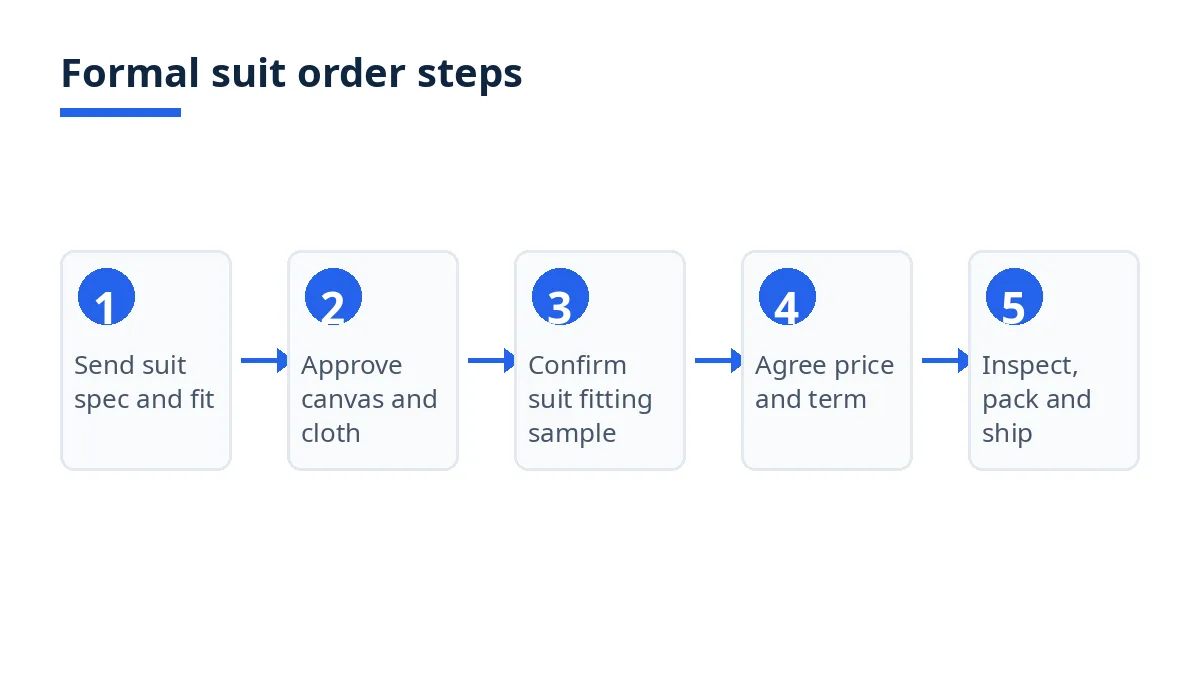
Send a suit specification, not a photograph. State the set, the cloth composition, weight and finish, the jacket construction, lapel, vent, pocket and button details, trouser rise, waistband and hem finish, the size ratio and trim specification.
Ask how the jacket is built, in writing. Record whether the chest uses a full canvas, a half canvas or a fused front, what the canvas is made from, and whether the lapel is hand-padded or machine-padded. This one answer changes the making cost, the drape and the pressing method.
Approve the cloth before cutting. Ask for a cutting of the actual suiting cloth, with the lining and canvas sample beside it. Check hand, shade and stretch recovery.
Run the fitting sequence on a real size set. Order a proto sample, then a fit sample in the middle sizes, then a pre-production sample in the actual cloth, canvas and trims. Measure jacket and trouser points and record every correction in writing.
Agree the price structure before bulk cutting. Ask for the quotation split into cloth, lining and trims, canvas and interlining, making, pressing and finishing, packing, and delivery to the vessel, with sample and fitting charges shown apart from the unit price.
Confirm inspection, packing and the delivery term. Write the inspection points for a suit, the packing method for a matched set, and one Incoterm with a named port into the purchase order, then compare all replies on that same basis.4
Costs, timelines and documents
What are the typical costs and timelines?
There are no typical suit costs a guide can state as fact, because each factory prices your cloth, your construction and your fitting rounds. The lines below are the ones to ask for, in the order they usually appear on a suit quotation.
Suiting cloth. Wool, wool-blend and synthetic-fibre suitings differ in fibre cost, dyeing and finishing, and a heavier cloth consumes more metres per suit than a lighter one. State the composition, weight and finish, and ask whether the cloth is stocked or finished to order, and whether it carries a lot minimum.
Canvas construction. A full canvas jacket carries a floating canvas chest piece stitched, not glued, to the cloth, and takes longer to make than a fused jacket, where the front is bonded with adhesive interlining. A half canvas sits between the two. The canvas choice moves the making cost, the pressing cost and the way the jacket ages, so a quotation that does not name the construction has not yet priced the jacket.
Fitting and sample costs. A suit programme usually needs more sample rounds than a plain garment, because jacket fit cannot be judged from measurements alone. Ask whether proto, fit and pre-production samples are charged apart, whether the charge is credited against the bulk order, and how many correction rounds the price includes before extra rounds are billed.
Pressing, finishing and packing. Suits are pressed on forms, not flat-pressed like shirts: lapels are shaped, shoulders are set, trouser creases are fixed, and the finished set is inspected hanging, not folded. Ask whether pressing is priced per set and how the set is protected in the carton so the press survives transit. Jacket and trousers must travel as a pair, with the same shade, size and order reference on both pieces, so ask whether suits are packed hanging, folded in a suit carrier, or folded in cartons, and whether packing sits inside the unit price or apart from it.
Delivery to the vessel. Under FOB, the price runs to loading on board the vessel nominated by the buyer at the port of shipment.4 Ask for the named port and confirm that inland transport, export formalities and loading sit inside the quotation, while ocean freight and buyer import charges sit outside it.4
Example figures: a two-piece suit quotation split into 100 parts shows cloth at 45 parts, lining, canvas and trims at 15 parts, making at 25 parts, pressing and finishing at 5 parts, packing at 3 parts, and delivery to the vessel at 7 parts. Changing only the jacket from a fused front to a full canvas moves parts into the making line and raises the total.
For timelines, sampling depends on cloth availability and fitting rounds, and bulk production depends on cloth finishing, canvas supply, line capacity and pressing capacity. Ask for cloth ready, sample, cutting, pressing and inspection dates as separate lines, not a single delivery week.
Which documents are needed?
The order documents are the suit specification, the itemized quotation and the purchase order, with the canvas construction, the size ratio and the fitting approvals on both. For export clearance, confirm the Bill of Export position with your supplier before loading, since goods are not loaded for export unless the export declaration is submitted to Customs and approved.5
Bangladesh-specific rules and tips
Check tailored capacity, not only woven capacity. A factory that sews woven trousers well may not have a suit pressing section, a canvas team or a fit model programme. Ask which suit construction the factory runs regularly and whether pressing is done in-house or sent out, since sent-out pressing adds a handover and a second inspection point.
Keep one shade across the set. Jacket and trousers are cut from the same cloth lot, but a repeat order cut from a new lot can shade differently. Record the cloth lot reference on the first order and ask whether the repeat price holds the same lot or a new lot, with a shade approval step before cutting.
Check association claims with the association. A claimed BGMEA membership is worth confirming directly: BGMEA represents the readymade garment industry including woven garments,2 so membership shows an active garment business, not suit-making capacity and not a price for your order.
State fibre content exactly for the destination market. A wool-blend suit and a synthetic-fibre suit carry different declarations and different care and labelling requirements. If you sell into the European Union, a textile product shall be labelled or marked with the name and percentage by weight of all constituent fibres in descending order.6 Put the agreed composition on the specification, the quotation and the label artwork, and check all three match.
Agree the size curve before the fitting round. Record the size ratio per size on the purchase order, since the smallest and largest sizes cause the most fitting corrections.
Mistakes and red flags
What are the most common mistakes?
Comparing a fused jacket with a canvas jacket on unit price alone. The two jackets look alike in a photograph and differ in making time, pressing method and long-term shape. Compare only replies that name the same construction.
Approving fit from measurements without a worn sample. A jacket measurement can pass on paper while the lapel rolls or the back pulls when worn. Insist on a fit sample in the actual cloth and canvas before bulk cutting.
Accepting one price for jacket and trousers combined without a split. A combined set price hides whether the trousers are subsidising the jacket or the other way round. Ask for the jacket and trouser lines apart, so a later change to one piece can be priced without reopening the whole set.
Skipping the pressing check to save time. A suit is judged hanging, after transit. Ask for a pressed sample packed exactly as bulk will be packed, and inspect it after unpacking and hanging, not straight out of the carton.
Treating a profile or a badge as a capacity check, and leaving sample charges unpriced. A profile is a starting point for enquiries. It does not test whether a factory can cut, canvas and press your suit, and a badge is not a guarantee of capacity, quality or delivery. Likewise, record how many fitting rounds the price includes and what each extra round costs, since a programme with three rounds and a programme with one round are different offers.
Checklist
Before you confirm, every line should be answered in writing.
Set defined: two-piece or three-piece, with jacket and trouser details apart.
Suiting cloth stated: composition, weight, finish, stocked or finished to order.
Jacket construction named: full canvas, half canvas or fused, with lapel method.
Cloth, lining and canvas samples approved before cutting.
Fit sample approved in actual cloth and canvas, corrections recorded in writing.
Pre-production sample measured, pressed and approved in writing.
Quotation split into cloth, lining and trims, canvas, making, pressing, packing and delivery to the vessel.
Sample and fitting charges shown apart from the unit price, with included rounds stated.
Size ratio per size recorded, including smallest and largest sizes.
Inspection points for a suit and the packing method for a matched set agreed.
Quotations compared on the same construction, specification, Incoterm and named port.4
Fibre composition agreed across specification, quotation and label artwork.6
How Exportain helps
On Exportain, browse suppliers and post a request for quotation (RFQ) on the RFQ board with your suit specification, canvas construction, size ratio and delivery term, so suppliers quote against the same set. Ask each reply for the jacket and trouser split, the canvas method and the included fitting rounds. Read how supplier verification works on Exportain and the MOQ definition guide when a reply carries a minimum per cloth lot or per size.
FAQs
What should I know first about formal suits?
Know the set before the price. A formal suit is a matched jacket and trousers from the same cloth lot, and the jacket construction, full canvas, half canvas or fused, decides much of the making and pressing cost. Heading 6203 covers suits, ensembles, jackets, blazers and trousers for men or boys, not knitted or crocheted, with subheading 620312 covering suits of synthetic fibres.1
What are the typical costs and timelines?
There are no typical figures a buyer can rely on, because each factory sets its price and lead time for your cloth, construction and fitting rounds. Cloth, canvas, making, pressing and finishing, packing and delivery to the vessel build the FOB figure,4 and fitting corrections set the timeline.
Which documents are needed?
The order documents are the suit specification, the itemized quotation and the purchase order, with construction, size ratio and fitting approvals on both. For export clearance, confirm the Bill of Export position with your supplier before loading, since goods are not loaded for export unless the export declaration is submitted to Customs and approved.5
What are the most common mistakes?
The most common mistakes are comparing a fused jacket with a canvas jacket on unit price alone, approving fit from measurements without a worn sample, accepting a combined set price without a jacket and trouser split, and leaving sample charges and correction rounds unpriced. Compare only replies on the same construction, specification, Incoterm and named port.4
Next steps on Exportain
Browse suppliers, then post your suit specification, canvas construction and size ratio on the RFQ board so suppliers state their jacket and trouser split and their included fitting rounds. Before you confirm, read how supplier verification works on Exportain and the formal suits quality control checklist.
Sources
- Classification Detail — HS Code 620312. United Nations Statistics Division (accessed )
- Bangladesh Garment Manufacturers and Exporters Association (BGMEA). Devex (accessed )
- Bangladesh's garment exports grow 6.10% in Q1 of FY27. Business Mirror, (accessed )
- FOB & FAS Incoterms® 2020 explained: Key differences. ICC Academy (accessed )
- Customs Clearance Procedures for Export. Bangladesh Customs, National Board of Revenue (accessed )
- Regulation (EU) No 1007/2011 on textile fibre names and related labelling and marking of the fibre composition of textile products. European Union, (accessed )
- supplier verification
- buyer guide
- Bangladesh sourcing
- bangladesh garments
- FOB pricing
- Formal suits
- Woven apparel
About the author
Sourcing from Bangladesh?
Post a request for quotation and suppliers on Exportain can send you their quotes directly.
Post an RFQ