Formal Suits Exporters in Bangladesh: Verified Supplier Checklist
A numbered checklist for checking formal suits exporters in Bangladesh: suiting cloth, canvas construction, suit fit, set matching, pressing, labels, and maker papers, with fixes for common failures.
Short answer
Use this checklist to check a formal suits exporter in Bangladesh before ordering: compare suiting cloth and Super number evidence with the approved swatch, open a sample jacket to confirm canvas or fused construction and lapel roll, fit the suit in each main size, check trousers and waistcoat shade matching, review pressing, labels and packing, and agree maker papers, capacity and acceptance numbers in the purchase order.
On this page
Key takeaways
Agree the sampling plan, acceptance numbers, cloth evidence, and construction sheet before cutting, and draw the inspection sample at random across sizes and shades.
Open a sample jacket to confirm canvas or fused construction and lapel roll, and fit the suit in each main size with actual measurements recorded.
Check jacket, trousers, and waistcoat together as one set for shade and pattern, since different cloth lots can split a suit in bulk.
Treat a flat lapel, a shade split, bubbled fusing, or uneven pressing as a stop point: compare bulk against the sample and re-test before more suits are pressed or packed.
A formal suit is judged on a person, in motion, over a working day. A jacket that looks correct on a hanger can pull at the button, roll badly at the lapel, or lose its shape at the shoulder once worn. Work through the list below before you pay a deposit, and keep the signed result with the purchase order.
Why this checklist matters
Suit faults are rarely obvious in a single photograph. Cloth, inner structure, cut, and finish all have to agree, and a fault in one shows only when the suit is tried on, pressed, or worn for several hours. A written check forces each point to be answered with evidence: a cloth sample, a cut jacket, a fitting record, or a named test, rather than an assurance.
Checking construction and fit at the sample stage also protects timing. Cloth, canvas, and lining decisions are hard to change once cutting starts, and a fitting fault found after bulk pressing is expensive to correct. Use the list for a first order, for a new style, and whenever the cloth, construction, or factory changes.
Before you start
Gather the references before any item is marked: the approved suit sample, the cloth swatch with fibre composition and weight, the size chart with tolerances, the construction sheet naming full canvas, half canvas, or fused construction, and the packing specification.
Agree the sampling plan in writing before inspection. ISO 2859-1 defines a system of acceptance sampling plans for inspection by attributes, indexed by the acceptance quality limit, so sample size and accept and reject numbers can be set from the standard rather than chosen on the day.1 Draw the sample at random across sizes and shades, and include at least one suit tried on a form or wearer in each main size.
Ask for current maker papers at this stage, and check that the name on the papers matches the quotation, the bank details, and the factory address. BGMEA states that, prior to granting membership, it ensures through on-site inspections and verification processes that applicant factories meet the required standards.2 Membership evidence is a starting point for a paper check, not a substitute for checking the suit itself.
The full checklist
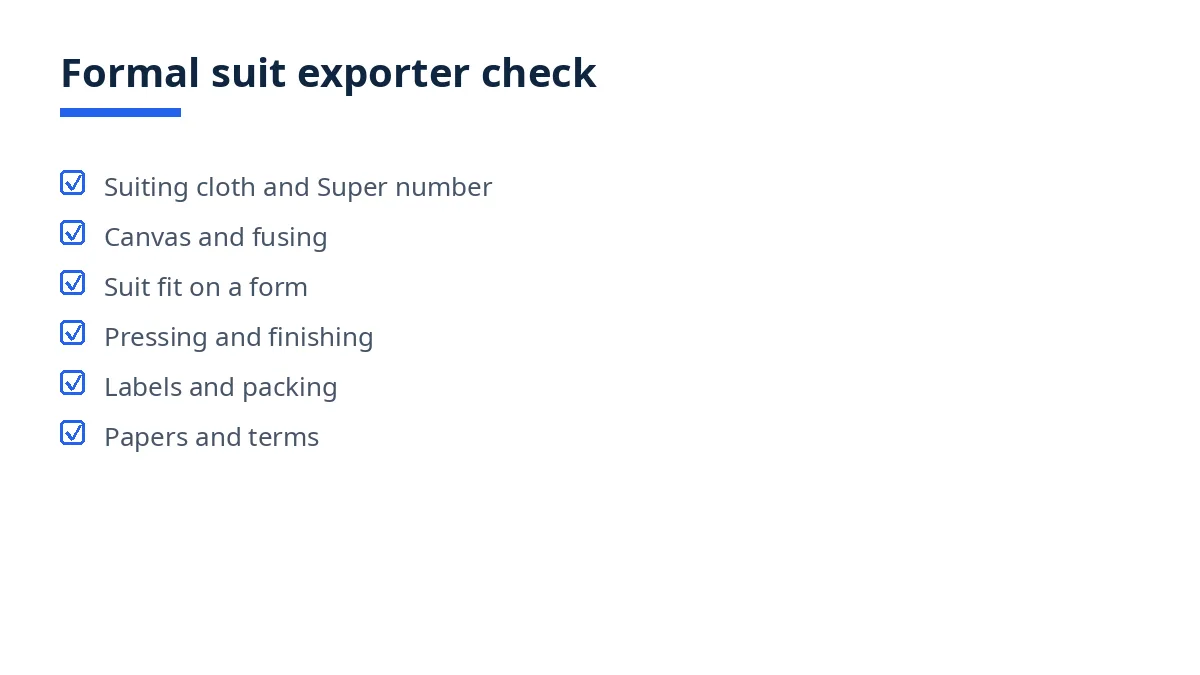
Suiting cloth and fibre evidence
Compare bulk cloth with the approved swatch for shade, hand, weave, and pattern scale, under the same light.
Confirm the fibre composition on the cloth invoice and the label plan agree, and record cloth weight and mill name.
Check any Super number against its meaning, not as a quality rank. A Super number states the maximum average diameter of the wool fibre in a cloth, with Super 100s meaning fibres no coarser than 18.75 microns and Super 120s meaning fibres no coarser than 17.75 microns.3
Check cloth for faults before cutting is signed off: holes, slubs, broken yarns, stains, oil marks, and shade bands.
Confirm lining, pocketing, and canvas cloth, and check that lining shade and weight suit the outer cloth.
Canvas, fusing, and jacket structure
Confirm the construction named in the order, and open one sample jacket to check it. In a half-canvas jacket the canvas covers the chest and lapels, while in a fully fused jacket a stiffening layer is glued to the outer cloth instead of a sewn canvas.4
Check the lapel roll: a canvassed lapel should curve gently from collar to top button, while a fused lapel often folds in a flat, sharp line.4
Check for fusing faults on the sample and in bulk: bubbling, puckering, or a stiff board-like front after pressing and cooling.
Check the shoulder line on a form: both shoulders sit at the same height, with no divot, roll, or excess padding.
Check chest and front quarters: the jacket closes without strain at the button, and fronts hang straight.
Pattern, fit, and the fitting suit
Fit the sample suit on a form or wearer in each main size, recording actual measurements against the size chart, not pass marks alone.
Check the sleeve: it hangs straight, the cuff sits at the agreed point, and both sleeves match in length and pitch.
Check the collar: it sits flat against the neck, does not gap when buttoned, and meets the lapel cleanly on both sides.
Check button stance and buttonholes: the top button sits at the agreed height, and buttons match in size, shade, and fixing.
Check the back: it hangs straight, the vent or vents lie flat, with no pulling across the shoulder blades.
Trousers, waistcoat, and set matching
Check trousers against the jacket for shade and pattern, since different cloth lots can read as two garments rather than one suit.
Check waistband, fly, and closures: the waistband sits level, the fly lies flat, and the closure holds without strain.
Check creases, hems, and leg line: creases run straight, hems are even, and both legs hang with the same break.
Where a waistcoat is ordered, check its length against the trouser waistband, its button stance, and its back strap.
Check the full set together on a form: jacket, trousers, and waistcoat read as one outfit in shade and finish.
Pressing, finishing, and presentation
Check pressing on sample and in bulk: no shine marks on wool, no unwanted creases, and no flattened lapel roll.
Check inside finishing: linings are secure, seams show no raw edges, pocket bags sit flat, and loose threads are trimmed.
Check trims: buttons, zips where used, hooks, and hangers match the specification, with no substitution in bulk.
Check the suit on a hanger as the buyer will receive it: the jacket keeps its shape, and the set is not crushed by packing.
Labels, care, and packing
Check fibre labels against the cloth evidence. For the EU, a textile product shall be labelled with the name and percentage by weight of all constituent fibres in descending order.5
Check care labels against the care method agreed for the suit. ISO 3758 establishes a system of graphic symbols for care labelling, based on the most severe treatments that do not cause irreversible damage during care.6
Check size, origin, and brand labels for position, legibility, and correct size marking for each suit.
Check packing: suits are folded or hung as directed, carton counts and size ratios match the packing list, and carton markings match the purchase order.
Maker papers, capacity, and terms
Confirm the maker: the factory that will cut and sew the order, its address, and any subcontracted stage, named in writing.
Confirm capacity for the order size and date: cutting, sewing, pressing, and packing capacity for the quantity and delivery week.
Confirm order terms in writing: price basis, payment terms, delivery date, quantity and size-mix tolerance, and acceptance numbers from the sampling plan.1
Agree who handles export clearance in writing, and name the party responsible for it in the purchase order.
Confirm the rework and rejection route before shipment: who sorts, who re-presses, who pays for re-inspection, and what happens to rejected suits.
Common failures and how to fix them
The most common suit failure is a lapel that looks pressed flat rather than rolled, usually because bulk construction does not match the sample, or pressing has flattened the roll. Stop, open a bulk jacket, compare its canvas and fusing with the sample, and re-press a test jacket with the roll protected before more jackets are pressed.
Next is a jacket and trousers that no longer match in shade, usually because more than one cloth lot is in a single order. Re-sort complete suits before packing, and do not mix lots within a single suit. A divoting shoulder or gapping collar usually traces to the pattern or padding: re-fit a corrected sample before bulk sewing continues. Fused fronts that bubble after pressing point to settings that do not suit the cloth: test a new setting on a spare panel, let it cool, and check it again before the bulk is fused. Above the agreed acceptance level, the options are re-inspection after sorting or rework, documented partial acceptance, or rejection.
Summary table
Section | Checks | Evidence |
|---|---|---|
Suiting cloth | Shade, fibre, Super number, faults | Swatch, cloth invoice |
Canvas and structure | Canvas, fusing, lapel roll, shoulder | Opened sample jacket |
Fit | Measurements, sleeve, collar, back | Fitting record |
Set matching | Trousers, waistcoat, shade | Full set on a form |
Pressing and finishing | Shine, creases, trims, hangers | Pressed sample |
Labels and packing | Fibre, care, size, cartons | Label check, packing list |
Papers and terms | Maker, capacity, clearance, acceptance | Signed purchase order |
How Exportain helps
Exportain is a B2B marketplace connecting buyers with Bangladeshi suppliers, so the cloth, construction, and fitting points in this checklist can be agreed at the enquiry stage. Browse suppliers and set out the construction, cloth evidence, and fitting record you will require. Supplier profiles show which document and photo checks have been recorded, not factory inspections. Exportain is not a party to the goods contract and does not inspect goods.
FAQs
When should this checklist be used?
Run it three times: before any deposit is paid, again at the sample and fitting stage, and finally when suits are pressed and largely packed for inspection.
Who should complete it?
Completion sits with the buyer, with a local agent acting for the buyer, or with an independent inspector. What the person needs is the same in all three cases: the approved sample, the size chart, the construction sheet, and a sample pulled at random across sizes and shades.
What are the most common failures?
A flat lapel roll, a shade difference between jacket and trousers, a gapping collar, a divoting shoulder, bubbled fusing, and uneven pressing are the failures buyers find most often on formal suits.
Can a third party do it?
Yes, if two things happen first: the approved sample, cloth evidence, size chart, construction sheet and acceptance numbers are handed over, and the third party commits to reporting measured values instead of simple pass marks.
Next steps on Exportain
Agree your cloth, construction, and fitting record with a supplier, then read how supplier verification works and the MOQ guide, and post a free RFQ via RFQs to compare quotes from Bangladeshi suppliers.
Sources
- ISO 2859-1:2026 - Sampling procedures for inspection by attributes — Part 1: Sampling schemes indexed by acceptance quality limit (AQL) for lot-by-lot inspection. ISO (accessed )
- BGMEA Strengthens Membership Verification and Compliance Standards. BGMEA, (accessed )
- Suit Fabrics For Men: The Complete Cloth And Weight Guide. Mojeh Men (accessed )
- Full Canvas vs Half Canvas. Oliver Wicks (accessed )
- Regulation (EU) No 1007/2011 on textile fibre names and related labelling and marking of the fibre composition of textile products. European Union, (accessed )
- ISO 3758:2023 - Textiles — Care labelling code using symbols. International Organization for Standardization (accessed )
About the author
Sourcing from Bangladesh?
Post a request for quotation and suppliers on Exportain can send you their quotes directly.
Post an RFQ