

How to Find EU health certificate for fishery products Certified Factories in Bangladesh
How to check an EU fishery health certificate for fishery products from Bangladesh: the consignment certificate, the listed establishment, and the shipment match.
Short answer
An EU health certificate for fishery products is not a factory certification and not a product quality mark. It is a consignment-level official certificate issued by the exporting country's competent authority, in Bangladesh the Department of Fisheries' Fish Inspection and Quality Control section, attesting that one specific consignment meets EU import requirements. It travels with that consignment only, so a buyer must check the certificate, the listed establishment, and the shipment match together.
On this page
Key takeaways
An EU health certificate for fishery products is a consignment-level official certificate, not a factory certification and not a product quality mark.
A consignment needs three linked parts: a listed third country, an establishment on the Commission-published list, and an official certificate for that consignment.
For fishery products, every stage that must be listed, including cold storage and any vessel stage, must appear on the list.
A single mistake on the certificate can lead to rejection at the EU border, so every field must match the shipment documents before dispatch.
An EU health certificate for fishery products is not a factory certification and not a product quality mark. It is a consignment-level official certificate issued by the exporting country's competent authority, in Bangladesh the Department of Fisheries' Fish Inspection and Quality Control section, attesting that one specific consignment meets EU import requirements. It travels with that consignment only, so a buyer must check the certificate, the listed establishment, and the shipment match together.
That distinction changes how the search in the title should be read. A buyer searching for an EU health certificate for fishery products certified factory in Bangladesh usually wants a plant whose shipments can enter the EU. The EU system does not grant a factory a health certificate. It works in three linked parts: the third country must be listed for the product, the establishment that obtained or prepared the product must be on the list published by the Commission, and each consignment must be accompanied by an official certificate.1 Remove any one part and the shipment cannot enter for placing on the market on that basis.
For fishery products, the establishment rule is wide. A consignment may enter only if it has been obtained or prepared, at any stage of production, in an on-land establishment, a factory or freezer vessel, or stored in a cold store or a reefer vessel that appears on the Commission-published list.1 A buyer therefore checks more than the packing plant: every stage that counts must be on the list.
The certificate itself is a guarantee for the consignment, not a standing approval for the company. Animals and animal products from non-EU countries can enter the EU market only if accompanied by an official certificate, and that certificate contains a public health attestation and, for certain fish and fishery products, an animal health attestation, in addition to information identifying the product and its origin.2 Official certificates must be signed by official veterinarians in non-EU countries, and they are guarantees that the consignment complies with EU legislation.2 Certificates are always checked during EU official controls at border control posts.2
Private schemes do not substitute for the certificate: a farm or facility scheme certifies a site or chain over time, while the EU health certificate certifies one consignment at export.
Why this matters for buyers and sellers
For a buyer, the main risk is treating a general claim as shipment evidence. An earlier certificate, a website badge, or a letter about a plant proves nothing about the next consignment, because the certificate belongs to a defined product, quantity, and shipment. A second risk is a listing change: the competent authority must keep lists up to date and remove an establishment that no longer fulfils the listing requirements.3
A third risk is a small mismatch at the border. The certificate is filled in by the operator in Part I and by the non-EU country competent authority in Part II, and a single mistake is sufficient for a consignment to be rejected at the point of entry.2 An incorrect weight is given as an example: it is not a sanitary issue, but it will still lead to rejection.2
For a seller, the same discipline protects the order. A processor that can name the listed establishment for each stage and show how the certificate details will match the packing list gives a buyer a claim that can be checked before the goods leave Bangladesh.
Step-by-step: how it works
Start with the product and the consignment, not with a company name. Write down the species, the product form, the quantity, the packing and storage route, and the destination border control post. The exact product description on the certificate must match the commercial documents.
Next, check the establishment list before agreeing terms. Lists for non-EU countries are proposed by approved countries, maintained by the Commission, and derived from data in TRACES-NT.3 Fishery products sit in Section VIII of the categorisation.3 Ask for the name exactly as listed, its approval number, and the listed activity, and check every stage that must be listed.1
Then confirm who issues the certificate and in what form. Certificates may be paper or electronic, and the electronic form must be submitted through TRACES-NT, which reduces the risk of using an out-of-date model.2 Ask which route applies, who signs Part II, and when the signed certificate will be available relative to dispatch.
Then match the certificate to the shipment line by line: consignor and consignee, establishment of origin, species and product description, quantity and weight, packages, and transport details, against the packing list, invoice, and transport document. Correct any difference before dispatch, because a mistake found at the border can mean rejection.2
After dispatch, keep the border step in view. The original official certificate must be shown at the border control post, and the certificate is checked there as part of the official controls.2
Finally, file the evidence per consignment and set a re-check for the next one. Keep the list-entry details with the date checked, the certificate copy, the packing list, and the transport document together. A new consignment needs a new check, even from the same supplier.
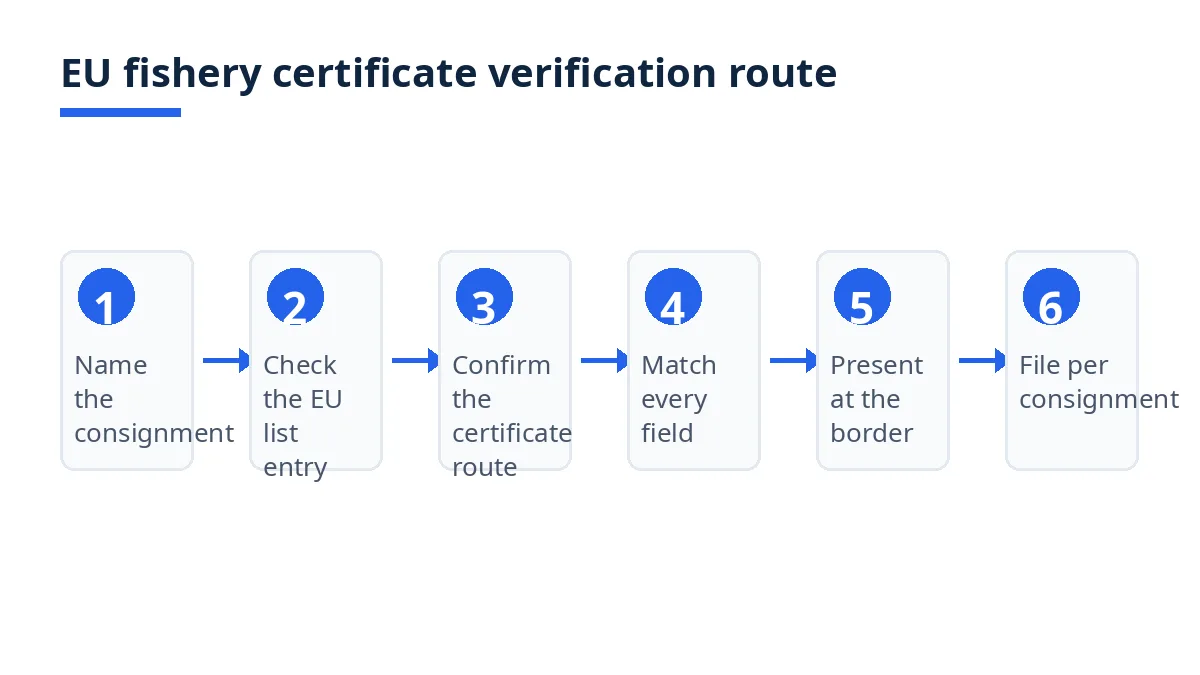
Treat each step as a gate. A missing list entry, an unnamed stage, a certificate that does not match the shipment, or a border presentation problem means the consignment is unverified until that step passes in writing.
Costs, timelines and documents
No single public figure fits what an EU health certificate costs for a Bangladeshi consignment, so this guide gives cost drivers instead of numbers: the inspection and testing work, the issuance process, any laboratory analysis required, cold-chain handling while the certificate is prepared, and the cost of delay if a border mismatch means the consignment is held, corrected, or returned. Ask for a written breakdown for the actual consignment, and confirm with the competent authority which fees, if any, apply.
Timelines follow the same logic. The certificate model must be current, because certificates are amended regularly and the models in TRACES are the most up-to-date ones.2 The supplier should confirm how long the inspection, any testing, and the signing step take for the product and the season, and the buyer should build that period into the shipping plan.
The document set for the buyer is short: the establishment list entry for each stage that must be listed, with the name, approval number, and date checked; the official certificate for the consignment, with Part I and Part II complete; the packing list and commercial invoice that match the certificate; the transport document; and any laboratory or inspection report the supplier relies on for the consignment. A brochure, a website page, or an earlier certificate for a different consignment is not part of this set.
Item | What to check | Why it matters |
|---|---|---|
Establishment list entry | Name, approval number, listed activity, date checked | Shows the stage is on the Commission-published list |
Official certificate | Consignment details, attestations, signature, model | Proves this consignment, not the company in general |
Packing list and invoice | Species, form, quantity, weight, packages | Must match the certificate or the border check fails |
Transport document | Consignor, consignee, route, border control post | Links the certificate to the shipment presented at entry |
Test or inspection report | Product, lot, result, date | Supports the certificate where the authority requires it |
Bangladesh-specific rules and tips
A 1998 Commission decision on fishery and aquaculture products from Bangladesh required each consignment to be accompanied by a numbered original health certificate and to come from approved establishments, and it named the Department of Fisheries, Fish Inspection and Quality Control, of the Ministry of Fisheries and Livestock, as the competent authority for verifying and certifying compliance with Community requirements.4 That decision has since been repealed, and it is cited only to explain where the Fish Inspection and Quality Control role comes from, not as the current entry rule.
In current practice, the Department of Fisheries runs an e-certification and laboratory information management service covering licences, health certificates, additional health certificates as per the importing country's requirements, sample collection, inspection, test reports, and certificate issuance.5 Traders can follow inspection status on a dashboard.5 A buyer should still ask which channel applies to the consignment, because the route, inspection, and signing steps are what matter at the border.
For aquaculture products, the EU-side requirements are stated plainly: exporting countries must be authorised for food safety and residue control plans, aquaculture establishments must be listed for export by the exporting country and included in a list published by the European Commission, and revised model certificates must be used.6
Shrimp dominates the Bangladesh picture, and that shapes the questions buyers usually ask. The Department of Fisheries plan notes that major export destinations for Bangladeshi fish and fishery products remain the member countries of the European Union, that around 50 to 60 percent of total export is composed of shrimp contributing about 75 to 85 percent of total value, and that shrimp is the major exporting seafood item, most of which is of aquaculture origin.7 That general picture must not be turned into a claim about any single plant. This guide names no establishment as listed or certified, gives no count of listed establishments in Bangladesh, and gives no ranking.
Mistakes and red flags
The most common mistake is treating a plant claim as a consignment certificate. A statement that a factory is certified, listed, or approved does not prove that a particular shipment is covered. Always ask for the list entry and the certificate for the consignment, and check that the two match. A second mistake is accepting a copy of an earlier certificate as evidence for a new order. Each consignment needs its own certificate, and an earlier certificate proves only that an earlier consignment was certified.
Other red flags include a certificate with no approval number, a name that differs from the list entry, a species, form, or weight that differs from the shipment documents, and an out-of-date certificate model. A supplier that will not share the list entry, model, or signing route is unverified until those items are given in writing. A logo or marketing page is not an official certificate.
A further mistake is assuming that a certificate proves quality, taste, size grade, or shelf life. The certificate attests compliance with EU import requirements for that consignment.1 Commercial quality, grade, and shelf-life terms belong in the purchase contract and must be checked separately.
Checklist
Use this checklist before a first order, and again before every repeat consignment.
Species, product form, quantity, and destination border control post written down for the consignment.
Establishment list entry checked for each stage that must be listed, with name, approval number, and date checked.
Certificate model confirmed as current, with the issuing route and signer confirmed.
Certificate Part I and Part II matched line by line to the packing list, invoice, and transport document.
Weight, species, product form, packages, consignor, and consignee checked for exact agreement.
Border control post confirmed, with a named contact for a border query.
Any laboratory or inspection report for the consignment filed with the certificate.
Any mismatch corrected before dispatch, not after arrival.
Evidence filed per consignment, with a re-check set for the next consignment.
Any gap or unverified claim recorded in writing, with a decision on whether to proceed.
How Exportain helps
Exportain's own supplier checks are a document and photo review, not an EU listing check and not a certificate check, and they do not replace the establishment and consignment checks in this guide. The Trust Center states plainly that supplier verification is a document review, not a factory inspection and not a check against a government database, and that a badge is not a guarantee of production capacity, product quality, or delivery. Use those checks for identity, business registration, export registration, and facility photos, while EU listing and certificate evidence is checked separately.
A buyer can use Exportain to describe the species, the product form, the listed establishment, and the consignment certificate clearly, and request the checklist documents. Certificate problems fail most often on mismatch: a weight that differs, a name that differs from the list entry, or a model that is out of date. The seller verification page describes the same document and photo review from the seller side, and the certification services category notes that no services are published in that category yet at the time of checking.
FAQs
What should I know first about EU health certificate for fishery products?
Know first that it is not a factory certification and not a product quality mark. It is a consignment-level official certificate issued by the exporting country's competent authority, in Bangladesh the Department of Fisheries' Fish Inspection and Quality Control section, attesting that one specific consignment meets EU import requirements. It accompanies that consignment only, and the buyer must also check the EU list entry and the shipment match.
What are the typical costs and timelines?
There is no typical figure that fits every consignment. Costs vary with inspection, testing, issuance, laboratory analysis, and border-delay costs. Timelines vary with the inspection and testing step and the certificate model in use, because certificates are amended regularly and the models in TRACES are the most up-to-date ones.2 Confirm the cost breakdown, the timing, and any fees in writing for the actual consignment.
Which documents are needed?
The core set is the establishment list entry for each stage that must be listed, the official certificate for the consignment with Part I and Part II complete, the matching packing list and invoice, the transport document, and any laboratory or inspection report for the consignment. A brochure or an earlier certificate for a different consignment is not a substitute.
What are the most common mistakes?
The most common mistakes are treating a plant claim as a consignment certificate, reusing an earlier certificate, matching the company name but not the list entry, accepting a logo as a certificate, and assuming the certificate proves commercial quality. Each has the same correction: check the list entry, check the consignment certificate, match every field, and record any gap in writing.
Next steps on Exportain
Start by describing the species, the product form, the listed establishment, and the consignment certificate precisely, then request the checklist documents and run the verification route before agreeing shipment dates. Post a free RFQ on Exportain with species, product form, establishment, and certificate requirements stated, so suppliers respond with matching evidence rather than general claims. For background on what platform checks do and do not cover, read the Trust Center and the seller verification page.
Sources
- Commission Delegated Regulation (EU) 2019/625 on requirements for the entry into the Union of consignments of certain animals and goods intended for human consumption. European Union (accessed )
- EU official health certificates for exports to the EU – explained. AGRINFO (accessed )
- Non-EU countries authorised establishments. European Commission (accessed )
- Commission Decision 98/147/EC laying down special conditions governing imports of fishery and aquaculture products originating in Bangladesh. InforMEA (accessed )
- Bangladesh rolls out online certification system to simplify fish and seafood trade. International Collective in Support of Fishworkers (ICSF) (accessed )
- AGRINFO Guide: Exporting aquaculture products to the European Union. AGRINFO (accessed )
- NPOA-IUU Bangladesh. Department of Fisheries, Ministry of Fisheries and Livestock, Bangladesh (accessed )
About the author
Sourcing from Bangladesh?
Post a request for quotation and suppliers on Exportain can send you their quotes directly.
Post an RFQ


