Duvet Covers Price in Bangladesh: FOB Cost Breakdown for Buyers
Read a duvet cover FOB price as a list of cost components, not a single number. This guide breaks down fabric, dyeing or printing, cutting and sewing, closure and corner ties, finishing, packing and freight to FOB, and shows what moves each line before you compare quotes.
Short answer
A duvet cover FOB price in Bangladesh is the sum of fabric, dyeing or printing, cutting and sewing, closure and corner ties, finishing and labels, packing, and freight to the port, ending when the goods are loaded on board. Ocean freight, insurance and import clearance sit outside FOB. Compare quotes line by line on the same specification and port, because a lower total may mean a simpler cover or a narrower price boundary.
On this page
Key takeaways
An FOB price for duvet covers is a stack of cost lines ending when the goods are loaded on board, not a single figure.
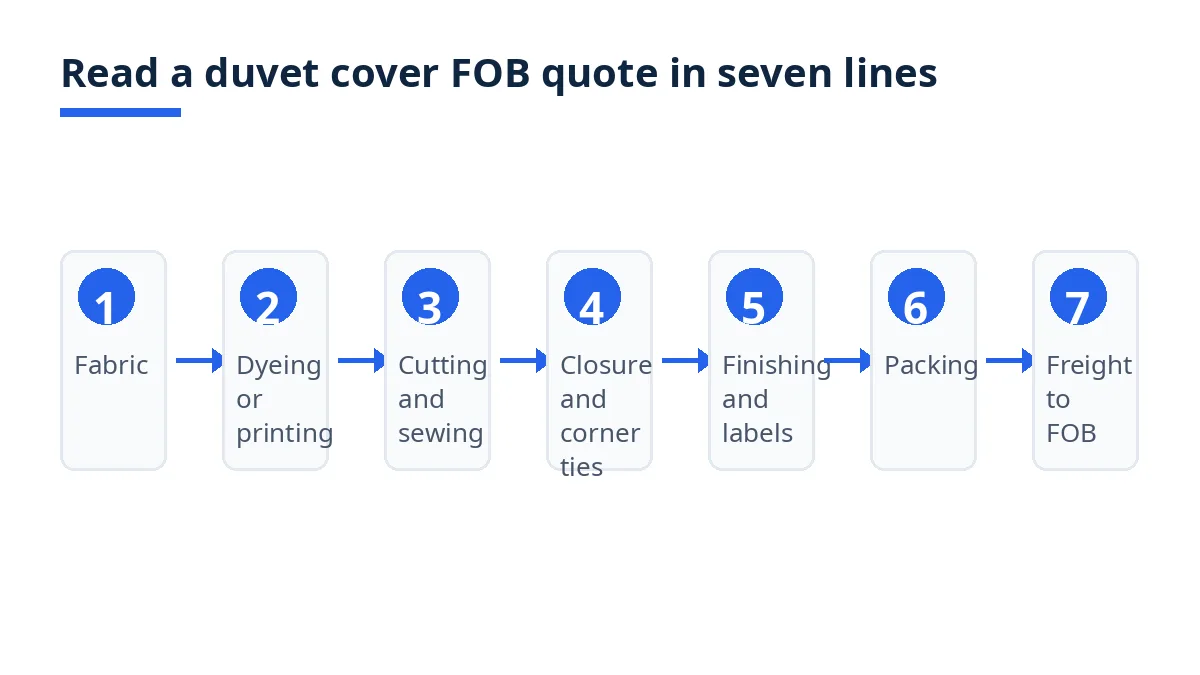
Fabric, dyeing or printing, cutting and sewing, closure and corner ties, finishing and labels, packing, and freight to FOB are the seven lines to compare.
Ocean freight, insurance, import clearance and destination transport sit outside FOB and must be priced separately.
A lower FOB total may mean a simpler cover, a different finish, or a narrower price boundary, not a saving on the same cover.
Exportain verification is a document and photo review, not a factory inspection, and a badge is not a guarantee.
A duvet cover price quoted FOB Bangladesh is not one number. It is a stack of cost lines that ends at the vessel, and each line moves for a different reason. Read the stack line by line, and a cheaper quote stops looking like a saving and starts looking like a different cover, finish, or price boundary.
This guide is for buyers in the United States, the United Kingdom, the European Union and the United Arab Emirates who buy duvet covers from Bangladesh. It covers only the FOB cost breakdown: what sits inside an FOB price, what moves each component, and how to compare two quotes on the same boundary. It does not cover minimum negotiation, private-label brand ownership, or the OEM tech-pack process. For the ordering route, see the how to import duvet covers from Bangladesh guide.
Under FOB, the seller delivers the goods loaded on board the vessel nominated by the buyer at the port of shipment, and risk transfers to the buyer at that point.1 The Incoterms 2020 rules give a clear allocation of cost, risk and obligations for each rule.2 Everything before loading sits inside the FOB price, and everything after loading sits outside it.
Why this matters for buyers and sellers
What should I know first about duvet covers?
A duvet cover is an empty sewn envelope for a separate insert, closed at one end and often sold alone or in a set with pillowcases. Empty duvet covers are bed linen in heading 6302.3 That distinction matters, because a filled duvet is different goods with a different cost stack, and must never be priced as if it were an empty cover.
For the buyer, the breakdown protects the specification: fabric weight, print method, closure type and packing each change the price, so a quote without one hides which changed. For the seller, it protects the margin, because dyeing, printing, corner ties, piping and carton packing are real operations with real inputs.
The most common pricing dispute here is about the boundary: whether the price includes inland transport, terminal handling, loading, export clearance, inspection, labels and cartons, or whether some lines were left out and will appear later as extra charges.
Step-by-step: how it works
Read every FOB quote in the same seven lines, in the same order, and ask for any missing line to be stated separately.
Ask for the FOB boundary in writing. Name the port of shipment and confirm that the price covers the goods loaded on board. Under FOB, the seller transports the goods to the port, loads them on board the buyer-nominated vessel, and completes export formalities.1
Split the cover into its parts. Ask for fabric, dyeing or printing, cutting and sewing, closure and corner ties, finishing and labels, and packing as separate lines.
Fix the specification behind each line. Record fibre, weave, finished weight, size, colour or print, closure type and position, corner ties, and set composition. A quote for a different weight or closure is a quote for a different cover.
Add the freight-to-FOB lines. Ask for inland transport, terminal handling, loading and export clearance to be shown apart from the factory price, even when the seller quotes a single FOB figure.
State what is excluded. Ocean freight, marine insurance, import clearance and destination transport sit outside FOB. Under FOB, the buyer contracts the carrier, pays transport costs, and carries out import formalities.1
Compare totals only after the lines match. Two totals can be compared only when both cover the same fabric, finish, closure, packing and port boundary. If one quote leaves out inspection or cartons, add that line first.
Freeze the breakdown in the order. Put the agreed lines, the port and the exclusions on the quotation and the purchase order, so a repeat order is priced from the same stack.
For containerised cargo, weigh FOB against FCA before you settle the term. When goods are containerised, the seller typically delivers them to a container terminal rather than on board, and in such cases FCA is the more appropriate rule.1 That choice changes which freight-to-FOB lines belong in the price.
Costs, timelines and documents
What are the typical costs and timelines?
There are no typical FOB costs a guide can state as market rates, because each mill prices your fabric, finish, closure and packing for your sizes and colours. What can be stated is the structure below: the lines that make up the price, and what moves each line. Treat every figure in it as illustrative only.
FOB cost line | What it covers | What moves it |
|---|---|---|
Fabric | Two full panels, plus pillowcase fabric in a set | Fibre, weave, finished weight, width, and whether fabric is woven in-house or bought in |
Dyeing or printing | Colour or print on the fabric, shade-matched across the set | Solid, yarn-dyed, or print; print colours; shade tolerance |
Cutting and sewing | Cutting two large panels and sewing long, straight seams | Size range, seam construction, marker fit |
Closure and corner ties | Buttons, zip, envelope flap, piping, ties or loops | Closure type and position, button count, piping length |
Finishing and labels | Washing, pressing, fibre, care, size and hang labels | Finish, label count and print method, market marking |
Packing | Inner packing, poly bags, cartons, carton marking | Pieces per carton, carton quality, set packing |
Freight to FOB | Inland transport, terminal handling, loading, export clearance | Distance to port, carton volume and weight, clearance route |
Example figures: the two builds below show structure only, not market rates, not typical prices, and not quotes from any mill. The plain build totals 6.80 per cover and the printed build totals 8.85 per cover, and the difference sits in printing, a heavier sewing load, and a more detailed closure, not in a single unexplained gap.
Example figures, per cover | Plain white cover | Printed cover with piping |
|---|---|---|
Fabric | 3.20 | 4.10 |
Dyeing or printing | 0.85 | 1.25 |
Cutting and sewing | 1.10 | 1.35 |
Closure and corner ties | 0.35 | 0.60 |
Finishing and labels | 0.30 | 0.40 |
Packing | 0.45 | 0.55 |
Freight to FOB | 0.55 | 0.60 |
Total FOB, example figures | 6.80 | 8.85 |
Read the example figures as a worked comparison, not as a price list. In the plain build, fabric accounts for the most, because two full panels go into every cover before sewing starts. In the printed build, the print and closure lines both rise, because printing adds an operation and piping adds sewing along the edge. If a real quote is lower, ask which line fell: a lighter fabric, a simpler closure, a different print method, or a narrower FOB boundary.
Timelines follow the same logic. Sampling depends on fabric availability and correction rounds, and bulk time on dyeing or printing, finishing, trim delivery and line capacity. Ask for sampling, fabric ready, production, inspection and port-ready dates as separate lines. A cover is not FOB-ready when sewing ends, but when it is loaded on board.
Which documents are needed?
For export clearance in Bangladesh, goods shall not be loaded or stuffed in containers for export unless an export declaration, known as the Bill of Export or Shipping Bill, is submitted to Customs in a prescribed format and approved.4 The documents enclosed with it for all export consignments include the export letter of credit, or where there is none, the export contract or purchase order or export guarantee approved by the negotiating bank, the commercial invoice, the packing list, the EXP form certified by Authorized Dealers, the certificate of origin issued by the EPB or a Chamber of Commerce and Industry, the VAT registration certificate, and the Taxpayer Identification Number.4
For the buyer, the order documents are the specification summary, the itemised quotation with the FOB lines above, and the purchase order carrying the same lines, the port of shipment and the exclusions. Keep the commercial invoice, packing list and certificate of origin with the shipment file, because their values and descriptions must match the quotation lines they settle.
Bangladesh-specific rules and tips
Confirm the fibre label before bulk sewing starts. In the European Union, a textile product shall be labelled or marked with the name and percentage by weight of all constituent fibres in descending order.5 Agree the wording at sampling stage and check that the percentages match the fabric actually bought, because a label change after bulk sewing means relabelling finished covers.
Keep one description across every paper. The export declaration specifies the description of goods, value, name of the exporter, name of the foreign buyer or importer, and name of the transport operator.4 The description, size, colour and set composition on the quotation, proforma invoice, packing list and Bill of Export should match, because a mismatch at clearance can push loading past the vessel window.
Price inspection as its own line. ISO 2859-1:2026 defines a system of acceptance sampling plans for inspection by attributes, and AQL stands for acceptance quality limit, the maximum average percentage of defective items considered acceptable during random sampling, used to determine sample sizes and acceptance or rejection thresholds.6 Agree the inspection level and AQL values before production, and show inspection as a separate line, so it is not the first line dropped when a quote is pressed down.
Check the set as a set, not piece by piece. A cover sold with pillowcases carries shade risk across pieces, so price shade matching and set packing as their own lines, and inspect the finished set together. See the duvet covers quality control checklist for piece-level points to agree before production.
Mistakes and red flags
What are the most common mistakes?
Comparing FOB totals on different boundaries. A quote that leaves out inland transport, terminal handling or export clearance is not cheaper than a quote that includes them. It is a shorter stack. Compare only quotes with the same port, loading point and inclusions.
Comparing totals on different covers. A lighter fabric, a plain colour instead of a print, an envelope flap instead of a zip, and no corner ties are four different covers. A lower total on a simpler cover is a specification change, not a saving.
Accepting a single-line FOB price with no breakdown. Without lines, you cannot tell whether a price rise came from fabric, print, closure or freight to the port. Ask for the seven lines before you accept.
Treating the FOB price as a landed cost. Ocean freight, insurance, import duty, import clearance and destination transport sit outside FOB, and they vary by route, market and entry date. Price the landed cost separately, from the FOB figure upward.
Reading a badge as a price or quality guarantee. Exportain verification is a document and photo review, not a factory inspection, and a badge is not a guarantee of production capacity, product quality or delivery.7 Sample approval and inspection stay with the buyer.
Paying for a specification change twice. If you change the closure, the print or the packing after the price is agreed, record the change as a priced amendment to the same stack, with the old and new lines both shown.
Checklist
Before you accept an FOB quote, every line below should be answered.
Port named, FOB boundary stated as loaded on board.
Seven cost lines shown separately: fabric, dyeing or printing, cutting and sewing, closure and corner ties, finishing and labels, packing, freight to FOB.
Specification fixed behind each line: fibre, weave, weight, size, colour or print, closure, corner ties, set composition.
Exclusions stated: ocean freight, insurance, import clearance, destination transport.
Inspection level and AQL agreed, inspection priced as its own line.6
Label wording agreed, with fibre percentages in descending order for the European Union.5
Export set agreed: Bill of Export, invoice, packing list, EXP form, certificate of origin.4
Repeat pricing from the same stack, any change recorded as a priced amendment.
How Exportain helps
On Exportain, browse suppliers and post a request for quotation on the RFQ board with your specification summary, the seven FOB lines, and your port of shipment, so suppliers quote against the same stack and boundary. Ask each reply to state its inclusions and exclusions in the same seven lines.
Read the badges for what they record. Exportain Verified means Exportain has checked identity, phone, email and business registration, and Export Verified means it has checked the Export Registration Certificate (ERC).7 Factory Verified means it has reviewed photos of the manufacturer factory, while Trading Company Verified means it has reviewed photos of the trading company office or warehouse.7 Verification is a document review by staff, free, and never granted by membership plans.8 It is not a factory inspection,7 8 so sample approval and inspection stay with you. See the HS code for duvet covers guide for the classification lines behind your order description.
FAQs
What should I know first about duvet covers?
A duvet cover is an empty sewn envelope for a separate insert, and empty covers are bed linen in heading 6302.3 An FOB price is a stack of lines ending at loading on board, not a single figure, and should be read line by line before any total is compared.
What are the typical costs and timelines?
There are no typical FOB costs or timelines a guide can state as market rates, because each mill prices your fabric, finish, closure and packing. The lines are fabric, dyeing or printing, cutting and sewing, closure and corner ties, finishing and labels, packing, and freight to FOB. Example figures show structure only.
Which documents are needed?
The order documents are the specification summary, the itemised quotation, and the purchase order carrying the same lines and port. The export set is the Bill of Export, commercial invoice, packing list, EXP form certified by an Authorized Dealer, and certificate of origin issued by the EPB or a Chamber of Commerce and Industry.4
What are the most common mistakes?
The most common mistakes are comparing FOB totals on different boundaries or different covers, accepting a single-line price with no breakdown, treating the FOB price as a landed cost, and reading a badge as a guarantee. Under FOB, the buyer contracts the carrier, pays main transport costs, and handles import formalities.1 A badge is not a guarantee of capacity, quality or delivery.7
Next steps on Exportain
Browse suppliers, then post your specification summary, the seven FOB lines and your port on the RFQ board so suppliers quote the same stack. Before you confirm, read the how to import duvet covers from Bangladesh guide and check the HS code for duvet covers lines for your order.
Sources
- FOB & FAS Incoterms® 2020 explained: Key differences. ICC Academy (accessed )
- Incoterms® 2020. International Chamber of Commerce (ICC) (accessed )
- HS Code for Duvet Covers. Exportain (accessed )
- Customs Clearance Procedures for Export. Bangladesh Customs, National Board of Revenue (accessed )
- Regulation (EU) No 1007/2011 on textile fibre names and related labelling and marking of the fibre composition of textile products. European Union, (accessed )
- ISO 2859-1:2026 - Sampling procedures for inspection by attributes — Part 1: Sampling schemes indexed by acceptance quality limit (AQL) for lot-by-lot inspection. ISO (accessed )
- Trust & Safety Center. Exportain (accessed )
- Supplier verification: Earn trust badges buyers can see. Exportain (accessed )
About the author
Sourcing from Bangladesh?
Post a request for quotation and suppliers on Exportain can send you their quotes directly.
Post an RFQ