

Denim Jackets Price in Bangladesh: FOB Cost Breakdown for Buyers
No single denim jacket FOB price in Bangladesh: how shell, lining, hardware, wash and packing build the quote, and how to compare quotations on the same jacket specification.
Short answer
A denim jacket FOB price from Bangladesh is a build-up of shell denim, lining cloth, a hardware set of rivets, buttons and zips, lined sewing, a laundry cycle approved by shade, packing and delivery to the vessel. Compare quotations only on the same shell, lining, hardware set, wash shade and delivery term.
On this page
Key takeaways
A denim jacket FOB price is a build-up of shell denim, lining cloth, hardware, lined sewing, washing and packing, not a single market figure.
Shell, lining, hardware finish and wash shade move a jacket quotation more than a small change in shell weight.
A lined, washed sample approved in writing is the control for bulk shade, lining fit and closure performance.
Hardware and lining ready dates must sit in the timeline apart from shell ready dates, since a jacket cannot finish while either is missing.
Exportain verification is a document and photo review, not a factory inspection, and a badge is not a guarantee.
A denim jacket quotation changes in places a jeans quotation does not reach. The outer shell is only the first layer: a jacket also carries a lining, a collar and cuff assembly, a front closure with its own hardware, and a wash that must hold its shade across the shell and any pocket fabric at the same time. When two suppliers quote different figures for jackets that look alike in a photograph, the difference is usually sitting in one of those jacket-only lines, not in a general discount.
Read a denim jacket FOB figure as a bundle of jacket lines, not a single number. FOB, Free On Board, is one of the Incoterms 2020 rules, which provide 11 rules with a clear allocation of cost, risk and obligations.1 Under FOB the price covers the goods up to loading on board the vessel at the named port, while ocean freight and import duty in the buyer's market fall outside it. Two jacket quotations only compare when they share the same term, the same port, the same shell, the same lining and the same wash.
Classification comes before any price discussion. Heading 6203 covers men's or boys' suits, ensembles, jackets, blazers, trousers, bib and brace overalls, breeches and shorts, other than swimwear, not knitted or crocheted.2 Heading 6204 covers the women's or girls' equivalents, including jackets and blazers, not knitted or crocheted.3 A jacket order therefore sits in the woven side of the Bangladesh garment trade. The Bangladesh Garment Manufacturers and Exporters Association (BGMEA) began its journey in 1983, and around 60 percent of its member factories are woven garment manufacturers.4
Why this matters for buyers and sellers
For a buyer, a jacket is a layered purchase, and a price agreed on the shell alone leaves the rest of the garment unpriced. A lined jacket needs lining cloth, lining cutting and lining sewing, and a quilted or brushed lining adds a further material and a further sewing pass. A buyer who approves a shell sample and then discovers the lining was never specified has approved only part of the order.
For a seller, the jacket's hardware and wash create commitments that cannot be undone cheaply. Rivets, buttons, snaps and zips are ordered in a stated finish and size, and a wash recipe is set for a stated shade. If the buyer changes the lining or the hardware finish after cutting, the seller must reorder hardware, re-cut lining or re-run the laundry, and each of those steps lands on the unit price or the delivery date. Naming the lining, the hardware set and the wash recipe in the first enquiry protects both sides from that rework.
The jacket also carries a shade problem that a single-cloth garment does not. The shell, the pocket bags, the collar underside and any contrast panel must read as one garment after washing, even though they may be cut from different cloth lots. A shade approval that covers only the shell leaves the buyer exposed to a jacket whose pockets look darker than its body.
Step-by-step: how it works
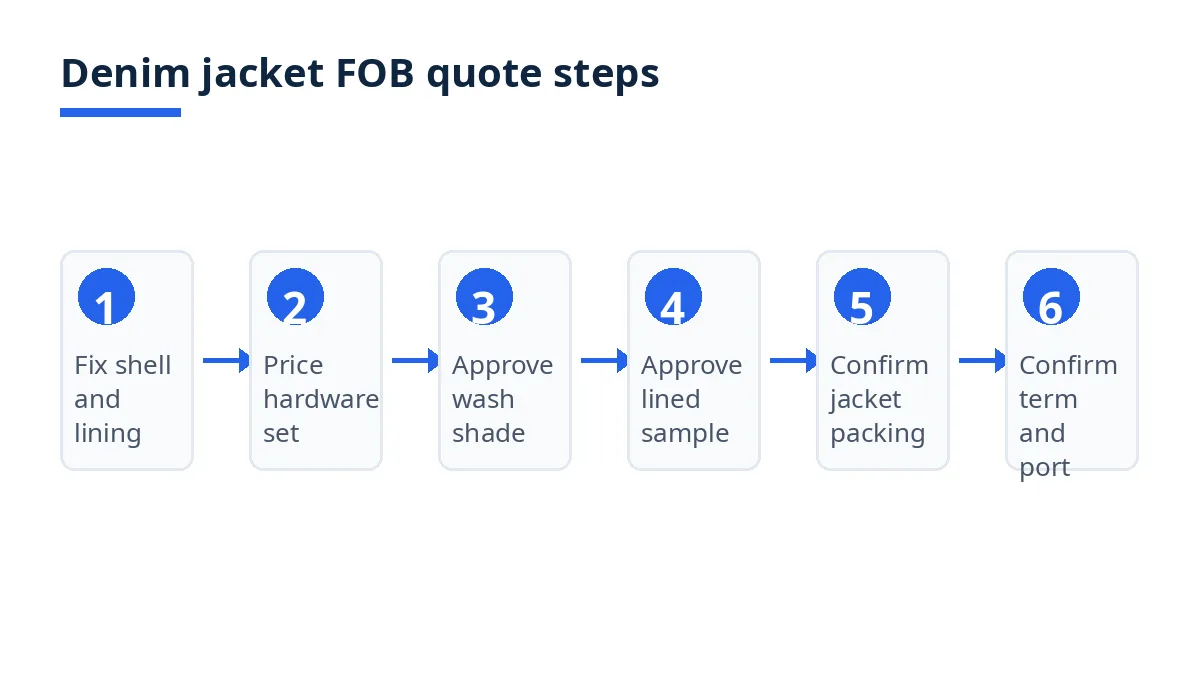
Fix the shell, the lining and the silhouette together. State the denim weight and composition, the lining type, whether the jacket is lined through the body only or through body and sleeves, the collar style, the cuff style and the front closure. A trucker style, a collarless style and a hooded style use different pattern pieces and different sewing time, so the silhouette belongs in the first message.
Price the hardware as a set, not as an afterthought. List every rivet, button, snap and zip by position, size, finish and supplier sample reference. Ask whether the hardware price is included in the unit price or billed as a separate line, and whether a change of finish restarts the hardware lead time.
Agree the wash by shade, not by name alone. State the wash name, the target shade on a physical swatch, the tolerance for shade variation across the order, and whether the wash is applied before or after the lining is attached. Approve the washed sample in writing before bulk washing starts.
Approve a lined, washed sample. Measure the sample after washing, check the lining fit inside the shell, test every closure, and check that pocket bags and panels match the shell shade. Record corrections in writing and re-approve after any change to shell, lining, hardware or wash.
Lock the size run and the packing for jackets. Jackets are bulkier than flat garments, so state the size ratio, the fold, the polybag type and the pieces per carton. Ask for carton dimensions and weight, since jacket cartons fill a container faster than trouser cartons at the same piece count.
Confirm the delivery term and the port in the same document as the price. State one Incoterm and one named port for every quotation.1 Compare jacket quotations only on that shared basis, with the lining, hardware and wash lines visible in each reply.
Costs, timelines and documents
What are the typical costs and timelines?
There is no published standard FOB price for denim jackets from Bangladesh, and this guide states none. Each factory prices the shell cloth per metre, the lining per metre, the hardware set, cutting and sewing for a lined garment, the laundry cycle, labels and packing, and delivery to the vessel at the named port.1 The lines that move a jacket quotation most are the ones a buyer most often leaves vague: lining choice, hardware finish, wash depth and carton packing for a bulky garment.
Example figures: a jacket order is split into shell cloth, lining cloth, hardware, sewing, wash, packing and delivery to the vessel. If the lining is changed from an unlined body to a quilted body-and-sleeve lining, the lining cloth line, the lining sewing line and the carton size all move, while the shell cloth line stays the same. The example shows structure only, not a typical price, and the same change in a different order would move the total by a different amount.
For timelines, sampling depends on shell and lining availability, hardware samples and wash approval rounds, while bulk production depends on lining delivery, laundry capacity and hardware delivery. Ask for sampling, lining ready, hardware ready, bulk washing and inspection dates as separate lines, not as one delivery week. A jacket order that waits on one hardware finish waits on the whole order, so the hardware ready date belongs in the timeline from the start.
Which documents are needed?
The order documents are the tech pack with shell, lining, hardware and wash lines, the itemized quotation showing each jacket line, and the purchase order carrying the approved sample reference and the delivery term.1 For export clearance, see the single pointer in the Bangladesh section below rather than a restated list: the buyer should confirm the export set with the supplier and the freight handler before the goods are booked.
Bangladesh-specific rules and tips
Confirm woven capability, not only garment capability. A factory that sews knitwear well may not cut and sew a lined woven jacket to the same standard. BGMEA represents the readymade garment industry, and around 60 percent of its member factories are woven garment manufacturers,4 so ask which woven jacket styles the factory has produced, and ask for a lined jacket sample rather than a flat woven sample.
Treat the laundry as a separate supplier relationship inside the order. Many jacket washes run in a laundry that is not the sewing factory, so the wash recipe, the shade tolerance and the laundry lead time need their own lines in the quotation. If the laundry changes its recipe between the sample and bulk, the shade of the whole order can shift, so the approved washed sample is the control for bulk, and any recipe change needs a fresh approval.
Check lining and hardware supply before confirming the shell. Lining cloth and metal hardware can arrive later than shell denim, and a jacket cannot be finished while either is missing. Ask for the lining source, the hardware source and their ready dates in writing, and confirm whether a lining or hardware delay moves the bulk washing date or only the sewing date.
Keep one legal name across every paper. For export clearance in Bangladesh, goods may not be loaded unless an export declaration, the Bill of Export or Shipping Bill, is submitted to Customs and approved.5 The declaration names the exporter and the foreign buyer,5 so the name on the trade licence, quotation, proforma invoice and payment account should match. The full export set is listed on the Bangladesh Customs clearance page.5
Mind fibre labelling for the market of sale. If the jacket sells into the European Union, Regulation (EU) No 1007/2011 states that a textile product shall be labelled or marked with the name and percentage by weight of all constituent fibres in descending order.6 A jacket with a cotton shell and a different lining composition needs both compositions stated correctly, and the lining fibre name belongs on the label, not only in the tech pack.
Mistakes and red flags
What are the most common mistakes?
Pricing the shell and forgetting the lining. A jacket quotation that names only denim weight and wash has left the lining unpriced. Ask for the lining cloth, the lining coverage and the lining sewing as visible lines before comparing any two figures.
Approving a wash on an unlined sample. An unlined sample cannot show how the lining will sit, shade or fit after the laundry cycle. Insist on a lined, washed sample, and check pocket bags and panels against the shell under the same light.
Accepting a hardware description without a finish and size. A button described only as metal can arrive in the wrong finish, the wrong size or the wrong shank type, and reordering hardware delays the whole order. Require position, size, finish and sample reference for every hardware piece.
Comparing jacket quotations on different linings or washes. A quilted lining, a deeper wash and a branded-look zip set are different garments, even when the shell denim matches. Compare only replies to the same tech pack, the same lining, the same hardware set, the same wash and the same Incoterm.1
Reading a profile or a badge as a jacket capability check. A profile is a starting point for enquiries. It does not test whether a factory can cut, line and wash your jacket, and a badge is not a guarantee of capacity, quality or delivery. Verification on Exportain is a document and photo review, not a factory inspection.7
Skipping shade tolerance in writing. Without a stated tolerance, a bulk order with visible shade drift has no agreed standard to judge it against. Write the tolerance, the light condition for checking and the approved swatch reference into the purchase order.
Checklist
Before you confirm, every line should be answered in writing.
Shell stated: denim weight, composition, width and source.
Lining stated: type, coverage, composition and source.
Silhouette stated: collar, cuff, closure and pocket layout.
Hardware set listed by position, size, finish and sample reference.
Wash stated by name, target shade swatch and tolerance.
Lined, washed sample measured, closure-tested and approved in writing.
Size ratio, fold, polybag and pieces per carton confirmed, with carton size and weight.
Lining ready date and hardware ready date confirmed apart from shell ready date.
Quotations compared on the same shell, lining, hardware, wash and Incoterm.1
Fibre labelling for the market of sale checked, including the lining.6
Export set confirmed with the supplier before booking, per the customs page.5
How Exportain helps
On Exportain, browse suppliers and post a request for quotation (RFQ) on the RFQ board with your jacket tech pack, lining and hardware lines, wash shade reference and delivery term, so suppliers quote against the same jacket specification. Ask each reply for its lining, hardware and wash lines apart from the shell price, and read how supplier verification works on Exportain and the MOQ guide before you confirm. Verification is a document and photo review, not a factory inspection.7
FAQs
What should I know first about denim jackets?
A denim jacket price is a build-up of shell cloth, lining cloth, a hardware set, lined sewing, a laundry cycle and packing, up to loading on board under FOB.1 Men's or boys' jackets sit under heading 6203,2 and women's or girls' jackets under heading 6204.3 Fix the lining, the hardware set and the wash shade before comparing quotations, because those three lines move a jacket price more than a small change in shell weight.
What are the typical costs and timelines?
There are no typical figures a buyer can rely on, because each factory prices your shell, lining, hardware, wash and packing for your specification, and each timeline depends on lining, hardware and laundry availability. Example figures in this guide show structure only. Ask for each cost line and each ready date separately, and compare quotations only on the same lining, hardware, wash and delivery term.1
Which documents are needed?
The order documents are the tech pack with shell, lining, hardware and wash lines, the itemized quotation and the purchase order carrying the approved lined, washed sample reference. For export, goods may not be loaded unless the Bill of Export or Shipping Bill is submitted to Customs and approved,5 and the full export set is listed on the Bangladesh Customs clearance page.5
What are the most common mistakes?
The most common mistakes are pricing the shell without the lining, approving a wash on an unlined sample, accepting hardware without finish and size, comparing quotations on different linings or washes, and reading a badge as a guarantee. Verification is a document and photo review, not a factory inspection,7 so sample approval and shade checks stay with the buyer.
Next steps on Exportain
Browse suppliers, then put your jacket tech pack with lining, hardware and wash lines on the RFQ board so every supplier prices the identical jacket. Before confirming, read how to import denim jackets from Bangladesh and the HS code for denim jackets guide.
Sources
- Incoterms® 2020. International Chamber of Commerce (ICC) (accessed )
- Classification Detail — HS Code 6203. United Nations Statistics Division (accessed )
- Classification Detail — HS Code 6204. United Nations Statistics Division (accessed )
- Bangladesh Garment Manufacturers and Exporters Association (BGMEA). Devex (accessed )
- Customs Clearance Procedures for Export. Bangladesh Customs, National Board of Revenue (accessed )
- Regulation (EU) No 1007/2011 on textile fibre names and related labelling and marking of the fibre composition of textile products. European Union, (accessed )
- Supplier verification: Earn trust badges buyers can see. Exportain (accessed )
About the author
Sourcing from Bangladesh?
Post a request for quotation and suppliers on Exportain can send you their quotes directly.
Post an RFQ


