

Custom Windbreakers Manufacturer in Bangladesh: OEM Process From Tech Pack to Bulk
Follow a custom windbreaker from tech pack to bulk: versioned specifications, pattern and grading, the sample ladder, lot-based shell and finish approval, pre-production sign-off, and final inspection in Bangladesh.
Short answer
Custom windbreaker OEM manufacturing in Bangladesh means a factory makes a windbreaker to your design and specification, working from a versioned tech pack through pattern and grading, proto and fit samples, lot-based material approval, a pre-production sample, and bulk production with final inspection. You control the shell, finish, seams, and trim decisions. Each stage ends with a written approval, and the pre-production sample is the bulk release gate.

On this page
Key takeaways
OEM means the factory makes the windbreaker to your design and specification, under a versioned tech pack, while you keep control of shell, finish, seam, and trim decisions.
The sample ladder proves construction, fit, and materials in stages, and the pre-production sample in production materials is the bulk release gate.
Approve shell, lining, coating or membrane, finish, and trims as lots, with the test standard, lot number, and report on file for the lots that ship.
Agree the inspection standard before production, with AQL values, inspection level, and defect classifications in the purchase order, and keep the sealed sample as the reference.
A trust badge records document and photo checks only, not a factory inspection, so sample approval, test evidence, and inspection stay with you.
A custom windbreaker made under an OEM arrangement starts with your specification, not with a factory catalog. In OEM production, the factory makes the jacket to the design and specification you supply, and you keep control of the design, the materials, and the construction decisions. Your job is to supply decisions a factory can build from, size after size and lot after lot. The factory's job is to turn those decisions into a repeatable shell garment.
The document that carries those decisions is the tech pack. For a windbreaker, the tech pack is a shell contract: it states the fabric, the weave, the finish, the seam construction, the hood, and the trims, and it states the test method and the acceptance level for every performance claim the jacket will carry. This guide follows that document from pattern work to inspection. Prices, minimums, and delivery dates come from quotations for your specification.
Why this matters for buyers and sellers
OEM and ODM answer different starting questions. Under OEM, the buyer supplies the design and the specification, and the factory produces the garments according to those specifications.1 Under ODM, the manufacturer supplies the design from its own range, and the buyer chooses from existing designs or works with the manufacturer to develop new ones. ODM can move faster when you have no in-house design capacity, but the design starting point belongs to the factory, so a second buyer can start from the same base. OEM keeps the starting point yours, at the cost of more work before sampling.
Model | Who supplies the design | Who controls materials and construction |
|---|---|---|
OEM | The buyer, in the tech pack | The buyer, through the tech pack and sample approvals |
ODM | The factory, from its own range | The factory, within the options it offers |
For the buyer, each gate answers one question before the next stage spends money. For the seller, a complete tech pack makes the quotation, the sample, and the bulk run answer the same document. A windbreaker tech pack has one feature a puffer or knit tech pack does not: the shell performance table. Wind resistance, water resistance, surface wetting, and vapor resistance are fabric properties with test methods, and the tech pack must name the method, the specimen state, and the result required, for each one.
Wind resistance is measured as air permeability. Wind-resistant and wind-proof properties of a fabric can be determined by the air permeability under a prescribed air pressure differential between the two surfaces of a material, with the air flow rate passing perpendicularly through a given area of fabric measured at a given pressure difference.2 The applicable methods include ISO 9237.2 ISO 9237 determines the permeability of fabrics to air, with a recommended pressure drop of 100 Pa for apparel fabrics.3 State the pressure drop and the test area in the tech pack: results at different pressures are not comparable.
Step-by-step: how it works
Work the process in order. A later gate cannot repair an earlier gate that was skipped, and a sample approved in the wrong shell proves nothing about bulk.
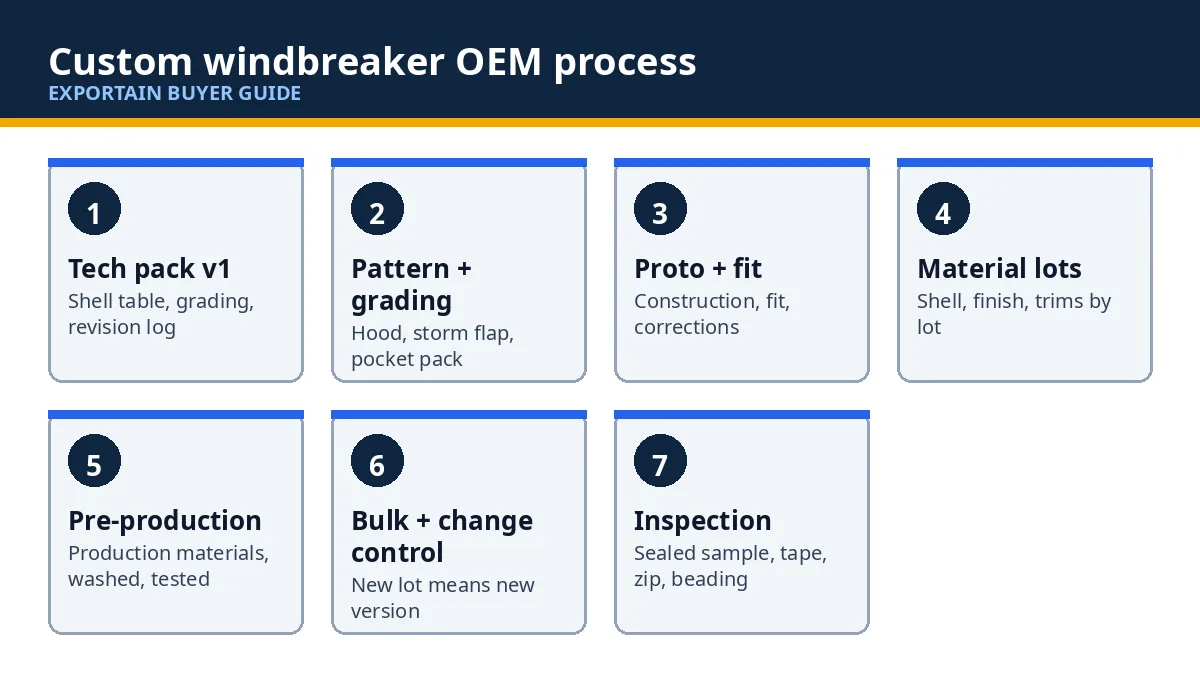
Freeze tech pack version one. Build one document per style. Include a cover page, flat sketches, a bill of materials, measurement specifications with a grading chart, construction notes, the shell performance table, a cost sheet, and a revision log. The version number matters: without it, a factory can build to an older iteration without either party knowing. Add the windbreaker decisions: shell fabric and weight, weave and denier, coating or laminate, DWR finish and chemistry, seam construction and tape, hood construction, zip and trim specification, packability, labels, packing, and the size and color plan.
Pattern, grading, and marker. The pattern maker builds the pattern from the flats and the measurement chart. The point-of-measure chart lists every dimension at base size, with a tolerance range for each measurement, and grading rules specify how each dimension changes across the size run. For a windbreaker, check the hood pattern, the storm flap overlap, and the pocket pack construction at the pattern stage: a hood that pulls the neckline or a pocket that will not hold the packed jacket is a pattern problem, not a sewing problem. Check the graded pattern against the chart before cutting a sample.
Proto and fit samples. Treat sampling as a ladder: prototype, fit sample, corrected sample, pre-production sample, and top-of-production sample. The proto sample proves construction: seam finishes, pocket placement, zip operation, hood fit, and toggle function. The fit sample proves measurements on the base size against the chart. Record corrections with photographs and a revised measurement page. Test the proto for beading and seam tape adhesion early: a finish or tape problem found at pre-production is expensive to fix.
Material approval by lot. Approve the shell, lining, mesh, membrane or coating, and trims as lots, not as catalog descriptions, and require test evidence for the lot that will ship. For water resistance, ISO 811 specifies a hydrostatic pressure method for determining the resistance of fabrics to penetration by water.4 For surface wetting, ISO 4920 specifies a spray test for determining the resistance of a fabric to surface wetting by water, and states that it is not intended for use in predicting rain-penetration resistance.5 For vapor resistance, the sweating guarded-hotplate test in ISO 11092 measures thermal resistance and water-vapour resistance under steady-state conditions, and a material with high water-vapour resistance loses vapor only gradually, so moisture builds up inside the garment.6 Ask for the standard, the lot, and the report for each check, and approve shade across shell, lining, hood, and pocket fabric under the same light.
Pre-production sample approval. Order the pre-production sample in the production shell, finish, lining, trims, labels, and packing. Measure and wash it, and check wind and water behavior, seam tape, stitching, zip operation, hood fit, and label wording on the physical sample. Approve it in writing. This written approval is the bulk release gate.
Bulk production with change control. Bulk runs through cutting by the approved marker, seam taping, sewing, and inline checks. Any change after pre-production approval needs a new tech pack version and a new sample where it affects fit, shell, finish, seams, or labels. A new shell lot, a new finish batch, or a new zip supplier is a change, even if the style number stays the same.
Final inspection against the approved record. Inspect bulk against the pre-production sample, the measurement chart, and the material lots. Keep the sealed sample as the shipment reference. Check performance on the finished jacket, not only on flat fabric: beading on the shoulders, tape adhesion at the hood and shoulder seams, and zip function under the storm flap.
Costs, timelines and documents
What the quotation should itemize
Ask for the quotation as lines: shell and lining, coating or laminate, cutting and sewing, seam taping, trims, labels, and packing, testing and set-up, inspection, and inland transport and port handling, each with its quantity basis and delivery term.
Example figures: structure only; every amount is an example figure, not a market price. An example total of 100 units divides as shell and lining 46 units, cutting, taping, and sewing 26 units, trims, labels, and packing 13 units, testing and set-up 9 units, and inland transport and port handling 6 units. If the shell line rises by 8 units and nothing else changes, the example total rises to 108 units.
Also ask how the minimum is counted: per order, per style, or per color. Confirm the basis in writing before planning the color and size mix. See the guide to MOQ meaning.
Timelines by gate, not by a single date
Ask for a date for each gate: tech pack freeze, pattern and grading, proto sample, fit corrections, material ready, pre-production sample, bulk start, inline checks, final inspection, and shipment readiness. Material readiness and correction rounds usually decide the timeline: dyeing, coating, finish application, and trim delivery run on lot schedules, and each correction round restarts pattern and sampling work.
Which documents are needed
Keep three sets in one order record, under one legal name for each party: the order set (tech pack, quotation version, purchase order, sample approvals), the product set (test reports naming the lot, finish declarations, label approvals), and the shipment set (invoice, packing list, transport document, origin or customs documents).
State one delivery term with its named place on every quotation. The Incoterms 2020 rules provide 11 rules with a clear allocation of cost, risk, and obligations, used globally since 1936 and updated in 2020.7 Quotations on different terms are not comparable on price alone.
Agree the inspection standard before production. ISO 2859-1:2026 specifies sampling schemes indexed by acceptance quality limit (AQL) for lot-by-lot inspection by attributes.8 AQL is the maximum percentage of defective items considered acceptable in a lot. Name the AQL values, level, and defect classifications in the purchase order, and add garment-level checks for tape adhesion, zip operation, and DWR beading.
Label approvals belong in the product set. In the European Union, a textile product shall be labelled or marked with the name and percentage by weight of all constituent fibers in descending order.9 Confirm care, origin, and fiber rules for the United States, the United Kingdom, the European Union, and the UAE before the label run, and check the care wording against the finish and coating.
Bangladesh-specific rules and tips
Treat classification as indicative, then confirm it. Heading 6201 covers anoraks including ski-jackets, wind-cheaters, wind-jackets and similar articles, men's or boys', not knitted or crocheted, and subheading 6201.93 covers anoraks, wind-cheaters, and wind-jackets of man-made fibers for men or boys.10 The matching women's and girls' subheading is 6202.93, covering anoraks, wind-cheaters, and wind-jackets of man-made fibers, other than those of heading 6204.11 Confirm the matching heading for women's styles and the full code with the destination tariff before filing, and confirm the code for knitted windbreakers separately.
Declare the finish chemistry. From 10 October 2026, Commission Regulation (EU) 2024/2462 restricts PFHxA, its salts, and PFHxA-related substances in textiles in clothing for the general public, at 25 parts per billion for the sum of PFHxA and its salts, or 1,000 parts per billion for the sum of PFHxA-related substances, measured in homogeneous material.12 The regulation names outdoor clothing like rain jackets among the products concerned.12 Name the finish chemistry in the tech pack, state whether it is fluorinated, and hold the test evidence for the lots that ship. A finish change after pre-production approval needs a new tech pack version and a new test record.
Confirm association and badge claims at the source. If a supplier claims membership of a trade association, confirm it with the association itself. The Bangladesh Garment Manufacturers and Exporters Association runs an online Membership Management System that issues an e-certificate of membership.13 Verification on Exportain is a document review by its team, not a factory inspection, and not a check against any government database.14 A badge is not a guarantee of production capacity, product quality, or delivery.14 See how supplier verification works on Exportain before you shortlist.
Check the export document set before loading. For export clearance in Bangladesh, goods shall not be loaded unless an export declaration, known as the Bill of Export or Shipping Bill, is submitted to Customs in the prescribed format and approved.15 The enclosed documents include the export letter of credit or the export contract or purchase order, the commercial invoice, the packing list, the EXP form, the certificate of origin, the VAT registration certificate, and the taxpayer identification number.15
Mistakes and red flags
Writing "waterproof" in the tech pack without a test method. A spray rating measures surface wetting.5 Hydrostatic evidence, seam treatment, and closures must match a waterproof claim.4
Approving a sample in the wrong shell. A proto in a substitute shell proves construction only. The pre-production sample must be in the production shell, finish, and trims, and the lot numbers must match the bulk lots.
Leaving the shell performance table out of the tech pack. Without the test method, specimen state, and acceptance level, a test report cannot be judged against the order, and a supplier cannot be held to a claim.
Accepting a finish change as a minor change. A new DWR chemistry, coating, or shell lot is a change. It needs a new tech pack version, a new lot approval, and a new test record.
Grading the hood and storm flap from the base size without checking them. A hood that fits at base size can pull at the largest size. Check the graded hood and flap before bulk cutting.
Red flags in a reply. Pause where a supplier will not work to a versioned tech pack, will not name the finish chemistry, will not provide lot-level test reports, offers a hydrostatic figure without the test method, or treats a badge as proof of shell capability.4 12 14
Checklist
Before you confirm, every line should be answered in writing, with version numbers that match the order record.
Tech pack frozen at version one, with the shell performance table, grading chart, and revision log.
OEM or ODM model chosen in writing, with design ownership stated.
Pattern, grading, and marker checked, including hood, storm flap, and pocket pack construction.
Proto and fit samples approved in writing, with corrections recorded.
Shell, lining, mesh, membrane or coating, and trims approved as lots, with test reports naming each lot.3 4 5 6
Finish chemistry declared, with PFHxA evidence for European Union sales.12
Pre-production sample in production materials measured, washed, performance-tested, and approved in writing as the bulk release gate.
Label proofs approved word for word for each market, with care wording checked against the finish.9
Inspection standard agreed, with AQL values, defect classes, and garment-level tape, zip, and beading checks.8
Quotation itemized by line, with the minimum quantity basis and delivery term stated.7
Export document set agreed, with one legal name on every document.15
Supplier checks completed: association claim confirmed, badges read for what they record.14 13
How Exportain helps
Exportain is a B2B marketplace where buyers find Bangladeshi suppliers, post requests for quotation, and compare versioned quotations. Use suppliers to shortlist factories by shell capability and lot control, then send each one the same versioned tech pack, shell performance table, and market list. Read the how-to-buy guide before you post. Exportain is not a party to the goods contract and does not inspect goods, book freight, or clear customs.
What should I know first about windbreakers?
Know the windbreaker as a shell system: the weave decides air passage, the finish decides surface wetting, the coating or membrane decides water penetration and vapor passage, the seams decide whether those results survive assembly, and the hood, zip, and toggles decide daily use. A tech pack that states only a fabric name and a color has not specified a windbreaker.
What are the typical costs and timelines?
There are no typical costs or timelines for custom windbreakers as a category that a buyer can rely on. Shell fabric, coating or laminate, finish chemistry, seam taping, trims, labels, quantity, the size and color plan, the delivery term, and the destination each move the figure.7 Ask for an itemized quotation, a date for each gate, and a validity date, and compare suppliers on the same itemization and delivery term.
Which documents are needed?
The order set is the versioned tech pack, the quotation version, the purchase order, and the sample approvals. The product set is the test reports naming each lot, the finish declarations, and the label approvals. The shipment set is the invoice, packing list, transport document, and origin or customs documents.15 For Bangladesh export clearance, the enclosed set includes the export letter of credit or the export contract or purchase order, the commercial invoice, the packing list, the EXP form, the certificate of origin, the VAT registration certificate, and the taxpayer identification number.15
What are the most common mistakes?
The most common mistakes are writing "waterproof" without a test method, approving a sample in the wrong shell, leaving the shell performance table out of the tech pack, accepting a finish change as a minor change, grading the hood and storm flap without checking them, and reading a badge as proof of shell capability.4 5 12 14
Next steps on Exportain
Browse suppliers and shortlist factories by shell capability and lot-level test evidence, then send each one the same versioned tech pack and shell performance table. Post a free RFQ on Exportain and get quotes from Bangladeshi suppliers → https://exportain.com/rfqs
Sources
- Understanding OEM and ODM in Apparel Manufacturing. JF Apparel (accessed )
- Wind Resistance / Wind-Proof Test. Intertek (accessed )
- ISO 9237:1995 - Textiles - Determination of the permeability of fabrics to air. International Organization for Standardization (accessed )
- ISO 811:2018 - Textiles - Determination of resistance to water penetration - Hydrostatic pressure test. International Organization for Standardization (accessed )
- ISO 4920:2012 - Textile fabrics - Determination of resistance to surface wetting (spray test). International Organization for Standardization (accessed )
- Measuring thermal and water vapour resistance. SATRA (accessed )
- Incoterms® 2020. International Chamber of Commerce (ICC) (accessed )
- ISO 2859-1:2026 - Sampling procedures for inspection by attributes — Part 1: Sampling schemes indexed by acceptance quality limit (AQL) for lot-by-lot inspection. ISO (accessed )
- Regulation (EU) No 1007/2011 on textile fibre names and related labelling and marking of the fibre composition of textile products. European Union, (accessed )
- HS, 2012 - Code 6201. United Nations Statistics Division (accessed )
- HS, 2012 - Code 620293. United Nations Statistics Division (accessed )
- Commission Regulation (EU) 2024/2462 amending Annex XVII to Regulation (EC) No 1907/2006 as regards undecafluorohexanoic acid (PFHxA), its salts and PFHxA-related substances. European Union (accessed )
- BGMEA launches Membership Management System to provide faster and simpler services. BGMEA (accessed )
- Trust & Safety Center. Exportain (accessed )
- Customs Clearance Procedures for Export. Bangladesh Customs, National Board of Revenue (accessed )
About the author
Sourcing from Bangladesh?
Post a request for quotation and suppliers on Exportain can send you their quotes directly.
Post an RFQ


