

Custom Terry Bathrobes Manufacturer in Bangladesh: OEM Process From Tech Pack to Bulk
Custom terry bathrobes from Bangladesh, step by step: tech pack, proto and pre-production samples, fit and fabric approvals, bulk production, inspection, and the export documents to settle before shipment.
Short answer
A custom terry bathrobe order from Bangladesh is a development project: the buyer writes a tech pack, the factory makes a proto sample, and each stage is approved in writing before the next starts. This guide follows the pipeline from tech pack to proto, fit and fabric approval, pre-production sample, bulk production, and final inspection.
On this page
Key takeaways
A custom terry bathrobe order is a development project: the tech pack, proto sample, fit and fabric approvals, pre-production sample, bulk production, and final inspection each lock a decision the next stage depends on.
Approve every sample by measuring it against the chart, not by looking at it, and record each approval in writing with photographs and measurements so bulk has a reference to be judged against.
Approve bulk fabric as a dyed lot against a sealed colour standard, not only as a lab dip, and agree a dye-lot plan before cutting so shade is controlled across sizes, colours, and cartons.
Never start bulk on a conditional pre-production approval and never skip the in-line inspection: a final inspection finds faults, while an in-line inspection prevents them in pieces not yet sewn.
Knitted or crocheted women's or girls' bathrobes sit under heading 6108, and EU and US labelling rules require fibre content in descending order, origin marking, and care instructions for each destination market.
A custom terry bathrobe order from Bangladesh is a development project before it is a bulk order. The buyer supplies the design intent, the factory turns it into a measurable specification, and both sides approve a physical sample at each stage before the next starts. This guide follows that pipeline: tech pack, proto sample, fit and fabric approvals, pre-production sample, bulk production, and final inspection. It is for a buyer placing a first custom order, or one whose bulk delivery differed from an approved sample and who wants to know which approval step failed.
A terry bathrobe is not a flat towel with sleeves added. It is a garment, with a pattern, a size range, and measurements checked at each stage. Treat every sample as a decision record, not a preview: a sample approved in writing, with measurements and fabric details attached, becomes the reference bulk is judged against.
Why this matters for buyers and sellers
For a buyer, the development pipeline is where cost and risk are set. Fabric, length, collar, pocket, belt, and embroidery choices are cheap to change in a tech pack and expensive to change after bulk fabric is cut. Approving a proto sample without checking belt loop position, pocket depth, or sleeve length against the chart means finding those faults in thousands of pieces, not one.
For a seller, a complete tech pack is the difference between a quotation that can be honoured and one that unravels. Quoting from a photograph, a factory cannot price terry weight, loop construction, dyeing, or trims accurately. Quoting from a full tech pack, it can price fabric, dyeing, sewing, embroidery, washing, packing, and inspection as separate lines.
Each approval stage also gives both sides a clean point to stop or correct before the next, larger commitment: a failed proto sample costs one sample, a failed bulk order costs a shipment.
Step-by-step: how it works
Work in this order: each stage locks a decision the next depends on.
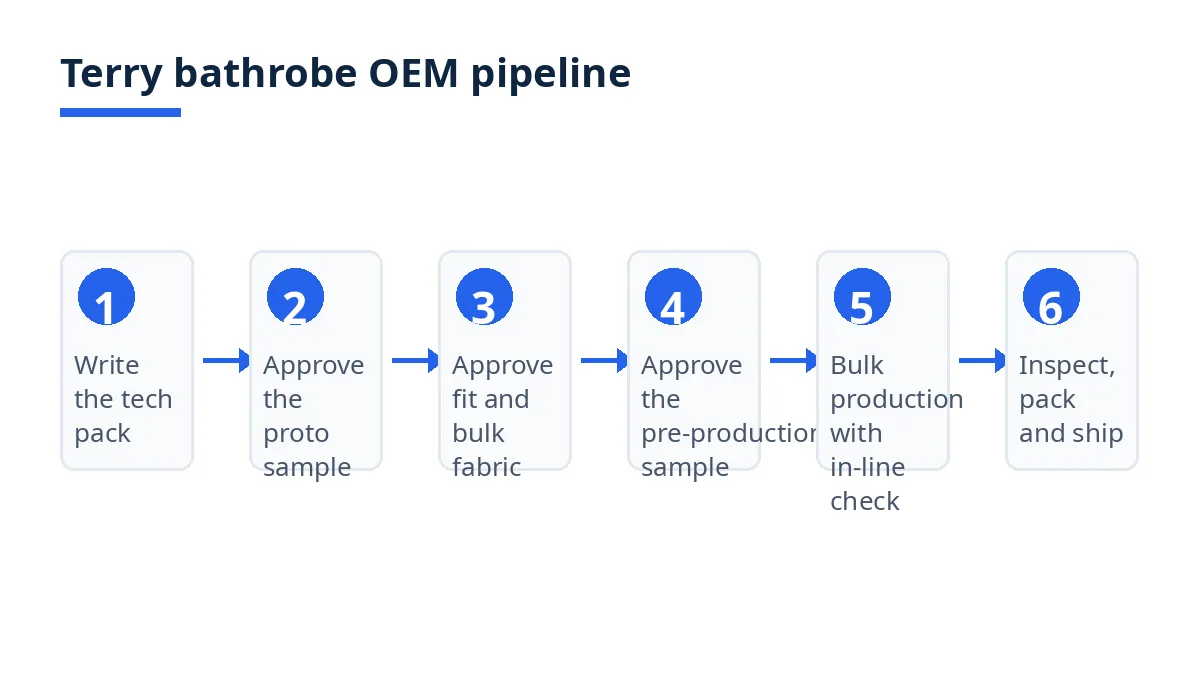
Write the tech pack. The tech pack is the single specification document for the robe: sketches or photographs, the measurement chart for every size, fabric specification (fibre, terry construction, weight per square metre, dyeing or printing method), colour standard with a physical swatch, collar style (shawl, kimono, or hooded), pocket and belt details, trim and label list, packing instruction, and tolerances. State tolerances as numbers, such as plus or minus 1 centimetre on body length.
Agree the quotation against the tech pack. Ask for the quotation broken into fabric, dyeing, sewing, embroidery or print, washing, packing, and inspection lines, with the delivery term stated once. The Incoterms 2020 rules set out 11 rules allocating cost, risk, and obligations between buyer and seller.1 Compare quotations only on the same delivery term, size range, and fabric weight.
Approve the proto sample. The factory makes one sample, usually in one size and one colour, from the tech pack. Check it line by line: measurements, collar shape, pocket position and depth, belt length and loop position, seam construction, and fabric hand feel. Record every deviation in writing, with a photograph of each fault, and ask for a corrected sample if the deviation touches fit, construction, or fabric. Never approve on appearance alone.
Approve fit across the size range and the fabric in bulk form. A robe fitting in medium may not grade correctly to extra large, so ask for a size set, or at minimum the smallest and largest sizes, measured against the chart. In parallel, approve bulk fabric: a dyed lab dip against the colour standard, and a wash test for shrinkage and colour change. Swatch approval and bulk-lot approval are different decisions; the second is the one that matters.
Approve the pre-production sample. Made from bulk fabric, trims, and labels, this is the last sample before cutting starts. Check it as a bulk piece: measurements, construction, embroidery or print placement, label wording and position, and packing. Its approval authorises bulk cutting; never approve conditionally with conditions unanswered.
Run bulk production with an in-line check. Production moves through fabric inspection, cutting, sewing, embroidery or print, washing, and packing. Ask for an in-line inspection partway through sewing, when faults can still be corrected in the remaining pieces, rather than only a final inspection when the order is finished. Measure against the approved pre-production sample, which is the current reference.
Inspect, pack, and ship against the approved sample. The final inspection measures finished, packed pieces against the pre-production sample, checks the size and colour mix per carton, and confirms label and packing against the order. Seal cartons only after that inspection.
Costs, timelines and documents
What sets the cost
There is no typical custom terry bathrobe cost: cost follows the tech pack. The main lines are fabric (fibre, terry weight, width), dyeing or printing, cutting and sewing, embroidery setup and running, washing, labels and packing, inspection, and freight under the agreed term. Two changes move cost most: heavier terry, which raises fabric and freight weight, and embroidery coverage, priced by stitch count and placement, not logo size. Keep each line separate, so a change in one line does not quietly move the total.
Example figures, for structure only: separate quotation lines show that removing sleeve embroidery changes only the embroidery line. These are not market rates; real prices come from the factory quotation against the buyer's own tech pack.
What sets the timeline
Timelines run in stages, and each stage needs its own date: tech pack completion, proto delivery and approval, size-set and fabric approval, pre-production delivery and approval, bulk cutting start, in-line inspection, final inspection, and shipment. A delay in proto approval moves every later date, so ask for stage dates in writing at quotation and re-confirm them at each approval. Do not accept a single delivery week for a custom order: one date hides which stage slipped.
Which documents sit in the order file
The order file holds the versioned tech pack, the quotation with the delivery term, the written approval for each sample stage with photographs and measurements, the purchase order, the packing instruction, and the inspection plan. The export set is separate: goods may not load until a Bill of Export, also called a Shipping Bill, is submitted and approved, and the standard export documents include the contract or purchase order, commercial invoice, packing list, EXP form certified by an authorized dealer bank, and a certificate of origin issued by the EPB or a Chamber of Commerce.2 The order file proves what was agreed; the export set proves what was shipped.
Bangladesh-specific rules and tips
Classify the robe by construction, not by product name. A knitted or crocheted women's or girls' bathrobe, dressing gown, or similar article sits under heading 6108, with the subheading following fibre: cotton, man-made fibres, or other textile materials.3 A woven bathrobe, a men's robe, and a child's robe follow different lines, so confirm the heading for the exact construction, gender, and fibre before export documents are prepared. The code on the packing list, invoice, and Bill of Export must match.
Settle labelling law for each market before the label is printed. In the EU, a textile product must be labelled or marked with the name and percentage by weight of all constituent fibres in descending order.4 In the USA, federal law requires that most textile and wool products have a label listing fibre content, country of origin, and the identity of the manufacturer or another business responsible for marketing or handling the product, and under the Care Labeling Rule, manufacturers and importers must provide cleaning instructions.5 Settle fibre wording, origin marking, and care instructions for each destination market before bulk labels are ordered. A label reading "100% cotton" cannot stay unchanged if bulk fabric becomes a cotton blend.
Approve colour against a physical standard, and keep it. Terry pile reads differently under warehouse, daylight, and retail light, and a screen photograph is not a colour standard. Approve colour against a physical dyed swatch, seal it as the reference, and judge bulk fabric against it under agreed lighting, one reference per colour.
Check the belt, the loops, and the pockets as a system. On a bathrobe, the belt is a functional part, not a trim. A belt that is too short, loops that sit too high, or pockets that pull the front open when loaded are faults a flat measurement chart can miss. Ask for the pre-production sample to be worn, belted, and photographed from the front and the side, with a pocket loaded, before approval.
Treat dye lots as a bulk decision, not a sample decision. Terry fabric dyed in separate lots can vary in shade, so a bulk order split across lots needs a lot plan: which lots go into which sizes and colours, and whether lots are mixed within a single carton. Agree the lot plan before cutting, and ask the final inspection to check shade across lots, not only within one carton.
Mistakes and red flags
Which mistakes repeat most often
Approving a proto sample that was never measured. A robe that looks right on a model but measures 3 centimetres short in body length is a failed sample. Measure every proto sample against the chart.
Approving fabric from a swatch and never from a bulk lot. A lab dip shows the colour is achievable; it does not show the bulk dye lot matches it. Approve the bulk lot, or accept shade variation in writing before cutting.
Approving the pre-production sample conditionally and starting bulk anyway. A conditional approval with unanswered conditions is not an approval; bulk cutting turns each condition into a bulk fault.
Skipping the in-line inspection. A final inspection finds faults; an in-line inspection prevents them in pieces not yet sewn. An order with only a final inspection has no correction stage.
Changing the design after the pre-production sample. A collar change, pocket move, or embroidery change after pre-production approval is a new development cycle, not a small edit. It needs a new sample, a new approval, and a price and timeline revision.
Reading a profile or a badge as a development guarantee. A supplier profile is a starting point for enquiries. Exportain verification is a document and photo review, not a factory inspection, and a badge is not a guarantee of development skill, capacity, quality, or delivery.6 Assurance comes from the tech pack, sample approvals, and inspection plan.
Red flags in a supplier reply
A reply that will not quote against the tech pack line by line, commit to a proto sample before bulk, state measurement tolerances, accept an in-line inspection, or explain shade control across dye lots is a reply to pause on. So is a lump-sum quotation with no cost lines, or a single delivery date with no stage dates.
Checklist
Before bulk cutting starts, every line should be answered in writing.
Tech pack complete and versioned: sketches, measurement chart for every size, fabric specification, colour standard, collar, pocket and belt details, trim and label list, packing instruction, tolerances.
Quotation itemised by cost line, with one delivery term stated and compared on the same term.1
Proto sample measured against the chart, deviations recorded with photographs, approval issued.
Size set, or smallest and largest sizes, measured and approved; bulk fabric lot approved against the sealed colour standard.
Pre-production sample from bulk fabric, trims, and labels, worn and belted, approved in writing with no open conditions.
In-line inspection date agreed, with the approved pre-production sample as reference.
Final inspection plan agreed: measurements, size and colour mix per carton, label and packing checks, shade checks across dye lots.
Labelling settled per destination market: fibre wording in descending order, origin marking, care instructions.4 5
Classification confirmed for the exact construction, gender, and fibre, matched across invoice, packing list, and Bill of Export.3
Export set agreed: contract or purchase order, commercial invoice, packing list, EXP form, certificate of origin, Bill of Export.2
Lot plan agreed before cutting: which dye lots go into which sizes, colours, and cartons.
How Exportain helps
On Exportain, browse suppliers and post a request for quotation on the RFQ board with the tech pack summary, size range, fabric weight, and delivery term, so suppliers quote against the same specification and stage dates. Ask each reply for its proto sample process, measurement tolerance, dye-lot control, and in-line inspection position. When you accept a quotation, Exportain creates one order and issues one proforma invoice from the accepted terms.6
Read the badges for what they record. Exportain Verified means Exportain has checked identity, phone, email, and business registration; Export Verified means it has checked the Export Registration Certificate (ERC).6 Factory Verified means it has reviewed photos of the manufacturer factory, and Trading Company Verified means photos of the trading company office or warehouse.6 Verification is a free document review, never granted by membership plans, and not a factory inspection.6
FAQs
What should I know first about terry bathrobes?
A terry bathrobe is a garment, not a towel with sleeves: a pattern, a size range, a measurement chart, and a sample approved at each stage. Write the tech pack first, agree tolerances as numbers, and approve the proto sample by measuring it, not by looking at it. Bulk is then judged against the approved pre-production sample, made from bulk fabric, trims, and labels.
What are the typical costs and timelines?
There are no typical figures to rely on: each factory prices the buyer's own tech pack (fabric, dyeing, sewing, embroidery, washing, packing, inspection, freight under the agreed term).1 Timelines run in stages, with a separate date for each sample, approval, and inspection. Example figures here show cost structure only, not market rates.
Which documents are needed?
The order file holds the versioned tech pack, itemised quotation, written approval for each sample stage, purchase order, packing instruction, and inspection plan. The export set holds the contract or purchase order, commercial invoice, packing list, EXP form certified by an authorized dealer bank, certificate of origin from the EPB or a Chamber of Commerce, and the Bill of Export.2 Labelling per destination market must be settled before bulk labels are ordered.4 5
What are the most common mistakes?
The most common mistakes are approving a proto sample without measuring it, approving fabric from a swatch and never from a bulk lot, starting bulk on a conditional pre-production approval, skipping the in-line inspection, changing the design after pre-production approval, and reading a profile or badge as a development guarantee. Each is cheap to avoid at its own stage and expensive to correct after bulk cutting.
Next steps on Exportain
Browse suppliers, then post your tech pack summary, size range, fabric weight, and delivery term on the RFQ board so suppliers quote against the same specification and stage dates. Before you confirm, read how supplier verification works on Exportain and the MOQ guide.
Sources
- Incoterms® 2020. International Chamber of Commerce (ICC) (accessed )
- Custom Clearance in Bangladesh: Port Procedures and C and F Agent Guide. Bizmend (accessed )
- HS Code 61089200 — Women's or girls' bathrobes, dressing gowns and similar articles of man-made fibres, knitted or crocheted. Tariff Number (accessed )
- Regulation (EU) No 1007/2011 on textile fibre names and related labelling and marking of the fibre composition of textile products. European Union, (accessed )
- Textile, Wool, Fur, Apparel and Leather Matters. Federal Trade Commission (accessed )
- How Supplier Verification Works on Exportain. Exportain, (accessed )
About the author
Sourcing from Bangladesh?
Post a request for quotation and suppliers on Exportain can send you their quotes directly.
Post an RFQ


