

Custom Shorts Manufacturer in Bangladesh: OEM Process From Tech Pack to Bulk
A custom shorts OEM order in Bangladesh, from tech pack to bulk: fabric and wash approval, proto and fit samples, grading, pre-production approval and bulk checks for one style.
Short answer
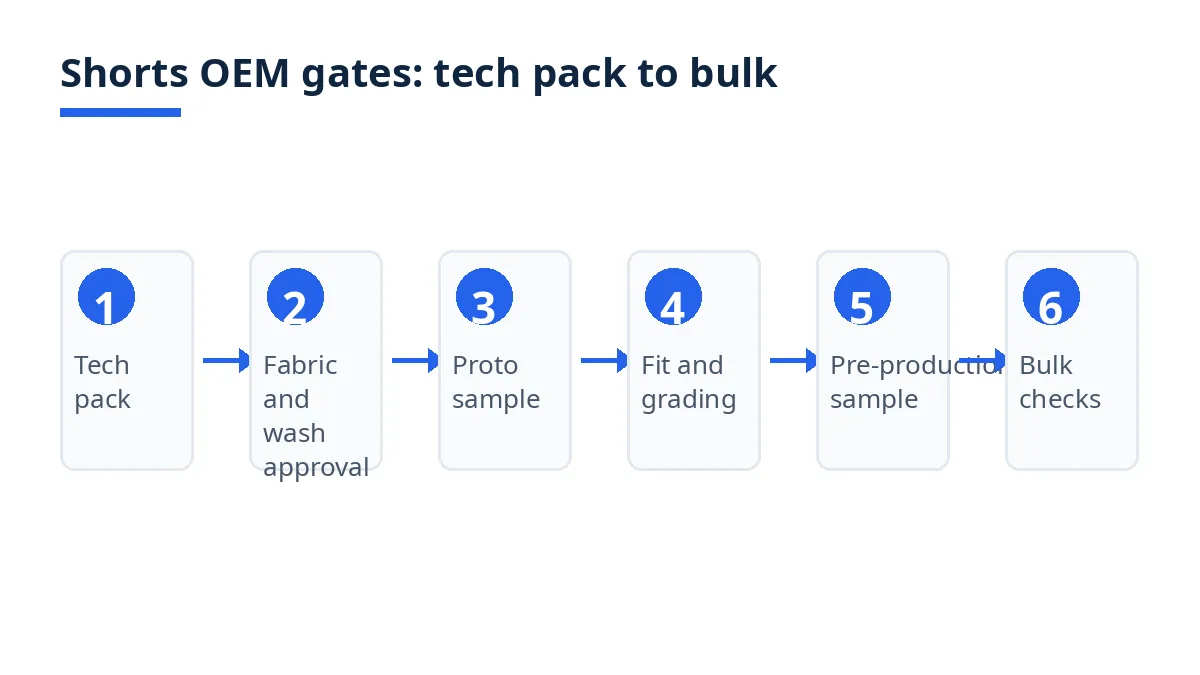
A custom shorts manufacturer in Bangladesh working on an OEM basis makes one style to your specification, through fabric and wash approval, a proto sample, fit samples, grading approval, a pre-production sample and bulk checks. Each stage is approved in writing before the next starts, so waistband, drawcord, stretch recovery, wash shade and washed measurements are fixed before bulk production begins.
On this page
Key takeaways
A custom shorts OEM order runs as a gate sequence: tech pack, fabric and wash approval, proto sample, fit samples, grading approval, pre-production sample, then bulk checks.
Shorts are judged at the waist and in movement, so waistband construction, drawcord end finishing, stretch recovery and washed measurements are checked at every sample round.
Fit is approved on washed samples in the actual fabric, across several sizes, and grading is approved size by size before the pre-production sample.
The pre-production sample, made in the actual production fabric, wash, trims and labels, is sealed as the bulk reference, and bulk is not released on a conditional approval.
Exportain verification is a document and photo review, not a factory inspection, and a badge is not a guarantee of capacity, quality or delivery.
A custom shorts manufacturer in Bangladesh working on an OEM basis makes one style to your specification: your fabric, your pattern, your waistband, your wash, your labels. The factory supplies cutting, sewing, washing where the style needs it, finishing and packing. You approve each stage before the next one starts.
This guide follows a single style from tech pack to bulk. It is written for a buyer in the United States, the United Kingdom, the European Union or the United Arab Emirates placing a first OEM order for shorts. The order is fixed: fabric approval, proto sample, fit samples, grading approval, pre-production sample and bulk checks.
Why this matters for buyers and sellers
For the buyer, the OEM sequence is where fit and shade are fixed. A short is a small garment with little room to hide an error: the waist carries the fit, the inseam and rise set how it sits, and the drawcord and elastic decide comfort in wear.
For the seller, the same sequence protects the production run. Starting bulk on an unapproved wash or an ungraded size set risks rework across the whole order. Written approval at each gate gives both sides one reference: the approved sample, lab dip and size chart.
Step-by-step: how it works
The sequence below treats each sample as a gate. Bulk does not start until the gate before it is approved in writing.
Write the tech pack that a cutter can follow. State the style, fabric composition, construction and weight, and the measurement chart with tolerances for waist, hip, front rise, back rise, inseam, thigh and leg opening. Add waistband construction, fly type, pockets, drawcord or elastic, trims, artwork, labels and packing. State the target markets, because market rules shape the label: if you sell into the European Union, Regulation (EU) No 1007/2011 states that a textile product shall be labelled or marked with the name and percentage by weight of all constituent fibers in descending order.1 Send the same pack to every candidate factory.
Approve the fabric, the lab dip and the wash before any sample is cut. Ask for the fabric swatch, the composition reference where one is available, and a lab dip for each color. For a washed style, ask for a wash trial on the actual fabric and agree the shade reference and tolerance band for bulk. Record the fabric weight, dye lot and wash reference in writing, and compare the lab dip and wash trial side by side under the same light.
Order a proto sample and check construction, not fit alone. The proto sample is usually cut in a substitute fabric, or in the intended fabric where it is available, and it answers one question: can this factory construct the style as drawn. Work the fly several times, pull the drawcord through the casing, check pocket depth and bartacks, and check that the waistband sits flat without twisting. List every correction in writing, numbered, against the tech pack section it refers to.
Approve fit on samples in your actual fabric and wash, across several sizes. Measure waist relaxed and extended on elasticated styles, because a waist that measures correctly relaxed can still fail in wear when the elastic does not recover. Check rise, inseam and leg opening on more than the middle size: fit drift hides at the ends of the size set. For a stretch fabric, stretch the waistband and check recovery after release. For a washed style, measure again after washing. ISO 5077 specifies a method for determining the dimensional change of fabrics, garments or other textile articles when subjected to specified washing and drying procedures.2 Set your bulk tolerance against the washed measurements.
Approve grading before the pre-production sample. Grading scales the approved fit from the base size to the full size set. Ask for the graded measurement chart and check it against your chart size by size, not only at the base size. A grading error at this gate repeats in every size in bulk. Confirm the size ratio per color at the same time, so cutting quantities match the order split.
Approve the pre-production sample as the bulk reference. The pre-production sample is made in the actual production fabric, color, wash, trims and labels, on the production line where possible. It becomes the sealed reference for bulk: measurements, shade, drawcord length and end finishing, pocket placement, label content and packing. Measure it, wash it where required, check the label fiber content against the fabric specification,1 and check the drawcord ends: knots, aglets or bartacks as the tech pack directs, so the cord cannot slip back into the casing. Approve it in writing, or list corrections and ask for a second sample.
Run bulk with inline checks and a final inspection against the approved sample. Inline inspection during sewing catches drift while correction is still possible: waistband setting, pocket placement and shade across dye lots. Final inspection draws a random sample across sizes, colors and cartons and checks it against the approved sample and the purchase order. ISO 2859-1 defines a system of acceptance sampling plans for inspection by attributes, indexed by acceptance quality limit (AQL) for lot-by-lot inspection.3 Agree the inspection level and the AQL values for critical, major and minor defects before production, and write them into the purchase order. See the shorts quality control checklist for the bulk points to check.
Stage | What you approve | What blocks bulk |
|---|---|---|
Tech pack | Construction, measurements, trims, labels | A missing waistband or wash detail |
Fabric and wash | Swatch, lab dip, wash trial | An unapproved color or wash |
Proto sample | Fly, pockets, drawcord operation | An uncorrected construction fault |
Fit samples | Washed measurements, several sizes | Fit approved on one unwashed size |
Grading | Graded chart, size ratio | A size set scaled from an unchecked base |
Pre-production sample | Bulk reference in actual fabric and wash | Open corrections |
Bulk checks | Inline control, final AQL inspection | A lot that fails acceptance numbers |
Example figures: a buyer orders a woven chino short in two colors. The proto sample shows a twisting waistband, corrected in the tech pack, and the fit sample measures short on the inseam after washing, so the graded chart is adjusted against the washed measurements. The example shows the gate sequence only, not a typical price, quantity or lead time.
Costs, timelines and documents
What are the typical costs and timelines?
There are no typical costs or timelines a guide can state as fact for a custom shorts OEM order. Each factory prices your fabric, waistband and pocket construction, wash, trims, label and carton runs, finishing, packing and the delivery term. A jersey short and a washed denim cargo short are different offers even at the same quantity, because the operations, wash and trim list differ.
For timelines, ask for each stage as a separate line: fabric and lab dip, wash development, proto, fit, grading, pre-production sample, bulk production, inspection and shipment. Sampling depends on fabric availability and correction rounds, and bulk production on dyeing, washing, trim delivery and line capacity. Agree one delivery term for every quotation: the Incoterms 2020 rules set out 11 rules with a clear allocation of cost, risk and obligations.4
Which documents are needed?
Your order documents are the tech pack, the itemized quotation, the purchase order carrying the split per style, color and size, the approved lab dip and wash reference, the graded chart, and the written sample approvals. The purchase order should also carry the inspection level and AQL values,3 the packing specification and the delivery term.4
For export clearance in Bangladesh, goods may not be loaded unless an export declaration, the Bill of Export or Shipping Bill, is submitted to Customs and approved.5 Enclosed documents include the export contract or purchase order where there is no export letter of credit, the commercial invoice, the packing list, the EXP form certified by an authorized dealer, and a certificate of origin.5 Keep one legal name across every paper, because the declaration names the exporter and the foreign buyer.5
Bangladesh-specific rules and tips
Start with the woven or knit base your style belongs to. Shorts in twill, canvas and denim belong with woven factories, and jersey and fleece shorts with knitwear lines. According to the Bangladesh Garment Manufacturers and Exporters Association (BGMEA) website as reported in December 2025, the association has around 4,500 member factories, of which about 60 percent are woven garment manufacturers.6 That scale does not prove that any one factory can hold your waistband, wash and shade standard. Ask which steps are in-house and where washing happens.
Confirm the classification for each style before you price. Woven shorts are classified with trousers, not as a standalone shorts heading: the tariff line for women's or girls' cotton shorts, excluding knitted or crocheted, panties and swimwear, sits under heading 6204.7 Confirm the full national code for each style before you price or ship.
Treat wash and shade as a controlled process, not a finish note. Agree the wash recipe, shade reference and shade band in writing, and approve bulk washing only after written shade approval on the actual fabric. Check shade across the size set side by side, and set the bulk tolerance against the washed measurements.2
Ask which inputs are bought in for your order. Elastic, drawcord, eyelets, zips, buttons and waistband tape may be bought in for your specification, and an imported trim can set both the earliest production date and a separate minimum. Agree the size ratio per color before production, and check it at final inspection. Proof the label file before labels are produced, because the fiber names and percentages must match the fabric you specified and the sample you tested.1
Mistakes and red flags
What are the most common mistakes?
Approving fit on an unwashed sample. Washing changes inseam length, waist recovery and shade. Approve fit on washed samples in your actual fabric and wash.2
Approving one size and one color. Fit drift hides at the ends of the size set, and shade drift in the color you checked least. Measure several sizes and compare every color against its lab dip.
Skipping grading approval. A correct base size with an unchecked graded chart produces a size set that drifts away from the base. Approve the graded chart size by size first.
Releasing bulk on a conditional approval. A pre-production sample with open corrections is not a bulk reference. Close every correction in writing first.
Checking the garment but not the drawcord and elastic. A short that measures correctly can still fail in wear when the drawcord slips into the casing or the elastic does not recover. Work both on every sample round.
Comparing quotations on different specifications. A lower price on a lighter fabric, a simpler wash, stock labels or a different delivery term is a different offer. Compare only replies to the same tech pack on the same Incoterm.4
Treating a profile or a badge as a production guarantee. A profile is a starting point for enquiries. It does not test whether a factory can make your short to your tolerances, and a badge is not a guarantee of capacity, quality or delivery.8
Checklist
Before you confirm, every line should be answered.
Tech pack sent: fabric, construction, waistband, fly, pockets, drawcord or elastic, trims, labels, packing.
Fabric approved: swatch, lab dip per color, wash trial and shade band for washed styles.
Proto sample checked for construction and operation, corrections listed in writing.
Fit approved on washed samples in actual fabric, across several sizes, waist relaxed and extended.
Grading approved size by size, with the size ratio per color confirmed.
Pre-production sample approved in actual fabric, wash, trims and labels, sealed as the bulk reference.
Drawcord ends finished as the tech pack directs, stretch recovery checked on elasticated styles.
Inspection level and AQL values in the purchase order.3
Quotations compared on the same specification and Incoterm.4
Export set agreed: invoice, packing list, EXP form, certificate of origin, Bill of Export.5
Label fiber content checked against the fabric specification.1
How Exportain helps
On Exportain, browse suppliers and post a request for quotation (RFQ) on the RFQ board with your tech pack summary, target markets and delivery term, so factories quote against the same specification. Ask each reply for its stage plan and the approval that releases bulk. When you accept a quotation, Exportain creates one order and issues one proforma invoice from the accepted terms.8
Read the badges for what they record. Exportain Verified means Exportain has checked identity, phone, email and business registration, and Export Verified means it has checked the Export Registration Certificate (ERC).8 Factory Verified means it has reviewed photos of the manufacturer factory, and Trading Company Verified means it has reviewed photos of the trading company office or warehouse.8 Verification is a document and photo review by staff, free, and never granted by membership plans.9 It is not a factory inspection,8 9 so sample, wash and inspection checks stay with you. See the shorts MOQ guide for the minimums alongside this process, and the HS code for shorts guide for classification detail.
FAQs
What should I know first about shorts?
Fix the construction family first: woven, knitted or washed denim. Then fix the gates: fabric and wash approval, proto, fit, grading, pre-production sample and bulk checks. Waistband, drawcord, stretch recovery and washed measurements matter more than any single price line.
What are the typical costs and timelines?
There are no typical figures a buyer can rely on, because each factory sets its price and lead time for your specification. Fabric, construction, wash, trims and the delivery term drive the price,4 and fabric availability, wash development and line capacity drive the timeline.
Which documents are needed?
The order documents are the tech pack, itemized quotation, purchase order with the split per style, color and size, approved lab dip and wash reference, graded chart and written sample approvals. The export set is the Bill of Export, commercial invoice, packing list, EXP form certified by an authorized dealer, and a certificate of origin.5
What are the most common mistakes?
The most common mistakes are approving fit on an unwashed sample, approving one size and one color, skipping grading approval, releasing bulk on a conditional approval, and comparing quotations on different specifications or terms.4
Next steps on Exportain
Browse suppliers, then post your tech pack summary and delivery term on the RFQ board so factories quote against the same specification. Before you confirm, read how to import shorts from Bangladesh and the shorts quality control checklist.
Sources
- Regulation (EU) No 1007/2011 on textile fibre names and related labelling and marking of the fibre composition of textile products. European Union, (accessed )
- EVS-EN ISO 5077:2008 - Textiles - Determination of dimensional change in washing and drying. EVS (accessed )
- ISO 2859-1:2026 - Sampling procedures for inspection by attributes — Part 1: Sampling schemes indexed by acceptance quality limit (AQL) for lot-by-lot inspection. ISO (accessed )
- Incoterms® 2020. International Chamber of Commerce (ICC) (accessed )
- Customs Clearance Procedures for Export. Bangladesh Customs, National Board of Revenue (accessed )
- BGMEA sets new membership criteria to ensure factory safety, operational standards. The Financial Express, (accessed )
- HS Code 62046290 - Women's or girls' cotton shorts. TariffNumber (accessed )
- Trust & Safety Center. Exportain (accessed )
- Supplier verification: Earn trust badges buyers can see. Exportain (accessed )
- supplier verification
- quality control
- buyer guide
- woven garments
- Bangladesh sourcing
- Shorts
- OEM manufacturing
About the author
Sourcing from Bangladesh?
Post a request for quotation and suppliers on Exportain can send you their quotes directly.
Post an RFQ


