Custom Medical Scrubs Manufacturer in Bangladesh: OEM Process From Tech Pack to Bulk
A first custom scrub program for a hospital group or clinic chain: how to brief departments and colors, build a set tech pack, grade petite to tall, trial fabric in the wash, and gate samples before bulk.
Short answer
A custom medical scrubs program in Bangladesh runs as a stage-gated OEM process: brief the departments and colors, build a tech pack for the top and pant as a matched set, grade the pattern from petite to tall, trial the fabric on the program laundry route, then pass proto, fit, wear-trial and pre-production samples in writing before bulk, with shade bands and an AQL inspection plan controlling delivery.
On this page
Key takeaways
A scrub program is a set system: top and pant must match in fabric lot, shade and wash behavior, and are approved as a pair, not as separate pieces.
Grade the pattern from petite to tall with pocket and length positions that move with the size, and fit-test the ends of the size curve, not only the middle.
Choose fabric against the laundry route: wash swatches in every department color and report color retention, shrinkage and pilling per color before bulk fabric is booked.
Gate samples in order: proto, fit on three points of the size curve, a real-shift wear trial, then a pre-production sample approved in writing.
Everyday clinical scrubs are workwear, distinct from surgical gowns, so do not demand surgical-gown barrier standards for ward wear.
A hospital group that dresses six departments in six colors has a different buying problem from a retailer that orders one scrub style in black. The retailer worries about one fit and one shade. The hospital group worries about whether the ceil blue top issued to nursing still matches the ceil blue pant after both pieces have been through the laundry fifty times, whether the petite nurse and the tall porter both get a waistband that stays put through a shift, and whether a replacement set ordered six months later arrives in the same color. A custom OEM program in Bangladesh is judged on those program questions, not on a single sample that looks right on a table.
This guide follows that program view from the first brief to bulk delivery, for a buyer placing a first custom scrub program for a hospital group, a clinic chain or a uniform program.
Scrubs sit in Bangladesh's woven garment sector. The Bangladesh Garment Manufacturers and Exporters Association (BGMEA) reports around 4,500 member factories, about 60 percent of them woven garment manufacturers, and its member factories account for 100 percent of woven garment exports.1 That woven base is the starting point, but it does not by itself answer whether a given factory can hold a department color system across sizes and repeat orders.
Why this matters for buyers and sellers
For the buyer, a scrub program is a uniform system, not a clothing purchase. Staff wear the sets every working day, the sets are laundered on a fixed cycle, and a mismatch between top and pant, or between this year's set and last year's, is visible to patients and to the wearer. A program that drifts in shade or fit creates replacement sets, re-issues and complaints that land on the uniform manager, not on the factory.
For the seller, a hospital program is attractive because once the pattern, the color system and the size curve are agreed, repeat orders reuse the same work. That is also why the first order carries the risk for both sides: every decision left vague at the start becomes a dispute in the first repeat.
The distinction that shapes the whole program comes early. Everyday clinical scrubs are workwear worn by healthcare staff, while surgical gowns are a separate protective product with their own barrier standards. The United States Centers for Disease Control and Prevention notes that EN 13795 is used for surgical gowns and that ANSI/AAMI PB70 classifies surgical and isolation gowns by liquid barrier performance.2 A buyer who asks a scrub factory for surgical-gown barrier certification on an everyday scrub set is asking for the wrong test on the wrong garment, and a factory that offers it without being asked should be asked which product the certificate actually covers. State in the brief whether the sets are everyday clinical wear or whether any part of the program is intended for use in a sterile area, and keep the two requirements apart.
Step-by-step: how it works
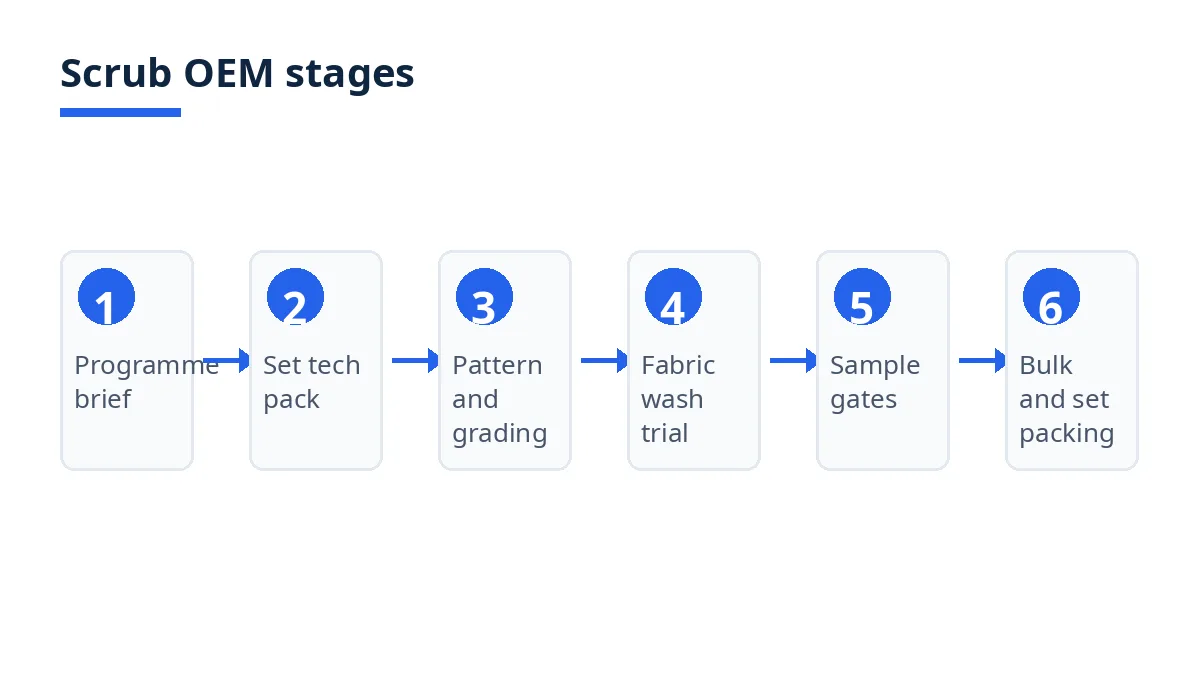
Write the program brief before the tech pack. Name each department, the color assigned to it, the wearer groups in it and the number of sets per wearer. Record the laundry route the sets will follow, whether that is an in-house laundry or an industrial laundry, and the wash temperature and drying method the sets must survive. A factory cannot choose a fabric or a thread without knowing how the sets will be washed.
Build the scrub tech pack around the set, not the single piece. For the top, state the neckline shape, sleeve length, pocket map with each pocket's position and size, side vents and any badge or embroidery placement. For the pant, state the waist system, whether that is a drawstring, an elastic waist or a combination, the leg shape, whether straight or jogger, and the pocket map. Add a set-matching rule: the top and the pant of one set must be cut from the same fabric lot and checked together, so a set is approved or rejected as a pair.
Agree the pattern and the grading. A scrub pattern is graded across a size curve that runs from petite to tall, and grading a scrub is not only widening the body. Pocket positions, drawstring casing length and pant length must move with the size, or a pocket that sits correctly at a middle size will sit too high on a tall wearer and too low on a petite wearer. Ask the factory to show the grade rules for the smallest, middle and largest sizes, and to confirm how tall sizes are handled.
Select the fabric against the laundry route. State the fiber blend, the fabric weight and whether stretch is required, and ask for a swatch in each department color. The decision that matters most is wash behavior: color retention, shrinkage and pilling after repeated laundering. Ask the factory to wash the swatches on the program's own laundry route, or on the closest stated equivalent, and to report the results per color before bulk fabric is booked.
Run the sample gates in order, with a wear trial. First, a proto sample proves the pattern and the pocket map in a substitute fabric. Next, a fit sample in the actual fabric and colors is tried on wearers from at least three points on the size curve, not only on a fit model. Then a wear trial puts a small number of sets through real shifts and real washes, and the trial sets are measured again after washing. Only then comes the pre-production sample, matching the bulk fabric lot, department colors, embroidery and labels, approved or corrected in writing.
Control bulk by set, shade and size. In bulk, shade must be controlled lot by lot, because a department color that drifts between lots breaks the program even when each lot is acceptable on its own. Agree a shade band with a reference swatch kept by both sides, and pair tops and pants by lot before packing. Write the inspection plan into the purchase order, including the inspection level and acceptance quality limit (AQL) values. ISO 2859-1 defines a system of acceptance sampling plans for inspection by attributes, indexed by AQL for lot-by-lot inspection, and AQL is the maximum average percentage of defective items considered acceptable during random sampling.3
Pack by department and by set. Pack each set as a top and a pant together, sorted by department color and size, with the carton marked by department and size range. Mixed cartons push the sorting work onto the hospital's uniform store and hide a missing size until opening.
Costs, timelines and documents
What are the typical costs and timelines?
There are no typical costs or timelines that hold across scrub programs, because the price follows the program's own choices: the fabric blend and weight, the number of department colors, the size curve, the embroidery placements, the packing method and the delivery term. The Incoterms 2020 rules set out 11 rules with a clear allocation of cost, risk and obligations,4 so compare quotations only when they state the same rule and named place.
Example figures: a program of 1,200 sets across four department colors, at 300 sets per color, with two embroidery placements and packing by set, is priced differently from the same 1,200 sets in a single color with no embroidery and bulk packing, even though the total quantity is identical. The example shows structure only, not a typical price or lead time. For timelines, ask for a date for each gate, not one delivery week: pattern and grading, fabric ready, proto sample, fit sample, wear trial, pre-production approval, bulk production and inspection. The wear trial is the gate that catches the failures a table inspection misses.
Which documents are needed?
The program documents are the brief, the tech pack with the set-matching rule, the grade rules, the wash-trial report, the written sample approvals at each gate and the purchase order carrying the inspection plan and the delivery term.3 4 For export clearance, see the single pointer at the end of this section: goods may not be loaded for export until the export declaration is submitted to Customs and approved, with the accompanying documents the clearance procedure lists.5
Bangladesh-specific rules and tips
Confirm woven capacity and association claims at the source. Scrubs are woven garments, so the relevant supplier pool sits in the woven sector, where BGMEA reports about 60 percent of its member factories and 100 percent of woven garment exports.1 If a supplier claims BGMEA membership, confirm it with the association itself, and ask what the factory actually makes: a woven shirt factory and a woven scrub factory share cutting and sewing skills, but only the scrub factory has the pattern, grading and wash-trial routine the program needs.
Put fiber content on the label in the form the destination market requires. If you sell into the European Union, Regulation (EU) No 1007/2011 states that a textile product shall be labeled or marked with the name and percentage by weight of all constituent fibers in descending order.6 That rule decides what goes on the care and composition label for every department color, so confirm the label artwork before bulk, not after the sets are packed.
Treat department colors as dye lots, not catalogue colors. A color chosen from a screen or a catalogue card is not a production color until it exists as a dyed fabric lot. Book the fabric for all departments together where the program allows it, keep a sealed reference swatch for each department color, and agree in writing what happens when a repeat lot falls outside the shade band: re-dye, re-cut or reject.
Mistakes and red flags
What are the most common mistakes?
Approving the top and forgetting the pant. A top approved on its own says nothing about whether the pant matches it in shade, fabric hand or wash behavior. Approve sets, not pieces, and reject a set when either piece fails.
Grading only the middle sizes. A size curve approved at medium and large can still fail at petite and tall, where pocket position and pant length move most. Fit-test the ends of the curve, not only the middle.
Accepting a finish claim without a test report. If a fabric is offered with an antimicrobial or fluid-resistant finish, ask for the test report that names the test method, the organism or liquid tested and the number of washes the result survives. A claim without a report is a sales line, and a report on unwashed fabric says nothing about a set that will be washed weekly.
Applying a surgical-gown standard to everyday scrubs. EN 13795 is used for surgical gowns, and ANSI/AAMI PB70 classifies surgical and isolation gowns.2 Demanding those standards for everyday ward scrubs adds cost and testing that does not measure what ward wear needs, while missing the tests that do matter: wash behavior, shade retention and fit across the size curve.
Skipping the wear trial to save a week. A sample that measures correctly can still pull at the shoulder on a long shift, or lose its drawstring casing shape after hot washing. The wear trial is the only gate that tests the set the way staff will use it.
Treating a profile or a badge as proof of program ability. A badge records a document and photo review, not a factory inspection.7 It does not prove that the factory can hold six department colors across a size curve. The sample gates are the proof.
Checklist
Before bulk is confirmed, every line should be answered in writing.
Program brief written: departments, colors, wearer groups, sets per wearer, laundry route.
Tech pack complete for top and pant, with pocket maps, waist system, leg shape and embroidery placements.
Set-matching rule agreed: top and pant from the same fabric lot, approved as a pair.
Grade rules shown for smallest, middle and largest sizes, with tall sizes handled explicitly.
Fabric swatches in every department color washed on the program laundry route, results reported per color.
Proto sample, fit sample on three points of the size curve, wear trial and pre-production sample approved in writing.
Shade band and reference swatch agreed per department color, with the repeat-lot rule in writing.
Inspection level and AQL values in the purchase order.3
Quotations compared on the same specification and the same Incoterm and named place.4
Labels checked against the destination market's fiber labeling rule.6
Packing agreed by set, department color and size, with cartons marked by department and size range.
How Exportain helps
On Exportain, browse suppliers and post the program brief, department color map and size curve on the RFQ board, so factories quote against the same set specification. Read the supplier badges for what they record: verification is a document and photo review, not a factory inspection, and a badge is not a guarantee of capacity, quality or delivery.7 See how supplier verification works on Exportain and the MOQ definition guide for how minimums are structured.
FAQs
What should I know first about medical scrubs?
Know first that a scrub program is a set system, not a single garment order. Top and pant must match in fabric lot, shade and wash behavior, the pattern must be graded from petite to tall, and the fabric must be chosen against the laundry route the sets will follow. Everyday clinical scrubs are workwear, distinct from surgical gowns, which carry their own barrier standards.2
What are the typical costs and timelines?
There are no typical figures that hold across programs, because price follows the fabric, the number of department colors, the size curve, embroidery placements, packing method and delivery term, and the Incoterms 2020 rules allocate cost, risk and obligations for each delivery term.4 Ask for a date per gate, from pattern and grading through the wear trial to inspection, rather than a single delivery week.
Which documents are needed?
The program documents are the brief, the tech pack with the set-matching rule, the grade rules, the wash-trial report, the written approvals at each sample gate and the purchase order carrying the inspection plan and delivery term. Export clearance follows the same pointer given above: no loading until the export declaration is submitted and approved.5
What are the most common mistakes?
The most common mistakes are approving the top without the pant, grading only the middle sizes, accepting a finish claim without a test report, applying a surgical-gown standard to everyday scrubs,2 skipping the wear trial and reading a badge as proof of program ability. A badge records a document and photo review, not a factory inspection.7
Next steps on Exportain
Browse suppliers, then post your program brief, department color map and size curve on the RFQ board so factories quote on the same set specification. Before you confirm, read how supplier verification works on Exportain.
Sources
- BGMEA sets new membership criteria to ensure factory safety, operational standards. The Financial Express, (accessed )
- Standards and Specifications for Healthcare Protective Clothing. Centers for Disease Control and Prevention (accessed )
- ISO 2859-1:2026 - Sampling procedures for inspection by attributes — Part 1: Sampling schemes indexed by acceptance quality limit (AQL) for lot-by-lot inspection. ISO (accessed )
- Incoterms® 2020. International Chamber of Commerce (ICC) (accessed )
- Customs Clearance Procedures for Export. Bangladesh Customs, National Board of Revenue (accessed )
- Regulation (EU) No 1007/2011 on textile fibre names and related labelling and marking of the fibre composition of textile products. European Union, (accessed )
- Trust & Safety Center. Exportain (accessed )
About the author
Sourcing from Bangladesh?
Post a request for quotation and suppliers on Exportain can send you their quotes directly.
Post an RFQ