Custom Duvet Covers Manufacturer in Bangladesh: OEM Process From Tech Pack to Bulk
How a custom duvet cover moves from tech pack to bulk in Bangladesh: fabric, closure and corner-tie approvals, proto and wash samples, grading and pre-production approval, and the bulk checks that protect fit and wash durability.
Short answer
A custom duvet cover manufacturer in Bangladesh works to your tech pack through written stage approvals: fabric and trim approval, closure and corner-tie approval, proto sample, wash sample, size grading approval, pre-production sample, inline bulk checks and final inspection. Each gate approves one risk, so bulk covers match the approved sample for fit, closure, wash behaviour and labelling.
On this page
Key takeaways
A custom duvet cover OEM order runs through written stage gates, not a single sample approval: fabric and trims, closure and corner ties, proto, wash sample, grading, pre-production sample, inline checks and final inspection.
Size every cover from the insert it will be sold for, measured after washing, and fit each sampled cover over that insert with ties fastened before approving.
Name the wash parameters in every wash approval, because ISO 6330 results depend on machine type, detergent and drying method.
Agree the inspection method and AQL values in the purchase order before production, and inspect packed goods against the sealed pre-production sample.
Exportain verification is a document and photo review, not a factory inspection, and a badge is not a guarantee of capacity, quality or delivery.
A custom duvet cover made under an original equipment manufacturer (OEM) arrangement is produced to your design, not to a factory stock design. You supply the specification; the manufacturer sources fabric, cuts panels, fits the closure and sews the cover, with each stage approved before the next starts. The strength of that chain of written approvals decides whether the bulk covers match the sample you approved.
Duvet covers concentrate risk in places apparel does not. Two large panels carry long seams that must stay straight, a closure must hold through repeated use and washing, corner ties must keep the insert spread inside the cover, and finished sizes must still fit the insert after washing. A fault in any of these points is hard to fix once hundreds of covers are sewn.
Why this matters for buyers and sellers
For the buyer, the OEM process is the main protection on a first order. Money is committed to fabric and sewing before a single bulk cover can be checked, so a written approval at each gate records that the bulk was made to an agreed standard. For the seller, the same gates protect the run: wrongly cut fabric, a wrongly fitted closure or a wrongly approved shade cannot be undone. With a dated approval at each gate, a bulk problem can be traced to the gate that missed it; without one, it turns into a dispute about what was agreed.
What should I know first about duvet covers?
A duvet cover is a sewn envelope that holds a duvet insert, closed at one end and sold alone or in a set with pillowcases. In the United Kingdom tariff, heading 6302 covers bed linen, table linen, toilet linen and kitchen linen, and duvet covers sit inside it as bed linen, split by fibre and by whether the linen is printed.1
Three facts shape the whole OEM process. First, size the cover from the insert it will be sold for, measured after washing, not from a supplier standard chart. Second, fibre labelling follows the composition of the fabric you bought: under Regulation (EU) No 1007/2011, a textile product shall be labelled or marked with the name and percentage by weight of all constituent fibres in descending order.2 Third, the cover is judged in use, fitted over an insert and washed, so approvals of a flat, unwashed cover miss the failures buyers see.
Step-by-step: how it works
The OEM process below runs as nine gates. No gate is skipped to save time, because a skipped gate moves its risk into the bulk run. Keep every approval in writing, dated, and tied to the sample or fabric lot it covers.
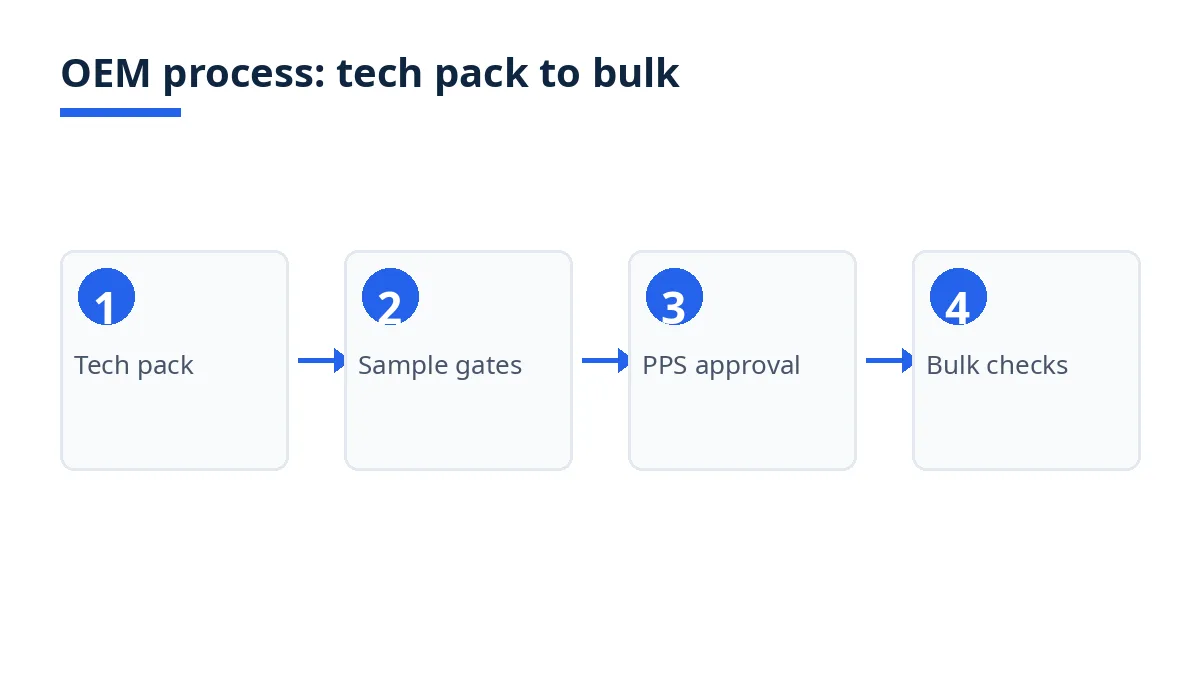
Build the tech pack. Write one document carrying finished measurements for every size, the size ratio across the range, fabric composition, weave and weight, colour or print artwork, closure type and position, corner tie or loop position and length, seam and hem construction, label wording and position, and packing per set and per carton.
Approve the fabric and trims. Ask for the actual sheeting fabric, not a similar cloth: a lab dip per solid colour, a strike-off per print, and a swatch card recording composition, weave, weight and width. Approve buttons, snaps, zip tape, tie tape and thread on the same card, under the agreed light.
Approve the closure and the corner ties separately. Before a full sample is sewn, ask for a test opening: a panel section carrying the closure and corner ties, fitted over an insert. Work the closure repeatedly, check the opening lies flat without gaping, and pull each tie to confirm stitching and length.
Approve the proto sample. The proto is the first full cover, sewn to the tech pack to test construction: panel squareness, seam straightness over both long panels, closure alignment, tie position, print placement and label position. Measure it flat, fit it over the insert, and record corrections as a numbered list.
Approve the wash sample. Wash a proto or a cut panel set under the care label conditions and measure it again. ISO 6330:2021 specifies domestic washing and drying procedures for textile testing, and a complete test consists of a washing procedure and a drying procedure; different machine, detergent and dryer parameters can affect the results.3 Name the machine type, detergent and drying method in the approval.
Approve the size grading. Grading turns one approved size into the full range; each graded size must be measured after washing before bulk cutting starts, and the insert must still reach all four corners at the smallest and largest sizes.
Approve the pre-production sample. The pre-production sample is sewn in the bulk fabric, bulk colour and bulk trims, with bulk labels and packing. It authorises bulk production, so it must pass every earlier check at once. Approve it in writing and keep one sealed counter-sample of each design.
Run inline checks during bulk sewing. Agree an inline check while sewing is under way, when drift in seam straightness, closure setting or shade can still be corrected. Check pieces across sizes and colours, fit one cover per size over the insert, and record results per size and colour.
Inspect the finished bulk and packing. Agree the inspection method and defect limits before production. ISO 2859-1 defines a system of acceptance sampling plans for inspection by attributes, indexed by acceptance quality limit (AQL) for lot-by-lot inspection; AQL is the maximum average percentage of defective items considered acceptable during random sampling.4 Inspect packed goods against the sealed sample. See the duvet covers quality control checklist.
Costs, timelines and documents
What are the typical costs and timelines?
There is no typical cost or timeline for a custom duvet cover order, because each order prices its own fabric, sizes, closure, print or dye route, testing and delivery term. The table below shows where the cost sits, so a quotation can be checked line by line.
Cost element | What drives it | Ask for it as |
|---|---|---|
Sheeting fabric | Two full panels per cover | Composition, weave, weight, width, price per metre |
Closure and ties | Zip, buttons, snaps or envelope flap, plus tie tape | Type, count, price per cover |
Dyeing or printing | Batch size per colour or print | Lab dip or strike-off approval, shade standard |
Samples and testing | Proto, wash and pre-production rounds, lab reports | Rounds included, charge per extra round |
Packing | Polybag, set packing, carton, markings | Per set and per carton |
Delivery term | Who carries freight, insurance and risk | One Incoterm and named place |
The Incoterms 2020 rules set out 11 rules with a clear allocation of cost, risk and obligations, so compare quotations only on the same rule and named place.5 A lower price on a different delivery term, a simpler closure or a lighter fabric is a different offer, not a saving.
Example figures: a buyer plans three sample rounds, one closure test opening and one wash test before bulk approval, with the pre-production sample as the final gate. If the wash sample shows shrinkage beyond the chart tolerance, the cutting plan is corrected before bulk starts. The example shows gate structure only, not typical counts, prices or lead times.
Timelines follow the same logic. Sampling time depends on fabric availability and correction rounds; bulk time on dyeing, printing, trim delivery and line capacity. Ask for sampling, fabric ready, production and inspection dates as separate lines.
Which documents are needed?
The order documents are the tech pack, the itemized quotation, the purchase order, the dated approval sheets for each gate, and any agreed lab reports.
For export clearance in Bangladesh, goods may not be loaded unless the Bill of Export or Shipping Bill is submitted to Customs and approved.6 Enclosed documents include the export contract or purchase order where there is no export letter of credit, the invoice, the packing list, the EXP form certified by an authorized dealer, and a certificate of origin from the Export Promotion Bureau or a Chamber of Commerce and Industry.6 Keep one legal name across the trade licence, quotation, proforma invoice and payment account, because the declaration names the exporter and the foreign buyer.6
Bangladesh-specific rules and tips
Agree label wording at the sampling stage, not at bulk label sewing. Fibre names and percentages, care symbols, size and origin marking sit on labels printed or woven in their own runs. Under Regulation (EU) No 1007/2011, textile products shall be labelled or marked to give an indication of their fibre composition, and the labelling or marking shall be durable, easily legible, visible and accessible.2 A label error found after bulk sewing means re-labelling finished covers.
Check the fabric route before you commit dates. Ask whether the fabric is in stock, woven to order or bought in, and whether each colour is dyed to order or from stock. A bought-in or dyed-to-order fabric sets both the earliest production date and the shade risk, and a shade approved from one lot does not automatically cover the next.
Plan market rules into the tech pack. For the European Union, bed textiles face mandatory requirements including Textile Regulation labelling, restricted chemicals under REACH such as azo dyes that release prohibited aromatic amines, and the General Product Safety Regulation requirement that a non-EU product has an EU-based economic operator responsible for its safety.7 The same CBI guidance notes there is no EU-wide legislation on care symbols, and points buyers to the ISO 3758 standard for graphic symbols in care labelling.7 For the United Kingdom, confirm the heading 6302 line for each design before pricing, since printed and unprinted linen and different fibres sit on different lines.1
Match carton markings to the packing list. CBI guidance for bed textiles notes that outer packaging information should correspond to the packing list, with labels carrying producer name, consignee, quantity, size and volume.7
Mistakes and red flags
What are the most common mistakes?
Approving a sample in substitute fabric. A proto in a different cloth cannot approve dimensions after washing, shade or hand feel, because washing and finishing change all three. Approve fit, wash behaviour and shade only on the bulk fabric.
Approving dimensions before washing. A cover that measures correctly flat can finish short or narrow after its first wash, and then no longer fits its insert. Measure every approval that matters after washing, and record the wash parameters used.3
Skipping the insert-fit test. Measuring a flat cover misses a gaping closure, a short flap, ties too short to hold the insert, and an insert that bunches to one side. Fit each sampled cover over the named insert, tie it in at all corners, fasten the closure and shake it out.
Accepting verbal approvals. A spoken agreement on shade, closure or size cannot be checked against the bulk. Record every gate approval in writing, with sample, fabric lot and date.
Comparing quotations on different specifications. A lower price built on a lighter fabric, a simpler closure, a different size ratio or a different delivery term is not a lower price for your cover. Compare only replies to the same tech pack on the same Incoterm.5
Treating a profile or a badge as a production guarantee. Exportain verification is a document and photo review, not a factory inspection, and a badge is not a guarantee of capacity, quality or delivery.8
Red flags in a reply. Watch for a manufacturer that will not name its fabric source, quotes without asking for the size chart, approves shade from a phone photograph, or promises bulk production before the pre-production sample exists.
Checklist
Before bulk production starts, answer every line below in writing.
Tech pack complete: sizes, ratio, fabric, weave, weight, colour or print, closure, ties, seams, labels, packing.
Fabric and trim approvals recorded: lab dips, strike-offs, swatch card, closure and tie test opening.
Proto sample measured flat and fitted over the insert, corrections numbered.
Wash sample approved with machine type, detergent and drying method named.3
Size grading approved at every size, measured after washing, insert fit confirmed.
Pre-production sample in bulk fabric and trims approved in writing, counter-sample sealed.
Inspection method and AQL values in the purchase order.4
Export set agreed: invoice, packing list, EXP form, certificate of origin, Bill of Export.6
How Exportain helps
On Exportain, browse suppliers and post the tech pack summary, size range and delivery term on the RFQ board so manufacturers quote against the same specification. Ask each reply for its fabric route, closure and tie construction, and sample gates.
Read the badges for what they record. Exportain Verified means Exportain has checked identity, phone, email and business registration, and Export Verified means it has checked the Export Registration Certificate (ERC).8 Factory Verified means it has reviewed photos of the manufacturer factory.8 Verification is a document review by staff, free, and never granted by membership plans.9 It is not a factory inspection,8 9 so sample approval and inspection stay with you. When you accept a quotation, Exportain creates one order and issues one proforma invoice from the accepted terms.8
FAQs
What should I know first about duvet covers?
A duvet cover is a sewn envelope that holds a duvet insert, closed at one end. Size it from the insert it will be sold for, measured after washing, and agree the closure, corner ties, fibre composition and label wording in the tech pack before sampling starts. Duvet covers sit inside heading 6302 as bed linen, split by fibre and by whether the linen is printed.1
What are the typical costs and timelines?
There are no typical figures a buyer can rely on, because each manufacturer prices your fabric, sizes, closure, dye or print route, testing and delivery term.5 Sampling time depends on fabric availability and correction rounds; bulk time on dyeing, printing, trim delivery and line capacity. Ask for sampling, fabric ready, production and inspection dates as separate lines.
Which documents are needed?
The order documents are the tech pack, quotation, purchase order, dated approval sheets for each gate, and any agreed lab reports. The export set is the Bill of Export, invoice, packing list, EXP form certified by an authorized dealer, and a certificate of origin issued by the Export Promotion Bureau or a Chamber of Commerce and Industry.6
What are the most common mistakes?
The most common mistakes are approving a sample in substitute fabric, approving dimensions before washing, skipping the insert-fit test, accepting verbal approvals, and comparing quotations on different terms.5 A badge is not a guarantee of capacity, quality or delivery.8
Next steps on Exportain
Browse suppliers, then post your tech pack summary and delivery term on the RFQ board so manufacturers state their fabric route and sample gates in writing. Before you confirm, read how to import duvet covers from Bangladesh.
Sources
- Bed linen, table linen, toilet linen and kitchen linen - UK Integrated Online Tariff, Heading 6302. GOV.UK (accessed )
- Regulation (EU) No 1007/2011 on textile fibre names and related labelling and marking of the fibre composition of textile products. European Union, (accessed )
- ISO 6330:2021 - Textiles — Domestic washing and drying procedures for textile testing. International Organization for Standardization (accessed )
- ISO 2859-1:2026 - Sampling procedures for inspection by attributes — Part 1: Sampling schemes indexed by acceptance quality limit (AQL) for lot-by-lot inspection. ISO (accessed )
- Incoterms® 2020. International Chamber of Commerce (ICC) (accessed )
- Customs Clearance Procedures for Export. Bangladesh Customs, National Board of Revenue (accessed )
- Entering the European market for bed textiles. CBI (accessed )
- Trust & Safety Center. Exportain (accessed )
- Supplier verification: Earn trust badges buyers can see. Exportain (accessed )
About the author
Sourcing from Bangladesh?
Post a request for quotation and suppliers on Exportain can send you their quotes directly.
Post an RFQ