

Custom Cushion Covers Manufacturer in Bangladesh: OEM Process From Tech Pack to Bulk
Custom cushion covers manufacturer in Bangladesh: the OEM pipeline from tech pack to bulk, judged on the filled set — cover-plus-insert fit, closures, decoration, and set matching.
Short answer
A custom cushion cover order from Bangladesh should be approved as a filled set, not as a flat cover. The buyer fixes the cover-plus-insert fit, closure, piping, decoration placement, and set-matching rule in the tech pack, then approves a filled design sample, a size-set sample, and a pre-production filled set in bulk materials before bulk production and a filled-set inspection.
On this page
Key takeaways
A cushion cover is a two-part product: cover and insert together decide fit, fullness, and pattern behavior. Approve them together, filled, not as a flat cover alone.
The tech pack must fix the filled size, insert size and fill, closure placement, piping or trim, decoration placement, and set-matching rule, before any sample is cut.
Sample in development order: filled design sample, decoration strike-off on production fabric, size-set sample for every size, and a pre-production filled set in bulk materials.
Bulk inspection must also be filled and set-based: covers on inserts, closures under use, and the set together under one light.
Classification, fibre labelling, care symbols, and export documents follow the exact product as shipped, cover-only or cover-plus-insert, confirmed before bulk.
A cushion cover order can fail even when the flat cover measures correctly and the print looks right. The cover is judged filled, on a sofa, next to the other covers in its set. A cover loose on its insert sags at the corners. A cover tight on its insert pulls at the zip and distorts the pattern. A set in which one cover is a shade warmer than the others reads as a mistake.
This guide follows the development pipeline for a custom cushion cover made in Bangladesh, from the tech pack to bulk, with that filled, set-matched result as the approval standard. It is written for a buyer ordering a cover to a design, not for a buyer choosing from a catalog.
Why this matters for buyers and sellers
For the buyer, the pipeline protects the repeat order and the retail set. A second delivery must sit beside the first without a visible change in fullness, shade, or pattern scale, and a cover approved flat cannot guarantee that, because fullness changes how a pattern reads and how a seam sits.
For the seller, the same pipeline protects the factory from rework. A factory that cuts bulk from an unfilled cover approval, or from a sample in a different fabric, carries the cost when the buyer rejects filled covers that do not match. A written tech pack, a filled pre-production sample, and a set-matching rule give the factory a fixed target.
Step-by-step: how it works
Work through the pipeline in this order.
The diagram below shows the pipeline from tech pack to bulk inspection.
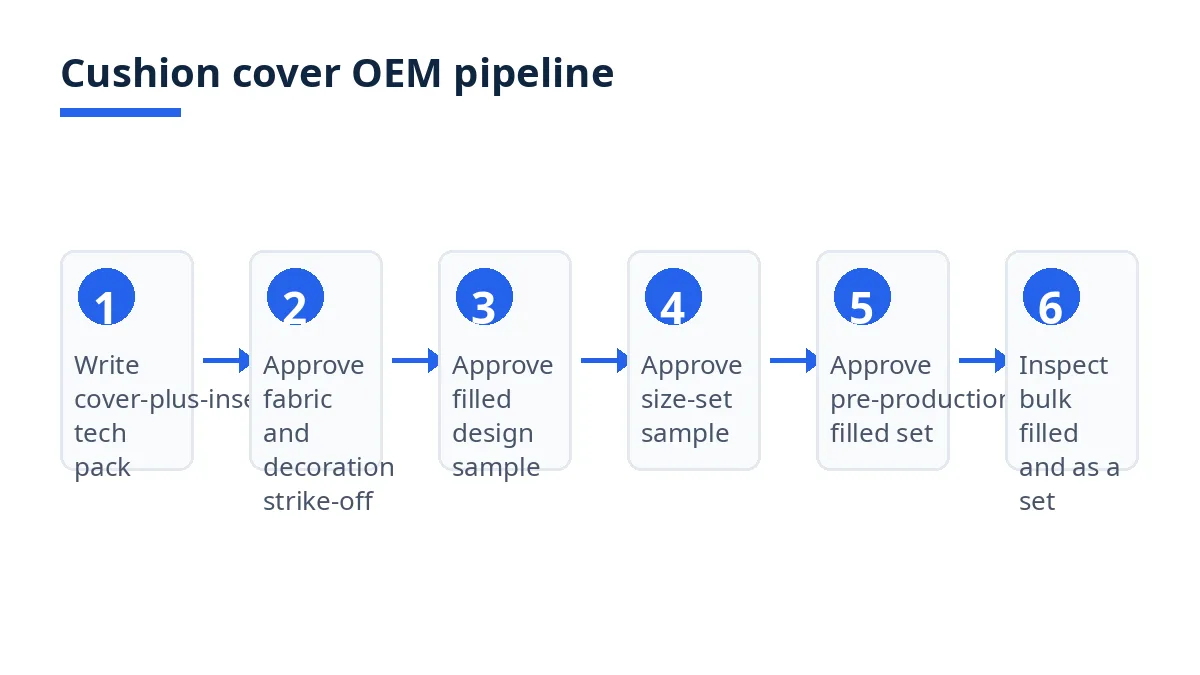
1. Write the cover-plus-insert tech pack
A tech pack for a cushion cover is the manufacturing instruction for one filled cover, written so that two factories quoting on it price the same product. A point left open here becomes a factory choice in bulk.
Tech pack section | Fix in writing |
|---|---|
Cover and set | Style, set, and every size, measured flat and filled |
Insert | Insert size, fill type, loft, and whether it ships with the cover |
Fabric | Fibre, weave or knit, weight, and an attached swatch |
Closure | Type, length, placement, and tape color |
Piping and trim | Cord size, flange width, tassel or fringe, and attachment |
Decoration | Method, artwork file, placement from fixed points, and scale |
Labels and packing | Fibre and care labels, size marking, pieces per set, carton marks |
Measurement and inspection | Flat and filled method, tolerances, defect list, set-inspection rule |
Example figures: a 45 cm square cover may be paired with an insert 2 to 5 cm larger in each direction, so the filled cover looks full without straining the closure. These are example figures only, not a standard size or a typical specification. Agree the actual pairing for each style in writing, and test it on the filled sample.
2. Approve the fabric and the decoration separately
Approve the fabric first for hand feel, drape, shade, and wash behavior. Then approve the decoration as a strike-off on the production fabric, checked for color, clarity, scale, and placement.
Measure decoration placement from a fixed point, such as a seam or a zip, not from the edge of a flat cover that will shift when filled. A motif centered on a flat sample can sit off-center on a filled cover, so approve its position on a filled cover as well.
3. Approve a filled design sample
The filled design sample is the first sample that shows the product as the customer will see it. Make it in the intended fabric, closure, piping, and trim, filled with the intended insert. Check the shape first: corners should fill without empty points, the cover should sit square, and the closure should lie flat when filled.
Then check the details under use: open and close the closure several times, and set the cover beside the other samples in its set. Record the sample reference and every correction in writing.
4. Approve the size-set sample
A cushion range is rarely one size. Approve a sample of every size in the set, filled, before bulk. Sizes do not scale by copying one cover: a larger cover needs a different insert pairing, a longer closure, and sometimes a different trim proportion. Check the sizes together as a set. This stage also settles packing: pieces per pack, the set label, and the carton split.
5. Approve the pre-production filled set
The pre-production sample is the bulk gate. Make it from the bulk fabric lot, bulk color, bulk decoration method, bulk closure and trim, bulk insert, and bulk packing. Measure it flat and filled, put it through the care method that will appear on the label, and check it again after care.
Judge shade and pattern as a set, under one light, against one sealed reference, and keep that sealed set as the bulk reference.
6. Inspect bulk filled and as a set
Bulk inspection repeats the filled-set check on the production lot. Draw the sample from finished, packed goods, fill the drawn covers with the bulk insert, and check measurement, appearance, closure function, decoration, and shade as a set. Agree the sampling plan and defect list before bulk.
ISO 2859-1 specifies an acceptance sampling system for inspection by attributes, indexed by acceptance quality limit (AQL) for lot-by-lot inspection.1 Write the AQL values, defect categories, and action on a failed lot into the purchase order.
Costs, timelines and documents
What sets the cost and the timeline
There is no typical cost or timeline for a custom cushion cover order that a guide can state as fact, because the cost follows the cover, the insert, the decoration, and the set. Product costs cover fabric, insert, dyeing or printing, sewing, closure and trim, finishing, and packing. Development costs sit apart: tech pack review, strike-offs, and samples. Set-up costs sit apart again: print screens, embroidery digitizing, and custom label or pack tooling. Keep the three groups on separate lines.
Timelines run in stages, not as a single delivery week. Ask for separate dates for the tech pack review, each sample stage, bulk production, inspection, and shipment. Correction rounds at the filled-sample stage usually move the date, not sewing.
For the quantity side, the counting rule matters as much as the number. Ask in writing whether a minimum is counted per order, per style, per size, or per color. Example figures: a per-color minimum on a three-color set triples the smallest order compared with the same minimum counted across the order. These are example figures only, not a typical minimum or a quoted figure.
One delivery term should apply to every quotation for the same order. The Incoterms 2020 rules set out 11 rules with a clear allocation of cost, risk, and obligations.2 Compare quotations only on the same term and insert inclusion, because a cover-only price and a cover-plus-insert price are not comparable figures.
Which documents sit in the order file
The order documents are the tech pack, the itemized quotation, the purchase order carrying the filled-size tolerances and set-matching rule, the sampling plan, and the written approval for each sample stage.
The export set is separate. Goods may not be loaded for export unless an export declaration, the Bill of Export or Shipping Bill, is submitted to Customs and approved, and the enclosed documents include the export contract or purchase order where there is no export letter of credit, the commercial invoice, the packing list, the EXP form certified by an authorized dealer, and a certificate of origin issued by the EPB or a Chamber of Commerce and Industry.3
Bangladesh-specific rules and tips
Confirm the classification for the exact product as shipped. Heading 6304 covers furnishing textiles, including cushions in its scope.4 A cover-only shipment and a cover-plus-insert shipment are different products for paperwork purposes, so confirm with the factory and the customs broker, before bulk, how each shipment is classified.
Settle labelling law for each market before artwork and labels are made. In the EU, Regulation (EU) No 1007/2011 states that a textile product shall be labelled or marked with the name and percentage by weight of all constituent fibres in descending order.5 In the USA, federal law requires that most textile and wool products have a label that lists the fibre content, the country of origin, and the identity of the manufacturer or another business responsible for marketing or handling the product, and under the Care Labeling Rule, manufacturers and importers must provide cleaning instructions.6 Put the fibre statement in the tech pack, and require the factory to reproduce it exactly on the label.
Match the care label to a tested care method. ISO 3758:2023 establishes a system of graphic symbols for care labelling, showing the most severe treatments that do not cause irreversible damage during textile care.7 Choose the symbols only after the pre-production set has been through that care method and rechecked filled and as a set.
Mistakes and red flags
Which mistakes repeat most often
Approving a flat cover as the finished product. A flat cover proves size and decoration only. Fullness, corner fill, closure behavior, and set matching need a filled cover, beside its set.
Approving bulk from a design sample. A design sample proves shape and decoration only. Only a pre-production set in bulk materials and packing proves what bulk will be.
Approving decoration by photograph. Color, scale, texture, and pattern position cannot be approved from a photograph, which cannot show how a pattern shifts when filled.
Leaving the insert out of the specification. A cover without a stated insert size, fill, and inclusion rule is an incomplete product. Buyer and factory will each assume a different insert, and the filled result will match neither.
Judging shade cover by cover. A set judged one piece at a time, under different lights, will pass pieces that fail as a set. Shade is a set decision, under one light.
Treating a profile or a badge as a development approval. Exportain verification is a document and photo review, not a factory inspection, and a badge is not a guarantee of capacity, quality, or delivery.8 Development approval comes from the filled samples and bulk inspection in this guide.
Red flags in a supplier reply. A reply that will not make a filled sample, state the insert pairing, supply a size-set sample, accept a filled-set inspection, or put the sampling plan and set-matching rule in writing is a reply to pause on.
Checklist
Before bulk is released, every line below should be answered in writing.
Tech pack complete: set, flat and filled sizes, insert, closure, trim, decoration, labels, packing, inspection.
Fabric and decoration strike-off approved on the production fabric, placement from fixed points.
Filled design sample approved, closure and trim checked under use, corrections recorded.
Size-set sample approved for every size, filled, checked as a set.
Pre-production filled set approved in bulk materials and packing, sealed as the bulk reference.
Care method tested on the pre-production set; care symbols chosen from that test.7
Classification confirmed per shipment, cover-only and cover-plus-insert.4
Labelling confirmed per market: EU fibre order, USA fibre, origin, responsible business, cleaning instructions.5 6
Sampling plan, AQL values, defect list, failed-lot action in the purchase order.1
Delivery term stated once, compared on the same term and insert inclusion.2
Export set agreed: invoice, packing list, EXP form, certificate of origin, Bill of Export.3
Repeat-order reference filed: sealed set, fabric and dye lots, insert specification, set-up lines.
How Exportain helps
On Exportain, browse suppliers and post a request for quotation (RFQ) on the RFQ board with your tech pack summary, the filled-sample stages, the set list, and the delivery term, so suppliers quote against the same filled product and the same set. Ask each reply to confirm, in writing, that it will supply a filled design sample, a size-set sample, and a pre-production filled set before bulk starts.
Read the badges for what they record. Exportain Verified means Exportain has checked identity, phone, email, and business registration, and Export Verified means it has checked the Export Registration Certificate (ERC).8 Factory Verified means it has reviewed photos of the manufacturer factory, while Trading Company Verified means it has reviewed photos of the trading company office or warehouse.8 Verification is a document review by staff, free, and never granted by membership plans, and it is not a factory inspection.8
When you accept a quotation, Exportain creates one order and issues one proforma invoice from the accepted terms.8
FAQs
What should I know first about cushion covers?
Know the product as a filled set, not as a flat cover. Settle the tech pack, insert pairing, and set-matching rule before sampling, and approve a filled design sample, a size-set sample, and a pre-production filled set before bulk.
What are the typical costs and timelines?
There are no typical figures a buyer can rely on, because each factory prices your fabric, insert, decoration, set size, and delivery term for your order.2 Keep development, set-up, and product costs on separate lines.
Which documents are needed?
The order documents are the tech pack, itemized quotation, purchase order, sampling plan, and written approval for each sample stage. The export set is the Bill of Export, commercial invoice, packing list, EXP form, and a certificate of origin issued by the EPB or a Chamber of Commerce and Industry.3
What are the most common mistakes?
The most common mistakes are approving a flat cover instead of a filled set, approving bulk from a design sample, leaving the insert out of the specification, judging shade cover by cover, and approving decoration by photograph. Reading a badge as development approval is another: verification is a document and photo review, not a factory inspection.8
Next steps on Exportain
Browse suppliers, then post your tech pack summary, set list, and delivery term on the RFQ board so suppliers state their insert pairing and set-matching method. Before you confirm, read how supplier verification works on Exportain and the MOQ guide.
Sources
- ISO 2859-1:1999/Amd 1:2011 Sampling procedures for inspection by attributes. International Organization for Standardization (accessed )
- Incoterms® 2020. International Chamber of Commerce (ICC) (accessed )
- Customs Clearance Procedures for Export. Bangladesh Customs, National Board of Revenue (accessed )
- HS Code for Furnishing Articles: 2025 Guide. FreightAmigo (accessed )
- Regulation (EU) No 1007/2011 on textile fibre names and related labelling and marking of the fibre composition of textile products. European Union, (accessed )
- Textile, Wool, Fur, Apparel and Leather Matters. Federal Trade Commission (accessed )
- ISO 3758:2023 Textiles — Care labelling code using symbols. International Organization for Standardization (accessed )
- Trust & Safety Center. Exportain (accessed )
- supplier verification
- pre-shipment inspection
- quality control
- buyer guide
- Bangladesh sourcing
- home textiles
About the author
Sourcing from Bangladesh?
Post a request for quotation and suppliers on Exportain can send you their quotes directly.
Post an RFQ


