

Custom Bed Sheets Manufacturer in Bangladesh: OEM Process From Tech Pack to Bulk
Custom bed sheets OEM in Bangladesh, gate by gate: tech pack, weave and color approvals, proto and wash samples, grading, pre-production sample and bulk checks.
Short answer
A custom bed sheet OEM order in Bangladesh runs from a tech pack through weave and thread-count approval, lab-dip or strike-off color approval, proto and wash samples, grading approval and a pre-production sample in bulk materials, with bulk released only against the sealed sample and an agreed inspection plan.
On this page
Key takeaways
A custom bed sheet OEM order is a chain of approvals, and bulk should be released only against the pre-production sample in bulk materials, not against a proto sample.
The tech pack must define every set completely, including fiber, weave, thread-count target, weight, pocket depth, hems, elastic, print or dye method, labels and packing.
Color is approved on the production fabric by lab dip for solid colors and by strike-off for prints, never from a screen image or a catalogue swatch.
Grading must be approved at the smallest and largest sizes, because a fitted sheet that fits at the sample size can fail at the extremes on pocket depth and elastic length.
Exportain verification is a document and photo review, not a factory inspection, and a badge is not a guarantee of capacity, quality or delivery.
A custom bed sheet order made under an original equipment manufacturing (OEM) arrangement starts with your specification and ends with bulk goods that match it. The manufacturer builds the sheet you described, rather than selling you a sheet from its own range. The work that protects that result is the sequence of approvals between the tech pack and bulk production, and each approval closes a different risk.
This guide follows that sequence gate by gate for buyers in the United States, the United Kingdom, the European Union and the United Arab Emirates: what belongs in the tech pack, what each sample proves, which sheet-specific tests apply, and what to hold back until bulk checks are done. It sets no price, minimum quantity or delivery date.
Why this matters for buyers and sellers
For the buyer, the OEM process is where a sheet stops being a description and becomes a product your customers will wash and compare with the sample they were shown. A fitted sheet that fits the mattress, keeps its size after washing and holds its color across the set is the result of decisions made before bulk cutting, not corrections made after packing. Approving a proto sample, a lab dip and a pre-production sample gives you three chances to catch a problem while it is still cheap to fix.
For the seller, the same gates protect the production run: a manufacturer that cuts bulk fabric from an unapproved weave, shade or ungraded chart risks rework across the whole order. Written approvals give the factory a fixed target and a record of what you accepted.
Bed sheets sit in heading 6302, which covers bed linen, table linen, toilet linen and kitchen linen.1 Within bed linen, the split turns on whether the linen is knitted or crocheted, whether it is printed, and on the fiber: 6302.21 covers printed cotton bed linen and 6302.31 covers other cotton bed linen.1
Step-by-step: how it works
The sequence below is a chain of approvals. Do not let bulk work start on a gate that is still open.
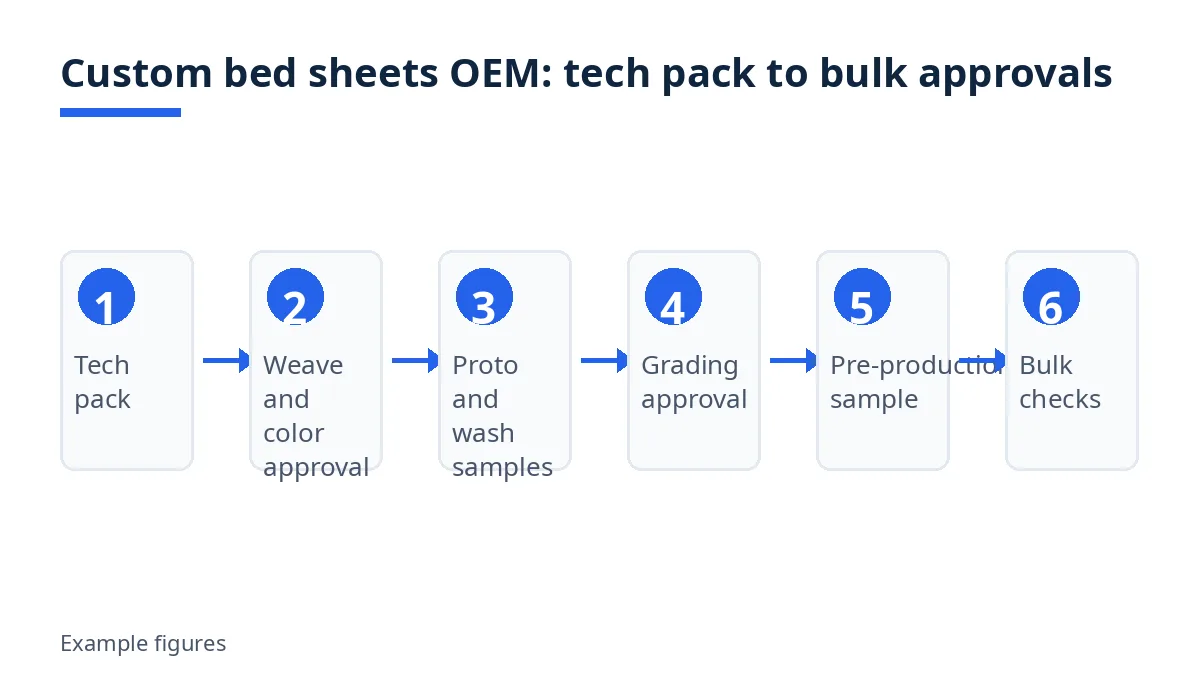
Write the tech pack, one set at a time. List every piece, flat or fitted, with finished dimensions, fiber composition, weave, thread-count target and finished weight. Add pocket depth and mattress depth, hem widths, elastic type and placement, pillowcase style, print or dye method, color references, label wording and packing.
Ask for one quotation on that pack, with one delivery term. The Incoterms 2020 rules give 11 rules with a clear allocation of cost, risk and obligations.2 State one rule and one named place, and ask the factory to list what the price includes and excludes, including testing, special packing and set-up charges.
Approve the weave and thread-count target on fabric, not on paper. Ask for a swatch in the weave you specified, with the yarn count and construction the factory will use, and check its weight against the pack target. A swatch in a different weave or a lighter weight is a different sheet, even when the color matches.
Approve color and print before sewing starts. For a solid color, approve a lab dip against your color reference under the light source you will use for bulk shade checks, and state how many lab-dip rounds the quotation includes. For a printed set, approve a strike-off at production scale, checking repeat size, placement against the hem, and color against the reference.
Approve construction with a proto sample. The proto sample is made to your tech pack to prove the factory can construct the set: panels cut to chart, fitted corners formed and elasticated, hems finished at the stated width, pillowcases sewn with the stated opening, and the full set present. Measure it flat, fit the fitted sheet on a mattress of the depth in your chart, and list corrections in writing.
Approve washing performance with a wash sample. Wash the sample by the care method that will appear on your label, then measure it again and check shade, hand feel, hem flatness and elastic recovery. ISO 6330 specifies standardized washing and drying methods that simulate domestic laundering conditions, and the test evaluates shrinkage in length and width, dimensional change after washing, and fabric deformation and appearance retention.3
Approve color fastness and surface performance on lab evidence. ISO 105-C06 specifies methods for determining the resistance of the color of textiles to domestic or commercial laundering procedures using a reference detergent, and a single test closely approximates one domestic or commercial laundering.4 For surface change, ISO 12945-2 specifies a modified Martindale method used to evaluate resistance to surface pilling, fuzzing and matting under controlled laboratory rubbing conditions.5 Ask for the report to name the fabric, color and lot tested.
Approve grading across the size range. Grading turns one approved sample size into a full size chart, and it is the gate most often skipped on sheet orders. Ask for a graded set, the same set made in the smallest and largest sizes as well as the sample size, and measure each one against its own chart line. A fitted sheet graded by scaling the sample size without checking pocket depth and elastic length at the extremes can fit at the middle size and fail at the ends.
Approve the pre-production sample in bulk materials. The pre-production sample, often shortened to PPS, is the last sample before bulk. It must be made in the bulk fabric, the approved color or print, the approved weave and weight, with bulk labels, bulk trims and bulk packing. Measure it, fit it, and check the set complete. Approve it in writing, or require a second sample, and keep one sealed counter-sample as the bulk reference.
Release bulk only against the approved references. Bulk production then runs against the approved tech pack, the approved lab dip or strike-off, the graded size chart and the sealed pre-production sample. Agree inline checks during sewing and finishing, and a final inspection on packed goods against the same references. ISO 2859-1 defines a system of acceptance sampling plans for inspection by attributes, indexed by acceptance quality limit (AQL) for lot-by-lot inspection, and AQL is the maximum average percentage of defective items considered acceptable during random sampling.6 Write the inspection level and AQL values into the purchase order before bulk starts.
Costs, timelines and documents
What are the typical costs and timelines?
There are no typical costs or timelines for a custom bed sheet OEM order that a guide can state as fact. The price is built from your fabric and weave, the dye or print route, cutting and sewing, finishing, testing, packing and the delivery term you choose, and each line moves with your specification.2 A printed set carries print set-up and strike-off rounds that a solid-color set does not, and a set with a separate label run carries a cost that a set with a stock label does not.
Timelines follow the same logic: sampling time depends on fabric availability, approval rounds and lab testing time, and bulk time depends on dyeing or printing, finishing, trim delivery and line capacity. Ask for sampling, fabric ready, production and inspection dates as separate lines, not a single delivery week.
Which documents are needed?
The order documents are the tech pack, the itemized quotation, the approval record for each gate, and the purchase order carrying the approved references, graded chart, test methods and inspection plan. Keep the approval record with the purchase order, because a dispute about shade or size is settled from that record, not from memory.
For export clearance in Bangladesh, goods may not be loaded unless an export declaration, the Bill of Export or Shipping Bill, is submitted to Customs and approved.7 Documents enclosed include the export contract or purchase order where there is no export letter of credit, the commercial invoice, the packing list, the EXP form certified by an authorized dealer, and a certificate of origin issued by the EPB or a Chamber of Commerce and Industry.7 The declaration names the exporter and the foreign buyer,7 so the legal name on the trade licence, quotation, proforma invoice and payment account should match.
Bangladesh-specific rules and tips
Lock the fiber wording at the tech pack stage for the European Union. Regulation (EU) No 1007/2011 covers textile fiber names and related labelling and marking of fiber composition.8 Textile products must be labelled or marked to give an indication of their fiber composition when made available on the market, and the labelling must be durable, easily legible, visible and accessible.8 Agree the exact fiber wording, percentages and care wording at the pre-production sample stage, and check the finished label before bulk label sewing begins.
Confirm the classification line per set, not per order. Heading 6302 splits bed linen by construction, print and fiber, so a printed cotton set, a plain cotton set and a man-made fiber set in one order can sit on different lines.1 State the fiber and print status of each set in the tech pack and confirm the national code for each set.
Mistakes and red flags
What are the most common mistakes?
Approving bulk from a proto sample. A proto sample proves construction. It does not prove bulk color, bulk weight, bulk labels or graded sizes, because it is rarely made in bulk materials at every size. Bulk approval belongs to the pre-production sample only, after the weave, color, wash, fastness and grading gates behind it are closed.
Approving color from a screen or a catalogue swatch. Dye and print behave differently on your fabric, at your weight and with your finish. A lab dip on your fabric and a strike-off at production scale are the only color approvals that predict bulk shade. A shade dispute with no lab dip on file has no reference.
Skipping grading. A single sample size tells you nothing about the smallest and largest sizes in your range. A fitted sheet that fits at the sample size can fail at the extremes on pocket depth, elastic length or panel width. Require a graded set and measure the extremes before the pre-production sample, not after bulk cutting.
Accepting a verbal approval or a verbal correction. An approval given without a sample reference, a date and a condition list will be read differently by each side when bulk is inspected. Record every approval and correction in writing, attach it to the purchase order, and keep the sealed counter-sample with the same reference.
Treating a profile or a badge as production capacity. A supplier profile and its badges record document and photo checks, not a test of whether a factory can weave, dye, print and sew your sheet to your chart. Exportain verification is a document and photo review, not a factory inspection, and a badge is not a guarantee of capacity, quality or delivery.9 10 Judge capacity from the proto sample, wash and lab evidence and graded set, not from the profile page.
Checklist
Before bulk is released, answer every line in writing.
Tech pack sent, one set at a time: pieces, dimensions, fiber, weave, thread-count target, weight, pocket depth, hems, elastic, pillowcase style, print or dye method, labels, packing.
Quotation compared on the same pack and the same Incoterms rule and named place.2
Weave and weight approved on a fabric swatch, with the swatch reference recorded.
Color approved by lab dip, print approved by strike-off, both on the production fabric.
Proto sample measured, fitted and corrected in writing.
Wash sample measured after laundering by the label care method.3
Color fastness and pilling evidence received, naming fabric, color and lot.4 5
Graded set measured at the smallest and largest sizes against their chart lines.
Pre-production sample in bulk materials, labels and packing approved in writing, with a sealed counter-sample kept.
Inspection level and AQL values in the purchase order.6
Export set agreed: invoice, packing list, EXP form, certificate of origin, Bill of Export.7
Fiber and care label wording agreed and checked before bulk label sewing.8
How Exportain helps
On Exportain, browse suppliers and post a request for quotation on the RFQ board with your tech pack summary, the gates you will approve and the delivery term, so suppliers quote against the same specification and approval sequence. Ask each reply for its fabric route and lab-dip rounds. When you accept a quotation, Exportain creates one order and issues one proforma invoice from the accepted terms.9
Read the badges for what they record. Exportain Verified means Exportain has checked identity, phone, email and business registration, and Export Verified means it has checked the Export Registration Certificate (ERC).9 Factory Verified means it has reviewed photos of the manufacturer factory.9 Verification is a document review by staff, free, and never granted by membership plans.10 It is not a factory inspection,9 10 so the proto sample, wash and lab evidence, graded set and pre-production sample stay as your controls.
FAQs
What should I know first about bed sheets?
Know that an OEM bed sheet order is a sequence of approvals, not a single purchase: the tech pack defines the sheet, the swatch approves weave and weight, the lab dip or strike-off approves color or print, the proto sample approves construction, wash and lab tests approve performance, grading approves the size range, and only the pre-production sample in bulk materials approves bulk. Bed sheets fall under heading 6302, split by construction, print and fiber.1
What are the typical costs and timelines?
There are no typical figures a buyer can rely on, because each factory prices your fabric, weave, dye or print route, construction, testing, packing and delivery term for your specification.2 Timelines are set by fabric availability, approval rounds, lab testing time and line capacity, so ask for sampling, fabric ready, production and inspection dates as separate lines.
Which documents are needed?
The order documents are the tech pack, the itemized quotation, the written approval record for each gate, and the purchase order carrying the approved references, graded chart, test methods and inspection plan. The export set is the Bill of Export, the commercial invoice, the packing list, the EXP form certified by an authorized dealer, and a certificate of origin issued by the EPB or a Chamber of Commerce and Industry.7
What are the most common mistakes?
The most common mistakes are approving bulk from a proto sample, approving color from a screen instead of a lab dip or strike-off, skipping grading, accepting approvals verbally, and reading a badge as a guarantee of capacity. A badge records a document and photo review, not a factory inspection,9 10 and bulk should be released only against the sealed pre-production sample and the agreed inspection plan.6
Next steps on Exportain
Browse suppliers, then post your tech pack summary and approval gates on the RFQ board. Before you release bulk, read the bed sheets quality control checklist.
Sources
- HS 2017 - Code 6302: Bed linen, table linen, toilet linen and kitchen linen. United Nations Statistics Division (accessed )
- Incoterms® 2020. International Chamber of Commerce (ICC) (accessed )
- Dimensional Stability Testing | ISO 6330. METS Laboratories (accessed )
- ISO 105-C06:2010 - Textiles — Tests for colour fastness — Part C06: Colour fastness to domestic and commercial laundering. International Organization for Standardization (accessed )
- ISO 12945-2 | NextGen Material Testing. NextGen Material Testing (accessed )
- ISO 2859-1:2026 - Sampling procedures for inspection by attributes — Part 1: Sampling schemes indexed by acceptance quality limit (AQL) for lot-by-lot inspection. ISO (accessed )
- Customs Clearance Procedures for Export. Bangladesh Customs, National Board of Revenue (accessed )
- Regulation (EU) No 1007/2011 on textile fibre names and related labelling and marking of the fibre composition of textile products. European Union, (accessed )
- Trust & Safety Center. Exportain (accessed )
- Supplier verification: Earn trust badges buyers can see. Exportain (accessed )
About the author
Sourcing from Bangladesh?
Post a request for quotation and suppliers on Exportain can send you their quotes directly.
Post an RFQ


