

Cushion Covers Exporters in Bangladesh: Verified Supplier Checklist
A 24-point, gate-by-gate checklist for buyers checking a cushion-cover exporter in Bangladesh: identity and export documents, closure and insert fit, shade and label approvals, commercial terms, and shipment inspection, before bulk is ordered.
Short answer
Use this 24-point checklist before trusting a cushion-cover exporter in Bangladesh. Check identity and export documents first, then cushion-specific evidence: closure samples, insert fit, seams and piping, print and shade matching, and a washed sample with an approved label. Compare quotations on the same delivery term and scope, tie payment to inspection, and hold shipment until the final file is complete. A missing answer is an open item, not a pass.
On this page
A cushion cover looks simple on a product page, and that simplicity is where buyer risk hides. Two covers can share a photo, fabric name, and size, yet differ once they reach a customer: the insert does not fill the corners, the zip fails, the print drifts across a set, or one dye lot reads as a different color. This checklist gives the checks to run, the evidence to ask for, and the point at which to stop, before money moves.
Use it as a gate system, not a scorecard to average out.
Why this checklist matters
Cushion covers fail where a general supplier check never reaches. A factory can hold a valid trade license yet outsource embroidery, piping, or dyeing unseen. A quotation can state a fabric and size yet leave open whether the price covers the insert, and whether a set is matched as a set.
This checklist separates identity, product, and commercial checks. Each gate ends with one decision: proceed, fix and re-check, or walk away.
For classification, keep cover and insert apart. Heading 6304 covers other furnishing articles, excluding those of heading 9404, including not knitted or crocheted cotton goods under 6304 92.1 State which one you are buying on every document.
Before you start
Write a one-page brief first. Without it, quotations cannot be compared. State cover or cover-plus-insert scope, sizes, closure type, fabric and color standard with a physical reference, set logic, labeling and packing per destination, and quantity, delivery term, and inspection point.
Send the same brief to every supplier, and ask for any omitted line specifically.
The full checklist (numbered, printable)
Work the gates in order. Do not order samples until Gate 1 is closed, or bulk until Gates 2 and 3 are closed. Mark each item Pass, Fix, or Fail.
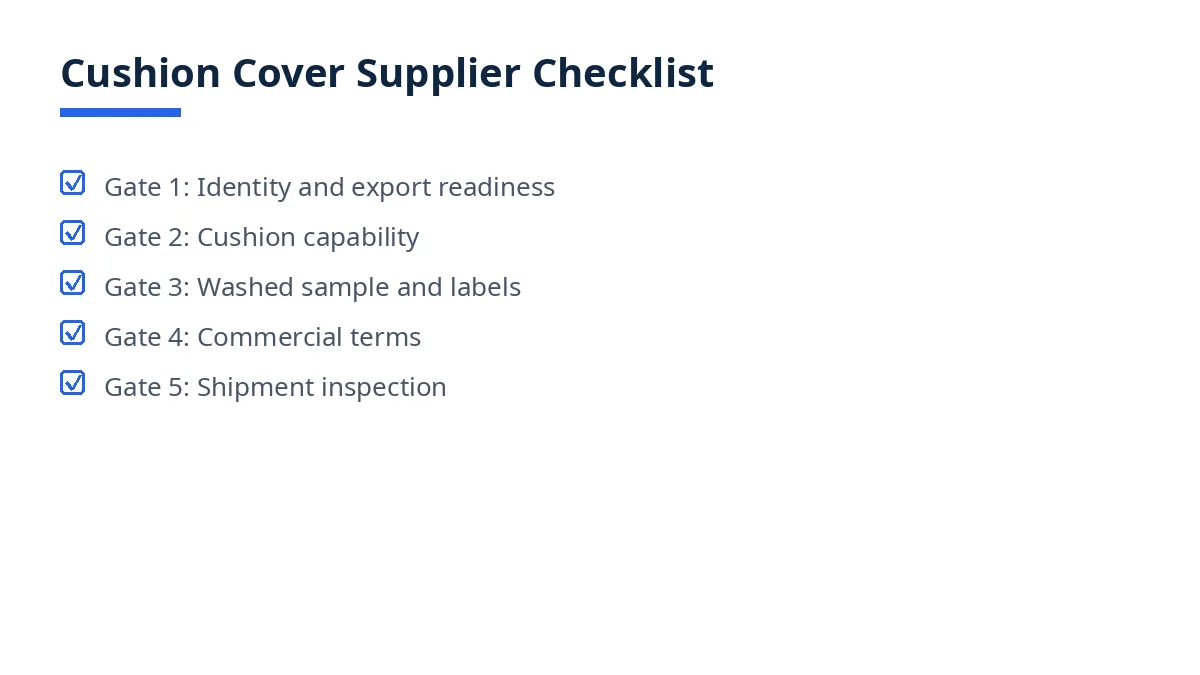
Gate 1: Identity, legal standing, and export readiness
Name and address match. Check the name and address are identical on the quotation, proforma invoice, and business documents; fix any mismatch before paying.
Business and export registration on file. Ask for the trade license and Export Registration Certificate (ERC). On Exportain, Export Verified means the ERC was checked, while Exportain Verified means identity, phone, email, and business registration were checked.2
Who makes the goods. Ask in writing whether the supplier sews the covers itself, and which steps are subcontracted. An undisclosed subcontracted step is a red flag.
Export documents available. Confirm the supplier can supply the Bangladesh export set: Bill of Export, commercial invoice, packing list, EXP form certified by an authorized dealer, and certificate of origin from the EPB or a Chamber.3 Goods may not be loaded unless the export declaration is submitted and approved.3
Payment account in the company name. Confirm payment goes to an account in the same legal name as the quotation. Any other payee is a Fail item until explained in writing.
Gate 2: Cushion-specific capability
Closure samples for each type. Ask for a sample in each closure you will order: hidden zip, visible zip, envelope, or button. Open and close each repeatedly.
Insert fit, not just cover size. Ask how insert size relates to cover size, and whether the price is cover only or cover plus insert. Fill the sample with the actual insert.
Seams, piping, and corners. Turn the sample inside out and check seam strength, piping alignment, and whether piping stops at a corner.
Print and embroidery across a set. For printed or embroidered covers, check design position, repeat alignment, and color on more than one piece.
Shade matching within and across lots. Ask how shade is judged, against what reference, and under what light. Approve one sealed reference, and judge later lots against it.
Fabric specification in writing. Record fiber composition, construction, and weight as quoted, and confirm it on the sample label. In the EU, a textile product must be labeled with the name and percentage by weight of all constituent fibers in descending order.4 In the USA, federal law requires most textile and wool products to carry a label listing fiber content, country of origin, and the responsible business.5
Gate 3: Samples, testing, and approvals
Washed sample before bulk. Approve a sample washed and dried under the care method you will print on the label, then measure it again. ISO 5077 specifies a method for determining dimensional change after specified washing and drying procedures.6 Record the measurements and tolerance.
Closure and seam check after washing. Re-check the zip, envelope overlap, buttons, and seams on the washed sample.
Label proof as a physical proof. Approve the actual label, not a text description: fiber wording, care symbols, size, origin, and claims. EU and USA labeling rules differ, so check it per destination before printing.4 5
Claims checked against certificates. If a cover is sold as organic, recycled, or tested for harmful substances, ask for the certificate, scope, issuer, and expiry date. OEKO-TEX STANDARD 100 confirms through independent certification that textiles have been tested for harmful substances.7 A fabric certificate is not a finished-cover certificate.
Pre-production sample for new styles. For any new style, closure, or print, require a pre-production sample from bulk fabric and trims, approved before cutting.
Gate 4: Commercial terms
MOQ counted as the supplier counts it. Ask whether the minimum is per order, per style, or per color, and work the total before agreeing. Example figures: 500 pieces per color, across 3 styles in 2 colors each, is 3,000 pieces total, not 500. Example figures show structure only.
Quotation structure you can compare. Require the same lines from every supplier: specification, cover and insert scope, quantity, price, packing, delivery term, lead time, payment terms, and validity. Compare quotations only on the same delivery term. Incoterms 2020 sets out 11 rules allocating cost, risk, and obligations.8
Payment terms matched to risk. Do not accept full payment in advance as the default for a first order. Tie payment stages to sample approval, inspection, and shipment documents, with the remedy for failure in writing.
Change control in the order. State how a change is requested, who approves it, what new sample it requires, and from which delivery it applies.
Gate 5: Shipment, packing, and inspection
Inspection plan agreed before bulk. Agree who inspects, against which approved sample, and what failure means: rework, replacement, or rejection. Agree the sampling basis in writing.
Packing that protects a cover, not just a carton. Confirm individual and set packing, carton contents, marking, and moisture protection. A set split across cartons creates a receiving problem even when every cover is correct.
Carton and document consistency. Check that the packing list, carton marks, and invoice describe the same quantities by style and color, with the same scope stated on each.
Final file before shipment. Before shipment, hold one file with the brief, color reference, washed measurements, label proof, certificates, inspection result, and packing list.
Common failures and how to fix them
The insert is an afterthought. The cover is approved empty, or with a different insert. Fix it at Gate 2: approve the filled cover, and write the insert specification into the order.
Shade drifts. Each lot is matched to the previous lot. Fix it at Gate 2: hold one sealed reference, and check a full set before bulk.
A certificate is quoted for the wrong item. A fabric certificate is presented for a finished cover, or it has expired. Fix it at Gate 3: read its scope, issuer, and expiry date.
Labels are approved as text, then printed wrong. Fix it at Gate 3: approve a physical label proof, checked against the EU and USA rules per market before printing.4 5
The quotation hides the scope. Cover only is quoted against cover plus insert, or the MOQ is counted per color. Fix it at Gate 4: require the same quotation structure, and work the MOQ total in writing.
Inspection is agreed after packing. Fix it at Gate 5: agree the plan before bulk, and tie payment stages to the inspection result.
Downloadable template / summary table
Gate | Evidence to file | Pass mark | If missing |
|---|---|---|---|
1. Identity | Business documents, ERC, subcontracting statement, payment account name | Names match; maker named | Do not pay |
2. Capability | Closure samples, filled-cover check, seam and piping check, shade reference | Cover fills; closures work; one shade reference | Re-sample |
3. Approvals | Washed measurements, label proof, certificate copies | Within tolerance; label approved; certificates in scope and in date | Hold bulk |
4. Commercial | Comparable quotations, MOQ calculation, payment stages, change control | Same structure; MOQ total worked | Re-quote |
5. Shipment | Inspection plan and result, packing list, final file | Inspection passed; documents consistent | Hold shipment |
How Exportain helps
On Exportain, read the trust and verification checklist on each supplier profile before shortlisting. Exportain Verified means identity, phone, email, and business registration were checked; Export Verified means the ERC was checked; Factory Verified means factory photos were reviewed, while Trading Company Verified means office or warehouse photos were reviewed.2 Verification is a document and photo review, not a factory inspection, and a badge is not a guarantee of capacity, quality, or delivery.2
Use that reading to shorten Gate 1, not to skip Gates 2 to 5: a badge does not tell you whether a zip will last, a print will align, or a shade will match on reorder.
FAQs
When should this checklist be used?
Use it before trusting a new cushion-cover exporter with a bulk order, and again when anything material changes. After bulk is packed, it can only document a problem.
Who should complete it?
The buyer completes it, or a person the buyer appoints in writing. The supplier supplies evidence; it does not mark its own checklist.
What are the most common failures?
The most common failures are an insert approved separately from the cover, shade judged lot to lot, a certificate quoted for the wrong item or past expiry, labels approved as text, a quotation hiding the insert scope, and an inspection plan agreed only after packing.
Can a third party do it?
A third party can inspect, test, and report, but it cannot replace your decisions. You still approve the sample, shade reference, label proof, and payment stages.
Next steps on Exportain
Browse suppliers, then post your brief, with its scope and inspection point, on the RFQ board. Before agreeing a quantity, read how supplier verification works on Exportain and the MOQ guide.
Sources
- Other furnishing articles, excluding those of heading 9404: UK Integrated Online Tariff, heading 6304. GOV.UK, HM Revenue and Customs (accessed )
- How Supplier Verification Works on Exportain. Exportain, (accessed )
- Customs Clearance Procedures for Export. Bangladesh Customs, National Board of Revenue (accessed )
- Regulation (EU) No 1007/2011 on textile fibre names and related labelling and marking of the fibre composition of textile products. European Union, (accessed )
- Textile, Wool, Fur, Apparel and Leather Matters. Federal Trade Commission (accessed )
- ISO 5077:2007 - Textiles — Determination of dimensional change in washing and drying. International Organization for Standardization (accessed )
- OEKO-TEX STANDARD 100 for textiles tested for harmful substances. Hohenstein (accessed )
- Incoterms® 2020. International Chamber of Commerce (ICC) (accessed )
About the author
Sourcing from Bangladesh?
Post a request for quotation and suppliers on Exportain can send you their quotes directly.
Post an RFQ


