

Chino Trousers Price in Bangladesh: FOB Cost Breakdown for Buyers
Chino trousers price in Bangladesh has no single figure: twill weight, dye route, wash, waistband and pocket trims, and the FOB delivery term shape every quote. This guide breaks each line down so buyers can compare like with like.
Short answer
A chino trousers FOB price in Bangladesh is a build-up, not a single rate. Twill weight and consumption, the piece-dye or garment-dye route, cutting and construction, wash, pocket and waistband trims, packing, and delivery to the vessel each sit on a separate line. Compare quotations only on the same twill, dye route, specification, delivery term, and named port.
On this page
Key takeaways
A chino FOB figure is a build-up: twill, cutting and construction, wash and dye, pocket and waistband trims, packing, and delivery to the vessel, each on its own line.
The dye route drives shade risk: piece dye sets shade at cloth stage, while garment dye gives a washed look with wider batch-to-batch variation, so approve a physical shade swatch per colour.
Pocket bags, waistband tape, buttons, and zips are bought in their own lots and are easy to miss in a quotation, so ask for every trim named with its material.
Consumption per pair rises with leg length and waist size, so agree the size ratio before cutting and compare quotations only on the same tech pack, delivery term, and named port.
Exportain verification is a document and photo review, not a factory inspection, and a badge is not a guarantee of capacity, quality, or delivery.
A chino trousers quotation is decided long before the sewing line starts. The cloth is a woven cotton twill, the colour is usually dyed rather than printed, the waistband carries its own tape and button, and the legs must match shade from waist to hem after washing. Each of those choices sits on a separate line of the price, and a supplier who prices one of them differently is quoting a different pair of trousers, even when the photograph looks the same.
This guide reads a chino FOB figure line by line: twill cost, cutting, construction, wash and dye, pocket and waistband trims, packing, and delivery to the vessel. It states no standard FOB price for chino trousers from Bangladesh, because no single figure could hold across twill weights, colour counts, fits, and order sizes. Where numbers appear, they are labelled Example figures and show only how a quotation adds up.
Chinos are woven trousers, and that places them in a different part of the trade system from knitted garments. The Bangladesh Garment Manufacturers and Exporters Association (BGMEA), which began its journey in 1983, represents the readymade garment industry, and around 60 percent of its member factories are woven garment manufacturers.1 For classification, heading 6203 covers men's or boys' suits, ensembles, jackets, blazers, trousers, bib and brace overalls, breeches and shorts, not knitted or crocheted, and subheading 620343 covers trousers of synthetic fibres on that basis.2 State the gender split, fibre share, and whether the trouser is woven or knitted in the first enquiry, since the heading follows those answers.
Why this matters for buyers and sellers
For a buyer, the FOB figure is the baseline everything else is added to. Under FOB, the seller delivers the goods loaded on board the vessel nominated by the buyer at the port of shipment, and risk transfers to the buyer at that point.3 Ocean freight, insurance, and import duty sit outside the FOB figure, so an error in the FOB build-up travels through the landed cost unchanged. A buyer who compares two FOB totals without checking that both cover the same twill, the same dye route, and the same waistband and pocket specification is not comparing prices at all.
For a seller, a chino order concentrates risk in shade and fit. Twill dyed for one colour cannot be reused for another, a waistband cut on the wrong curve will not sit flat, and a leg pair washed to different depths will not sell as a pair. The seller prices that risk into the dye lot, the cutting allowance, and the wash recipe. A buyer who shortens the specification to save time is asking the seller to guess on exactly the lines where a wrong guess becomes a rejected shipment.
Size spread matters too: a leg panel grows with length and waist size, so agree the size ratio before cutting.
Step-by-step: how it works
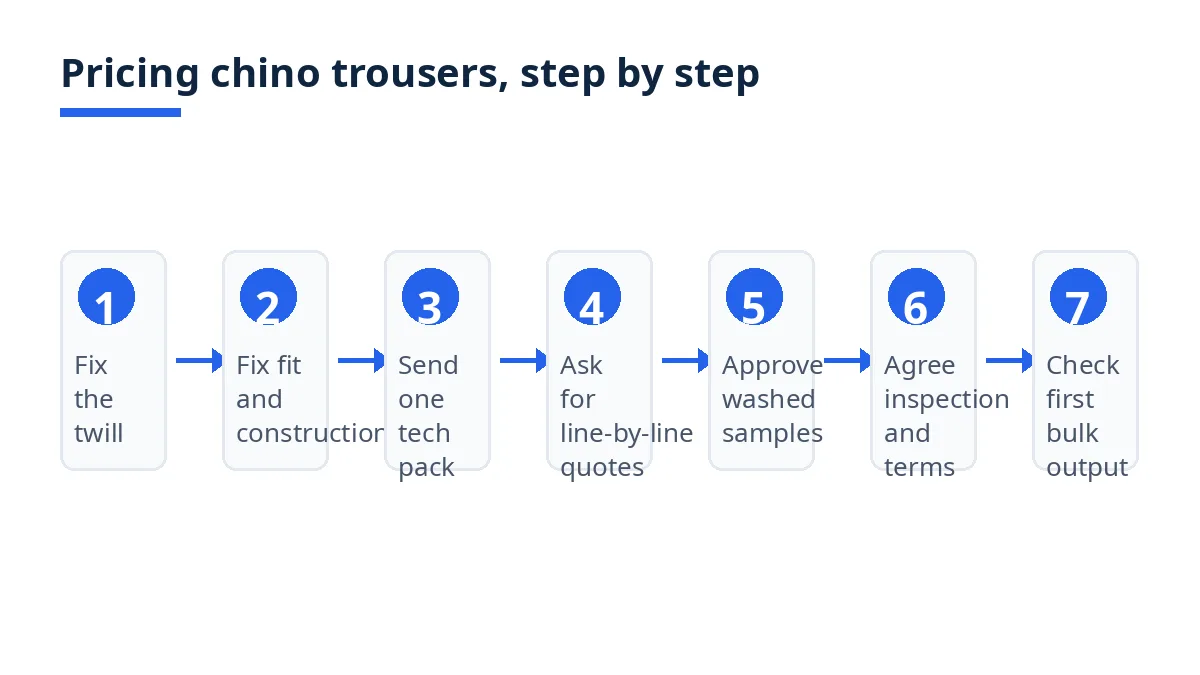
Fix the twill first. State fibre share, twill weave, weight, width, and colour, and whether the colour is piece-dyed cloth or garment-dyed after sewing. The dye route changes both price and shade risk.
Fix the fit and construction. State rise, leg shape, flat front or pleats, fly type, pocket style, waistband width, and belt loop count. Each detail changes cutting and sewing time.
Send one tech pack to every candidate. Include the measurement chart with tolerances, the pocket bag cloth, waistband tape, button and zip specification, stitching details, label positions, wash standard, and packing method.
Ask for the quotation broken into lines. Ask for twill, cutting, sewing, wash and dye, trims, packing, and delivery to the vessel as separate lines, on one named delivery term and one named port.
Approve samples in the real cloth and colour. Order a proto sample, then a pre-production sample in the actual twill, dye route, wash, waistband, and labels. Measure it, wash it, and check leg-to-leg shade before approving in writing.
Agree inspection and shipment terms before confirming. Write the inspection plan, the shade tolerance, and the delivery term into the purchase order, and confirm who files the export papers and who books the vessel.
Check the first bulk output against the approved sample. Compare shade, waistband shape, pocket placement, and leg length on the first finished pairs, so a wash or cutting drift is caught while it can still be corrected.
Costs, timelines and documents
What are the typical costs and timelines?
There is no typical cost a guide can state as fact for chino trousers, because twill weight, dye route, fit, colour count, and order size move every line. The lines below are what to ask for, not figures to budget from.
Chino twill fabric. This is usually the largest line. Twill weight, fibre share, width, and colour all move the cloth rate, and consumption per pair moves with length, waist size, and the cutting marker. A heavier twill costs more per metre and consumes more weight per pair, while a narrow cloth wastes more in the marker. Ask for consumption per pair beside the size ratio, and for the cloth rate apart from the sewing rate.
Cut and construction. Long leg panels, a shaped waistband, and pocket bags cut from a separate cloth all consume cutting time and cloth. Pleats add folding and pressing work, a button fly adds buttonholes and buttons, and a zip fly adds a zip and a different sewing sequence. Ask whether cutting and sewing are priced together or apart, and which construction details are inside the sewing line.
Wash and dye. Piece-dyed twill is dyed before cutting, so shade is set at cloth stage and cutting can proceed in bulk. Garment-dyed chinos are sewn first and dyed as finished trousers, which gives a softer, worn look but adds a dye cycle per batch and a shade risk across batches. An enzyme or soft wash adds a laundry cycle and a shrinkage allowance. Ask which route is priced and what shade tolerance applies between batches.
Pocket and waistband trims. Pocket bags, waistband tape, buttons, zips, rivets where specified, belt loops, and labels are each bought in their own lots. Pocketing cloth is often lighter than the twill and is easy to overlook in a quotation, yet a cheap pocket bag that tears or shows through the leg is a quality failure. Ask for each trim named with its material, so a quotation that omits pocketing or waistband tape is visible at once.
Finishing, pressing, and packing. Chinos are pressed with a crease or flat front as specified, folded, and packed, usually with a polybag per pair and cartons by size and colour. Ask whether polybags and cartons sit inside the unit price or apart from it.
Delivery to the vessel. Under FOB, the seller covers transport to the port, loading on board, and export formalities, while the buyer contracts the carrier and pays freight onward.3 Ask for the named port in writing, since two quotations naming different ports are not comparable.
Example figures: a quotation for one style might read twill 3.90, cutting and sewing 2.10, wash and dye 0.80, pocket and waistband trims 0.70, and packing with delivery to the vessel 0.90, giving a unit figure of 8.40. The arithmetic is 3.90 plus 2.10 plus 0.80 plus 0.70 plus 0.90, which equals 8.40. These are Example figures only, showing how the lines add up, not a price to expect or to quote.
Get timelines as separate lines: sampling, cloth-ready, dyeing or wash, bulk sewing, inspection and vessel dates — not a single delivery week.
Which documents are needed?
The order documents are the tech pack, the itemized quotation, and the purchase order carrying the agreed specification, shade tolerance, inspection plan, and delivery term. For export clearance, confirm with the seller and your forwarder who files the export declaration and which papers accompany it, following the customs procedures published by Bangladesh Customs.4
Bangladesh-specific rules and tips
Confirm woven capacity, not only garment capacity. Around 60 percent of BGMEA member factories are woven garment manufacturers, and BGMEA member factories account for 100 percent of woven garment exports.1 That describes the sector, not any one factory. Ask a candidate how many woven trouser lines it runs and whether its wash and dye work is done in-house or sent out.
Settle the dye route against the shade risk you can accept. Piece dye gives a more even shade across a large run, while garment dye gives the washed character many chino buyers want but with wider batch-to-batch variation. Ask for a shade band per colour approved on a physical swatch, not on a screen image.
Keep fibre and care labelling consistent with the destination market. If you sell into the European Union, Regulation (EU) No 1007/2011 covers textile fibre names and the labelling and marking of fibre composition.5 State the fibre share on the tech pack and on the label artwork together, so the label the factory sews matches the composition the cloth was bought to.
Protect the waistband in the measurement chart. Waistband stretch after washing is set by the waistband tape, the interlining, and the wash recipe together. Give a finished waist measurement after washing, with a tolerance, and measure the pre-production sample after its wash.
Agree one legal name across every paper. The export declaration names the exporter and the foreign buyer,4 so the name on the trade licence, quotation, proforma invoice, and payment account should match. A mismatch discovered at shipment stage is a delay, not a formality.
Mistakes and red flags
What are the most common mistakes?
Comparing quotations on different twills. A lighter twill, a different fibre share, or a stock colour against a dyed-to-order colour is a different garment. Compare only replies to the same tech pack, on the same delivery term and port.3
Accepting a shade description instead of a shade standard. Words such as khaki, stone, or olive cover a wide range. Without an approved swatch and a stated tolerance, two batches can both be called khaki and still fail to match on the shelf.
Forgetting the pocket and waistband lines. A quotation that omits pocketing cloth, waistband tape, or buttons looks cheaper until those items are added back. Ask for every trim named, and check the sample pockets and waistband rather than only the leg cloth.
Approving a sample before washing it. A chino approved unwashed has not yet shown its finished waist size, leg length, or shade. Wash the pre-production sample by the agreed method, measure it after washing, and approve that result in writing.
Do not mistake a badge for an inspection. Verification on Exportain is a document and photo review, not a factory visit, and a badge guarantees nothing about capacity, quality or delivery — sample approval and inspection remain the buyer's job.
Ordering the full colour range before the first shade is proven. Prove the dye route and wash on one or two colours first, then release the remaining colours against approved swatches.
Checklist
Before you confirm, every line should be answered in writing.
Tech pack sent: twill, fibre share, weight, dye route, fit, rise, leg shape, fly, pockets, waistband, labels, wash, packing.
Size ratio agreed, with consumption per pair beside it.
Quotation broken into twill, cutting and sewing, wash and dye, trims, packing, and delivery to the vessel.
Dye route named per colour, with an approved shade swatch and tolerance.
Pocket bag cloth, waistband tape, buttons, zip, and labels each named in the quotation.
Pre-production sample measured and washed, then approved in writing.
Inspection plan, shade tolerance, delivery term, and named port in the purchase order.3
Export declaration responsibility confirmed with the seller and forwarder.4
Fibre share on the tech pack matches the label artwork for the destination market.5
Carton packing by size and colour agreed, with polybag and carton costs placed inside or apart from the unit price.
How Exportain helps
On Exportain, browse suppliers and post your tech pack summary, colour split, size ratio, dye route, and delivery term on the RFQ board, so suppliers quote against the same specification. Ask each reply to break its FOB figure into twill, cutting and sewing, wash and dye, trims, packing, and delivery to the vessel. Read what each badge records on the seller verification page before treating it as assurance, since verification is a document and photo review, not a factory inspection.6 7 When you accept a quotation, Exportain creates one order and issues one proforma invoice from the accepted terms.6 Read the MOQ guide alongside this breakdown, since dye lots and trim lots set the floor for small colour runs.
FAQs
What should I know first about chino trousers?
A chino is a woven cotton twill trouser, usually piece-dyed or garment-dyed, with a shaped waistband, pocket bags, and a pressed leg. Its price is set by twill weight and consumption, the dye route, cut and construction, wash, and pocket and waistband trims, not by a single per-pair rate. Heading 6203 covers men's or boys' trousers, not knitted or crocheted, so state the gender split, fibre share, and woven construction in the first enquiry.2
What are the typical costs and timelines?
There are no typical figures a buyer can rely on, because twill, dye route, fit, colour count, and order size move every line. Costs sit in twill, cutting and sewing, wash and dye, trims, packing, and delivery to the vessel under FOB, where the seller delivers loaded on board and the buyer pays freight onward.3 Timelines sit in cloth readiness, dyeing or wash, bulk sewing, and inspection, so ask for each stage as a separate date.
Which documents are needed?
The order documents are the tech pack, the itemized quotation, and the purchase order carrying the specification, shade tolerance, inspection plan, and delivery term. For export clearance, confirm who files the export declaration and which papers accompany it, following the customs procedures published by Bangladesh Customs.4
What are the most common mistakes?
The most common mistakes are comparing quotations on different twills or delivery terms,3 accepting a colour name instead of an approved shade swatch, omitting pocket and waistband trims from the comparison, approving a sample before washing it, and reading a badge as a guarantee. Verification is a document and photo review, not a factory inspection.6 7
Next steps on Exportain
Browse suppliers, then post your twill, dye route, colour split, and size ratio on the RFQ board so suppliers quote the same chino on the same terms. Before you confirm, read the chino trousers quality control checklist and the MOQ guide.
Sources
- Bangladesh Garment Manufacturers and Exporters Association (BGMEA). Devex (accessed )
- Classification Detail — HS Code 620343. United Nations Statistics Division (accessed )
- FOB & FAS Incoterms® 2020 explained: Key differences. ICC Academy (accessed )
- Customs Clearance Procedures for Export. Bangladesh Customs, National Board of Revenue (accessed )
- Regulation (EU) No 1007/2011 on textile fibre names and related labelling and marking of the fibre composition of textile products. European Union, (accessed )
- Trust & Safety Center. Exportain (accessed )
- Supplier verification: Earn trust badges buyers can see. Exportain (accessed )
About the author
Sourcing from Bangladesh?
Post a request for quotation and suppliers on Exportain can send you their quotes directly.
Post an RFQ


