Chino Trousers Exporters in Bangladesh: Verified Supplier Checklist
A numbered checklist for checking chino trousers exporters in Bangladesh: twill and weight, waistband and cut, pockets and fly, wash and dye, seams, grading and labels, plus maker papers, terms and acceptance, with fixes for common failures.
Short answer
Use this checklist to check a chino trousers exporter in Bangladesh before ordering: confirm the twill, weight and weave direction, measure waistband, rise and leg line, test pockets, fly and closures, review wash, dye and colour evidence, check seams and grading, and agree labels, terms and acceptance numbers in the purchase order.

On this page
Key takeaways
Start from the twill: confirm diagonal direction, weight, composition and shade against the approved sample and lab dip before any other check.
Measure the waistband, rise and leg line on sampled sizes, and judge fit on a form or wearer, since flat measurements alone miss a rolling waistband.
Test pockets, fly and closures by hand, and review wash, rubbing and dimensional-change evidence per colour and lot before bulk cutting.
Agree labels, commercial terms and acceptance numbers in the purchase order, and record the acceptance decision per defect class in writing.
A chino looks plain on a hanger, which is why it needs a written check. The faults that cost a buyer money rarely show in a single sample: a waistband that rolls after washing, a pocket that gaps in wear, a leg that twists, or a shade that drifts between sizes. This checklist works through a chino trousers exporter in Bangladesh, from twill to papers. Agree the sampling plan first, and draw the sample at random across sizes, colours and cartons, not factory-selected pieces. ISO 2859-1 specifies an acceptance sampling system for inspection by attributes, indexed by acceptance quality limit (AQL), for lot-by-lot inspection.1
Why this checklist matters
Chinos are defined by their cloth. A chino is a trouser cut from cotton twill, a weave in which the weft passes over two or more warp threads and steps sideways each row, drawing the fine diagonal rib on the fabric face.2 That diagonal governs drape, wear at the seat and inner leg, and how evenly it takes dye. A twill with a broken diagonal, or with one leg cut against the grain of the other, will not hang straight, and the fault usually appears only after the first wash.
Bangladesh is a natural place to run this check. Men's cotton woven trousers, the family chinos sit in, were the second-highest earner among the country's garment exports in 2022 at $5.94 billion, about a 13 per cent share of total apparel exports, according to BGMEA data reported by the Financial Express.3 That depth lets a buyer compare makers, but standards vary, so a checklist turns a low quote into a comparable offer.
Before you start
Do not begin until the references are complete: an approved sample per colour, the tech pack, the size chart with tolerances for waist, hip and leg measurements, the fabric specification naming twill type, weight, fibre composition and any stretch content, the wash standard, and the label and packing specification. Agree the sampling plan and acceptance numbers per defect class in the purchase order.1
Record the fabric weight the order was sold on. One twill guide puts everyday trouser twills from about 180 to 300 GSM, with midweights around 220 to 260 GSM as the usual three-season chino cloth.2 Treat those figures as a reference, not a rule: the weight that matters is the one in the tech pack, matched by the bulk cloth.
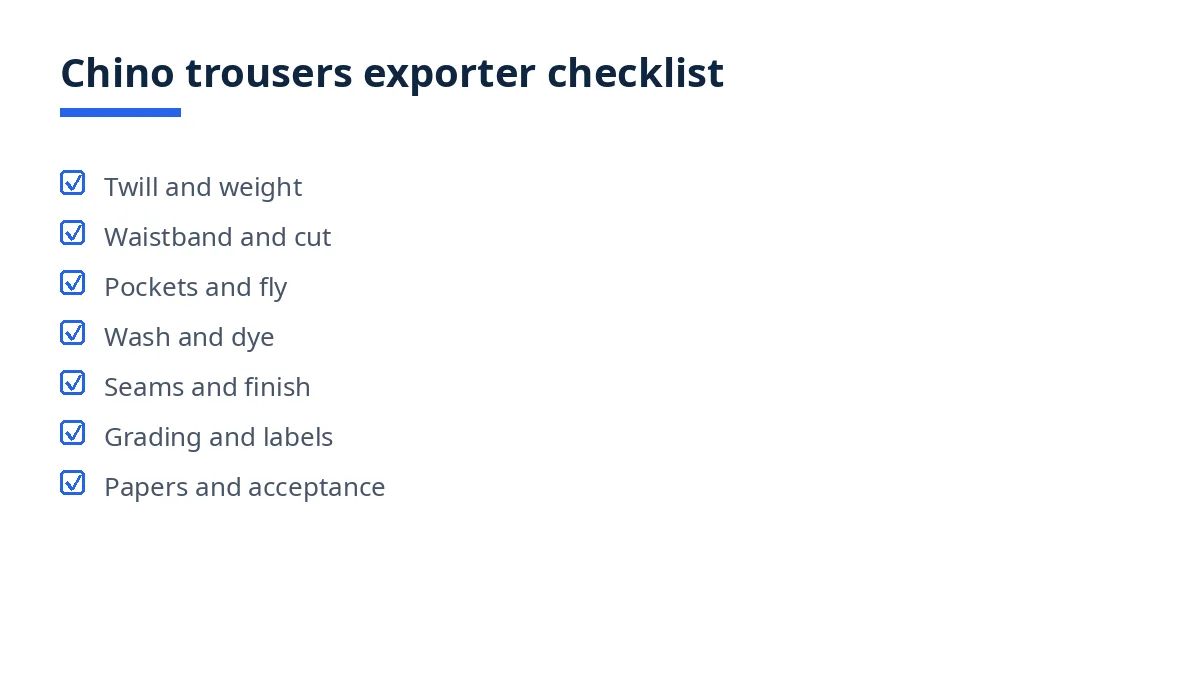
The full checklist (numbered, printable)
A. Chino twill: cloth, weight and weave direction
Check the bulk cloth against the sample: the diagonal rib runs one way, is even across the width, and matches the sample.
Check fabric weight and composition against the tech pack, and confirm any stretch fibre is named with its percentage, not only as stretch.
Check the cloth for weaving faults, slubs, holes, stains and oil marks, panel by panel, holding pieces to the light.
Check shade within each piece, between pieces in one size, and across the size range under the same light, against the approved lab dip per colour.
Check that left and right legs share the same twill direction, so the pair cannot twist after washing.
B. Cut: waistband, rise and leg line
Measure the waist on every sampled size, laid flat and fastened, against the chart tolerance, recording actual values, not pass marks alone.
Check the waistband for structure: it sits flat, holds its shape without a belt, and shows no rolling, puckering or uneven topstitching when fastened.
Check front and back rise against the chart, and confirm the back rise gives a seated fit without pulling at the fork.
Check the leg line and hem: inseam and outseam match the chart, the leg hangs straight from the knee, the hem sits level when the trouser hangs by the waistband, and hem width and stitching are even, including any specified turn-up.
C. Pockets, fly and closures
Check the side pockets: the opening lies flat, the bag is full depth, sits inside without showing through the twill, and is stitched at mouth and base.
Check the back pockets: welt or patch construction matches the sample, both pockets sit at the same height, and stitching is straight with no puckering.
Check the fly and closures: the zip or button fly closes flat, teeth or buttons run true, topstitching is even, fly faces sit level, and every button, rivet and zip matches the sample for type, colour and position and is pulled by hand, with bags, facings and linings in the pack material.
D. Wash, dye and colour behaviour
Review wash evidence for the bulk fabric and each colour, and confirm every report names the fabric, the colour tested and this lot.
Check dimensional change evidence for waist, inseam and leg opening after washing. ISO 5077 gives a method for determining dimensional change in washing and drying.4
Check washing fastness evidence where required. ISO 105-C06 gives methods for determining resistance of textile colour to domestic or commercial laundering.5
Check rubbing fastness evidence for dark colours, since chino seats and pocket edges rub in wear. ISO 105-X12 gives a method for determining resistance of colour to rubbing, with dry and wet tests.6
Check the washed sample for leg twist, waistband roll and crease behaviour against the unwashed sample, not on its own.
E. Seams, stitching and finishing
Check every seam for skipped or broken stitches, open sections and uneven stitch density, pulling each by hand, above all at the fork and seat, and check the seat and fork for reinforcement where the pack requires it, with no raw edge inside at stress points.
Where seam strength is tested, confirm the method and limit were agreed in advance. ISO 13935-1 gives a strip test for maximum force to seam rupture.7
Check pressing and finishing: no shine marks, unwanted creases, loose threads or pressing impressions on the twill face, inside pockets or at the waistband.
F. Size grading, fit and labels
Check grading across the range: waist, hip, thigh and leg opening step evenly from size to size, and no size was graded by stretching its neighbour's pattern.
Check the fit of a sampled pair in the middle and extreme sizes against the approved fit sample, on a form or wearer, not only flat.
Check fibre labels against the bulk composition. Under Regulation (EU) No 1007/2011, a textile product shall be labelled with the name and percentage by weight of all constituent fibres in descending order.8
Check care labels against the agreed care method. ISO 3758 gives a system of graphic symbols for care labelling, based on the most severe treatments that do not cause irreversible damage.9
Check that size, origin, brand and barcode labels are present, legible and correctly positioned, with size labels matching measured sizes.
G. Maker identity, papers, terms and acceptance
Check the exporter's identity papers, the factory that will actually cut and sew the order, and its capacity for cutting, sewing, washing and packing, and confirm whether any stage is subcontracted and to whom, and committed dates.
Check the commercial terms: price basis, payment terms, minimum order quantity, lead time, and what happens to rejected or short-shipped goods, with export documents confirmed and named in the order.
Record the acceptance decision per defect class against the agreed numbers, and agree in writing whether failed lots are sorted and re-inspected, partly accepted, or rejected.1
Common failures and how to fix them
A waist that measures correctly flat but rolls or gaps in wear is the most frequent chino failure, usually because the waistband lacks structure or was sewn under uneven tension. Re-sew a test pair against the sample before bulk waistbands are attached. Leg twist after washing traces to cutting against the twill direction or mismatched panels: re-check the lay before more cloth is cut.
Shade drift across sizes points to more than one dye lot in the order: re-sort complete size runs before packing. A pocket bag that shows through the twill or splits at the mouth usually means the bag cloth was substituted or the mouth stitching was shortened: re-sew a test pocket to the sample. Waist drift after washing means the wash standard and cutting allowance were not agreed together: wash and measure a test pair, then adjust the cutting chart before bulk cutting.
Downloadable template / summary table
Use the checklist as the spine of your inspection sheet: each pair you examine gets its own row, with the size chart, tolerances and acceptance numbers written in before you start scoring.
Section | Checks | Evidence |
|---|---|---|
Twill and weight | Diagonal, weight, composition, shade | Cloth comparison, lab dip |
Waistband and cut | Waist, rise, leg line, hem | Measurements, hang check |
Pockets and fly | Bags, welts, closures, facings | Pull checks, photos |
Wash and dye | Dimensional change, wash and rubbing fastness | Reports per lot |
Seams and finishing | Stitch density, seat, pressing | Pull checks, test reports |
Grading and labels | Size steps, fit, fibre and care labels | Fit check, label check |
Papers and terms | Maker, capacity, terms, acceptance | Order, acceptance record |
How Exportain helps
On Exportain, shortlist from suppliers, check what each profile's verification record covers in how supplier verification works, and settle the order quantity with the MOQ guide before you commit.
FAQs
When should this checklist be used?
Use it before you commit to a maker, at a mid-production check, and at final inspection when goods are finished and largely packed.
Who should complete it?
The runner can be the buyer, an agent on the ground, or an inspector hired for the job — what matters is identical inputs: the approved sample, the tech pack, the size chart and a sample drawn at random.
What are the most common failures?
A rolling waistband, leg twist after washing, shade drift across sizes, pocket bags that show or split, and waist drift after washing are the failures buyers find most often.
Can a third party do it?
Yes, on two conditions: the third party receives the approved references, tolerances and acceptance levels before it starts, and it hands back measured values for each item instead of pass marks alone.
Next steps on Exportain
Agree fabric weight, size chart, wash standard and acceptance numbers, then browse suppliers, read the MOQ guide, and post a free RFQ via RFQs to compare Bangladeshi supplier quotes.
Sources
- ISO 2859-1:1999 - Sampling procedures for inspection by attributes — Part 1: Sampling schemes indexed by acceptance quality limit (AQL) for lot-by-lot inspection. International Organization for Standardization (accessed )
- Women's Cotton Twill Pants Guide: The Diagonal Weave Behind Every Chino. Apparel Search (accessed )
- Cotton T-shirt top player in BD export earning. The Financial Express (accessed )
- ISO 5077:2007 - Textiles — Determination of dimensional change in washing and drying. International Organization for Standardization (accessed )
- ISO 105-C06:2010 Textiles — Tests for colour fastness — Part C06: Colour fastness to domestic and commercial laundering. International Organization for Standardization, (accessed )
- ISO 105-X12:2016 - Textiles — Tests for colour fastness — Part X12: Colour fastness to rubbing. International Organization for Standardization (accessed )
- ISO 13935-1:2014 - Textiles — Seam tensile properties of fabrics and made-up textile articles — Part 1: Determination of maximum force to seam rupture using the strip method. International Organization for Standardization (accessed )
- Regulation (EU) No 1007/2011 on textile fibre names and related labelling and marking of the fibre composition of textile products. European Union, (accessed )
- ISO 3758:2023 - Textiles — Care labelling code using symbols. International Organization for Standardization (accessed )
About the author
Sourcing from Bangladesh?
Post a request for quotation and suppliers on Exportain can send you their quotes directly.
Post an RFQ