

How to Find CE marking Certified Factories in Bangladesh
How to check CE marking for products from Bangladesh: the manufacturer declaration, conformity route, and product model, not a factory certificate.
Short answer
CE marking is not a factory certification and not a product quality mark. It is the manufacturer's declaration that a product conforms to applicable EU legislation, affixed after the applicable conformity-assessment procedure. There is no central EU body granting permission to use it, and a notified body is involved only where legislation requires third-party assessment. Buyers should check the declaration, route, and product model, not a factory claim.
On this page
Key takeaways
CE marking is not a factory certification and not a product quality mark; it is the manufacturer's declaration for a product under applicable EU legislation.
A notified body is involved only where the legislation requires third-party assessment, and its four-digit number appears beside the mark only for certain modules.
The buyer check is the EU declaration of conformity for the exact product model, plus the module and route statement, not a company claim.
For Low Voltage products, the route is internal production control, Module A, with no notified body required, and the declaration is kept for 10 years.
CE marking is not a factory certification, not a product quality mark, and not a status any authority grants to a factory. It is the manufacturer's declaration that a product conforms to the applicable EU legislation, affixed by the manufacturer or its authorised representative after the applicable conformity-assessment procedure. There is no central EU body that gives permission or a certificate allowing use of the CE mark.1 The phrase in the title, "CE marking Certified Factories", is therefore common search phrasing, not a real status.
What a buyer can check is narrower: a named product model whose conformity route can be stated in writing and whose EU declaration of conformity can be read. CE marking is only required for products covered by harmonised EU rules that specifically mandate it, and if no such rule exists, it must not be used.1 The mark allows a product to be moved freely in the EU regardless of where it is manufactured.1 The first task is to establish whether the product needs CE marking, which legislation applies, and what route was used.
Manufacturers must carry out a conformity assessment, decide whether they may assess the product themselves or must involve a notified body, set up the technical file, draft and sign an EU declaration of conformity, and attach the CE marking.2 Importers and distributors must know the legal requirements and ensure that the products they distribute or import meet them.2 The Bangladeshi manufacturer owns the declaration, and the EU importer placing the product on the market must be able to show that the steps were done.
A notified body is an independent organisation authorised by an EU country to assess compliance when required by legislation, used for third-party assessment, typically for higher-risk products like medical devices, construction products, or machinery.1 That involvement is not universal: if the law allows self-assessment, no body is needed, and if it requires third-party testing, a body must be involved.1 Where a body is used, its four-digit number must appear next to the mark.1 Voluntary certificates are not valid for CE marking, are not legally recognised, and may be issued without testing or beyond the body's competence.1
The framework is the New Legislative Framework, adopted in 2008 to improve the internal market for goods and clarify the use of CE marking.3 It consists of Regulation (EC) 765/2008, Decision 768/2008, which acts as a template for future product harmonisation legislation, and Regulation (EU) 2019/1020.3 The supplier should be able to name the instruments that apply to its product, and no others.
Procedures for modules A, A1, B, C, D, F, G, and H are described in Annex II to Decision No 768/2008/EC.4 Module A is internal production control, Module B is EC type examination, Module G is unit verification, and Module H is full quality assurance.4 The notified-body number appears beside the mark only when modules D, F, G, H, or E have been applied.4
Why this matters for buyers and sellers
For a buyer, the main risk is paying for a claim that cannot be traced to a product. A factory profile or a letter stating that a company is CE certified proves nothing about a particular model, because CE marking attaches to a product model under named legislation, not to a company. A second risk is scope error: a product under several EU requirements at once must comply with all of them before the mark is affixed.1
A third risk is timing. CE marking refers to compliance when the product was placed on the EU market, and the declaration and technical documentation must be kept up to date and retained for at least 10 years.1 If the legislation, product, or contact details change, the declaration must be reviewed and updated.1 A declaration copied from an earlier model is not evidence for the model being ordered.
For a seller, the same discipline protects the order: a manufacturer that can state the legislation, module, and notified-body details gives a buyer a claim that can be checked before shipment. CE marking is not a management-system or private certification scheme: it is a product conformity declaration under EU law, separate from schemes such as ISO certification.
Step-by-step: how it works
Start with the product, not a company name. Write down the exact model, its intended use, and the EU market. Ask the supplier to name every harmonised EU instrument that applies. If the supplier cannot name the legislation, the route cannot be checked, and the order should not proceed on a CE claim.
Next, establish the route. Ask which module applies, whether the manufacturer assessed the product itself or involved a notified body, and, where a body was involved, its name, four-digit number, and procedure. Check the answer against the rule that a body is required only where third-party testing is required, and that its number appears beside the mark only for certain modules.1 4 If the answer contradicts that rule, ask for the legislation text or the body's scope that supports it.
Then ask for the evidence set. The manufacturer must identify all relevant EU-wide product requirements, decide whether self-assessment or a notified body applies, gather evidence including the technical documentation, and draft and sign an EU declaration of conformity.1 Ask to see the declaration itself, and check that it identifies the model, lists the legislation and standards relied on, and is signed by the manufacturer or its authorised representative. The technical documentation is held by the manufacturer and must be provided to the competent authority on request.1
Then check the marking. It must be visible, legible, and indelible, preferably on the product, or if that is not possible, on the packaging or accompanying documents.1 It must consist of the initials CE, both letters with the same vertical dimension, at least 5 mm unless product rules specify otherwise, with proportions preserved if resized.1 Work through one concrete route before agreeing terms. Take an electrical product in the Low Voltage range, designed for use at 50 to 1,000 volts alternating current or 75 to 1,500 volts direct current, other than Annex II equipment and phenomena.5 For that product, the supplier should state that the procedure is internal production control, Module A, in which a notified body is not required.5 The manufacturer draws up the technical documentation, including a risk analysis, affixes the mark to each compliant item, draws up a written declaration for the model, and keeps it for 10 years after placing on the market.5 If the supplier instead claims a notified-body certificate, ask which other legislation required it.
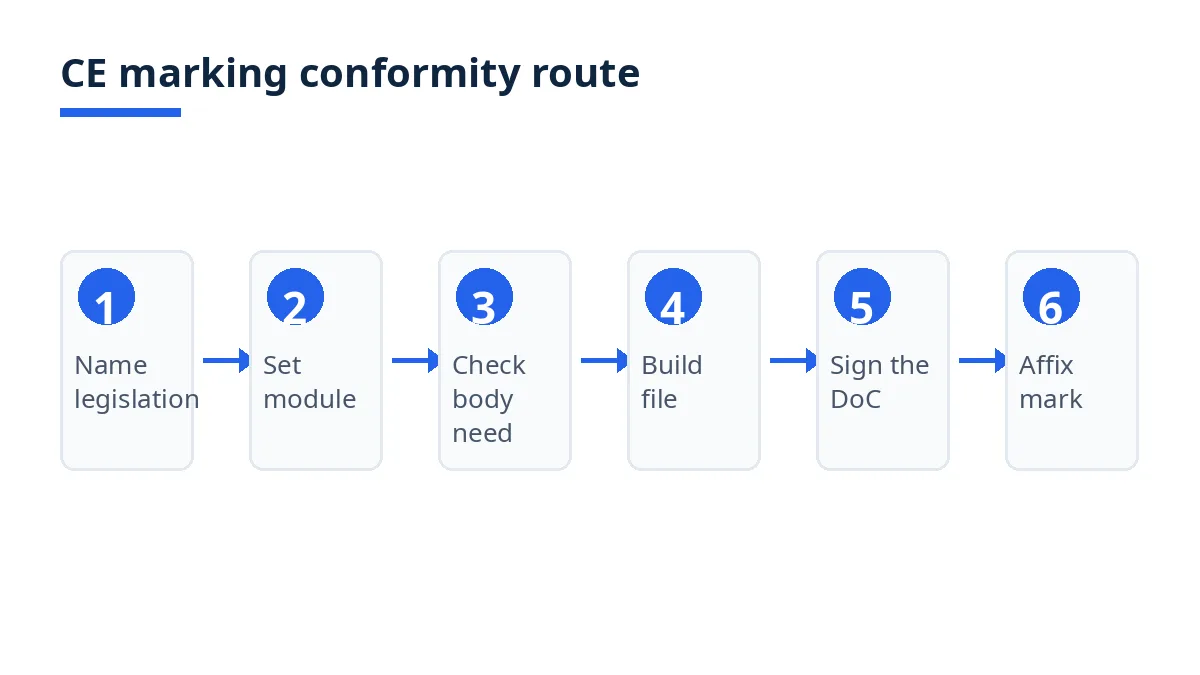
Finally, file the route per model and re-check it for any change. Keep the legislation, module, notified-body details where applicable, declaration copy, and date checked together. A new model or changed design or legislation means a new check.1
Costs, timelines and documents
There is no single public figure for CE marking costs, so this guide gives cost drivers instead of numbers. The manufacturer must bear the assessment costs, but affixing the mark itself has no fee, and the cost depends on the product's complexity and the assessment procedure.1 Ask about testing, any notified-body involvement where required, compiling the technical documentation, and rework after a design or legislation change, and ask for a written breakdown for the actual model.
Timelines follow the same logic: they depend on complexity, the procedure, notified-body availability where required, and any repeat testing after a design change. A supplier should confirm in writing how long the assessment, any notified-body step, and the declaration step take for the actual model. The 10-year retention period is a record-keeping duty after placing on the market, not a delivery timeline.1
The document set is short: the declaration for the product model, the notified-body name, number, and scope where involved, a written route statement, and commercial documents identifying the same model. A brochure, a voluntary certificate, or a declaration for a different model is not part of this set.
Item | What to check | Why it matters |
|---|---|---|
Declaration | Model, legislation, standards, signer | The manufacturer's declaration for this model |
Route statement | Module, self-assessment or notified body | Shows whether third-party involvement was required |
Notified-body details | Name, number, scope | Number must match the marking and procedure |
Marking check | Visible, legible, indelible, correct proportions, 5 mm minimum | A faulty mark signals a faulty route |
Shipment match | Declaration model matches shipped model | A declaration for another model proves nothing |
Bangladesh-specific rules and tips
There is no Bangladesh-specific CE marking rule, because CE marking is EU legislation that applies to the product, not to the country of manufacture.1 A supplier in Bangladesh should be judged on the same route evidence as a supplier anywhere else. Do not accept a claim that a Bangladeshi factory holds a CE certificate, or that a product is exempt because it was made in Bangladesh.
The Bangladesh work is therefore about evidence handling, not a local CE register. There is no public directory of CE-marked factories, and the verification route is the declaration plus the route statement plus, where applicable, the notified-body check. Ask for those items before the order is confirmed, with the same model name as the order.
Where a product needs a notified body, check that it is authorised for the specific procedure required under EU law, and search the NANDO database by product category or legislation.1 A body authorised for one category is not automatically authorised for another. Where no body is required, do not pay for one. Capacity, quality, price, and delivery checks belong in the purchase contract and pre-shipment inspection, and none is proved by the CE mark.
Mistakes and red flags
The most common mistake is treating a company claim as a product declaration. A statement that a factory is CE certified, CE approved, or CE registered does not identify a model, a legislation, or a module, and is unverified until the declaration and route statement are produced. A second mistake is accepting a voluntary certificate as CE evidence: such certificates are not legally recognised, may be issued without testing, and may be used beyond the body's competence.1 If the document does not name the legislation and procedure, it is not CE evidence.
Other red flags include a notified-body number with no named body or scope, a declaration with no model, a declaration signed by someone other than the manufacturer or its authorised representative, an illegible or wrongly proportioned mark, and a supplier that will not share the declaration before the order is placed. A supplier that offers to add the mark after shipment, or describes it as a certificate to be bought, is describing a different process.
A further mistake is assuming the mark covers every market or requirement. It only applies to products covered by specific EU rules that harmonise product requirements, and products that do not require it are subject to general product safety rules.1 Requirements outside the CE legislation must be checked separately.
Checklist
Use this checklist before a first order, and for every new model.
Product model, intended use, and EU market written down.
Every applicable EU instrument named in writing.
Module stated, with self-assessment or notified-body route identified.
Notified-body name, number, and scope checked where involved, and matched to the marking.
Declaration received for the model, with legislation, standards, and signer checked.
Technical documentation confirmed as existing and available to the competent authority on request.
Marking checked as visible, legible, indelible, correctly proportioned, and at least 5 mm unless otherwise specified.
Shipment documents matched to the declaration by model, not by company name.
Any design, legislation, or manufacturer change flagged for a fresh review before shipment.
Any gap recorded in writing, with a decision on whether to proceed.
How Exportain helps
Exportain's supplier checks are a document and photo review, not an EU conformity check, and they do not replace the declaration and route checks in this guide. The Trust Center states plainly that supplier verification is a document review, not a factory inspection and not a check against a government database, and that a badge is not a guarantee of production capacity, product quality, or delivery. Use those checks for identity, registration, and facility photos, while CE evidence is checked separately, model by model.
A buyer can use Exportain to describe the model, legislation, module, and declaration requirement, and to request the checklist documents before agreeing shipment dates. The seller verification page describes the same document and photo review from the seller side. The certification services category currently renders "No services published in this category yet", so a buyer should not assume a certification service is available through that category at the time of checking, and should request the declaration and route evidence directly from the supplier.
FAQs
What should I know first about CE marking?
Know first that it is not a factory certification and not a product quality mark. It is the manufacturer's declaration that a product conforms to the applicable EU legislation, affixed after the applicable conformity-assessment procedure. No central EU body grants permission to use the mark, and a notified body is involved only where third-party assessment is required.
What are the typical costs and timelines?
There is no typical figure for every product. The manufacturer bears the assessment costs, affixing the mark itself has no fee, and the cost depends on complexity and the procedure.1 Timelines depend on the same factors, plus notified-body availability where required, and any rework after a change. Confirm the breakdown and timing in writing for the actual model.
Which documents are needed?
The core set is the declaration for the exact model, a written module and route statement, the notified-body name, number, and scope where involved, and shipment documents identifying the same model. The technical documentation is held by the manufacturer and must be provided to the competent authority on request, and its existence and retention should be confirmed.
What are the most common mistakes?
The most common mistakes are treating a company claim as a product declaration, accepting a voluntary certificate, accepting a notified-body number with no scope, matching the company name but not the model, and assuming the mark proves quality or covers outside requirements. The correction is the same: ask for the legislation, module, declaration for the exact model, and, where applicable, the notified-body scope, and record any gap in writing.
Next steps on Exportain
Start by describing the model, the legislation you expect to apply, and the declaration and route documents you require, then run the checklist before agreeing shipment dates. Post a free RFQ on Exportain with the model and CE evidence stated, so suppliers respond with a declaration and route statement rather than a general claim. For background on platform checks, read the Trust Center and the seller verification page.
Sources
- CE marking – obtaining the certificate, EU requirements. European Union (accessed )
- CE marking (EUR-Lex glossary). European Union (accessed )
- New legislative framework. European Commission (accessed )
- Procedures for conformity assessment applied in Directive 2013/53/EU. PRS (accessed )
- Low Voltage Directive LVD. J.S. Hamilton (accessed )
About the author
Sourcing from Bangladesh?
Post a request for quotation and suppliers on Exportain can send you their quotes directly.
Post an RFQ


