

Cargo Pants Price in Bangladesh: FOB Cost Breakdown for Buyers
No single cargo pants FOB price in Bangladesh: how bellowed pockets, knee reinforcement, wash, and trims build the quotation, and how to compare suppliers on the same pocket map, wash, and delivery term.
Short answer
There is no standard FOB price for cargo pants from Bangladesh. The price is a build-up of main cloth, bellowed pocket construction, knee reinforcement, trims and closures, sewing, wash, packing, and delivery to the vessel at the named port. A six-pocket washed style costs more to build than a four-pocket unwashed style, so compare quotations only on the same pocket map, knee specification, wash recipe, and Incoterm.
On this page
Key takeaways
There is no standard FOB price for cargo pants from Bangladesh, because each factory prices your cloth, pocket count, knee work, closures, wash, and order size.
Bellowed pocket construction is the largest cargo-specific driver: gusset cloth, flap work, edge stitching, and a closure fixed through several layers all add cost.
Knee reinforcement and wash are separate priced lines, and a washed sample must be approved, because shade and fit after washing are what the buyer receives.
Compare quotations only on the same pocket map, knee specification, wash recipe, and Incoterm, with the FOB port named.
Exportain verification is a document and photo review, not a factory inspection, and a badge is not a guarantee.
A cargo pant order is priced pocket by pocket. Two suppliers can quote the same waist size and leg length and still land far apart, because one has priced six bellowed pockets with flaps and snap closures, knee panels cut from a second cloth, and a garment wash, while the other has priced four flat pockets, a single cloth throughout, and no wash at all.
This guide breaks a cargo pants FOB price into its lines up to the ship, so a buyer can trace which choice moved the quotation and which question to ask next. No standard FOB price for cargo pants from Bangladesh is stated here: one figure cannot span cloth weights, pocket counts, fits, wash recipes, and order sizes. Where numbers appear, they are labelled Example figures and show only how a quotation adds up.
Cargo pants are woven trousers, and that places them in the woven side of the Bangladesh garment sector. The Bangladesh Garment Manufacturers and Exporters Association (BGMEA), which began its journey in 1983, represents the readymade garment industry, and around 60 percent of its member factories are woven garment manufacturers.1 Woven exports reached $4,614.80 million in the July to September quarter of fiscal year 2026-27, up 5.11 percent year on year, within ready-made garment exports of $10,578.56 million, according to data released by the Export Promotion Bureau (EPB).2
Why this matters for buyers and sellers
For the buyer, pocket layout decides how the garment is worn and sold, knee reinforcement decides whether it survives work use, and wash decides shade and hand feel, so a cheaper quotation that quietly drops a pocket, thins a knee panel, or skips the wash is a different product at a lower price, not the same product at a better price.
For the seller, the build-up is protection in the other direction. A bellowed pocket needs a separate pattern piece, a fold or gusset that holds volume, a flap cut and finished to match, edge stitching that stays straight across a three-dimensional shape, and a closure fixed through several layers. Knee reinforcement needs a panel cut, positioned, and topstitched so it does not pucker after washing.
The delivery term frames the build-up. The Incoterms 2020 rules set out 11 rules with a clear allocation of cost, risk, and obligations.3 Under FOB, the seller's price runs up to loading on board the vessel at the named port, and ocean freight and the buyer's import duty sit outside it.
Step-by-step: how it works
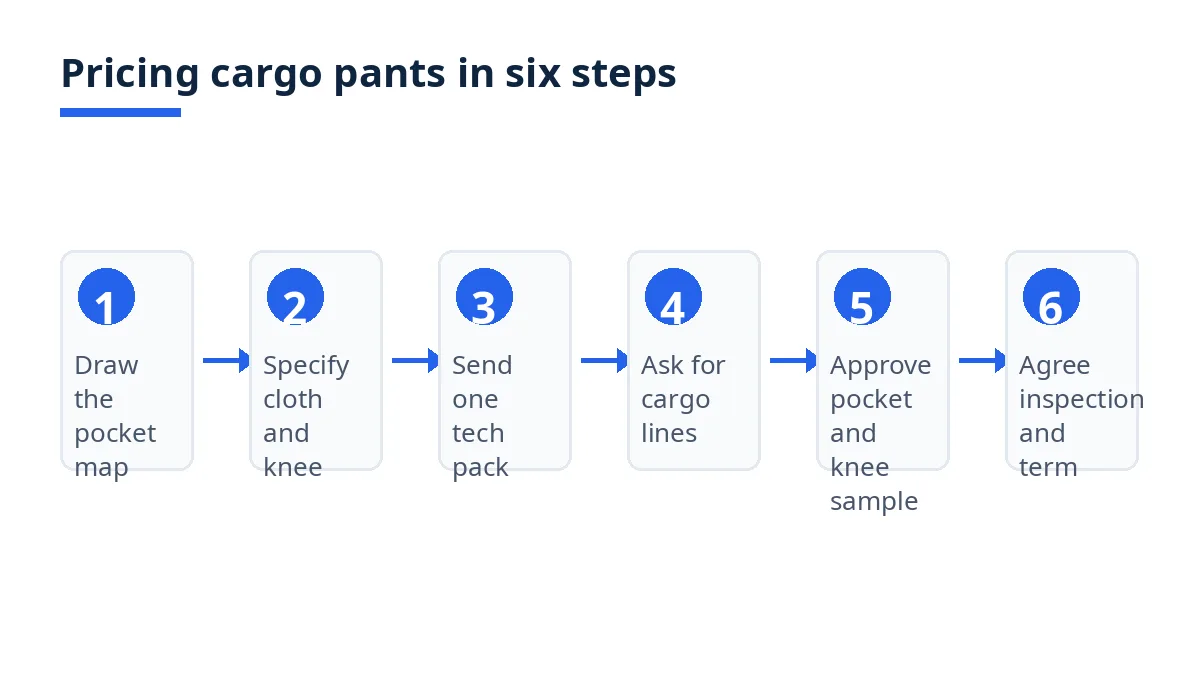
Draw the pocket map before asking for a price. State the number of pockets, their positions, and their type: flat, bellowed, or flap-covered, with or without a closure. Name the closure for each pocket, such as a button, snap, hook-and-loop tape, or zip, and state whether the flap is lined.
Specify the cloth and the knee separately. State the main cloth by fibre, weave, and weight, and state whether the knee panel uses the same cloth, a heavier cloth, or a second cloth altogether.
Send one tech pack to every candidate. Include the pocket map, waistband and fly construction, drawcord or belt-loop detail, leg fit and hem finish, knee panel placement, size chart, stitching and bar tack points, wash recipe if any, labels, and packing.
Ask for the price broken into cargo lines. Ask for cloth, pocket construction, knee reinforcement, trims and closures, sewing, wash, and packing as separate lines, with the FOB port named.
Approve a sample that tests the pockets and knees. Order a proto sample, then a pre-production sample in the actual cloth, pocket construction, closures, knee panels, and wash. Fill each bellowed pocket, sit and bend in the sample, wash it, and check that flaps still close, bar tacks hold, and knee panels sit flat.
Agree inspection and the delivery term before confirming. Write the inspection level and acceptance quality limit (AQL) values into the purchase order. ISO 2859-1 defines a system of acceptance sampling plans for inspection by attributes, indexed by AQL for lot-by-lot inspection,4 and AQL is the maximum average percentage of defective items considered acceptable during random sampling, which determines sample sizes and acceptance or rejection thresholds.4 State one Incoterm and named place for every quotation.3
Costs, timelines and documents
What are the typical costs and timelines?
There are no typical costs or timelines a guide can state as fact for cargo pants, because each factory prices your cloth, pocket count, knee work, closures, wash, and order size, and each factory's line capacity and wash capacity set its own calendar. What a buyer can do is learn which lines move, so that a quotation can be checked rather than merely accepted.
Main cloth. Cloth cost follows fibre, weave, and weight, and cargo cloth is usually a twill or ripstop weave bought by weight and width. A heavier cloth costs more per garment because each pair consumes more kilograms, and cloth width changes how many leg and pocket pieces fit a cutting marker.
Pocket construction. This is the largest cargo-specific driver. A bellowed pocket consumes more cloth than a flat pocket of the same outline, because the gusset adds depth, and more sewing time, because the fold must be formed and stitched without twisting. A closure adds a trim purchase plus a fixing operation through several layers, and a zip pocket adds both a zip purchase and a zip-setting operation. Count pockets per pair: a six-pocket pant carries half as much pocket work again as a four-pocket pant.
Knee reinforcement and wash. A knee panel adds cloth, a cutting step, a positioning step, and topstitching, plus a shade-matching risk, because the panel and the leg must still match after washing. Cargo pants are often garment-washed or garment-dyed, and the wash is a separate priced operation with its own recipe, cycle time, and shade risk. An enzyme wash, a stone wash, and a simple rinse differ in cost and in effect on flaps and knee panels, which can pucker or twist if the recipe is too harsh.
Trims, sewing, packing, and delivery. Buttons, snaps, hook-and-loop tape, zips, drawcords, belt loops, and labels are each bought per pair or per pocket, with their own minimum and lead time. Sewing time follows the pocket and knee work, plus waistband, fly, and hem construction, and the FOB price then carries the goods to loading on board at the named port.3
Example figures: a quotation for one cargo style breaks down as main cloth $2.10, pocket cloth and knee reinforcement $0.85, trims and closures $0.60, sewing $1.40, wash $0.55, and packing with delivery to the vessel $0.50, giving an FOB unit price of $6.00. The arithmetic is $2.10 plus $0.85 plus $0.60 plus $1.40 plus $0.55 plus $0.50, which equals $6.00. An order of 5,000 pairs at that unit price totals $30,000. The example shows structure only, not a market price, a typical MOQ, or a lead time.
For timelines, sampling depends on cloth availability, pocket sample corrections, and wash trials, while bulk production depends on cloth dyeing, trim delivery, line capacity, and wash capacity. Ask for sampling, cloth ready, production, wash, and inspection dates as separate lines, not a single delivery week. For shipment, the seller files the export declaration under the procedure described by Bangladesh Customs, and your forwarder confirms the set for your market before loading.5
Bangladesh-specific rules and tips
Check membership at the source, not from the price. A supplier claiming BGMEA membership should be confirmed with the association itself; BGMEA represents the readymade garment industry, and around 60 percent of its member factories are woven garment manufacturers.
Get the classification right before quoting duty. Cargo pants are woven trousers, so they sit in Chapter 62 rather than the knitted chapters. Heading 6203 covers men's or boys' trousers, and subheading 6203.42 covers men's or boys' trousers of cotton, while heading 6204 covers women's or girls' trousers, with 6204.62 covering cotton.6 See the HS code for cargo pants guide.
Write fibre content for the market of sale, and keep one legal name across every paper. If you sell into the European Union, Regulation (EU) No 1007/2011 requires a textile product to be labelled or marked with the name and percentage by weight of all constituent fibres in descending order.7 The export declaration names the exporter and the foreign buyer,5 so the name on the trade licence, quotation, proforma invoice, and payment account should match.
Mistakes and red flags
What are the most common mistakes?
Comparing quotations with different pocket counts. Compare only replies to the same pocket map, knee specification, wash recipe, and Incoterm.3
Leaving the wash out of the sample approval, and checking pockets empty. A cargo pant approved unwashed and delivered washed can arrive in a different shade, with flaps that no longer sit flat and knee panels that pucker. A bellowed pocket that looks neat empty can also gape, sag, or fail at the bar tack once filled and worn, so fill the sample pockets, wear the sample, and wash it before approving.
Treating shade as one decision, and accepting a single unit price. Main cloth, knee panel, flap, and pocket bag can come from different lots, and each lot can wash to a slightly different shade, so require shade approval across all panels of one washed sample, not only the leg cloth.
Reading a profile or a badge as a capacity proof. A profile is a starting point for enquiries. It does not test whether a factory can form a bellowed pocket cleanly at volume, and a badge is not a guarantee of capacity, quality, or delivery.8
Checklist
Before you confirm, every line should be answered in writing.
Pocket map sent: count, position, type, flap, lining, and closure for every pocket.
Cloth specified by fibre, weave, and weight, with knee cloth stated separately.
Knee reinforcement specified: patch or double layer, placement, and topstitching.
Wash recipe stated, and the washed sample approved, not only the unwashed sample.
Trims and closures priced per pair or per pocket, with imported items flagged.
Itemized quotation received: cloth, pockets, knees, trims, sewing, wash, packing, FOB port.
Quotations compared on the same pocket map, knee work, wash, and Incoterm.3
Pre-production sample filled, worn, washed, and approved in writing.
Inspection level and AQL values in the purchase order.4
Size ratio per colour agreed before cutting.
Fibre label specification confirmed for the market of sale.7
Export declaration route confirmed with the forwarder before loading.5
How Exportain helps
On Exportain, browse suppliers and post a request for quotation (RFQ) on the RFQ board with your pocket map, knee specification, wash recipe, and delivery term, so suppliers quote against the same cargo specification. Ask each reply for the itemized cargo lines, and for its minimum per style and per colour. Read the MOQ definition guide before you set the order size, and read each badge only for what it records, a document and photo review rather than a factory inspection, as described on the verification page.8 See how supplier verification works on Exportain.
FAQs
What should I know first about cargo pants?
Know the pocket map first, because it drives the price more than the leg does. A cargo pant is priced by its pockets, its knee reinforcement, its closures, and its wash, on top of its main cloth, and a quotation that does not itemize those lines cannot be compared with one that does. Cargo pants are woven trousers, so classification follows gender, fibre, and construction, with men's cotton trousers under 6203.42 and women's cotton trousers under 6204.62.6
What are the typical costs and timelines?
There are no typical figures a buyer can rely on, because each factory sets its price and lead time for your pocket count, knee work, cloth weight, wash recipe, and order size. Cloth, pocket construction, knee reinforcement, trims, sewing, wash, packing, and delivery to the vessel form the FOB build-up,3 and sampling, cloth readiness, trim delivery, line capacity, and wash capacity set the timeline.
Which documents are needed?
The order documents are the tech pack with the pocket map, the itemized quotation, the purchase order carrying the inspection level and AQL values,4 and the sample approvals in writing. For shipment, the seller files the export declaration under the procedure described by Bangladesh Customs, and your forwarder confirms the set for your market before loading.5
What are the most common mistakes?
The most common mistakes are comparing quotations with different pocket counts or wash recipes, approving an unwashed sample, checking pockets empty, accepting a single unit price that hides the cargo lines, and reading a badge as a guarantee of capacity, quality, or delivery.8
Next steps on Exportain
Browse suppliers, then post your pocket map, knee specification, and wash recipe on the RFQ board so suppliers state their itemized cargo lines. Before you confirm, read the cargo pants quality control checklist and how to import cargo pants from Bangladesh.
Sources
- Bangladesh Garment Manufacturers and Exporters Association (BGMEA). Devex (accessed )
- RMG exports rise 6.10pc to US$10.58b in July-Sept of FY27. The Financial Express, (accessed )
- Incoterms® 2020. International Chamber of Commerce (ICC) (accessed )
- ISO 2859-1:2026 - Sampling procedures for inspection by attributes — Part 1: Sampling schemes indexed by acceptance quality limit (AQL) for lot-by-lot inspection. ISO (accessed )
- Customs Clearance Procedures for Export. Bangladesh Customs, National Board of Revenue (accessed )
- HS Code for Trousers 2026 | Customs Guide. FreightAmigo, (accessed )
- Regulation (EU) No 1007/2011 on textile fibre names and related labelling and marking of the fibre composition of textile products. European Union, (accessed )
- Trust & Safety Center. Exportain (accessed )
About the author
Sourcing from Bangladesh?
Post a request for quotation and suppliers on Exportain can send you their quotes directly.
Post an RFQ


