Cargo Pants Exporters in Bangladesh: Verified Supplier Checklist
A numbered checklist for checking cargo pants exporters in Bangladesh: cloth weight, bellowed pockets, knee reinforcement, fit, wash, labels, and maker papers, with fixes for common failures.
Short answer
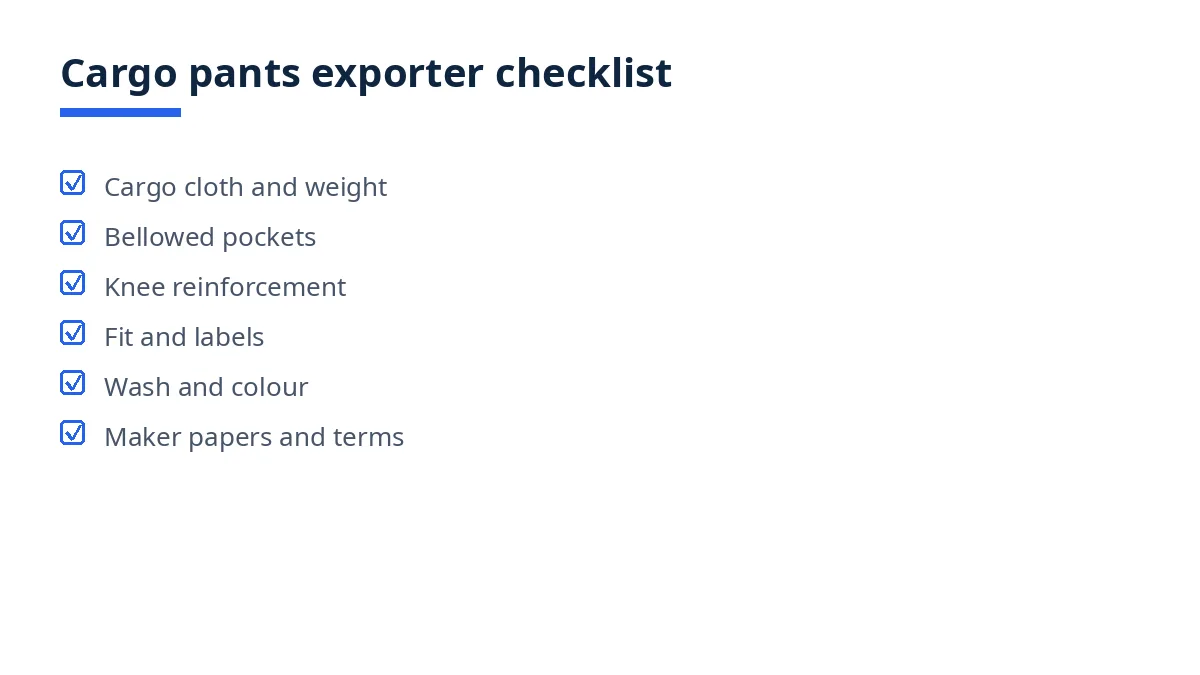
Use this checklist to check a cargo pants exporter in Bangladesh before ordering: compare cloth weight with the approved sample, test bellowed pockets under load, check knee reinforcement and bartacks, measure fit and grading, review wash and colour evidence, check labels, and agree terms and acceptance numbers in the purchase order.
On this page
Key takeaways
Test cargo construction first: bellowed pocket depth and load, knee-panel attachment, and bartacks at every stress point, before judging general exporter paperwork.
Compare bulk cloth with the approved sample for composition, weight, and shade, and resolve any gap before bulk cutting, because every later check inherits it.
Measure fit across the size range and check that pocket and knee-panel sizes grade with the leg, recording actual values rather than pass marks alone.
Agree defect classes, acceptance numbers, and the rework, re-inspection, or rejection route in the purchase order, and name the sampling plan there.
A cargo pant is judged by parts that rarely show on a catalogue page: the cloth behind a bellowed pocket, the stitching where a knee panel meets the leg, and a closure that must still hold after repeated washing. So this checklist tests cargo construction first and paperwork second. Work through it against the approved sample and the tech pack, recording each item as pass, fail, or not applicable. Agree the sampling plan before inspection starts, and draw the sample at random across sizes and colours rather than accepting pieces the factory selects. ISO 2859-1 specifies an acceptance sampling system for inspection by attributes, indexed by the acceptance quality limit (AQL), for lot-by-lot inspection.1
Why this checklist matters
Bangladesh ships a large volume of woven garments, and cargo pants sit inside that woven flow. In the July to September quarter of fiscal 2026-27, woven garment exports from Bangladesh reached 4.61 billion dollars, up 5.11 percent on the same quarter a year earlier, according to Export Promotion Bureau data reported by The Business Standard.2 Capacity is easy to find, and cargo competence varies widely between makers who look similar on paper.
A missed check is costly once goods ship. A pocket that tears at the corner, a knee panel that pulls away, or a wash that fades one leg differently cannot be fixed in the carton, so check those points before bulk cutting and again at final inspection.
Before you start
Do not start until the references are complete: one approved sample per style and colour, the tech pack with pocket drawings and knee-panel construction, the size chart with tolerances, the wash and colour requirements, and the packing specification. Agree what happens to a failed lot before production begins.
Ask for cloth evidence early. The maker should name the fabric composition, cloth weight, and the mill or merchant who supplied the bulk cloth, and show that bulk cloth matches the approved sample. If sample and bulk differ in weight or hand feel, resolve that gap first, because every later check inherits it.
The full checklist
A. Cargo cloth and weight evidence
Compare bulk cloth with the approved sample for composition, weave, weight, and hand feel, and record any substitution as a failure.
Check the cloth panel by panel for holes, slubs, broken yarns, stains, and oil marks, so a defect in the centre of a cut piece is not missed.
Check shade within each leg, between legs of a pair, and across sizes and colours under the same light, against the approved lab dip.
Confirm cloth weight and weave suit the use named in the tech pack, such as heavier twill for workwear or lighter ripstop for warm weather, and that the choice is written in the order.
Check that fabric width and cutting markers allow pocket and knee panels to be cut on grain, with no panel twisted or cut short to save cloth.
B. Bellowed pockets and cargo construction
Count the pockets on the sample and on bulk pieces, and check each pocket position, size, and flap shape against the tech pack drawing.
Measure bellows depth at the top, middle, and bottom of each cargo pocket, and confirm the pocket opens and closes flat without pulling the leg out of shape.
Load a sampled pocket with the weight and bulk the buyer expects it to carry, then check corners, flap, and stitching for strain, gaping, or stitch breakage.
Check every pocket closure named in the pack, whether button, snap, or hook-and-loop, for secure fixing, correct alignment, and clean operation after repeated opening and closing.
Check pocket stitching at the corners and along the bellows fold for skipped stitches, uneven stitch density, and loose thread ends, and pull each corner seam by hand.
Confirm pocket flaps sit flat, cover the opening, and match left to right in size, shape, and position.
C. Knee reinforcement and stress points
Check the knee panel, where the tech pack calls for one, for size, position, and attachment, whether double layer, articulated, or darted, and confirm bulk matches the sample.
Check bartacks at pocket corners, knee-panel ends, fly ends, and belt-loop bases, and confirm each one is present, centred, and firmly sewn.
Check the crotch, inseam, and outseam for skipped stitches, seam puckering, and uneven stitch density, pulling each seam by hand.
Where seam strength is tested, agree the method and limit in advance. ISO 13935-1 specifies a strip test for maximum force to seam rupture, with force applied perpendicularly to the seam, mainly for woven fabrics.3
Sit, kneel, and flex a sampled pair as the wearer would, then check knee, seat, and pocket areas for seam strain, fabric distortion, and closure failure.
D. Fit, grading, and labels
Measure waist, hip, thigh, knee, leg opening, inseam, and outseam on sampled pieces across the size range, compare every measurement with the chart tolerance, and record actual values rather than pass marks alone.
Check grading between sizes, so a larger size is a true grade of the sample rather than a stretched copy, and check that pocket and knee-panel sizes grade with the leg.
Check the waistband for even width, secure belt loops, a working fly, and a closure that fastens cleanly without gaping.
Check leg shape from hip to hem against the sample, including taper, straight, or relaxed lines, and confirm both legs match.
Check fibre, care, size, and origin labels for correct wording and position. Under Regulation (EU) No 1007/2011, a textile product shall be labelled with the name and percentage by weight of all constituent fibres in descending order.4
Check care symbols against the care the garment can actually withstand. ISO 3758 establishes a system of graphic symbols for care labelling, based on the most severe treatments that do not cause irreversible damage during care.5
E. Wash, colour, and finished appearance
Review wash evidence for bulk cloth and the finished garment, and confirm the wash recipe, enzyme or stone treatment where used, and the resulting hand feel match the approved sample.
Check washed pairs for uneven fading, leg-to-leg shade difference, pocket-shadow marks, and colour loss at folds and knee panels.
Review dimensional change evidence where required. ISO 5077 specifies a method for determining dimensional change of fabrics, garments, or other textile articles in specified washing and drying procedures.6
Check pressing and finishing: no shine marks, unwanted creases, loose threads, or crushed pocket flaps, and confirm drawcords, where fitted, are secured and matched in length.
F. Maker identity, papers, terms, and acceptance
Confirm the legal name, address, and export papers of the maker, and check whether work is done in-house or passed to a subcontractor, including which steps are subcontracted.
Ask for cargo-pants references from comparable orders, and check what the maker produced: cloth weight, pocket style, and wash type, not only the order quantity.
Agree minimum order quantity, price basis, lead time, payment terms, and packing in writing, and read the MOQ minimum order quantity explainer before fixing an unworkable quantity.
Agree defect classes, acceptance numbers, and the rework, re-inspection, or rejection route for a failed lot, and name the sampling plan in the purchase order.1
Common failures and how to fix them
The most frequent cargo failure is a bellowed pocket that looks right empty and fails under load. The bellows are cut too shallow, the corner stitching is light, or the flap is short, so the pocket gapes or tears at the corner once filled. Stop, load a sampled pocket, measure bellows depth against the tech pack, and re-sew a test pocket before bulk pockets are sewn.
Next is a knee panel that separates or distorts, because it is cut off grain, attached with too few stitches, or graded badly, so it pulls at one end when the wearer kneels. Re-cut a test panel on grain, check the bartacks at both ends, and flex the test pair before the bulk run continues.
Wash problems usually trace to cloth and trims that were never washed together, or a wash recipe changed between sample and bulk. Wash a full test pair, including pockets, closures, and labels, and compare it with the approved washed sample before bulk washing starts. Shade differences across a lot usually point to more than one dye lot: re-sort sets before packing.
Cross the agreed acceptance level and the buyer holds three options, not one: send the lot back for sorting or rework and a second inspection, accept part of it in writing, or reject the lot outright.
Summary table
Give the inspector one sheet that merges checklist and measurements: the size chart, tolerances and acceptance numbers sit at the top, and each examined pair gets a scored row beneath.
Section | Checks | Evidence |
|---|---|---|
Cargo cloth | Composition, weight, defects, shade | Sample comparison, lab dip |
Bellowed pockets | Bellows depth, load, closures, corners | Loaded pocket check, photos |
Knee and stress points | Panel, bartacks, seams, flex | Pull checks, seam reports |
Fit and labels | Measurements, grading, fibre and care labels | Measurement record |
Wash and colour | Wash recipe, fading, dimensional change | Wash reports |
Maker and terms | Identity, references, MOQ, acceptance | Papers, purchase order |
How Exportain helps
Settle the cloth, pocket, knee and wash points while you are still at enquiry stage: browse suppliers, and check how supplier verification works on Exportain for what a profile actually records. Exportain stays outside the goods contract and inspects nothing itself.
FAQs
When should this checklist be used?
Apply it at three points in the order: before committing, to test whether the maker handles cargo construction; midway through a first production run; and once the finished goods are packed for shipment.
Who should complete it?
The checklist does not care who holds the pen. Whether the buyer runs it, a local agent runs it, or an independent inspector runs it, the inputs stay identical — approved sample, tech pack, and a sample drawn at random.
What are the most common failures?
A shallow bellows pocket that tears at the corner, a knee panel that pulls away at the seam, uneven wash fading, and shade differences across a lot are the failures buyers find most often.
Can a third party do it?
Yes — hand the third party the full inspection pack up front (approved sample, tech pack, tolerances, acceptance levels) and name it as sign-off for each section.
Next steps on Exportain
Agree cloth weight, pocket drawings, knee construction, wash standard, and acceptance numbers, then post a free RFQ via RFQs and compare quotes from Bangladeshi suppliers. Read the MOQ minimum order quantity explainer to set a workable order quantity.
Sources
- ISO 2859-1:1999 - Sampling procedures for inspection by attributes — Part 1: Sampling schemes indexed by acceptance quality limit (AQL) for lot-by-lot inspection. International Organization for Standardization (accessed )
- RMG exports grow 6.1% in Q1. The Business Standard, (accessed )
- ISO 13935-1:2014 - Textiles — Seam tensile properties of fabrics and made-up textile articles — Part 1: Determination of maximum force to seam rupture using the strip method. International Organization for Standardization (accessed )
- Regulation (EU) No 1007/2011 on textile fibre names and related labelling and marking of the fibre composition of textile products. European Union, (accessed )
- ISO 3758:2023 - Textiles — Care labelling code using symbols. International Organization for Standardization (accessed )
- ISO 5077:2007 - Textiles — Determination of dimensional change in washing and drying. International Organization for Standardization (accessed )
About the author
Sourcing from Bangladesh?
Post a request for quotation and suppliers on Exportain can send you their quotes directly.
Post an RFQ