Cardigans Exporters in Bangladesh: Verified Supplier Checklist
A buyer checklist for cardigans exporters in Bangladesh: gauge and button-band evidence, shade checks, ERC and association documents, labeled samples, label and certificate checks, references, and inspection terms agreed before production.
Short answer
To check cardigans exporters in Bangladesh, work through construction evidence first: gauge and yarn, button-band linking, shade across both fronts, and washed measurements. Then check the ERC, trade license, tax papers, and association membership in one legal name, approve a labeled sample, check label and certificate claims, and agree inspection and acceptance numbers in the purchase order before production.
On this page
Key takeaways
Check cardigan construction first: gauge and yarn, button-band linking, shade across both fronts, and washed measurements, all against a finished sample.
Stop on document fails: the ERC, trade license, tax papers, and association membership must be current and in one legal name before production or payment.
Approve one labeled sample per style and color, agree fiber and care wording before labels are printed, and check every product claim on the certificate itself.
Agree the inspector, sampling scheme, defect classes, and acceptance numbers in the purchase order before production, and leave no acceptance figure as a universal rule.
If you are comparing cardigans exporters bangladesh, start with the garment, not the catalog. A cardigan is a sweater that opens like a jacket and is fastened in the front with buttons.1 This checklist is a tool for you, the buyer, to check an exporter before you commit. It does not claim any exporter is checked or approved. Record the evidence, mark each item pass, fail, or not applicable, and stop the order on a document or factory-identity fail until fixed in writing.
Why this checklist matters
A cardigan order is judged on two fronts that must match, and a fault in the opening, fit, or hand feel shows at once. Machine gauge is the number of knitting needles per inch, with lower numbers producing coarser stitches and higher numbers producing finer stitches.2 3GG to 5GG suits chunky knitwear, 7GG to 10GG mid-gauge products, and 12GG to 18GG finer, smoother knitwear, but gauge alone does not guarantee weight, warmth, softness, or quality.2 Construction evidence comes first here.
Before you start
Gather the references first: styles and front types, size range, fiber direction, colors, and packing plan. Name one contact for the sample and one for the documents.
Read any badge on a supplier profile for what it is. Exportain describes supplier verification as a document review, not a factory inspection and not a check against any government database, and a badge is not a guarantee of production capacity, product quality, or delivery.3 Use a badge as a starting point, not a substitute for checks of your own.
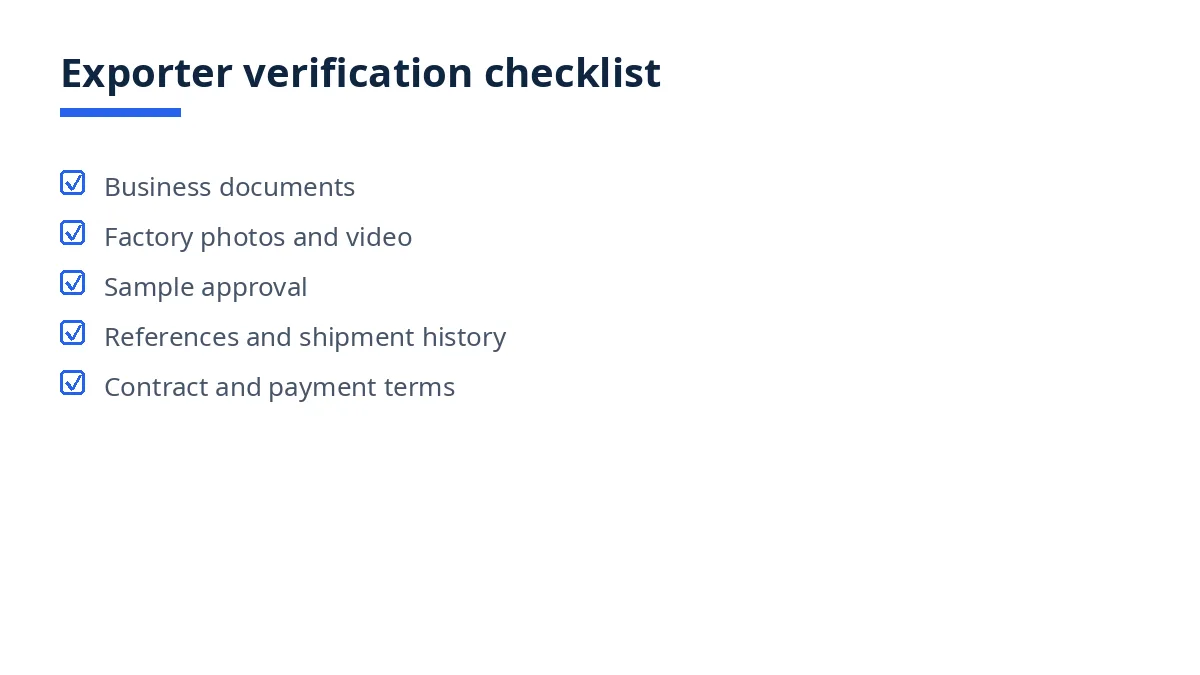
The full checklist for cardigans exporters in Bangladesh (numbered, printable)
Print this section. Items 7 to 11 are stop items: no production or payment until corrected documents arrive in one legal name.
Cardigan construction evidence first
Gauge and yarn direction. State gauge, yarn count and ply, fiber, and stitch structure per style, with a swatch in each color. Evidence: labeled swatch. Red flag: gauge with no yarn or structure.
Gauge consistency. Check stitch density from the back panel to both fronts. Evidence: dated photos of both fronts laid flat. Red flag: one front denser than the other.
Button band and linking. Ask whether the fronts are linked or seamed, and how band stability is checked after washing. Evidence: sample photographed flat and buttoned. Red flag: no linking record.
Button stance and buttonholes. Check button spacing against the tech pack, buttonhole size against the button, and a spare button of the same dye lot where required. Evidence: positions measured in two sizes. Red flag: stance drifting between sizes.
Shade bands. Ask for the dye-lot plan for the left front, right front, sleeves, and back. Evidence: sample checked under one light. Red flag: no shade check.
Rib recovery, pockets, symmetry. Check cuff and hem rib recovery, pocket placement and size on both sides, and front length each side. Evidence: sample measured on both sides. Red flag: a pocket placed by eye.
Who the exporter is on paper
Role in writing. Ask whether the exporter is a manufacturer, a trading company, or both, and ask it to name the factory. Evidence: written statement, factory name and address. Red flag: a factory in photos it will not name.
Export Registration Certificate (ERC). Ask for a current ERC in the same legal name and address as the trade license and invoice. CCI&E issues the ERC; core documents typically include a trade license, TIN certificate, chamber membership, and ID.4 Indenting agents hold a different ERC category.4 Evidence: current ERC copy. Red flag: expired ERC or mismatched name.
Trade license, tax, VAT. Ask for the current trade license, TIN certificate, and VAT registration (BIN) where applicable, all in the same legal name. Evidence: matching, current copies. Red flag: a license for a different address.
Association membership. Ask for current chamber or trade association membership that fits knitwear. BKMEA, established in 1996, represents approximately 2,540 knitwear member factories.5 Evidence: membership certificate checked. Red flag: a lapsed certificate.
Bank details. Ask for the nominated bank branch in writing, and confirm any change through a known contact channel before paying. Evidence: matching details on quotation and invoice. Red flag: details from a new email address.
Sample, label, and claim evidence
Labeled sample. Approve one finished sample per style and color, made through the intended knitting, washing, and finishing route. Evidence: sample labeled with style, color, size, gauge. Red flag: approval on an unfinished panel.
Washed measurements. Ask for measurements after washing and drying: body length, chest, sleeve length, and front length on each side. ISO 5077 specifies a method for determining dimensional change in washing and drying.6 Evidence: before-and-after measurements. Red flag: measurements taken only before washing.
Fiber wording. Agree the fiber wording before any label is printed. Under Regulation (EU) No 1007/2011, fiber names and percentages by weight must appear in descending order.7 Evidence: approved artwork checked against the yarn evidence. Red flag: a missing percentage.
Care symbols. Agree the care symbols from the actual care the cardigan will receive. ISO 3758 establishes a system of graphic symbols for care labeling.8 Evidence: artwork matched to care steps. Red flag: a symbol for an untested treatment.
Product claims. For any claim on the product, check the certificate itself: holder, scope, issue date, and expiry. Under OEKO-TEX STANDARD 100, the label requires all components, including buttons, to meet the criteria.9 Evidence: certificate with the styles inside its scope. Red flag: a certificate in another company's name.
Packing sample. Approve a packing sample: fold, bag, carton, insert, and label, cardigan buttoned and fronts aligned. Evidence: sample photographed with carton marks visible. Red flag: packing approved from a description only.
Past work you can check
References. Ask for two buyers of similar cardigans, with style, quantity, and market named, and ask what went wrong and how it was fixed. Evidence: references, permission to contact them. Red flag: references for unrelated garments only.
Past shipment documents. Ask for a past invoice, packing list, and bill of lading or airwaybill, consistent across product, quantity, and marks. Evidence: document set checked for consistency. Red flag: packing list not matching the invoice.
Repeat orders. Ask whether the exporter has repeated the same style for the same buyer, and how many reworks the last three cardigan orders needed. Evidence: answer in writing, with dates. Red flag: no repeat order to point to.
Terms, inspection, and the written record
Quotation and MOQ. Get the quotation in writing with the full specification attached, including the minimum order quantity per style, color, and size. Check the MOQ guide before accepting a per-order minimum. Evidence: quotation confirmed in writing by both sides. Red flag: a price without the specification attached.
Payment and change control. Agree payment terms in writing, and agree no change to yarn, gauge, fiber mix, buttons, label, or packing happens without your written approval. Evidence: terms in the purchase order. Red flag: a verbal yarn change after sample approval.
Inspection before production. Agree the inspector, sampling scheme, defect classes, and acceptance numbers before production, and draw the sample randomly. ISO 2859-1 specifies an acceptance sampling system indexed by the acceptance quality limit (AQL).10 Leave acceptance numbers to the purchase order. Evidence: inspection plan in writing, inspector named. Red flag: inspection agreed after packing.
File the record. File the checklist with sample approvals, the inspection report, and shipment documents, and hold any open fail in writing until fixed and re-checked. Evidence: one file per order. Red flag: a fail closed by phone.
Common failures and how to fix them
The most common failure is a shade band: the two fronts do not match because they came from different dye lots. The fix sits in item 5: one dye-lot plan, both fronts checked under one light, lot numbers recorded. Next is a button band that rolls after the first wash, usually because the linking check or wash step was skipped; wash a sample through the named method and measure the band flat and buttoned (items 3 and 13). Gauge drift is fixed by items 1 and 2, a document stop by items 8 to 10, and an uncovered label claim by item 16.
Summary table
Group | Items | Evidence to file |
|---|---|---|
Cardigan construction evidence | 1 to 6 | Swatches, sample, dye-lot plan |
Who the exporter is on paper | 7 to 11 | Role statement, ERC, license, membership, bank details |
Sample, label, and claim evidence | 12 to 17 | Labeled sample, wash measurements, artwork, certificate |
Past work you can check | 18 to 20 | References, shipment documents, repeat orders |
Terms, inspection, and the written record | 21 to 24 | Quotation, payment terms, inspection plan |
How Exportain helps
Exportain is a B2B marketplace where buyers can find suppliers on Exportain and compare them before ordering. Browse suppliers on Exportain and read how supplier verification works on Exportain first. Supplier verification is a document and photo review, not a factory inspection, and approved checks earn trust badges.11 A badge is not a guarantee of production capacity, product quality, or delivery, and verification is free and never purchased.3 Exportain is not a party to the goods contract and does not inspect goods.
FAQs
When should this checklist be used?
Use it after shortlisting and before the bulk order is confirmed, then again at sample approval and pre-shipment inspection. For a repeat order, re-run the construction and document groups.
Who should complete it?
The buyer, a sourcing agent, or an independent inspector, using the approved sample, size chart, and shipment documents. Whoever completes it must be able to stop the order on a failed stop item and record the evidence for each pass.
What are the most common failures?
Shade differences between the fronts, a rolling button band, gauge drift, a document name mismatch, and an uncovered label claim.
Can a third party do it?
Yes, if you share the labeled sample, size chart, label artwork, dye-lot plan, inspection plan, and written authority to hold an order on an open fail. Without the sample and artwork, a third party can check papers, but cannot judge the cardigan.
Next steps on Exportain
Shortlist cardigan suppliers through suppliers on Exportain, run this checklist before confirming, and post an RFQ through RFQs with your styles, gauge and yarn direction, size range, and label requirements attached. Read how supplier verification works on Exportain, and check the MOQ guide before agreeing a minimum.
Sources
- Cardigan Definition & Meaning. Britannica Dictionary (accessed )
- Sweater Knitting Gauge Guide: 3GG-18GG. KnitSeek (accessed )
- Trust & Safety Center. Exportain (accessed )
- Export Registration Certificate (ERC) In Bangladesh: How To Apply. Bizmend, (accessed )
- BKMEA at a Glance. BKMEA (accessed )
- ISO 5077:2007 - Textiles — Determination of dimensional change in washing and drying. International Organization for Standardization (accessed )
- Regulation (EU) No 1007/2011 on textile fibre names and related labelling and marking of the fibre composition of textile products. European Union, (accessed )
- ISO 3758:2023 - Textiles — Care labelling code using symbols. International Organization for Standardization (accessed )
- OEKO-TEX STANDARD 100 for textiles tested for harmful substances. Hohenstein (accessed )
- SIST ISO 2859-1:2003 - Sampling procedures for inspection by attributes, Part 1: Sampling schemes indexed by acceptance quality limit (AQL). International Organization for Standardization, (accessed )
- Supplier verification: Earn trust badges buyers can see. Exportain (accessed )
About the author
Sourcing from Bangladesh?
Post a request for quotation and suppliers on Exportain can send you their quotes directly.
Post an RFQ