Black Tiger Shrimp Price in Bangladesh: FOB Cost Breakdown for Buyers
Black tiger shrimp FOB prices in Bangladesh, read line by line: count size, glaze and net weight basis, processing, freezing, and cold chain — and how to normalise two quotations to the same basis before comparing them.
Short answer
To read a black tiger shrimp FOB quotation from Bangladesh, normalise it before comparing: fix the species and form, the count size with its unit and basis, the glaze percentage and net weight basis, and the freezing method. Under FOB, the seller delivers on board the vessel at the named port and completes export formalities, while the buyer pays ocean freight and insurance. Convert every price to cost per kilogram of deglazed net weight, then compare.
On this page
Key takeaways
A black tiger shrimp FOB price is a bundle: raw shrimp, processing, freezing and glaze, packaging, inspection and testing, inland cold chain transport, and export documentation and loading, all up to loading on board at the named port.
Never compare two quotations until they share the same form, count size with unit and basis, glaze percentage, and net weight basis; convert every price to cost per kilogram of deglazed net weight first.
Under Incoterms 2020 FOB, the seller delivers on board the vessel nominated by the buyer, completes export formalities, and risk passes once the goods are on board; ocean freight and marine insurance sit outside the FOB price.
EU-bound product of animal origin requires listed establishments and official certification under Regulation (EU) 2017/625, while US-bound product rests on processor HACCP controls and importer verification records, not a per-shipment health certificate of the same kind.
Bangladesh holds a geographical indication registration for black tiger shrimp (GI-11, effective 4 July 2019), which identifies origin; it does not certify a particular farm, plant, or consignment and never replaces inspection or testing.
A black tiger shrimp quotation from Bangladesh is not a single number. It is a bundle of choices: species and form, count size, glaze and net weight basis, processing and freezing method, packaging, inspection, and transport to the port of shipment. Two quotations with the same headline price can describe very different products, and the cheaper one often costs more once the shrimp is deglazed, counted, and weighed at destination. This guide shows how to read an FOB quotation line by line, for like-for-like comparison.
Black tiger shrimp, known in Bangladesh as bagda, is the saltwater species Penaeus monodon. Bangladesh registered it as a geographical indication product, in classes 29 and 31 under number GI-11, effective 4 July 2019.1 That registration concerns origin and identity, not any single supplier's quality, so it never replaces the specification, sample, and inspection checks in this guide.
Why this matters for buyers and sellers
For buyers, the FOB price covers only the price up to loading on board the vessel at the named port of shipment. Under the Incoterms 2020 FOB rule, the seller delivers the goods on board the vessel nominated by the buyer, completes export formalities, and risk passes to the buyer once the goods are on board.2 3 Ocean freight, marine insurance, import clearance, and everything after the port are outside an FOB price.
For sellers, a precise quotation protects the margin: raw shrimp, processing labour, freezing, packaging, cold storage, and inland transport all sit inside the FOB price, and each moves with the specification. A seller who quotes a gross weight as if it were net weight will either lose money or face a dispute at inspection. Never compare two prices until you have normalised them to the same product: same form, count size, net weight basis, glaze, freezing method, and port.
Step-by-step: how it works
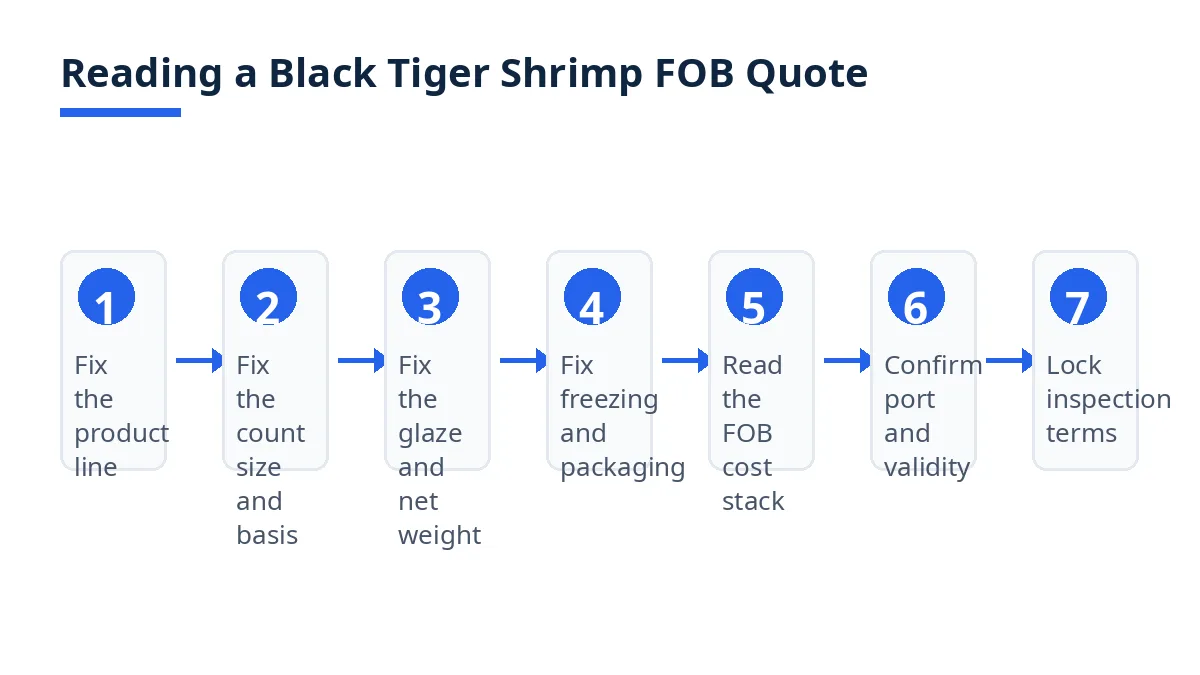
Step 1: Fix the product line. Confirm the species (Penaeus monodon), the form, and the treatment. Common forms include head-on shell-on, headless shell-on, peeled and deveined, peeled deveined tail-on, and cooked peeled tail-on. Each form has a different yield from whole shrimp, so each form carries a different price for the same count size. Also confirm whether the product is raw or cooked, and whether any additive treatment is used and declared.
Step 2: Fix the count size and its weight basis. Shrimp are sold by count, meaning the number of shrimp per unit weight. Common trade counts include U/10, 16/20, 21/25, 26/30, 31/40, 41/50, and 51/60 per pound, where "U" means "under" that number per pound. Larger shrimp mean a lower count and, in general, a higher price per kilogram. Confirm whether the count is per pound or per kilogram, and on what basis, because the same shrimp gives a different count on each basis. The Codex standard for quick-frozen shrimps or prawns provides that, where count is declared on the label, it is determined by counting shrimp in a representative sample and dividing by the actual deglazed weight.4
Step 3: Fix the glaze and the net weight basis. Frozen shrimp are usually coated with a thin ice glaze that protects against dehydration. Glaze is water, not shrimp, so the quotation must state the glaze percentage and whether the price is per kilogram of net weight (deglazed shrimp) or gross weight (shrimp plus glaze and packaging). The Codex method for net content removes all glaze that can be seen or felt, drains the product, and weighs the drained shrimp as the net content.4 This is the most common source of apparent price differences: a gross-weight quotation looks cheaper per kilogram than the same shrimp priced on net weight.
Step 4: Fix the freezing method and packaging. Confirm whether the shrimp is individually quick frozen (IQF) or block frozen, the carton size, the number of inner bags or layers, and the packaging materials. IQF suits buyers who take part of a carton at a time; block frozen suits buyers who thaw whole blocks. Confirm the storage temperature the supplier holds, since quality depends on an unbroken cold chain from processing to loading.
Step 5: Read the FOB cost stack. Ask the supplier to break the FOB price into its parts: raw shrimp, processing, freezing, packaging, cold storage, inland transport to the port, export documentation, and loading. You do not need the supplier's profit margin, but you do need to know which cost lines are included and which are marked as extra. A quotation with no breakdown cannot be compared with one that itemises.
Step 6: Confirm the port, validity, and shipment window. FOB Chittagong (Chattogram) and FOB Mongla are different cost stacks, because inland transport and port handling differ. Confirm the named port, validity period, shipment window, and minimum order quantity with its counting basis.
Step 7: Lock the inspection and claim terms. Agree what happens if the count, glaze, net weight, or quality at pre-shipment inspection differs from the quotation: the sampling basis, the laboratory if testing is required, and who pays for re-inspection. Put it in the purchase order or accepted quotation, not in a chat message.
Costs, timelines and documents
What sits inside an FOB price
An FOB price for black tiger shrimp is built from layers. The table below shows the structure, with example figures only — not market rates, and no figure here is a current price.
FOB cost layer | What it covers | Example figure (structure only) |
|---|---|---|
Raw shrimp | Whole or headless shrimp at the farm gate or depot, by count size | Example: 55% of the FOB price |
Processing | Heading, peeling, deveining, washing, grading | Example: 12% of the FOB price |
Freezing and glaze | IQF or block freezing, glaze water, cold storage | Example: 8% of the FOB price |
Packaging | Inner bags, cartons, labels, strapping | Example: 5% of the FOB price |
Inspection and testing | Pre-shipment inspection, laboratory tests where required | Example: 3% of the FOB price |
Inland transport and cold chain | Reefer transport from plant to port, port cold storage | Example: 9% of the FOB price |
Export documentation and loading | Export paperwork, customs handling, loading on board | Example: 8% of the FOB price |
FOB total | Price on board the vessel at the named port | Example: 100% |
The shares shift with the specification. Peeled and deveined shrimp carry more processing labour than headless shell-on, so processing takes a larger share. A high glaze percentage lowers the apparent price per gross kilogram while leaving the price per net kilogram unchanged, which is why the net weight basis matters more than the headline figure.
Normalising two quotations to the same basis
Convert each quotation to a price per kilogram of deglazed net weight, for the same form and count size. Example figures only: Supplier A quotes USD 10.00 per kilogram gross weight at 10% glaze; Supplier B quotes USD 10.50 per kilogram net weight. On a gross basis, A looks cheaper. On a net basis, A's shrimp content per gross kilogram is 0.90 kilograms, so A's net price is USD 10.00 divided by 0.90, or USD 11.11 per net kilogram. B is the cheaper shrimp. The same arithmetic applies to count size: convert both quotations to the same unit before comparing.
Timelines
There is no standard lead time, because it depends on raw material availability, the size mix, and the plant's schedule. Ask for a dated schedule for your order — sample date, production window, inspection date, latest loading date — rather than a single lead-time figure. If the order needs a specific count size in volume, confirm raw material availability first.
Documents
The usual set includes the commercial invoice, packing list, bill of lading, certificate of origin, and a health certificate where the destination requires one. Bangladesh export clearance follows the procedures published by Bangladesh Customs under the National Board of Revenue.5 For the European Union, consignments of products of animal origin from third countries must come from listed establishments and be accompanied by the required official certificate, under Regulation (EU) 2017/625 on official controls.6 For the United States, there is no per-shipment health certificate of the same kind; instead, processors operate under seafood HACCP controls, and importers hold verification records showing their foreign suppliers comply, under the FDA's fish and fishery products hazards and controls guidance.7 Confirm the exact list for your destination before production, not after loading.
Bangladesh-specific rules and tips
Start from the plant, not the price. Ask which plant will process your order, whether it already packs your form and count size, and which destination markets it already serves. A plant that already packs your specification will quote more reliably than one that must set up a new line.
Check the market status for your destination. EU-bound product must come from an establishment that meets the EU's third-country listing and certification conditions.6 US-bound product is judged on HACCP compliance and importer verification, not on an EU-style establishment list.7 UAE and UK buyers should confirm their own current import conditions with their authorities or brokers. Never accept a claim that one certificate covers every market.
Read the count size in the market's own unit. US buyers usually think in counts per pound; EU and Gulf buyers often think in counts per kilogram. A 26/30 per pound count is not a 26/30 per kilogram count. Write the count, its unit, and its basis into the purchase order.
Confirm cold chain handover points. Ask who owns the cold chain at each stage: plant cold store, reefer transport, port cold storage, and loading. Under FOB, the seller's responsibility ends when the goods are on board,3 but a break before loading is still the seller's problem. Agree the temperature records you will receive.
Mistakes and red flags
Comparing gross-weight prices with net-weight prices. This is the most expensive mistake in shrimp buying. Always convert to price per kilogram of deglazed net weight before comparing.
Accepting a count size without a basis. A quotation that says "26/30" without saying per pound or per kilogram, or headless or peeled, is incomplete.
Treating glaze as free shrimp. Glaze protects quality, but it is water. A high glaze percentage without a net weight price inflates the quantity you think you bought.
Assuming FOB includes freight or insurance. It does not. Under FOB, the buyer contracts and pays for the main carriage and insurance from the port of shipment.2 3 If you need the seller to arrange freight, you are asking for a different Incoterm, such as CFR or CIF.
Skipping the pre-shipment sample. Approve a sample from the same form, count size, and glaze as the order, and check its deglazed weight yourself. A catalogue photograph is not a sample.
Paying in full before inspection. Inspection before shipment, and payment terms that depend on documents showing the goods shipped as agreed, protect both sides better than full advance payment.
Red flags in a quotation. Watch for a price far below other quotations for the same specification, a refusal to break down the FOB price, a missing net weight basis, a plant that cannot be named, a health certificate promised for a market that does not use one, or pressure to skip inspection to meet a loading date.
Checklist
Check every quotation against this list:
[ ] Species confirmed as Penaeus monodon, with form (head-on, headless, peeled, cooked) stated
[ ] Count size stated with unit (per pound or per kilogram) and basis (headless, shell-on, or peeled)
[ ] Glaze percentage stated, and price stated per kilogram of deglazed net weight
[ ] Freezing method stated (IQF or block) with carton and inner-pack details
[ ] FOB cost stack broken down, with extras (inspection, testing, special packaging) identified
[ ] Named port of shipment, quotation validity, shipment window, and MOQ counting basis confirmed
[ ] Destination document list confirmed, including health certificate or HACCP verification as applicable
[ ] Pre-shipment inspection agreed, with sampling basis and who pays for re-inspection
[ ] Temperature records and cold chain handover points agreed in writing
[ ] Payment terms, claim procedure, and what happens on a count or weight shortfall agreed in writing
How Exportain helps
Exportain lets buyers post a sourcing request with the full specification — species, form, count size and basis, glaze and net weight basis, freezing method, quantity, port, and destination — so suppliers answer on the same lines instead of sending headline prices that cannot be compared. Supplier profiles show which trust checks Exportain staff have reviewed, and the verification guide explains what each badge does and does not mean, so a badge is read as a document review rather than a guarantee.8 Exportain is not a party to the trade, and inspection, testing, and payment terms remain matters for the buyer and supplier to agree in writing.
FAQs
What should I know first about black tiger shrimp?
Black tiger shrimp is Penaeus monodon, a saltwater species known in Bangladesh as bagda, and Bangladesh holds a geographical indication registration for it.1 Before price, fix the form, count size and its basis, glaze and net weight basis, and freezing method, because each one changes what a kilogram in the quotation contains.
What are the typical costs and timelines?
There is no standard cost or lead time for every order. An FOB price is built from raw shrimp, processing, freezing and glaze, packaging, inspection and testing, inland cold chain transport, and export documentation and loading, and the shares move with the specification. All figures in this guide are example figures showing structure only. Confirm a dated schedule for your order, from sample approval to latest loading date.
Which documents are needed?
The usual set includes the commercial invoice, packing list, bill of lading, certificate of origin, and a health certificate where the destination requires one. EU imports of products of animal origin require listed establishments and official certification under Regulation (EU) 2017/625,6 while US imports rest on processor HACCP controls and importer verification records.7 Confirm the exact list before production.
What are the most common mistakes?
Comparing gross-weight prices with net-weight prices, accepting a count size without its unit and basis, treating glaze as shrimp, assuming FOB includes freight or insurance, assuming one certificate covers all markets, and skipping pre-shipment inspection. Each is preventable by writing the full specification, net weight basis, and inspection terms into the accepted quotation.
Next steps on Exportain
Browse Bangladeshi suppliers and shortlist plants that already pack your form and count size, read how supplier verification works on Exportain before relying on any badge, and post your full specification as an RFQ so quotations arrive on comparable lines. If your quantity is still open, read the guide on MOQ, or minimum order quantity.
Sources
- Bangladesh got the GI certificate for Black Tiger Shrimp. Seafood Network BD (accessed )
- Incoterms® 2020. International Chamber of Commerce (ICC) (accessed )
- FCA & FOB Incoterms 2020 explained: Key differences. ICC Academy (accessed )
- Standard for Quick Frozen Shrimps or Prawns (CXS 92-1981). Codex Alimentarius Commission (accessed )
- Customs Clearance Procedures for Export. Bangladesh Customs, National Board of Revenue (accessed )
- Regulation (EU) 2017/625 on official controls and other official activities. European Union (accessed )
- Fish and Fishery Products Hazards and Controls. U.S. Food and Drug Administration (accessed )
- How Supplier Verification Works on Exportain. Exportain, (accessed )
About the author
Sourcing from Bangladesh?
Post a request for quotation and suppliers on Exportain can send you their quotes directly.
Post an RFQ