

Top Black Tiger Shrimp Manufacturers in Bangladesh: How to Find and Verify Them
How to find and check black tiger shrimp processors in Bangladesh: identity, market listing, HACCP, traceability, samples, cold chain, and contract terms, with a trial-order structure.
Short answer
Find a black tiger shrimp manufacturer in Bangladesh by checking evidence in order: the legal exporter and the actual plant, the destination-market basis, a HACCP plan written for your species and product form, a traceable lot from farm to shipment, lot-matched test reports, a cooked sample scored against a written specification, continuous cold-chain logs, and contract terms for rejection and re-testing. A supplier passes only when every check is documented, not when one certificate looks good.

On this page
A buyer searching for black tiger shrimp manufacturers in Bangladesh is usually not short of names. The harder problem is telling a processor that can consistently meet a destination market's food-safety, traceability, and cold-chain requirements from a trader, a broker, or a plant that only handles part of the work. This guide turns that problem into a checklist. "Top" here does not mean a ranking of companies. It means a supplier that passes every check below, with documents you can read and a trial shipment you can measure.
Black tiger shrimp is the farmed species Penaeus monodon, known locally in Bangladesh as bagda, and the main producing districts include Khulna, Satkhira, Bagerhat, and Cox's Bazar.1 That geography matters because raw material, processing, and cold storage are often in different hands, and each hand-off is a place where quality, identity, or temperature control can slip.
Key takeaways
Judge a supplier by evidence for your destination market, not by a brochure, a logo, or a long customer list.
For the EU, start with the competent-authority system: Bangladesh's Department of Fisheries is the authority for fishery and aquaculture products intended for export to the EU.1
For the USA, ask for the plant's written HACCP plan for the exact product and location, and for the importer verification steps that apply to that lot.2 3
Traceability is the thread that ties the farm or landing point, the processing plant, and the shipped lot together, and Bangladesh's 2020 fisheries law defines it in exactly those stages.4
A small trial order, tested and temperature-logged, tells you more than any certificate on its own.
Never approve a supplier on a single document. A pass needs identity, market listing, food-safety controls, traceability, samples, cold chain, and contract terms together.
The list
1. Confirm the legal exporter and the actual processor
What: Identify the legal entity that will sign the contract, invoice the goods, and export them, and separately identify the plant that will process them. Get the registered name, registered address, plant address, and the name that will appear on the export documents.
Why: A sales office, a trading company, and a processing plant are not the same thing. If the contracting entity does not control the plant, it cannot guarantee production, quality, or corrective action when something goes wrong.
How to fix: Ask for the business registration and the export registration documents for the contracting entity, then ask which plant will run your order and whether any step is subcontracted. If a name differs between the registration, the plant certificate, the test report, and the invoice, ask for a written explanation before you pay a deposit. Walk away from a supplier that cannot explain the difference in plain language.
2. Check the destination-market listing before you discuss price
What: For the EU, confirm how the plant sits within the EU's third-country system for fishery products. Bangladesh appears on the EU list of third countries authorised for the entry of certain fishery products.5 For the USA, confirm the plant's position under the seafood HACCP rules rather than assuming a general food-safety certificate covers the shipment.
Why: Market access is a gate, not a detail. A plant that cannot satisfy the destination's system will produce goods that cannot legally enter that market, however good the sample looks.
How to fix: Ask the supplier to show, in writing, the basis on which it exports to your market, and cross-check it against the official list or rule for that market. If the supplier answers with a generic certificate instead of a market-specific answer, treat that as an open item, not a pass.
3. Read the HACCP plan for your exact product
What: Ask for the written HACCP plan that covers your species, your product form, and the specific plant location. Under the US seafood HACCP rule, every processor must conduct a hazard analysis, and where hazards are reasonably likely to occur, must have and implement a written HACCP plan specific to each location and each kind of fish or fishery product processed.2
Why: A plan written for another species, another product form, or another site does not control the hazards in your order. Shrimp hazards, controls, and critical limits are product-specific, and a borrowed plan hides that gap.
How to fix: Request the plan's hazard list, critical control points, critical limits, monitoring steps, and corrective actions for your product, and ask who is trained to run it. If the supplier will only share a summary page, ask for the full plan under a confidentiality agreement. Refusal to share the plan at all is a reason to stop.
4. Test traceability from farm to shipped lot
What: Ask the supplier to trace one past lot backwards: farm or source, receiving records, processing date, cold-store records, and the shipped lot number. Bangladesh's fisheries law defines traceability as storing information on the farm, harvesting, extraction place or factory, and the care, transport, storage, and activities at each stage of processing, storage, transportation, and marketing.4
Why: Traceability is what makes a recall, a residue investigation, or a customer complaint answerable. Without it, a problem in one lot becomes a problem for every lot, and you cannot prove which shipment is affected.
How to fix: Run a mock trace before the first order: pick a lot number and ask for the chain within one working day. Small-scale black tiger shrimp production in Bangladesh is often aggregated from many small farms through intermediaries before it reaches a processor, which can delay delivery and affect quality.6 If the chain breaks at the intermediary, require farm-cluster or depot records that close the gap, or choose a supplier whose chain does not break.
5. Check residue and contaminant controls, not just a lab report
What: Ask how the plant controls veterinary drug residues and other contaminants: approved input lists, supplier declarations from farms and depots, and testing at laboratories in the Department of Fisheries system. That department operates quality-control laboratories in Dhaka, Chattogram, and Khulna that are accredited to ISO 17025.1
Why: A single clean test report proves one sample on one day. Residue control is a system: what goes into the pond, what is declared at receiving, and what is tested before shipment.
How to fix: Ask for the receiving checks, the list of prohibited substances communicated to farms, and the last three test reports for the same product form, with lot numbers you can match to shipments. If test reports cannot be matched to lots, ask for lot-matched testing on the trial order as a contract condition.
6. Judge samples the way your customer will judge them
What: Order samples in the exact product form, size grade, glaze, and packaging you intend to sell, and judge them after thawing and cooking, not only on arrival appearance.
Why: Frozen shrimp can look uniform while differing in size distribution, glaze, texture, and cooking yield. Your customer will judge the cooked product, so your sample test should too.
How to fix: Write the sample specification before the sample ships: species, form, size count, glaze tolerance, packaging, and labelling. Score the sample against that specification in writing, and keep a sealed reference sample. Any difference between the sample and the bulk shipment is then a measurable breach, not a matter of opinion.
7. Audit the cold chain, including the gaps between buildings
What: Map temperature control from receiving through processing, freezing, cold storage, container stuffing, and port handling, and ask for temperature logs for a comparable past shipment.
Why: Shrimp quality is lost in the gaps: a warm receiving dock, a slow freeze, a cold store door left open, or a container stuffed in the heat. A plant with good freezers and no dock discipline still ships a compromised product.
How to fix: Ask for continuous temperature records, not spot readings, and for the corrective action taken when a log shows a deviation. On the trial order, put a temperature logger in the container and compare its record with the supplier's log on arrival. A mismatch is a finding, even if the product still looks acceptable.
8. Lock the commercial terms that protect a food-safety failure
What: Put the food-safety specification, the testing regime, the rejection and replacement procedure, and the governing documents into the contract and the purchase order, before the trial order ships.
Why: A good supplier relationship still needs a written route for a bad lot. Without agreed rejection criteria, a failed shipment becomes a negotiation about opinions, and the goods sit in a cold store while the argument runs.
How to fix: Agree in writing: the specification and its tolerances, who tests and where, what happens to a rejected lot, who pays for re-testing and return or destruction, and how a repeat failure ends the arrangement. For the USA, remember that the importer's verification steps can include obtaining the foreign processor's HACCP and sanitation records for the lot, obtaining a certificate from the competent authority or a competent third party, inspecting the plant, holding a copy of the HACCP plan with a written guarantee, or periodically testing the product.3 Build whichever steps you will use into the order, not into a later conversation.
Summary table
Check | What passes | What fails |
|---|---|---|
Legal identity | Contracting entity, plant, and invoice name all explained | Unexplained name differences or a hidden subcontractor |
Market listing | Market-specific basis shown in writing | A generic certificate offered instead of a market answer |
HACCP plan | Written plan for your species, form, and plant | A borrowed plan for another product or site |
Traceability | One lot traced farm to shipment within a day | A chain that breaks at the intermediary |
Residue control | Input controls plus lot-matched test reports | One unmatched report offered as proof |
Samples | Scored against a written specification, cooked and thawed | Judged on frozen appearance alone |
Cold chain | Continuous logs plus a trial-order logger | Spot readings with no deviation record |
Contract terms | Rejection, re-testing, and repeat-failure terms agreed | A failed lot left to negotiation after shipment |
Example figures, for structure only: a trial order can be structured as one shipment split across two size grades, with one temperature logger and one independent lot-matched test, before any repeat order is discussed. These are example figures that show the shape of a trial, not market rates, and no price or volume in this guide should be read as a quotation.
How Exportain helps
Exportain's supplier pages and request-for-quotation route let a buyer compare shrimp processors in Bangladesh side by side, ask the same specification questions of each one, and keep the answers in one thread. Use that thread to collect the documents in the list above: the legal entity and plant identity, the market-specific basis, the HACCP plan for your product, the traceability example, and the lot-matched test reports. Keep the trial-order temperature log and the cooked-sample score in the same thread, so the decision to repeat an order rests on a file you can re-read rather than on a sales call you cannot.
When a supplier cannot answer a check, that gap stays visible in the thread. Do not let a fast reply on price close a slow answer on food safety. The cheapest supplier in the thread is only cheap if the shipment passes your market's checks, arrives at temperature, and matches the sample your customer approved.
FAQs
What is the biggest mistake?
The biggest mistake is approving a supplier on a certificate and a sample alone. A certificate describes a system at audit time, and a sample describes one batch. Neither proves that the plant controls residues, traceability, and temperature on your lot, in your product form, on your shipping date. The list above exists to close that gap, one document at a time.
How can I avoid it?
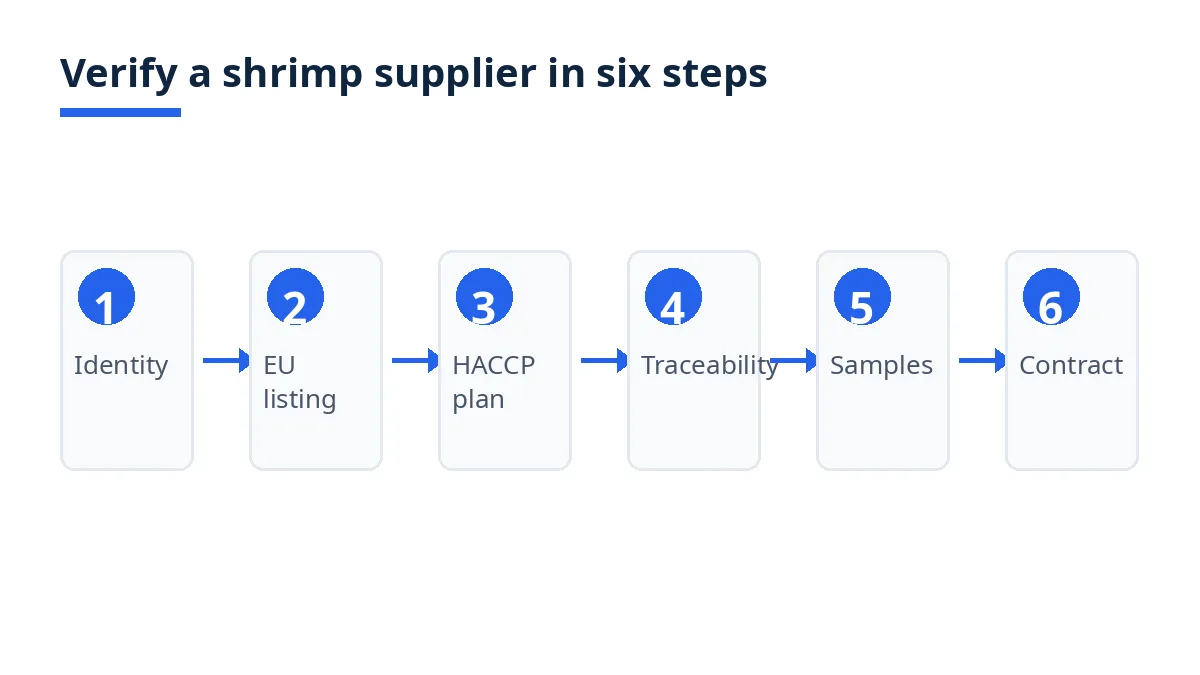
Work the list in order and in writing. Confirm identity and plant, confirm the market basis, read the HACCP plan for your product, run a mock trace, collect lot-matched test reports, score a cooked sample against a written specification, log the trial shipment's temperature, and agree rejection terms before bulk. If any step cannot be completed, pause that supplier and keep the others moving. A shortlist of two suppliers that pass slowly beats a shortlist of ten that were never checked.
Who is responsible?
Responsibility is shared, and each party's part should be written down. The processor is responsible for its hazard analysis, its HACCP plan, and its processing conditions.2 The importer is responsible for the verification steps that apply to the lot being imported, which can include obtaining records, certificates, inspections, or testing.3 The buyer who sets the specification is responsible for making that specification complete and measurable. When a failure occurs, the contract should say who tests, who decides, and who pays, before anyone needs it.
Where can I get help?
Start with the official sources for your destination market: the EU's third-country list for fishery products,5 the US seafood HACCP rules,2 3 and the Department of Fisheries system in Bangladesh.1 For comparing suppliers and keeping the document thread in one place, use the Exportain routes in the next section. For a plant visit or an independent inspection, engage an inspector who works in seafood and in your destination market's rules, and brief that inspector with your written specification rather than with a general request to "check quality."
Next steps on Exportain
Browse shrimp processors in Bangladesh on the Exportain suppliers directory and shortlist plants that answer the identity and market checks in writing.
Learn how supplier checks work on the platform in How supplier verification works on Exportain.
Post your exact specification, including species, product form, size grade, and destination market, as a request for quotation so each supplier answers the same questions.
Sources
- Portraying the Bangladesh Shrimp Industry: A SWOT Analysis. MDPI Sustainability (accessed )
- 21 CFR 123.6 — Hazard analysis and HACCP plan. Cornell Legal Information Institute (accessed )
- 21 CFR 123.12 — Special requirements for imported products. GovRegs (accessed )
- The Fisheries and Fish Products (Inspection and Quality Control) Act, 2020. Government of Bangladesh (accessed )
- Commission Implementing Regulation (EU) 2021/405 — list of third countries authorised for fishery products. European Union (accessed )
- Revitalising black tiger shrimp farming. World Fishing (accessed )
About the author
Sourcing from Bangladesh?
Post a request for quotation and suppliers on Exportain can send you their quotes directly.
Post an RFQ


