

Black Tiger Shrimp Exporters in Bangladesh: Verified Supplier Checklist
A printable pre-order audit for black tiger shrimp exporters in Bangladesh: species identity, market gates, HACCP, traceability, cold chain, samples and sign-off.
Short answer
Before ordering black tiger shrimp from Bangladesh, audit the exporter and its plant with one signed checklist: confirm exporter and plant identity, the destination market gate, a HACCP plan for your exact species and form, species identity control, lot traceability from pond to carton, cold chain custody, samples and pre-shipment inspection. Score each item pass, conditional or fail, and hold a first order until every fail closes with evidence.

On this page
Every check here follows one lot of black tiger shrimp — Penaeus monodon, known locally as bagda1 — from pond or landing point, through the processing plant, to the carton your customer receives. A quotation, certificate and sample can each belong to different lots. This guide is for a buyer about to place a first order with a black tiger shrimp exporter in Bangladesh. It tests the exporter that will sign your contract, the plant that will process your shrimp, and the evidence linking the two to your lot.
Why this checklist matters
Black tiger shrimp carry a species risk a general seafood checklist can miss. If the carton does not contain Penaeus monodon, or if farmed and wild-caught shrimp are mixed without that fact being stated, product, label and market paperwork no longer describe the same goods. Species identity therefore runs through this guide: checked at intake, carried in the lot code and confirmed on the carton label.
Market access is the second reason to check before ordering. Bangladesh appears on the EU third-country list for fishery products with a note that it can export all fishery products, including crustaceans.2 That country position is not a plant approval. For the USA, the importer side matters as much as the plant side; for the UK and UAE, confirm current entry requirements with your importer and file that confirmation.
Note that fishery products subject to FDA HACCP rules are listed among categories not covered by the FSVP rule.3
Before you start
Write the specification first. One page: species, farmed or wild-caught, form, size count, glaze declaration, net weight excluding glaze, pack, carton marking and markets. State how count and glaze will be measured.
Set the market gate for each destination.
Destination | Gate to confirm before ordering |
|---|---|
European Union | Country listing for fishery products, and the plant and product position within it2 |
United States | Importer verification procedures and the plant HACCP position for your lot4 5 |
United Kingdom | Current entry requirements, confirmed with your importer |
United Arab Emirates | Current entry requirements, confirmed with your importer |
Fix the decision rule. Score each item pass, conditional or fail: pass means evidence seen, matching and current; conditional means a named item closes by a named date; fail means no order until the gap closes. Sign-off: buyer or agent for identity and documents, food safety reviewer for HACCP and traceability, inspector for samples and pre-shipment checks.
The full checklist (numbered, printable)
Print this section and work from the top.
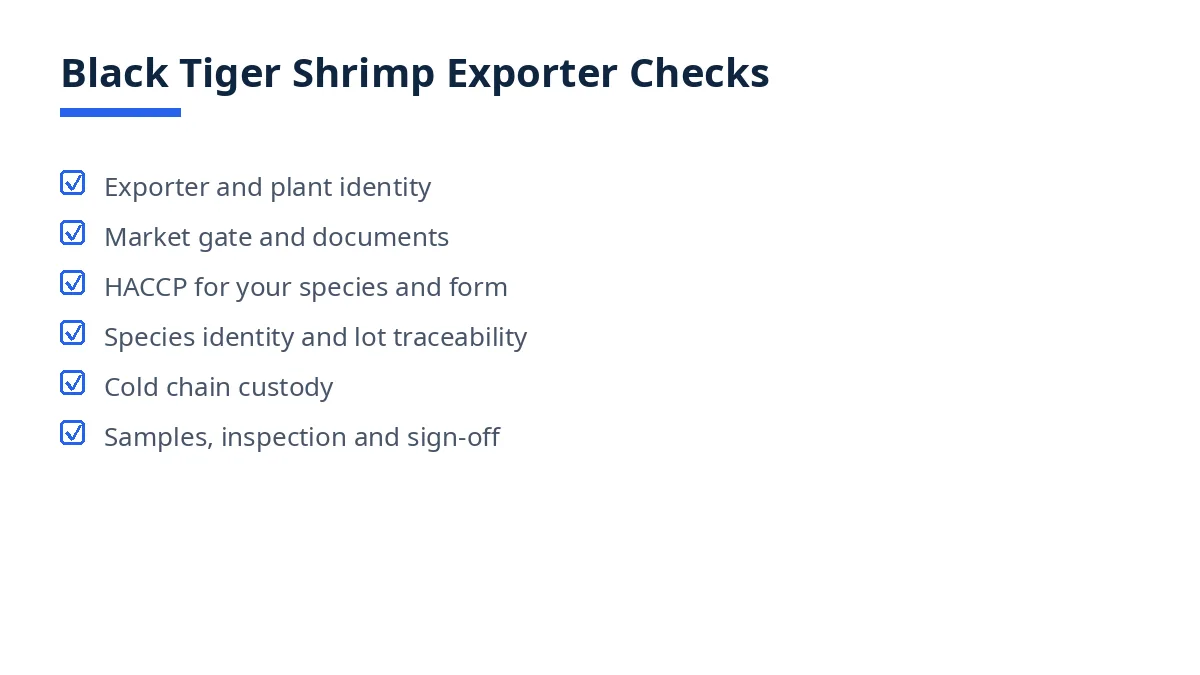
Exporter identity. Names identical on registration, quotation, contract, invoice and bank details; current trade licence and Export Registration Certificate.
Processor identity, stated separately. Plant name and address, and whether the exporter owns it, buys from it, or uses more than one plant.
Market gate, by destination. EU basis checked against the third-country fishery products list.2 USA: item 5. UK and UAE: the filed confirmation above.
Bangladesh export document route. A consistent sample document set. Goods may not be loaded unless a Bill of Export is approved, with contract, invoice, packing list, EXP form and certificate of origin enclosed, plus a Department of Fisheries quality certificate where required.6
United States importer verification, where applicable. Either a country with an active agreement covering the product, or written verification procedures: product specifications plus an affirmative step, such as lot HACCP records, a certificate, a facility inspection, or a held HACCP plan.5 Name your step.
HACCP plan for your exact product and plant. Written, signed and dated, specific to each location and each kind of product, covering hazards, critical control points, critical limits, monitoring, corrective actions and recordkeeping.4
Hazards beyond the plant walls. The hazard analysis must consider hazards before, during and after harvest, not only inside the plant.4 Ask who controls each one.
Farm and depot input controls. Approved input lists, farm and depot declarations, withdrawal periods where applicable, and receiving checks. Ask for recent lot-matched test reports.
Species identity control. How Penaeus monodon is confirmed at intake and packing, how farmed and wild-caught shrimp are kept apart where required, and what stops another species entering the line.
Lot traceability, pond to carton. A lot code linking a finished carton back to source, processing date and plant, with chain-of-custody information at every stage.
Traceability drill on a past lot. Before bulk, pick a lot code from a sample carton and ask for its full chain within an agreed timeframe. A chain stopping at a trader, depot or aggregator is a fail.
Cold chain custody map. Temperature control mapped from receiving to port handling, naming the custody transfer point at each hand-off. Put a logger in the trial shipment.
Product, pack and weight specification, signed. Form, count, glaze declaration, net weight excluding glaze, pack, carton marking and lot code, signed by both sides. Check a sample carton label against it word for word.
Sample protocol, in writing before bulk. Quantity, form, tests, who pays for testing, and what counts as approval. Judge the sample after thawing and cooking, not on frozen appearance alone.
Pre-shipment inspection and testing. Inspector, scope, sampling method, laboratory and the outcome on failure: rework, re-inspection or rejection of the affected lot.
Capacity and raw-material plan for your order window. Production and cold-storage capacity reserved for your order, the raw-material plan covering your order period, and the position if raw material is short.
Subcontracting and change notice. Every subcontracted step named in writing. Any change of plant, source, pack or inspector requires notice and re-approval before shipment.
Evidence file, sign-off and re-check. Completed checklist, with evidence references, checker names, results and a re-check date, signed by the buyer. Re-check earlier on change of plant or source, failed inspection, rejected consignment, new form or new market.
A fail on items 1, 2, 3, 6, 9 or 10 blocks a first order until closed with evidence. A conditional item proceeds only with its closing date in the purchase order.
Common failures and how to fix them
The carton does not prove it is black tiger shrimp. Fix at item 9: species confirmation at intake and packing, a lot code carrying species and source type, and a carton label checked against the signed specification.
The exporter cannot name the plant. Fix at item 2 by naming the plant, its address and the commercial relationship in writing. The seller may not control the processor.
The HACCP plan covers the wrong form. A plan for cooked shrimp does not control a raw product, because the US rule requires a plan specific to each location and each kind of product.4 Ask for the hazard list and critical limits for your species, form and plant.
Traceability ends at the depot. Supply is often aggregated before processing, and the chain commonly breaks where many small sources meet one depot. Fix at item 11: one past lot, traced end to end, before bulk.
Glaze, count and net weight were never defined. Fix at item 13 by signing the measurement method before bulk and checking the sample carton label against it.
Documents name different companies, or cold chain records gap at a hand-off. Return a mismatched set for correction before shipment, against the Bill of Export set in item 4.6 For cold chain, name every custody transfer point and compare the trial logger with the supplier's log.
Downloadable template / summary table
Copy this table into your exporter file, one row per checklist item.
Check group | Evidence to file | Result | Sign-off and re-check |
|---|---|---|---|
Identity and market gate | Trade licence, ERC, plant, market confirmation | Pass, conditional, or fail | Checker, date, trigger |
HACCP and hazards | Signed HACCP plan, hazard analysis | Pass, conditional, or fail | Reviewer, date, trigger |
Species and traceability | Intake records, lot code, drill result | Pass, conditional, or fail | Reviewer, date, trigger |
Cold chain and pack | Custody map, temperature records, signed specification | Pass, conditional, or fail | Checker, date, trigger |
Samples and inspection | Sample approval, inspection and lab reports | Pass, conditional, or fail | Inspector, date, trigger |
Capacity, change, terms | Capacity plan, change clause, purchase order | Pass, conditional, or fail | Buyer, date, trigger |
How Exportain helps
On Exportain, browse suppliers and post your black tiger specification, destination markets and delivery term on the RFQ board, so exporters quote against the same species, form, count, glaze and market questions. Ask each reply for the plant name, market basis, HACCP position for your form, species control and traceability method, and file replies against the checklist items above rather than by price alone.
Read any badge for what it records. Exportain verification is a document and photo review by staff, not a factory inspection, and verification is free.7 The decisions in this guide remain with the buyer, reviewer and inspector named in the sign-off.
FAQs
When should this checklist be used?
Before a first order with a new exporter, before a new form or market, and again on any change of plant, source, pack or inspector. It approves the exporter and plant for that lot and market; shipment checks still apply per consignment.
Who should complete it?
The buyer or agent completes identity, market gate and document items, and owns the sign-off file. A food safety reviewer completes HACCP, hazard, residue and traceability items. An inspector completes sample, visit and pre-shipment items.
What are the most common failures?
An unnamed plant behind the exporter, a HACCP plan for the wrong species or form, a traceability chain that stops at a depot, species identity asserted but not controlled at intake, and glaze, count and net weight never defined in writing. Cold chain gaps and mismatched document sets are also frequent. Each is fixed by closing the named evidence gap.
Can a third party do it?
Yes, for plant visits, sample and pre-shipment inspection, and for reporting on HACCP, traceability and cold chain records. The buyer should still set the specification, market gate and evidence to file, and receive the raw reports, including lot HACCP records where US importer verification requires them.5 Sign-off stays with the buyer.
Next steps on Exportain
Browse suppliers, then post your black tiger specification and destination markets on the RFQ board so replies can be scored against this checklist on the same basis. Before confirming an exporter, read how supplier verification works on Exportain to see what a badge records and what still needs your own check.
Sources
- Comparative study of the reproductive performance and White Spot Syndrome Virus (WSSV) status of black tiger shrimp (Penaeus monodon) collected from the Bay of Bengal. WorldFish (accessed )
- Commission Implementing Regulation (EU) 2021/405 — list of third countries authorised for fishery products. European Union (accessed )
- FSMA Final Rule on Foreign Supplier Verification Programs (FSVP) for Importers of Food for Humans and Animals. U.S. Food and Drug Administration (accessed )
- 21 CFR 123.6 — Hazard analysis and HACCP plan. Cornell Legal Information Institute (accessed )
- Code of Federal Regulations Title 21. Food and Drugs 21 CFR § 123.12. FindLaw (accessed )
- Customs Clearance Procedures for Export. Bangladesh Customs, National Board of Revenue (accessed )
- Supplier verification: Earn trust badges buyers can see. Exportain (accessed )
About the author
Sourcing from Bangladesh?
Post a request for quotation and suppliers on Exportain can send you their quotes directly.
Post an RFQ


