How to Find Better Cotton (BCI) Certified Factories in Bangladesh
How to check Better Cotton for orders from Bangladesh: mass balance versus physical chain of custody, platform records, BCCU volumes, and claim wording that fits the model.
Short answer
Better Cotton is not a factory certification. It is a farm-level standard: producers meet the Principles and Criteria, and cotton then moves through the supply chain under mass balance volume accounting on the Better Cotton Platform, or through a physical, segregated and traceable route. Check the supplier's platform record, chain of custody model, volume reconciliation, and claim wording, never a factory certificate.
On this page
Key takeaways
Better Cotton is not a factory certification and not a product quality mark; it is a farm-level standard, with producers meeting the Principles and Criteria and cotton moving under a chain of custody model.
Mass balance tracks volumes, not physical fibre: BCCUs on the Better Cotton Platform must match the order, sold volumes must not exceed purchased volumes, and mass balance cannot prove physical presence or a country of origin.
Physical Better Cotton is a separate route: certified members, segregated and traceable models, every owning handler certified, and the BCI Cotton label conditions met before any label claim is made.
The buyer check is the written model, the supplier's platform record, the volume reconciliation, and the exact claim wording, with consumer-facing wording reviewed and approved where the framework requires it.
Better Cotton is not a factory certification, not a product quality mark, and not a status issued to a factory. It is a farm-level sustainability programme and standard for how cotton is grown: producers meet the Better Cotton Principles and Criteria, and what then moves through the supply chain is Better Cotton under a chain of custody model. The phrase in the title, "Better Cotton (BCI) Certified Factories", is common search phrasing, not a real status. What a buyer can check is the supplier's place in that chain, the model used, the volume accounting, and the exact claim wording.
The farm standard is the starting point. The Principles and Criteria set out the global requirements producers must meet to sell cotton as Better Cotton, and the standard is described as a farm-level standard covering environmental, social and economic requirements for cotton production.1 It has six Principles: Management, Natural Resources, Crop Protection, Fibre Quality, Decent Work and Sustainable Livelihoods, with Gender Equality and Climate Change as cross-cutting priorities.1 Criteria describe outcomes, Indicators set the requirements producers are assessed against, and the standard follows continuous improvement over time.1
Between farm and gin, the cotton is kept apart. Better Cotton seed cotton and lint bales are always required to be segregated from other types of cotton between farm and gin, so that all Better Cotton bales from participating gins are 100 percent Better Cotton.2 Everything after the gin depends on the chain of custody model, and that choice changes what the buyer may claim.
Mass balance is the model most buyers will meet first. It is a volume-tracking system that allows Better Cotton to be substituted or mixed with conventional cotton by traders or spinners while ensuring the amount sold never exceeds the amount purchased at all levels, and it can be implemented from ginner onwards.2 Each kilogram of lint from the gin is assigned one Better Cotton Claim Unit (BCCU), and those units move along the chain to show the Better Cotton amount in each order, tracked on the Better Cotton Platform.2 Because BCCUs are not connected to the original farmers' cotton, mass balance Better Cotton is not traceable to its country of origin.2 The older Claims Framework states the same limit: under mass balance there is no guarantee of physical presence or quantity in the finished product, so claims focus on commitment rather than content.3
Physical Better Cotton is a different purchase. The label page distinguishes the BCI Cotton label, usable only by certified members sourcing through segregated and traceable models, from a mass balance label, under which licensed-farm cotton may be mixed with conventional cotton so physical origin cannot be guaranteed.4 For the BCI Cotton label, all cotton in the product must come from farmers certified to the Farm Standard, the product must contain at least 30 percent BCI Cotton, and 100 percent of its cotton must be BCI Cotton.4 After May 2026, new products may carry the label only if they contain certified, traceable Better Cotton.4 Settle this first: mass balance volume purchase, or physical purchase with a label ambition.
The programme is also moving from a licensing standard to a certification scheme. Its certification questions state that this transition culminates in the new Better Cotton Label for physical, traceable Better Cotton from a certified chain, and that currently it is a licensing standard using a mix of second-party and third-party verifiers.5 Only suppliers and manufacturers who wish to source, process and sell physical, traceable Better Cotton need certification; mass balance suppliers do not require certification at this time.5 Supplier and manufacturer certification lasts three years, and every handler of physical Better Cotton must be audited and certified for the new label to be used.5
Why this matters for buyers and sellers
For a buyer, the main risk is paying for a claim the paperwork cannot carry. A sheet calling a factory "BCI certified" proves nothing about the cotton in the order, because no such factory status exists, and the farm standard says nothing about sewing, dyeing, or delivery. A second risk is claim inflation: a mass balance order described as "made with Better Cotton" without that qualification invites an assumption of physical content mass balance does not guarantee.3 A third risk is origin invention: mass balance BCCUs are not traceable to a country of origin, so such an order cannot prove cotton grown in any named country, including Bangladesh.2
For a seller, the same discipline protects the order. A supplier that states its model up front, shows its platform record, matches BCCU volumes to the order, and uses fitting wording gives a buyer a file that can be checked before shipment. A vague factory claim, a lifted logo, or a percentage with no model behind it invites a dispute when the buyer's customer asks for proof. Members must communicate honestly, cannot use unsubstantiated or misleading claims, and must submit claims for review and approval before publication.3
Step-by-step: how it works
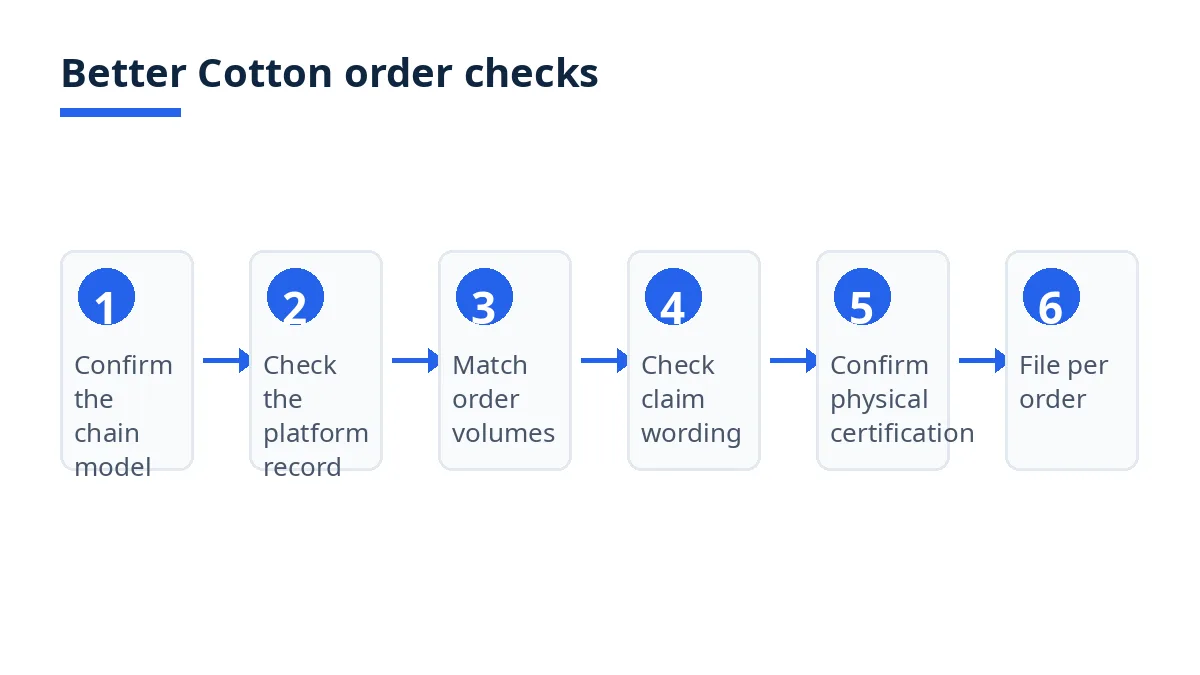
Start with the model, not the factory name. Ask the supplier to state in writing whether the order will be mass balance or physical, and, if physical, which physical model applies.
Next, check the supplier's place on the Better Cotton Platform. The mass balance page notes buyers can use the platform company list, from merchants to end product manufacturers, filtered by country, chain of custody model and certification status.2 Ask for the platform identity, the recorded model, and certification where the order requires it. For a physical order, confirm every organisation taking ownership of the physical cotton is certified.5 A service-only subcontractor is treated differently: the owning organisation remains responsible, although subcontracted sites may still need to pass an audit.5
Then check the volume accounting for the order. For mass balance, ask how many BCCUs correspond to the order, how they were acquired, and how the supplier ensures the amount sold never exceeds the amount purchased, allowing for conversion rates as cotton becomes yarn, fabric, and garments.2 For a physical order, ask for the records that keep the physical cotton identified through each handling step, and the certification details of each handling site.
Then check claim wording line by line. Under mass balance, the claim must not suggest Better Cotton is physically present in the finished product or physically traceable to it.3 Acceptable wording describes sourcing through mass balance, in volumes equivalent to those used. Reject "made with 100 percent Better Cotton", "contains Better Cotton from licensed farms", or any named farm origin, for a mass balance order. For a physical label ambition, check the label conditions: certified members only, segregated and traceable models only, and the percentage and fibre conditions on the label page.4
Work through one case before agreeing terms. A Bangladeshi supplier offers "BCI certified T-shirts, 100 percent Better Cotton" for cotton jersey T-shirts. If its platform record is mass balance only, the offer is wrong twice: the shirts are not certified as a product, and mass balance volumes do not guarantee physical Better Cotton in those shirts.2 3 The corrected offer states a volume sourced as Better Cotton through mass balance, with BCCUs matched to the order and no physical or origin claim. A label-ready order must instead be rebuilt as physical: certified handlers, segregated and traceable cotton, and the label conditions met.4 5
Costs, timelines and documents
There is no single public figure for Better Cotton costs that fits every order, so this guide gives cost drivers instead of numbers. For mass balance, the drivers are volume, any premium, platform and record-keeping work, and time spent agreeing wording. For a physical order, add certification costs: Better Cotton continues to fund producer-level assessment and audit costs where that was previously the case, while other supply chain organisations cover their own certification costs.5 Certification lasts three years, so renewal belongs in the order calendar.5
Timelines follow the same logic. A mass balance order can move as fast as the supplier's platform record and volume position allow, since no new certification is required for mass balance at this time.5 A physical order needs more time: each handling site must be certified, records must keep physical cotton identified, and consumer-facing claims must go through review and approval before publication.3 Confirm certification and approval times in writing, and do not promise a label date before that confirmation exists.
Item | What to check | Why it matters |
|---|---|---|
Model | Mass balance or physical, in writing | Decides what may be claimed |
Platform record | Supplier identity, model, certification status | Shows the supplier's place in the chain |
Volumes | BCCUs or physical volumes matched to the order | Sold must not exceed purchased |
Physical certification | Each owning handler certified, where physical | Label use needs certified handlers |
Claim wording | Exact words, model qualification included | Must not imply physical content for mass balance |
Claim approval | Better Cotton review before publication | Unapproved claims risk rejection |
Order file | Model, volumes, wording, date checked | A new order needs a fresh check |
Bangladesh-specific rules and tips
There is no Bangladesh-specific Better Cotton rule that changes the farm standard or the chain of custody models, and no Bangladesh farm or factory count is stated here, because no opened Better Cotton source used here states one. The Bangladesh work is about the supplier link in the chain, not a local register. Most buyers sourcing from Bangladesh will deal with a spinner, fabric mill, or garment manufacturer, not a farm, and the check is on that supplier's platform record, model, and volume accounting.2
Two cautions follow from the programme rules. First, do not accept a farm origin claim for a mass balance order placed in Bangladesh. Because mass balance BCCUs are not traceable to a country of origin, such an order cannot prove Bangladeshi farm origin, even when garments are cut and sewn in Bangladesh.2 Garment origin and cotton origin are different facts, and only a physical, segregated route can support an origin statement. Second, do not let a factory visit substitute for the chain check: a well-run factory and good samples say nothing about platform volumes or physical certification.
Where a buyer wants a physical, label-ready order from Bangladesh, planning must start earlier. Each organisation taking ownership of the physical cotton must be certified, and consumer-facing claims must be approved before publication.5 3
Mistakes and red flags
The most common mistake is accepting a factory claim as a programme claim. A sheet calling a factory "BCI certified", "BCI approved", or "BCI registered" does not identify a farm result, a model, a platform record, or a volume reconciliation, and it is unverified until those items are produced.
A second mistake is mass balance wording drift. Phrases such as "made with Better Cotton" or "100 percent Better Cotton" on a mass balance order overstate what mass balance proves, since it carries no guarantee of physical presence or quantity in the finished product.3
A third mistake is mixing up the two label routes. The BCI Cotton label route requires certified members sourcing through segregated and traceable models, while the mass balance route cannot guarantee physical origin.4 A supplier offering label artwork on a mass balance order, or a mass balance volume at a physical price without certified handlers, has confused the routes.
Checklist
Model stated in writing: mass balance or physical; platform identity, model and certification status confirmed.
For a physical order, every owning handler certified, details on file.
Volumes checked: BCCUs or physical volumes matched to the order.
Claim wording read line by line, model qualification present; consumer-facing wording approved where required.
Order file holds model, volumes, wording, certification details, and date checked.
Any model, supplier, or label change flagged for a fresh check before shipment; any gap recorded with a proceed-or-not decision.
How Exportain helps
Exportain's supplier checks are a document and photo review, not a Better Cotton chain of custody check, and they do not replace the checks here. The Trust Center states that supplier verification is a document review, not a factory inspection or a check against any government database, and that a badge is not a guarantee of production capacity, product quality, or delivery.
A buyer can use Exportain to describe the product, the model required, and the exact claim wording to be agreed before dates are set. The certification services category currently renders "No services published in this category yet", so request the platform record, volume reconciliation, and claim wording evidence directly from the supplier.
FAQs
What should I know first about Better Cotton (BCI)?
Know first that Better Cotton is not a factory certification and not a product quality mark. It is a farm-level standard: producers meet the Principles and Criteria, covering Management, Natural Resources, Crop Protection, Fibre Quality, Decent Work and Sustainable Livelihoods, with Gender Equality and Climate Change as cross-cutting priorities.1 After the gin, the order follows either mass balance accounting, without guaranteeing physical presence or origin, or a physical, segregated and traceable route for certified sites and label use.2 4
What are the typical costs and timelines?
There is no typical figure for every order. Mass balance costs turn on volume, any premium, and record-keeping, while physical orders add certification costs, which supply chain organisations other than producers cover themselves, with certification lasting three years.5 Timelines turn on the same factors, plus claim review and approval before publication.3 Confirm the breakdown for the specific chain, and do not promise a label date before certification and approval are confirmed.
Which documents are needed?
The core set is the written model, the supplier's platform record with model and certification status, the volume reconciliation for the order, the exact claim wording, and, for a physical order, certification details for every organisation taking ownership of the physical cotton.2 5 Consumer-facing wording should have Better Cotton review and approval where required.3 Hold all of these items in the order file, matched to the same product and volume as the order.
What are the most common mistakes?
The most common mistakes are accepting a factory claim as a programme claim, using physical content wording for a mass balance order, claiming a farm country of origin from mass balance volumes, offering label artwork on a mass balance order, and matching the company name but not the platform record, model, and volumes. The correction is the same: ask for the model, the platform record, the volume reconciliation, and the exact claim wording, and record any gap before agreeing shipment dates.
Next steps on Exportain
Describe the product, the model you require, and the documents you require, then run the checklist before agreeing shipment dates. Post a free RFQ on Exportain with the model and Better Cotton evidence stated. For background on platform checks, read the Trust Center and seller verification pages.
Sources
- Defining 'Better': the Better Cotton Principles and Criteria. Better Cotton (accessed )
- Sourcing With Mass Balance. Better Cotton (accessed )
- Better Cotton Claims Framework Version 3.1. Better Cotton (accessed )
- What the BCI Cotton label means. Better Cotton (accessed )
- FAQs: Better Cotton Certification for Ginners, Suppliers, Manufacturers, Retailers and Brands. Better Cotton (accessed )
About the author
Sourcing from Bangladesh?
Post a request for quotation and suppliers on Exportain can send you their quotes directly.
Post an RFQ