

Bed Sheets Exporters in Bangladesh: Verified Supplier Checklist
A 36-point checklist for vetting bed sheets exporters in Bangladesh for repeat programmes, covering export status, capacity, dye-lot control, lab evidence, labelling, and commercial terms, with a trial-order gate before volume grows.
Short answer
Use this checklist to vet bed sheets exporters in Bangladesh before committing to a repeat programme. Confirm the exporter's ERC and legal identity, test repeat capacity and dye-lot control, require lab reports naming the fabric, colour, and lot, agree labelling and packing for each destination market, settle price, lead time, and sample approval in writing, and run a trial order. Only scale volume after the trial passes every agreed check.
On this page
Key takeaways
Check export status and legal identity first, because good samples cannot rescue a supplier that cannot show it is entitled to export.
Judge repeat capacity and dye-lot control on evidence of past repeat runs, not on a single sample or a general assurance.
Require every lab report to name the fabric, colour, and lot it covers, and check certificate scope and expiry before approval.
Settle price elements, lead-time start, sample approval, and the trial-to-repeat gate in writing before volume grows.
If you plan repeat bed sheet programmes from Bangladesh, vet the exporter before you commit to volume. A supplier who makes one good sample may still struggle with dye-lot control, repeat sizing, or delivery across several drops. This checklist helps buyers in the USA, the UK, the EU, and the UAE test identity, capacity, fabric control, lab evidence, and labelling in one pass.
Why this checklist matters
A repeat programme fails in different places than a single order. The first shipment may match the sample while the second changes shade, shrinks differently, or arrives with a different fitted-sheet pocket. Those failures usually trace back to checks skipped at selection: who makes the goods, where fabric comes from, how colour is controlled across lots, and what evidence backs each claim.
This checklist is for selection, not shipment inspection: it records what the exporter can prove and where evidence is missing. After this gate, use the separate bed sheets quality control checklist at inspection stage.
Before you start
Fix the programme brief before you contact suppliers: sheet types, sizes, fibre, weave, colours, and destination markets, since labelling and test expectations differ by market. Decide which checks are pass or fail and which are scored, use the same sheet for every candidate, and set one evidence deadline for all.
Work through it in order: identity first, then production and dye control, then lab evidence and labelling, and terms last. Record each item as pass, fail, or evidence requested, with document name and date.
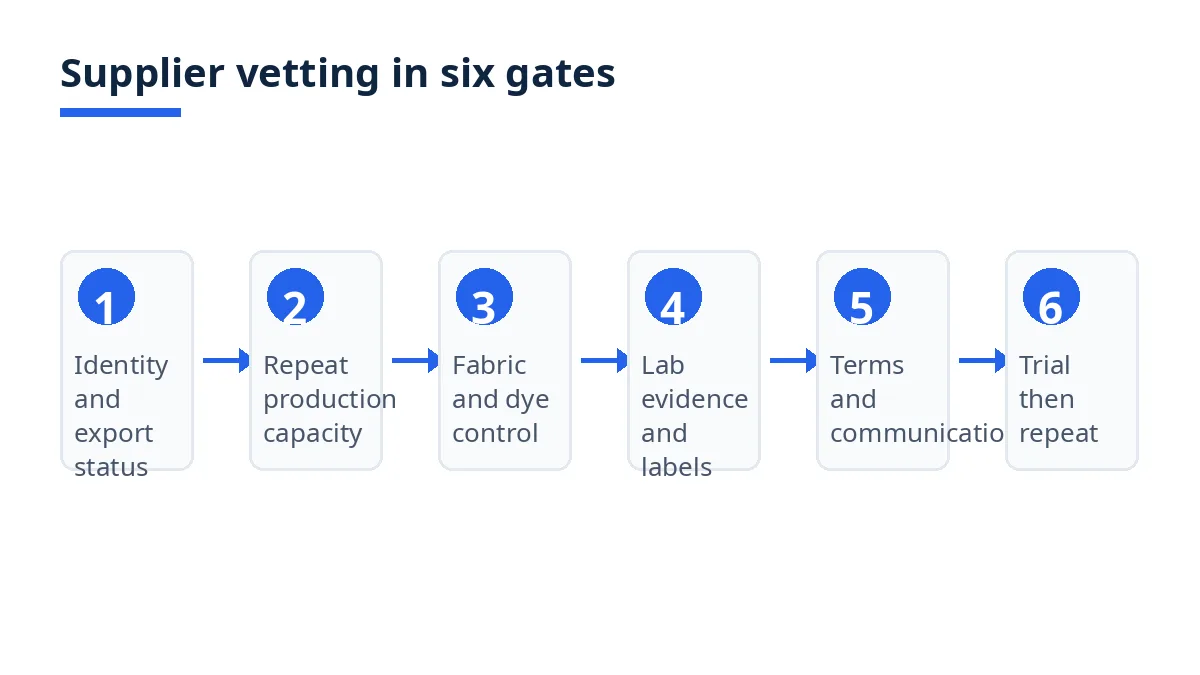
The full checklist (numbered, printable)
Identity, legal standing, and export status
Confirm the legal name, registered address, and contact person match across the trade licence, tax, and bank details.
Ask for the Export Registration Certificate (ERC), current for the entity named on the quotation. The ERC is issued by the Office of the Chief Controller of Imports and Exports (CCI&E), and applicants typically need a trade licence, TIN certificate, and chamber membership certificate.1
Ask whether the candidate is a manufacturer, a manufacturer with subcontracted stages, or a trading company, and record which stages sit in-house.
Ask for facility photos and a plain description of cutting, sewing, finishing, and warehousing.
Ask for two trade references from buyers in comparable markets, and contact at least one about repeat orders.
Product range and repeat production capacity
Ask for the current sheet range by type, size, fibre, and weave, and check your programme sizes sit inside it.
Ask how many repeat programmes the exporter runs now, and how one buyer's materials and packing are kept apart.
Ask for monthly capacity in finished sets by sheet type, and the longest recent repeat run.
Ask how production is planned across separate fabric, dyeing, and sewing sites, and who owns the schedule when a stage slips.
Ask what happens to your programme when a larger order arrives mid-run, and record the answer.
Ask how machines, patterns, and packing lines are reset between colours and sizes.
Fabric sourcing, dyeing, and shade control
Ask where the greige and finished fabric come from, and whether the supplier can name each programme fabric source.
Ask how fabric is inspected on arrival, and what happens to a roll that fails.
Ask how dye lots are controlled across a repeat programme, and how sets are grouped so cartons do not mix lots.
Ask for the lab dip approval process: who approves shade, under what light, and how the standard is stored.
Ask how printed or striped designs are matched across the sheet and pillowcases in a set.
Ask for the thread-count method behind any thread-count claim, since counting methods differ.
Lab evidence for washing, colour, pilling, and care
Ask for recent lab reports on the programme fabric, each naming the fabric, colour, and lot covered.
For dimensional change, ask for evidence by a recognised method. ISO 5077 covers dimensional change in washing and drying.2
For washing fastness, ask for evidence by a recognised method. ISO 105-C06 covers colour fastness to laundering.3
For rubbing fastness, ask for dry and wet test evidence. ISO 105-X12 covers colour fastness to rubbing.4
For perspiration fastness, ask for evidence where pillowcases sit against the skin. ISO 105-E04 covers colour fastness to perspiration.5
For surface pilling, ask for evidence by a recognised method and agreed rating scale. ISO 12945-2 covers pilling, fuzzing, and matting by the modified Martindale method.6
Confirm every lab report is recent, covers the bulk fabric and colour, and names a lab you can cite in the purchase order.
Labelling, packing, and destination rules
Ask for the full label plan for each destination market, including fibre, care, size, and origin, before bulk labels are printed.
For the EU, check fibre names and composition against Regulation (EU) No 1007/2011, which requires fibre composition to be labelled or marked when a textile product is made available on the market.7
For care labelling, agree the symbols in advance. ISO 3758 sets out graphic care symbols based on the most severe treatments that do not cause irreversible damage.8
If a harmful-substances claim will appear, check the certificate scope, number, and expiry date. Under OEKO-TEX STANDARD 100, the label is awarded only if all components meet the criteria, and a certificate is valid for 12 months.9
Ask for the packing specification by carton: set contents, size ratios, folding, inserts, barcodes, and markings.
Ask how a labelling or packing error found after packing is handled, and whether affected cartons trace to a dye lot.
Commercial terms, communication, and the trial gate
Ask for a written quotation separating fabric, making, trims, packing, and freight terms, so a later price change can be traced.
Agree payment terms, Incoterms, lead time, and the point at which the price is fixed, plus what triggers a price review.
Agree sample stages in writing: lab dip, pre-production sample, and bulk approval, each with a named approver and response time.
Test communication during vetting: reply speed, clarity on technical questions, and willingness to correct an error in writing matter more than a polished catalogue.
Run a trial order before a repeat commitment. Example figures: a trial of one size run in two colours, with a repeat programme only after the trial passes, gives a cleaner read on shade control and delivery than a single large first order.
Set the repeat gate in advance: the trial must pass the agreed lab, labelling, and packing checks, with a named fix and re-check for any failure before volume grows.
Common failures and how to fix them
The most common failure is a supplier that passes on samples and fails on repeats: shade drifts, fitted pockets vary, or packing mixes sizes, because dye-lot grouping and size separation were never agreed. Fix it by writing lot grouping, set contents, and carton ratios into the brief, and checking the first repeat against the trial.
The second common failure is evidence that does not match the goods: a report covers a different fabric, colour, or lot, or a certificate has expired. Fix it by requiring fabric, colour, and lot on every report and rejecting untied reports.
The third common failure is vague commercial terms: a price that moves with fabric costs, a lead time with no start point, or a sample stage with no approver. Fix it by separating price elements, naming the lead-time start, and writing sample approval into the purchase order.
The fourth common failure is slow or evasive communication during a problem. A supplier that answers quickly while selling and slowly while fixing costs more time than a slower supplier that answers plainly. Fix it by testing problem handling in the trial: raise one real query, record response time and answer quality, and weigh it in the repeat decision.
Downloadable template / summary table
Copy the checklist into one sheet per supplier, add a column for evidence document and date, and score each section before comparing candidates. A supplier missing its ERC, with an expired certificate, or no repeat evidence should not reach trial on samples alone.
Section | Checks | Evidence to file |
|---|---|---|
Identity and export status | 1-5 | ERC, trade licence, facility photos, references |
Repeat capacity | 6-11 | Capacity note, repeat run record |
Fabric and dye control | 12-17 | Fabric source, dye-lot method, lab dip record |
Lab evidence | 18-24 | Reports naming fabric, colour, lot |
Labelling and packing | 25-30 | Label plan, packing specification |
Terms and trial gate | 31-36 | Quotation, sample plan, trial result |
How Exportain helps
Exportain is a B2B marketplace where buyers can find Bangladeshi suppliers of bed sheets and home textiles, compare profiles, and post sourcing requests. Profiles show which document and photo checks have been recorded, and Exportain verification is a document and photo review, not a factory inspection, so a badge is not a promise of capacity, quality, or delivery. Exportain is not a party to the goods contract and does not inspect goods, book freight, or clear customs. Use the checklist on any shortlisted supplier, and keep your evidence file.
FAQs
When should this checklist be used?
Use it before a repeat programme, and again when you add a supplier, sheet type, or market. It belongs before the trial order, not after a failed shipment.
Who should complete it?
The buyer or the buyer's sourcing agent should complete it, because the buyer owns the brief and gate. A third party can gather documents and contact references, but the buyer should still review the evidence file and sign off the trial decision.
What are the most common failures?
Shade drift across dye lots, lab evidence that does not match the fabric or colour, expired certificates, mixed sizes in cartons, and vague price or lead-time terms are the failures this checklist catches. Each is cheaper to fix at selection than after bulk production.
Can a third party do it?
Yes, if you share the brief, the pass or fail rules, and the evidence standard first. A third party that only collects brochures and samples has not completed the checklist, so ask for the evidence file itself, with document names and dates, before acting on it.
Next steps on Exportain
Shortlist suppliers on suppliers, read what each profile check covers on the trust-center page and the seller-verification page, then post your programme brief as an RFQ through rfqs. Work the checklist on every shortlisted exporter, run the trial gate, and keep the evidence file.
Sources
- Export Registration Certificate (ERC) In Bangladesh: How To Apply. Bizmend, (accessed )
- ISO 5077:2007 - Textiles — Determination of dimensional change in washing and drying. International Organization for Standardization (accessed )
- ISO 105-C06:2010 Textiles — Tests for colour fastness — Part C06: Colour fastness to domestic and commercial laundering. International Organization for Standardization, (accessed )
- ISO 105-X12:2016 - Textiles — Tests for colour fastness — Part X12: Colour fastness to rubbing. International Organization for Standardization (accessed )
- ISO 105-E04:2008 - Textiles — Tests for colour fastness — Part E04: Colour fastness to perspiration. International Organization for Standardization (accessed )
- ISO 12945-2:2020 - Textiles — Determination of fabric propensity to surface pilling, fuzzing or matting — Part 2: Modified Martindale method. International Organization for Standardization (accessed )
- Regulation (EU) No 1007/2011 on textile fibre names and related labelling and marking of the fibre composition of textile products. European Union, (accessed )
- ISO 3758:2023 - Textiles — Care labelling code using symbols. International Organization for Standardization (accessed )
- OEKO-TEX STANDARD 100 for textiles tested for harmful substances. Hohenstein (accessed )
About the author
Sourcing from Bangladesh?
Post a request for quotation and suppliers on Exportain can send you their quotes directly.
Post an RFQ


