

How to Find BAP (Best Aquaculture Practices) Certified Factories in Bangladesh
How to check BAP certified seafood from Bangladesh: star level, facility certificates, certifying body, and lot trace for the exact shipment.
Short answer
Finding BAP certified seafood in Bangladesh means checking a chain of facilities, not a single factory and not a single logo. Best Aquaculture Practices, known as BAP, is the Global Seafood Alliance programme that certifies processing plants, farms, hatcheries, and feed mills, and its star level shows how many of those links are certified. Read the star level, each facility certificate, the certifying body, and the lot trace before treating any BAP claim as settled.
On this page
Key takeaways
BAP is the Global Seafood Alliance programme that certifies processing plants, farms, hatcheries, and feed mills, and the star level shows how many of those links are certified.
One star is the processing plant, two stars add the farm, three stars add the hatchery or the feed mill, and four stars mean the whole chain is certified.
BAP is not a food-safety system for a shipment, not a product quality mark, and not a guarantee of any single shipment.
A logo alone proves nothing: verify each facility certificate, the certifying body, the star-level count, and the lot trace, and confirm costs and timelines with the certification body.
Finding BAP certified seafood in Bangladesh means checking a chain of facilities, not a single factory and not a single logo. Best Aquaculture Practices, known as BAP, is the Global Seafood Alliance programme that certifies processing plants, farms, hatcheries, and feed mills, and its star level shows how many of those links are certified. Read the star level, each facility certificate, the certifying body, and the lot trace before treating any BAP claim as settled.
BAP stands for Best Aquaculture Practices, a third-party certification programme developed by the Global Seafood Alliance, known as GSA. It covers the entire farmed seafood production chain, and its four-star system represents each piece of that chain: the processing plant, the farm, the hatchery, and the feed mill.1 A processing plant, a farm, a hatchery, or a feed mill can each hold BAP certification, but a product's star level depends on which facilities in its own chain are certified, not on a company's reputation in general.
Read the star level in the order GSA gives it. One star means the processing plant is certified. Two stars add the farm. Three stars add the hatchery or the feed mill. Four stars mean the entire chain is certified: processing plant, farm, hatchery, and feed mill.1 The number on the label represents the processing plant where the product was packaged, so a four-star claim must be backed by certified facilities at every earlier step for that product. A plant certified on its own supports a one-star claim only.
BAP standards cover four pillars across the chain: environmental responsibility, social accountability, food safety, and animal health and welfare.1 The food-safety pillar means the standards address food-safety topics inside the certified facility, such as responsible handling of approved chemical treatments and avoidance of banned antibiotics or other chemicals, as the BAP introductory guide describes them.2 It does not turn BAP into a food-safety management system for a shipment, it does not make BAP a product quality mark, and it does not guarantee any single shipment.
By contrast, the Aquaculture Stewardship Council, known as ASC, is built around farm-level certification for a species plus chain-of-custody certification for later handlers, while BAP certifies each facility type in the chain and expresses the result as a star level.
Why this matters for buyers and sellers
For a buyer, the main risk is a star claim that runs ahead of its chain. A shipment may genuinely come from a certified processing plant while its farm, hatchery, or feed mill is uncertified, and in that case the correct star level is lower than claimed. A second risk is a name mismatch: the selling company may not be the legal entity named on the certificate, or the certificate may cover a different site. A third risk is time: BAP certification requires passing an annual third-party audit, with any non-conformities corrected before a certificate is issued.1
For a seller, the same discipline protects the order. A processor that can name each certified facility behind a lot, show the current certificate for each one, and explain the star level in GSA terms gives a buyer a claim that can be checked before shipment.
GSA states that more than 200 retail and foodservice companies around the world source products from BAP-certified producers, and that a certified facility is listed on the producer page of the BAP website once its certificate is released.2
Step-by-step: how it works
Start with the product and the chain. Write down the species, the product form, and every facility that will handle it: hatchery, feed mill, farm, and processing plant. If a supplier cannot name the farm or the plant behind a lot, the star claim cannot be checked, and the order should proceed without a BAP claim until those names are given.
Next, read the star level against the chain. Ask which facility supports each star: one star needs a certified processing plant, two stars add a certified farm, three stars add a certified hatchery or feed mill, and four stars need all four.1 If any link in the claimed level is missing, the claim drops to the level the certified links actually support.
Then ask for each facility certificate in full: legal name, facility type, site, standard named, and validity dates. The BAP guide states that certification is not in hand until all variances are remedied, and that audits are conducted by third parties.2 A facility still closing non-conformities does not yet support a BAP claim.
Then check the certifying body. BAP certification bodies must be accredited under ISO/IEC 17065 to be recognised by BAP, and the guide directs readers to the BAP website for the most up-to-date list.2 A certificate from an unrecognised body, or a body that cannot be identified, should be treated as unverified until that step is resolved in writing.
After the facilities, trace one lot: lot records linking the shipment back through the plant to the farm, and where the star level requires them, to the hatchery and the feed mill, plus how the supplier keeps BAP product separate from other product. A star claim that cannot be traced to a lot is a general company claim, not evidence for the order in hand.
Finally, file the evidence and set a re-check date. Keep each facility certificate, the certifying-body details, the star-level reasoning, and the lot trace together, with expiry dates noted. Re-check before the first shipment and again before any repeat order or change of facility, species, or product form.
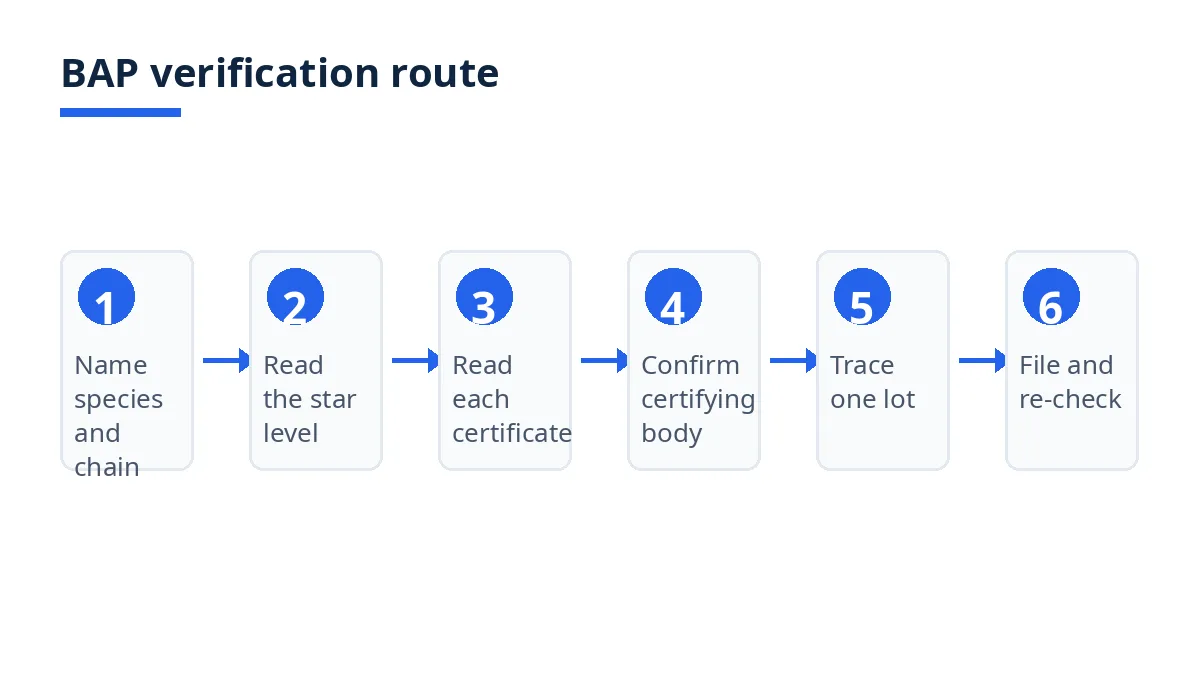
Treat each step as a gate. A missing certificate, an unrecognised certifying body, an open non-conformity, a star level above the certified chain, or an untraceable lot means the claim is unverified until that step passes in writing.
Costs, timelines and documents
No single public figure fits what BAP certification costs a Bangladeshi facility, so this guide gives cost drivers and questions instead of numbers. The BAP guide describes two payment points: an audit invoice when the facility applies, and a programme fee invoice, paid before BAP releases the certification certificate with a validation letter.2 The guide gives no fee amounts, and amounts will vary by facility type, size, and audit scope. Ask the facility and the certification body for a written quotation for the actual scope.
Budget, as items rather than figures, for the whole chain rather than for one plant: a gap review against the standard for that facility type, record systems for the four pillars, any facility changes the standard requires, the third-party audit, and the annual audit cycle.1
Timelines follow the same logic. The BAP guide states that the entire process takes four to six months from application to certification, with about 60 days for preparation, which covers reviewing the applicable standard and completing a free self-assessment form.2 The remaining steps are application, audit arrangement, the on-site audit, corrective actions, technical review by the certification body, a compliance determination, programme fee payment, and certificate release.2 Treat that figure as a guide for a prepared facility, not a promise. Do not treat a facility that has only applied, or only completed a self-assessment, as certified.
The document set is short: a certificate for each facility in the claimed chain, with facility type, site, standard, legal name, and dates; the certifying body for each certificate with its accreditation basis; the star-level reasoning; lot traceability records; and the label wording to be used. A gap-analysis report can help a facility prepare, but it is not a certificate.3
Bangladesh-specific rules and tips
Bangladesh is a shrimp country first in seafood exports, and that shapes how BAP questions usually arise here. The Department of Fisheries notes that around 50 to 60 percent of total fishery export volume is composed of shrimp, contributing about 75 to 85 percent of total export value, that shrimp is the major exporting seafood item, and that most of it is of aquaculture origin.4 The same plan notes that European Union member countries remain the major destinations, alongside the United States, China, Japan, and other markets.4
Do not turn that general picture into a claim about BAP in Bangladesh. This guide names no facility as BAP certified, gives no count of BAP-certified facilities in Bangladesh, gives no ranking, and lists no certification bodies operating in Bangladesh, because those facts change and must be checked against the current BAP producer page and the certification body concerned. A statement that a district is BAP certified is not evidence for a facility, a site, or a lot.
In practice, ask shrimp suppliers to separate four things often mixed in conversation: the hatchery and feed mill behind the farm, the farm itself, the processing plant that packed the product, and the export and food-safety paperwork for the shipment. BAP covers the facilities, not the shipment paperwork. Where a supplier works with several farms, ask for a farm-by-farm breakdown, and where a plant packs product from several farms, ask which farms supplied the exact lot.
Mistakes and red flags
The most common mistake is treating a plant certificate as a chain claim. A certified processing plant alone supports one star. It does not make the farm, hatchery, or feed mill certified, and it does not support a higher star claim for product from an uncertified farm. Always count the certified links in the actual chain.
A second mistake is accepting a logo, label draft, or website badge as evidence. The BAP label is only supported when the facilities behind the product are certified to the claimed star level and audit non-conformities have been closed. Ask for the certificates and the lot trace behind any label, and pause the claim if the supplier will not share a certificate, the certifying body, or the validity dates.
Other red flags include a certificate with no facility type, no site, or no expiry date; a star claim higher than the certified links; volumes shipped that exceed the volumes traceable to the certified facilities; and a claim that BAP proves food safety, quality grade, or legal compliance for a shipment. Each has the same correction: go back to the facility certificates, the certifying-body record, the star-level count, and the lot trace, and record any gap in writing.
Checklist
Use this checklist before a first order, and again before any repeat order after a change of facility, species, or product form.
Species, product, and form matched to the facilities in the chain.
Hatchery, feed mill, farm, and processing plant named for the exact lot.
Star level claimed in writing, with the facility supporting each star identified.
Full certificate received for each facility in the claimed chain, with type, site, standard, legal name, and dates checked.
BAP producer listing checked for each facility, with the result dated.
Certifying body identified for each certificate, with ISO/IEC 17065 accreditation basis confirmed.
Audit status understood, including any open non-conformities.
Lot trace reviewed, showing separation and a link back through the plant as the star level requires.
Label and claim wording checked against the facility evidence for that lot.
Expiry and annual audit dates noted, with a re-check set before shipment.
Any gap or unverified claim recorded in writing, with a decision on whether to proceed with or without a BAP claim.
How Exportain helps
Exportain's own supplier checks are a document and photo review, not a BAP audit, and they do not replace the facility and star-level checks in this guide. The Trust Center states plainly that supplier verification is a document review, not a factory inspection and not a check against a government database, and that a badge is not a guarantee of production capacity, product quality, or delivery. Use those checks for identity, business registration, export registration, and facility photos, while BAP evidence is checked separately.
A buyer can use Exportain to describe the species, the star level, and each facility clearly, request the checklist documents, and keep the evidence together for the order. BAP claims fail most often on missing links: a plant without a farm, a farm without a hatchery or feed mill for a higher star level, or a lot without a trace. The seller verification page describes the same document and photo review from the seller side, and the certification services category notes that no services are published in that category yet at the time of checking.
FAQs
What should I know first about BAP (Best Aquaculture Practices)?
Know first that BAP is the Global Seafood Alliance programme that certifies processing plants, farms, hatcheries, and feed mills, and that the star level shows how many of those links are certified. One star is the processing plant, two stars add the farm, three stars add the hatchery or the feed mill, and four stars mean the whole chain is certified.1 Read each facility certificate, confirm the certifying body, and trace the lot. BAP is not a food-safety system for a shipment, not a product quality mark, and not a guarantee of any single shipment.
What are the typical costs and timelines?
There is no typical figure that fits every facility. The BAP guide describes an audit invoice at application and a programme fee invoice before certificate release, with no fee amounts given, so confirm both amounts in writing with the certification body.2 The guide states the whole process takes four to six months from application to certification for a prepared facility, with about 60 days for preparation.2 Certification requires an annual third-party audit, with non-conformities corrected before a certificate is issued.1
Which documents are needed?
The core set is a certificate for each facility in the claimed chain, with facility type, site, standard, legal name, and dates; the certifying body for each certificate with its accreditation basis; the star-level reasoning; lot traceability records; and the label wording to be used. Certification bodies recognised by BAP must be accredited under ISO/IEC 17065.2 A gap-analysis report can help a facility prepare, but it is not a certificate.3
What are the most common mistakes?
The most common mistakes are treating a plant certificate as a chain claim, claiming a star level above the certified links, matching the company name but not the facility type or site, accepting a logo as evidence, and assuming BAP proves food safety or quality for a shipment. Each has the same correction: count the certified facilities in the actual chain, confirm each certifying body, trace the lot, and record any gap in writing.
Next steps on Exportain
Start by describing the species, the star level, and each facility in the chain precisely, then request the checklist documents and run the verification route before agreeing shipment dates or label wording. Post a free RFQ on Exportain with species, star level, facility, and product form requirements stated, so suppliers respond with matching certificates rather than general claims. For background on what platform checks do and do not cover, read the Trust Center and the seller verification page.
Sources
- Understanding the Best Aquaculture Practices Four-Star System. Global Seafood Alliance (accessed )
- An Introductory Guide to Best Aquaculture Practices Certification. Global Seafood Alliance (accessed )
- Global Seafood Alliance Best Aquaculture Practices (GSA BAP). LRQA (accessed )
- NPOA-IUU Bangladesh. Department of Fisheries, Ministry of Fisheries and Livestock, Bangladesh (accessed )
About the author
Sourcing from Bangladesh?
Post a request for quotation and suppliers on Exportain can send you their quotes directly.
Post an RFQ


