

Home Textiles for Wholesalers & Distributors: Sourcing From Bangladesh
Wholesale guide to sourcing home textiles and towels from Bangladesh: volume tiers per item and colour, container consolidation, private-label runs, distributor margin structure and replenishment cycles.
Short answer
Wholesalers and distributors sourcing home textiles and towels from Bangladesh should plan from the margin structure: volume tiers counted per item and per colour, a container filled by a deliberate assortment and carton plan, private-label work agreed early, and replenishment controlled by a written trigger and a sealed shade standard. Compare quotations only on the same delivery term, inspect by lot, and confirm the export document set before shipment.
On this page
Key takeaways
Plan from the margin structure: landed cost, onward trade price, pallet and case discounts, and the cost of holding slow stock decide whether a line earns its warehouse space.
Confirm how each volume tier is counted, per item or per colour, because a large order total can still miss every tier when it is spread thinly.
Fill the container deliberately: carton counts, dimensions, pallet build and readiness dates per item, priced on one delivery term and named place.
Agree private-label artwork and label minimums with the first enquiry, and control replenishment with a written trigger and a sealed shade standard per colour.
Exportain verification is a document and photo review, not a factory inspection, and a badge is not a guarantee of capacity, quality or delivery.
A wholesaler or distributor buying home textiles and towels from Bangladesh buys stock to sell onward, not stock for one shelf or one season drop. The order has to work at two prices at once: the price paid in Bangladesh and the price at which trade customers buy it in volume, with freight, duty, warehousing and handling still covered in between. Assortment breadth, volume tiers, container consolidation and replenishment discipline decide the margin before any negotiation over a single unit price begins.
Bangladesh Bank reported home textiles export receipts of USD 453.8 million in 2024-25, up 3.2 percent on the previous year, with terry towel receipts of USD 18.7 million, up 14.0 percent.1 That base gives a wholesaler a workable supplier pool, but the distribution work remains: planning the range, filling the container, protecting shade across repeats and keeping trade customers supplied between shipments.
Why this matters for buyers and sellers
For a wholesaler, the unit price is only one line in a margin structure. Landed cost per unit, onward trade price, discount for a full pallet or case, and cost of holding slow stock together decide whether a line earns its warehouse space. A towel that looks cheap at the factory can lose money if it arrives in mixed cartons that take a day to sort, or if its colour drifts between shipments. Price the whole chain, not the factory gate price alone.
Volume tiers work differently for a distributor. A supplier may price by total quantity, by quantity per colour, or by quantity per item, and those bases give different answers for the same order. A wholesaler who spreads an order thinly may miss every tier, while the same total concentrated in fewer colours clears them. Ask how each tier is counted, in writing per item.
Container consolidation is the second margin lever. Towels and bed linen are bulky relative to their value, so a part-filled container raises freight cost per unit sharply. Combining items from one supplier keeps one set of export papers and one timeline; combining suppliers adds a second shade and packing standard. Decide at quotation stage which route the container will take.
Assortment planning is the third lever. Trade customers want breadth, but every extra colour carries a dye lot, a label run and a separate stock line. Hold breadth in core colours and sizes, and treat slow colours as made-to-order lines rather than stocked lines.
For the seller, a wholesale order differs in handling. Goods arrive in bulk cartons, usually without retail tickets, and are broken down at the distributor warehouse into trade packs. State carton count, inner pack quantity and marking per carton in the enquiry.
Replenishment is where wholesale relationships are kept. Towels and bed linen sell steadily, so trade customers expect the same item, colour and pack again. Agree the repeat trigger in writing, a stock level, a calendar date or a confirmed customer order, and how shade is checked on the repeat. A repeat in a different shade is a new range to be sold from scratch.
Step-by-step: how it works
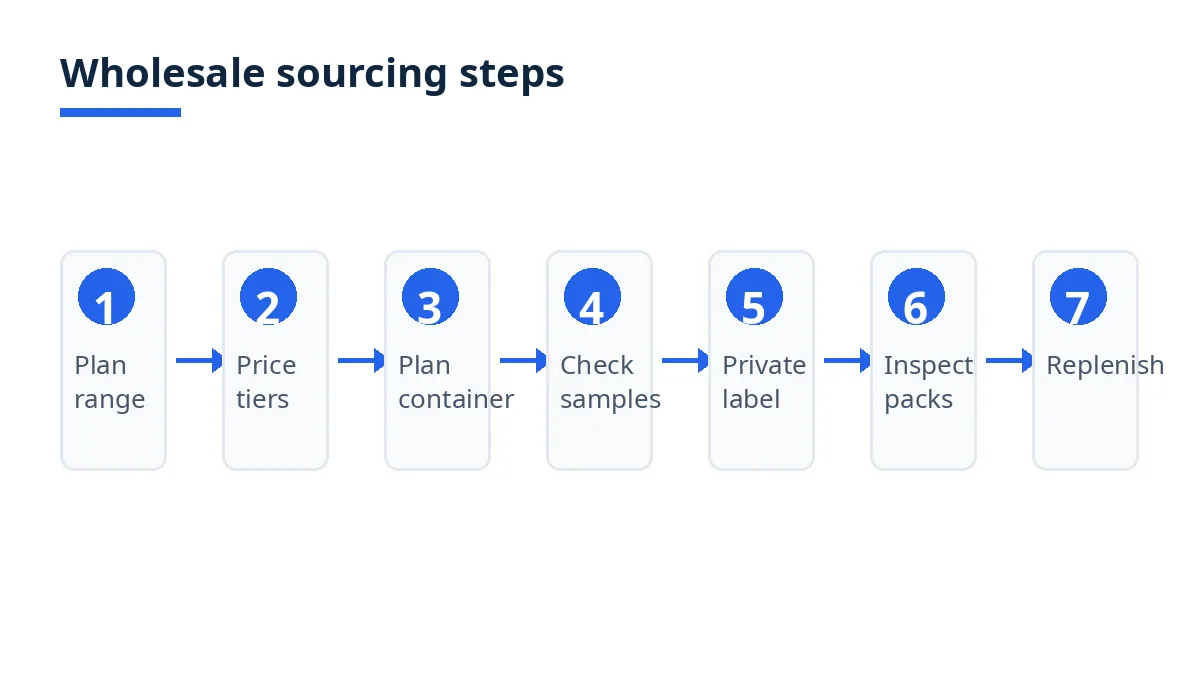
Set the assortment and the tiers together. List each item, colour and size, the trade pack quantity, and the volume tier each line must reach. Mark core lines for stock and slow lines as made to order, and send that plan to every candidate supplier.
Price by tier, not by total. Ask each supplier to price the same assortment at two or three quantity levels, and to state whether each tier counts per item, per colour or per order. Move quantity between colours before production where a line falls short.
Plan the container before confirming the order. Decide which items ship together, how many cartons of each item fill the container, and whether one supplier or several fill it. Ask for carton count, dimensions and weight per item, and confirm freight for the full container.
Approve samples for the trade pack, not only for the product. Order a pre-production sample in the actual fabric, colour and construction, then check it washed and measured, packed in the agreed inner pack and carton, and marked as it will be marked in bulk. List corrections in writing before bulk production.
Run private-label work in parallel, not at the end. Where trade customers sell under their own label, send label artwork, woven label specifications and carton marking files with the first enquiry. Artwork agreed after production starts delays the whole container.
Inspect by lot and pack by customer allocation. Agree the inspection level and acceptance quality limit (AQL) values in the purchase order, following ISO 2859-1, which defines acceptance sampling plans for inspection by attributes, indexed by AQL for lot-by-lot inspection.2 Check shade against a sealed reference sample, and pack cartons by the allocation sheet where the order is split.
Ship, receive and set the replenishment trigger. On arrival, check cartons against the packing list before breaking bulk, record shade and pack results per shipment, and confirm the repeat trigger agreed at quotation stage.
Costs, timelines and documents
What are the typical costs and timelines?
There are no typical costs a guide can state as fact for a wholesale range, because each supplier prices fabric, construction, colour count, label work, carton marking and delivery term separately, and freight depends on container fill. The Incoterms 2020 rules allocate cost, risk and obligations for each rule,3 so compare quotations only on the same rule and named place.
Cost element | What drives it for a wholesaler | State in your enquiry |
|---|---|---|
Fabric and dyeing | Construction, weight, colour count | Fabric spec per item and colour |
Making and finishing | Size range, hemming, print or embroidery | Size chart and finish per item |
Labels and marking | Label print runs, woven labels | Artwork files per customer |
Packing | Inner pack unit, carton counts | Pack unit, carton counts |
Inspection | Lot size, inspection level, AQL | Inspection level and AQL in the order |
Freight and term | Container fill, Incoterm, named place | One Incoterm and named place |
Warehousing | Carton sorting, trade packs | Carton marking, inner pack quantity |
Example figures: a distributor plans a container in three core colours, with 70 percent in the two fastest colours and 30 percent in a slower third colour, and a second container held as a replenishment order triggered by stock level. If the fast colours sell at twice the rate of the slow colour, the replenishment shifts quantity toward them within the agreed total. The example shows structure only, not a typical quantity, price or lead time.
For timelines, sampling depends on fabric availability and correction rounds, dyeing and finishing set the production start, and consolidation adds waiting time where several items must be ready together. Ask for sampling, fabric ready, production, inspection and container-ready dates as separate lines.
Which documents are needed?
The wholesaler document set has two halves: the distribution set and the export set. The distribution set is the assortment plan, size charts, label and carton marking artwork, the packing specification, the allocation sheet and the shade standard per colour. The export set is handled at the Bangladesh end, and the wholesaler should confirm it is complete before shipment.
For export clearance in Bangladesh, goods may not be loaded unless an export declaration, the Bill of Export or Shipping Bill, is submitted to Customs and approved.4 Enclosed documents include the export contract or purchase order where there is no export letter of credit, the commercial invoice, the packing list, the EXP form certified by an authorized dealer, and a certificate of origin issued by the Export Promotion Bureau or a Chamber of Commerce and Industry.4 Keep the packing list matched to the allocation sheet so the warehouse can break bulk by customer without opening every carton.
Bangladesh-specific rules and tips
Classification comes first, because it decides how each line is described on every document and how the onward price is calculated. Heading 6302 covers bed linen, table linen, toilet linen and kitchen linen, and subheading 6302.60 covers toilet and kitchen linen of terry towelling or similar terry fabrics, of cotton.5 Treat any heading as indicative and verify it against the destination tariff before confirming the order, because a towel sold as toilet linen and one sold as a cleaning cloth can fall under different headings even when the fabric looks similar.
Labelling rules differ by destination, and a distributor selling into several markets needs one label plan per market. In the European Union, Regulation (EU) No 1007/2011 states that a textile product shall be labelled or marked with the name and percentage by weight of all constituent fibres in descending order.6 In the United States, every covered textile product must carry a label showing fibre content, manufacturer or dealer identity, and country of origin.7 Send the supplier the exact label wording per market, with fibre percentages from a tested sample, and approve a printed label proof before bulk production. Where a trade customer applies its own label, agree in writing who holds the fibre-content records and whose name or registered identification number appears on it.
Shade control deserves separate attention in wholesale, because a distributor holds stock from several shipments at once. A bath towel, hand towel and face cloth in the same colour must match within a set, and a replenishment must match stock already in the warehouse. Agree a shade standard per colour, keep a sealed reference sample, and check replenishment lots against it under the same light, recording the result per shipment.
Keep one legal name across every paper. The export declaration names the exporter and the foreign buyer,4 so the name on the quotation, proforma invoice, purchase order and payment account should match. Ask which inputs are imported for your range, since an imported yarn or trim can set the earliest production date.
Mistakes and red flags
What are the most common mistakes?
Pricing a thin assortment as if it were a bulk order. A total that looks large can still miss every per-colour and per-item tier. Price each line at its tier.
Filling a container on paper only. A plan that ignores carton dimensions, pallet build and readiness dates per item leaves a part-filled container or a delayed shipment. Confirm carton counts and ready dates per item.
Comparing quotations on different delivery terms. A lower price on a different Incoterm is a different offer.3 Compare only replies to the same assortment on the same term.
Approving a sample that is not the trade pack. A sample approved without its inner pack, carton and marking hides the warehouse work that follows. Approve the sample in the pack it will ship in.
Leaving private-label artwork until after production. Label print runs delay a container when artwork arrives late. Send artwork with the first enquiry.
Treating a profile or a badge as a capacity check. A profile is a starting point for enquiries. It does not test whether a supplier can fill a container on a repeat cycle, and a badge is not a guarantee.
Skipping inspection to meet a container date. Sampling under ISO 2859-1 checks a lot against an agreed AQL,2 the last control before goods become warehouse stock.
Checklist
Before you confirm, every line should be answered in writing.
Assortment plan sent: item, colour, size, trade pack quantity, core or made-to-order.
Volume tier confirmed per item and colour; short lines moved before confirming.
Container plan agreed: items, carton counts, dimensions, weight, pallet build.
Quotations compared on same assortment, term and named place.3
Pre-production sample approved in actual fabric, colour, pack and marking.
Private-label artwork approved; label minimums confirmed.
Inspection level and AQL in the purchase order.2
Shade standard agreed; sealed reference sample held.
Packing list matched to the allocation sheet.
Export set agreed: invoice, packing list, EXP form, certificate of origin, Bill of Export.4
Replenishment trigger agreed: stock level, date or customer order.
How Exportain helps
On Exportain, browse suppliers and post a request for quotation (RFQ) on the RFQ board with your assortment plan, volume tiers, container plan and delivery term, so suppliers quote against the same distribution specification. Ask each reply for its tier basis, carton counts and label minimums, and compare replies line by line. When you accept a quotation, Exportain creates one order and issues one proforma invoice from the accepted terms.8
Read the badges for what they record. Exportain Verified means Exportain has checked identity, phone, email and business registration, Export Verified means it has checked the Export Registration Certificate (ERC), Factory Verified means it has reviewed photos of the factory, and Trading Company Verified means it has reviewed photos of the office or warehouse.8 Verification is a document and photo review by staff, not a factory inspection, and membership plans never grant a trust badge.9 It is not a guarantee of capacity, quality or delivery,8 so sample approval, shade control and inspection stay with you.
FAQs
What should I know first about Home Textiles & Towels Sourcing From Bangladesh for Wholesalers and Distributors?
Start from the margin structure, not from a single unit price. Confirm how each volume tier is counted, how the container will be filled, and how replenishment shade and pack will be controlled. Home textiles cover bed, table, toilet and kitchen linen under heading 6302, with cotton terry towels under subheading 6302.60.5
What are the typical costs and timelines?
There are no typical figures a buyer can rely on, because each supplier prices fabric, construction, colour count, label work, carton marking and delivery term separately, and freight depends on container fill.3 Sampling, dyeing, finishing and consolidation set the timeline, so ask for each stage as a separate date.
Which documents are needed?
The order documents are the assortment plan, itemized quotation and purchase order, with volume tiers, container plan, inspection values and replenishment trigger on both. The export set is the Bill of Export, commercial invoice, packing list, EXP form certified by an authorized dealer, and a certificate of origin issued by the Export Promotion Bureau or a Chamber of Commerce and Industry.4
What are the most common mistakes?
The most common mistakes are pricing a thin assortment as if it were a bulk order, filling a container on paper without carton and readiness dates, comparing quotations on different delivery terms,3 approving a sample that is not the trade pack, leaving private-label artwork until after production, and reading a badge as a guarantee.8
Next steps on Exportain
Browse suppliers, then post your assortment plan, volume tiers and container plan on the RFQ board so suppliers quote line by line. Before you confirm, read how to buy on Exportain and check the terms, tier basis and replenishment trigger against the checklist above.
Sources
- Annual Export Receipts of Goods and Services 2024-25. Bangladesh Bank (accessed )
- ISO 2859-1:2026 - Sampling procedures for inspection by attributes — Part 1: Sampling schemes indexed by acceptance quality limit (AQL) for lot-by-lot inspection. ISO (accessed )
- Incoterms® 2020. International Chamber of Commerce (ICC) (accessed )
- Customs Clearance Procedures for Export. Bangladesh Customs, National Board of Revenue (accessed )
- HS 2017 - Code 6302: Bed linen, table linen, toilet linen and kitchen linen. United Nations Statistics Division (accessed )
- Regulation (EU) No 1007/2011 on textile fibre names and related labelling and marking of the fibre composition of textile products. European Union, (accessed )
- Textile Fiber Products Identification Act: Labeling Rules. LegalClarity (accessed )
- Trust & Safety Center. Exportain (accessed )
- Supplier verification: Earn trust badges buyers can see. Exportain (accessed )
- supplier verification
- buyer guide
- Bangladesh sourcing
- Bed linen
- home textiles
- Wholesale sourcing
- Bath towels
- Distributors
About the author
Sourcing from Bangladesh?
Post a request for quotation and suppliers on Exportain can send you their quotes directly.
Post an RFQ


