

Corporate & Promotional Frozen Seafood Sourcing From Bangladesh: Branded Packs, Gifting and Event Orders
Corporate and promotional buyers sourcing frozen seafood from Bangladesh: branded packs, gifting and event orders, cold chain and documents.
Short answer
For corporate and promotional buyers, frozen seafood from Bangladesh works when the order is planned around the occasion first: the recipient list, the branded pack, the event or gifting date, and the freezer capacity at every delivery point. Specify species, form, size grade, glaze basis and pack size, approve artwork and a physical sample, confirm market documents, and hold product at minus 18 degrees Celsius or lower through delivery.
On this page
Key takeaways
Plan the occasion first: recipient list, branded pack, event or gifting date, and freezer capacity at every delivery point, before specifying species or asking for a price.
Specify the pack and the product together: outer carton, sleeve, insert and label wording, plus species, form, size grade, freezing method, glaze basis and pack size.
Approve artwork and a physical sample together, and confirm market approval before paying for a print run, so the first production run matches what was approved.
Hold quick-frozen product at minus 18 degrees Celsius or lower through the full journey to the final delivery point, with a written receiving threshold at each point.
Treat a marketplace badge as a document and photo review, not a factory inspection or a guarantee: sample approval, artwork approval, arrival checks and distribution checks stay with the corporate buyer.
A corporate buyer does not buy frozen seafood the way a retailer or a wholesaler buys it. The order has to land on a date, carry a brand, and survive distribution to people who may have no freezer of their own. For corporate and promotional buyers, frozen seafood from Bangladesh works when the occasion is planned first: the recipient list, the branded pack, the gifting or event date, and the freezer capacity at every delivery point.
Why this matters for buyers and sellers
For the corporate buyer, a frozen seafood gift or event pack is a logistics project dressed as a present. The product must look right on arrival, stay frozen through the last mile, and carry the information each recipient needs, including species, allergen group and storage instructions. A pack that thaws in a reception area or arrives with the wrong brand artwork fails even if the seafood inside is good.
For the seller, a corporate and promotional order is a repeatable programme rather than a single shipment. Companies reorder for annual events, festivals and client milestones, reusing the same artwork, pack and specification if the first run went well. A supplier that holds grade, glaze, pack size and print quality steady earns that repeat order.
The difference from other seafood buying is the audience. Retail buyers sell on a shelf and hotel buyers cook to a menu, while corporate and promotional buyers hand a finished pack to a named person on a named date, and that pack represents their own brand. Artwork approval, recipient handling and event timing therefore matter as much as species and price.
Step-by-step: how it works
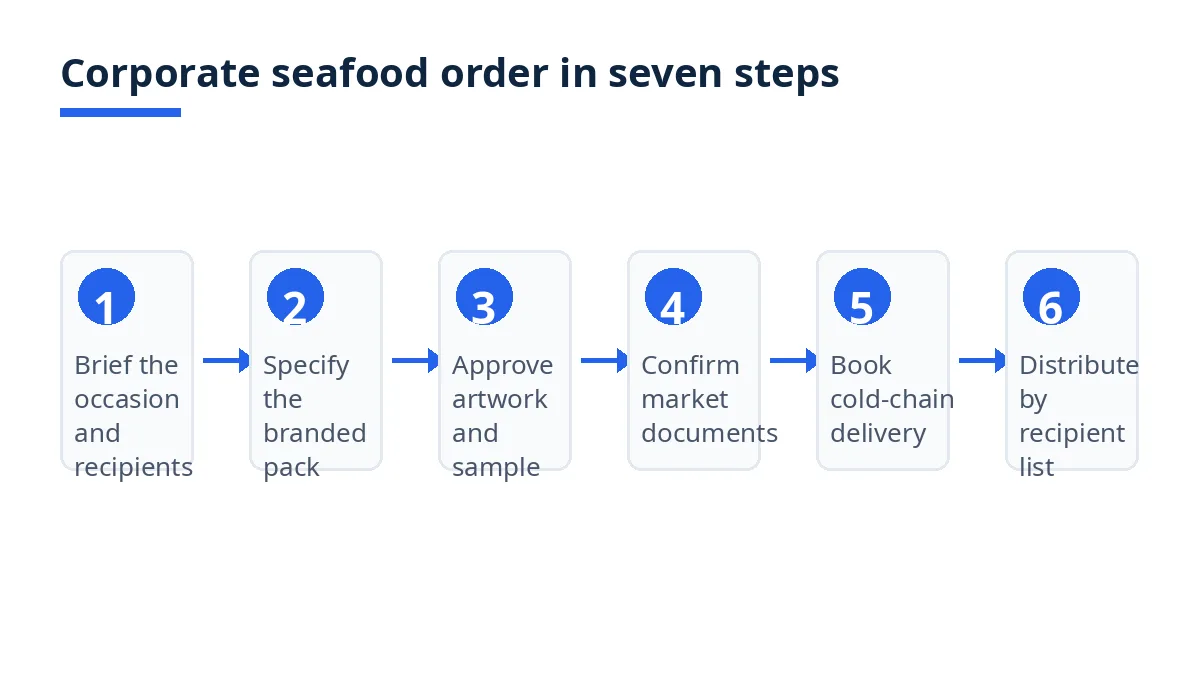
Brief the occasion, the audience and the date. State the occasion, the number of recipients, the delivery points, and the date by which every pack must be in hand. Work backwards from that date, with a buffer before the event, for artwork approval, sample approval, production, shipment, clearance and last-mile delivery.
Specify the pack before the product. Decide the outer carton, the inner pack, the sleeve or belly band, any gift insert, and the label wording. Then specify the seafood inside it: species, form, size grade, freezing method, glaze basis and pack size. Quotations cannot be compared until both the pack and the product specification match.
Approve artwork and a physical sample together. Ask for a printed proof of the branded pack and a sample in the exact pack size, with the exact label. Check print quality, spelling, allergen wording and storage instructions on the physical pack, not on a screen mock-up. Approve or list corrections in writing.
Confirm the recipient plan and the last mile. Confirm how packs reach each recipient: single delivery to one office, split deliveries to several sites, or handout at an event venue. Confirm freezer capacity, the named receiver at each point, and the rule for packs that cannot be handed over on the day.
Agree the commercial terms and the delivery term. State the price basis, including the glaze basis and whether the price is per gross or net weight, the payment terms, and one Incoterms 2020 rule with a named place for every quotation. The Incoterms 2020 rules allocate cost, risk and obligations between seller and buyer.1
Receive by lot, log temperature, and distribute by list. On arrival, check carton count, lot numbers and the temperature record against the invoice and packing list before the goods enter the freezer. Distribute against the recipient list, lot by lot, so a quality question can be traced to one lot rather than the whole order.
Collect feedback and lock the specification for the next run. Record what recipients said about pack quality, thawing instructions and taste, and keep the approved artwork, specification and supplier file together.
Costs, timelines and documents
What are the typical costs and timelines?
There are no typical costs or timelines a guide can state as fact for corporate and promotional seafood from Bangladesh: each supplier prices your species, form, size grade, glaze, pack size, print run and delivery term, and each route carries its own freight and cold-storage charges. Branded packaging adds its own lines: artwork setup, print costs, proofing, and any minimum print run, which can matter more than the seafood price on a small order. Ask for product price, packaging and print costs, freight and insurance, destination cold storage, clearance charges, and last-mile frozen delivery as separate lines. Compare quotations only when glaze basis, pack size, print specification and delivery term match.
Timelines work the same way. Sampling depends on whether the grade and pack are stocked or produced to order, print approval on how many proof rounds the artwork needs, and delivery on reefer booking, destination cold-store intake and the last-mile frozen fleet. Ask for artwork proof, sample, production-ready, shipment and arrival dates as separate lines, and agree in writing what happens if a shipment slips past the event date, including whether a partial delivery or a substitute pack is acceptable.
Example figures: how a corporate order cost is built up. Every figure is illustrative only, not a supplier quotation.
Cost line | Example figures |
|---|---|
Frozen seafood, per branded pack | Example figures: 8.00 currency units |
Branded outer carton, sleeve and insert, per pack | Example figures: 1.50 currency units |
Freight, insurance and destination cold storage, per pack | Example figures: 2.00 currency units |
Last-mile frozen delivery, per pack | Example figures: 1.00 currency units |
Illustrative landed cost, per pack | Example figures: 12.50 currency units |
Treat the table as a structure for comparing quotations, not as a price guide.
Which documents are needed?
For export clearance in Bangladesh, goods may not be loaded unless an export declaration, the Bill of Export or Shipping Bill, is submitted to Customs and approved.2 Enclosed documents include the export contract or purchase order where there is no export letter of credit, the commercial invoice, the packing list, the EXP form certified by an authorized dealer, and a certificate of origin issued by the Export Promotion Bureau or a Chamber of Commerce and Industry.2 For frozen fish, a quality control certificate by the Department of Fisheries may be necessary as required by the country of destination.2 The corporate buyer, or its importer, should also hold the health certificate and temperature record for the lot, the approved artwork file, and the import documents its own market requires, so receiving can match cartons to papers.
Bangladesh-specific rules and tips
Confirm the classification for your product form. In the Harmonized System, heading 0306 covers crustaceans, and subheading 0306.17 covers other shrimps and prawns, frozen.3 Frozen fish falls under heading 0303 and frozen fish fillets under heading 0304 in Chapter 03, so confirm the heading for the exact form you order.3 A wrong heading can hold a shipment at the destination port, a serious problem when packs are tied to a fixed event date.
Write the pack label from the specification sheet. Quick-frozen foodstuffs are held at minus 18 degrees Celsius or lower after thermal stabilisation, and labelling for the ultimate consumer must include the date of minimum durability, the storage period, the storage temperature and the storage equipment required.4 In the EU, the 14 allergens that must be declared include crustaceans, fish and molluscs.5 The gift pack, the sleeve and any insert should name the species and allergen group exactly as the supplier's specification states them, and any change of species, form or origin on a repeat order should trigger a label check before the packs are printed.
Confirm market approval before artwork is printed. In the European Union, animals and goods derived from them can only enter from listed non-EU countries, and establishments producing food of animal origin for export to the EU must comply with the applicable public health requirements, with fishery products under Section VIII of the establishment lists.6 Confirm the plant is on the applicable list, and that the consignment carries the health certificate its destination requires, before approving a sample or paying for a print run. For the United States, the importer verification rule for fish and fishery products requires the importer either to source from a country with an active memorandum of understanding covering the product, or to run written verification procedures covering product specifications and affirmative steps such as obtaining the processor's HACCP and sanitation records for the lot.7 Ask who holds that verification file for each lot.
Protect the cold chain at the recipient end, not only in transit. Quick-frozen product is held at minus 18 degrees Celsius or lower,4 and every delivery point must hold that line. An office fridge or a reception counter is not a freezer. Confirm freezer capacity at each delivery point, agree a receiving threshold in writing, and plan what happens to packs that arrive when no one is there to receive them. For event handouts, agree a named person responsible for the cold chain at the venue.
Plan the print run and the overage in the contract. Branded packs fail on print, not on seafood: a misspelt company name, a wrong logo colour or a sleeve that does not fit the carton. Agree how many proof rounds are included, who signs off the final proof, and what overage is printed for damaged or late packs, plus whether an unbranded pack is ever acceptable as a fallback.
Mistakes and red flags
What are the most common mistakes?
Ordering by species name alone. A quotation for shrimp without a form, size grade, glaze basis, pack size and print specification cannot be compared with another quotation, or handed to a recipient as a finished gift. Every order line needs the full specification, pack included.
Buying on gross weight without a glaze line. Glaze is the ice coating that protects frozen seafood, and it is also weight on the invoice. If the quotation does not state the glaze basis and maximum glaze percentage, the buyer cannot know the net edible weight it is paying for. State both in writing.
Approving artwork on screen and sampling a different pack. A screen proof hides print colour shifts, sleeve fit and label legibility. Approve the physical printed pack with the sample inside it, or the first production run may differ from what was approved.
Accepting a temperature record that covers only part of the journey. A record from the plant to the port says nothing about the port stay, the sea leg, the destination cold store or the last mile. Ask for the full journey record, from plant dispatch to final receiving, with a written receiving threshold.
Leaving the recipient plan until the shipment arrives. Recipient lists, delivery points and freezer capacity decided late cause the most common corporate failure: packs arriving where no one can store them. Confirm the recipient plan before production, not after shipment.
Treating a marketplace badge as a guarantee. A badge records what a marketplace has checked, not what the recipient will receive. Sample approval, artwork approval, arrival checks and distribution checks stay with the corporate buyer.
Red flags on a supplier reply. A reply that will not state the glaze basis, market approvals, or temperature record; a sample in a different pack or grade from the quotation; a print proof that keeps changing; a price that moves when the delivery term is clarified; a supplier that cannot name its lot system. Any one of these is a reason to pause.
Checklist
Before you confirm, every line should be answered in writing.
Occasion, recipient count, delivery points and final delivery date agreed, with a buffer before the event.
Pack specification complete: outer carton, inner pack, sleeve or belly band, insert, label wording and print proof.
Product specification complete: species, form, size grade, freezing method, glaze basis and pack size.
Physical sample in the exact branded pack approved in writing, including allergen and storage wording.
Market approval confirmed: plant on the applicable establishment list, health certificate requirements confirmed.
Price basis stated: net or gross weight, glaze percentage, packaging and print costs, delivery term with a named place.
Full-journey temperature record agreed, with a written receiving threshold and rejection rule.
Recipient plan confirmed: delivery points, freezer capacity, named receivers, and a rule for uncollected packs.
Documents agreed: invoice, packing list, Bill of Export set, certificate of origin, health certificate and temperature record.
Overage, substitute rule and fallback pack agreed in writing.
Feedback recorded and the approved specification filed for the next run.
How Exportain helps
On Exportain, browse suppliers and post the corporate specification, pack details, recipient points and event date on the RFQ board, so suppliers quote against the same branded-pack specification rather than a generic species name. Read how to buy before you post, and ask each reply for its glaze basis, its market approvals for your destination, its print proof process, and its full-journey temperature record. Keep the approved artwork file and sample specification with the order, so the next occasion starts from an approved pack.
FAQs
What should I know first about Frozen Seafood & Fish Sourcing From Bangladesh for Corporate and Promotional Buyers?
Know the occasion before the price: the recipient list, the branded pack, the event or gifting date, and the freezer capacity at every delivery point. Then specify species, form, size grade, glaze basis and pack size, approve artwork and a physical sample together, and confirm market approval before paying for a print run. Quick-frozen product is held at minus 18 degrees Celsius or lower.4
What are the typical costs and timelines?
There are no typical figures a buyer can rely on: each supplier prices your species, form, size grade, glaze, pack size, print run and delivery term. Ask for each cost line separately, and for artwork proof, sample, production, shipment and arrival dates as separate lines.1
Which documents are needed?
The Bill of Export set for Bangladesh export clearance, including the commercial invoice, packing list, EXP form and certificate of origin,2 plus the health certificate and temperature record for the lot, the approved artwork file, and the import documents the destination market requires.
What are the most common mistakes?
Ordering by species name alone, buying on gross weight without a glaze line, approving artwork on screen while sampling a different pack, accepting a partial temperature record, and leaving the recipient plan until the shipment arrives. Answer every line of the checklist above in writing before the order is confirmed.
Next steps on Exportain
Start with the occasion, not the species: write down the date, the recipient list and the pack you want recipients to hold. Then browse suppliers, read how to buy, and post the full branded-pack specification on the RFQ board. Ask each reply for its glaze basis, market approvals and print proof process, and approve the physical branded sample before production begins.
Sources
- Incoterms® 2020. International Chamber of Commerce (ICC) (accessed )
- Customs Clearance Procedures for Export. Bangladesh Customs, National Board of Revenue (accessed )
- HS Nomenclature 2017 - Chapter 03. World Customs Organization (accessed )
- Quick-frozen food: summary of Council Directive 89/108/EEC on quick-frozen foodstuffs for human consumption. European Union (accessed )
- Food labelling requirement. European Centre for Allergy Research Foundation (accessed )
- Non-EU countries authorised establishments. European Commission (accessed )
- 21 CFR 123.12 — Special requirements for imported products. GovRegs (accessed )
About the author
Sourcing from Bangladesh?
Post a request for quotation and suppliers on Exportain can send you their quotes directly.
Post an RFQ


