

Wholesaler and Distributor Sourcing of Electrical & Solar Goods From Bangladesh
Wholesalers and distributors sourcing electrical and solar goods from Bangladesh: bulk assortments, distributor pricing tiers, territory and channel terms, conformity files and warehouse replenishment.
Short answer
For wholesalers and distributors, electrical and solar goods from Bangladesh work as a programme, not a one-off order: define the assortment by channel, agree volume pricing tiers and territory terms in writing, hold conformity documents for the exact model, and replenish on par levels so trade customers get the full basket on time.
On this page
Key takeaways
Define the assortment by channel before asking for prices: one line per product with rating, standard, pack quantity and carton quantity, so quotations can be compared per saleable unit.
Agree volume pricing tiers and territory and channel terms in writing before the first order, including price protection on stock held and the warranty and returns route.
Hold conformity evidence for the exact model stocked: test report and declaration of conformity, matched to the model number on the sample and the carton.
Confirm the Harmonized System heading for every line, since a wrong heading can hold a shipment at the destination port and change the duty.
Replenish on par levels per line with a fixed slow-line review, so fast movers stay in stock without slow movers tying up working capital.
A wholesaler or distributor does not buy electrical and solar goods the way a retailer buys them. The order is not one shelf of stock but an assortment that has to serve many trade customers, hold its price across a territory, and replenish on a rhythm the warehouse can plan around. For wholesalers and distributors, electronics, electrical and solar sourcing from Bangladesh works when the assortment, the pricing tiers, the channel terms and the replenishment plan are agreed before the first container is ordered, not after it lands.
This guide is written for that buyer: the wholesaler stocking LED lamps, cables, switches, breakers and solar modules for resale to installers, contractors, retailers and project buyers.
Why this matters for buyers and sellers
For the distributor, the assortment is the business. A trade customer who cannot get the full basket from one supplier will split the order, and a split order is an order that can be lost at the next price check. A Bangladeshi programme earns its place when it covers the fast-moving core lines in depth, holds specification steady across repeat orders, and arrives in cartons that suit warehouse picking and trade-counter sale.
For the seller, a wholesale account is a programme rather than a single shipment. Distributors reorder the same lines on a rhythm, so a supplier that holds wattage, cable size, connector type and pack quantity steady earns the repeat order. One that changes a specification, a carton quantity or a label without warning forces the distributor to re-price every line and re-brief every trade customer.
The margin sits in the same place as the risk. Buying in bulk lowers the unit price, but it also concentrates the exposure: one wrong specification, one missing conformity document or one slow-moving line is multiplied across the whole consignment.
What should I know first about Electronics, Electrical & Solar Sourcing From Bangladesh for Wholesalers and Distributors?
Know the assortment before you ask for a price. Electrical and solar goods are not one category in practice. LED lamps and luminaires, wiring devices such as switches and sockets, cables and conductors, protection devices such as breakers, and solar modules and inverters each carry different standards, different test reports and different destination rules. A quotation that prices "electrical products" without naming the line, the rating and the standard cannot be compared with another quotation, or stocked with confidence.
Know the destination rules for each market before you shortlist suppliers. In the European Union, CE marking is a mark manufacturers use to show that a product meets the relevant EU legal conformity standards for safety, health and environmental protection, and it applies only to products falling under EU legislation that requires it.1 Obtaining it involves a conformity assessment, a technical file, a signed EU declaration of conformity and affixing the mark to the product, and importers and distributors must know the legal requirements and ensure the products they distribute or import meet them.1 A distributor in the EU supply chain is defined to include wholesalers who supply products to retailers, and a distributor must be able to show that it checked the product supplier followed the relevant rules.2
For solar modules specifically, IEC 61730-1 sets the construction requirements for photovoltaic modules to provide safe electrical and mechanical operation, covering prevention of electric shock, fire hazards and personal injury from mechanical and environmental stresses, while IEC 61730-2 defines the requirements for testing.3 Ask which standard version a module was tested to, and hold the test report for the exact model you stock.
Step-by-step: how it works
The diagram below sets out the wholesale order in seven steps, from assortment to replenishment.
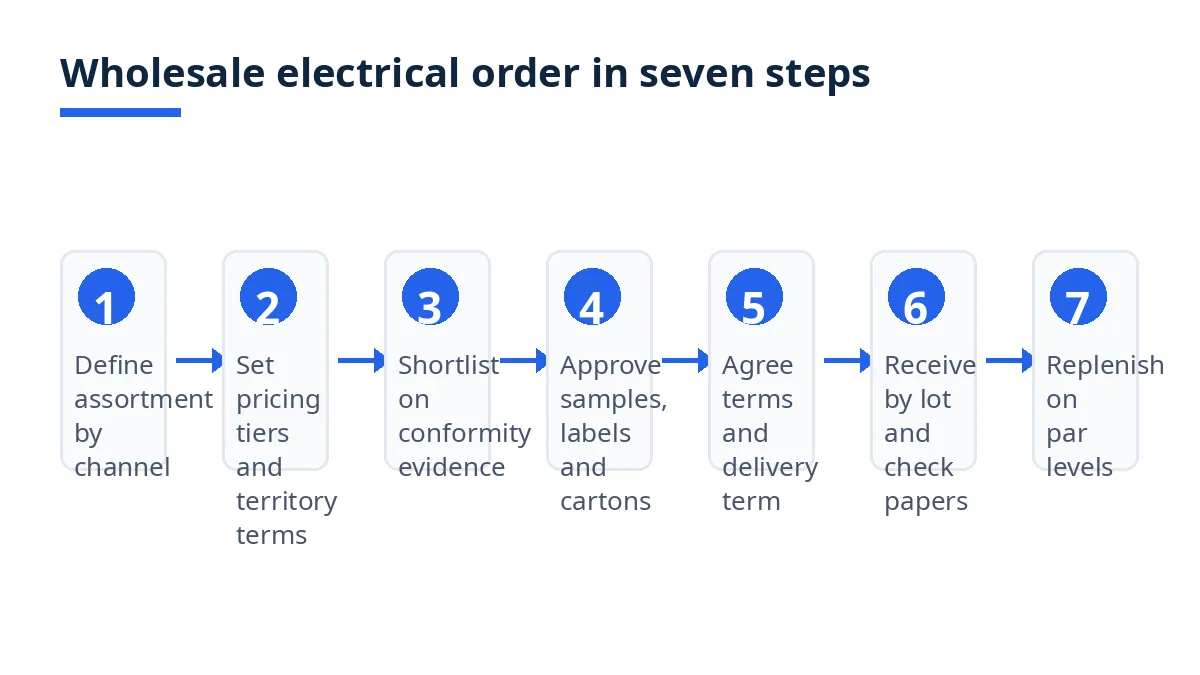
Define the assortment by channel, not by catalogue. List the lines each customer group buys: LED lamps and drivers for retailers, switches, sockets and breakers for electricians and contractors, cables by size and length for installers, and modules and inverters for solar installers. One line per product, with rating, standard, pack quantity and carton quantity.
Set pricing tiers and territory terms in writing. Agree the price breaks by volume, the territory or channel each tier covers, and whether the supplier will sell direct into your territory. A tier that is undercut by the supplier's own direct sales is not a tier at all.
Shortlist on conformity evidence, not price alone. Ask for the test reports and declarations for the exact model, the factory's quality records, and a sample in the exact pack. For EU lines, confirm the CE marking route and the declaration of conformity before approving the sample.1 4
Approve samples, labels and cartons together. Test the sample to the stated rating, check the label against the destination market's language and marking rules, and confirm the carton quantity suits warehouse picking. Approve or list corrections in writing.
Agree the commercial terms and the delivery term. State the price basis, the payment terms, the Incoterms 2020 rule with a named place for every quotation, and the replenishment rhythm. The Incoterms rules allocate risks, obligations and costs between seller and buyer, including where risk passes and who arranges transport, insurance and customs operations.5
Receive by lot and check against the papers. On arrival, check carton count, model numbers, lot numbers and conformity documents against the invoice and packing list before the goods enter the warehouse. Enter each lot separately, so a quality problem can be traced to one lot rather than the whole stock.
Replenish on par levels, not on memory. Set a par level per line: the minimum stock triggering the next order, and a maximum the warehouse can hold without tying up working capital. Reorder when the par level is reached, and review slow lines on a fixed cycle.
Example figures: a distributor stocking 40 LED lines might set par levels at four weeks of average sales for fast movers and two weeks for slow movers, with a monthly review that drops any line that has not moved in 90 days. The numbers are illustrative only.
Costs, timelines and documents
What are the typical costs and timelines?
There are no typical costs or timelines a guide can state as fact for wholesale electrical and solar goods from Bangladesh: each supplier prices your line, rating, standard, pack quantity and delivery term, and each route carries its own freight and handling charges. Ask for product price and weight basis, freight and insurance under the chosen delivery term, destination handling and clearance charges, and warehousing and breakage allowance as separate lines. Compare quotations only when rating, standard, pack quantity and delivery term match: a lower price per carton can be a higher price per saleable unit once pack quantity and breakage are counted.
Timelines work the same way. Sampling depends on whether the model and pack are stocked or produced to order, production on component availability and the factory's run schedule, and delivery on container booking and destination handling. Ask for sampling, production-ready, shipment and arrival dates as separate lines, and agree what happens to a committed trade order if a shipment slips.
A landed-cost table keeps the comparison honest. The table below uses example figures only.
Cost line | Example figures |
|---|---|
Product price, 1,000 LED lamps, EXW factory | USD 2,400 |
Freight and insurance to destination port | USD 650 |
Destination handling and clearance | USD 180 |
Duty and taxes at destination | USD 310 |
Warehouse intake and breakage allowance | USD 120 |
Example landed cost, total | USD 3,660 |
Example landed cost per lamp | USD 3.66 |
All figures in this table are example figures. Replace every line with your own quotation, freight rate and duty calculation before using it for a buying decision.
Which documents are needed?
For export clearance in Bangladesh, the shipping bill is an essential document issued by the Bangladesh Customs Authority after the exporter applies for it, and it is the mandatory document to complete customs clearance, load the goods and claim duty drawbacks.6 The documents required to obtain it include the export letter of credit or purchase order or contract, the commercial invoice with a detailed description of goods, the packing list with quantity, weight and packing information, the EXP form certified by an authorized dealer, the certificate of origin issued by the Export Promotion Bureau or a Chamber of Commerce and Industry, the VAT registration certificate, the taxpayer identification number and the Export Registration Certificate.6
For EU lines, the distributor must be able to provide the identity of the manufacturer or authorised representative so the market surveillance authority can obtain the declaration of conformity and technical documentation.2
Bangladesh-specific rules and tips
Confirm the classification for every line. Chapter 85 of the Harmonized System covers electrical machinery and equipment and parts, sound recorders and reproducers, television image and sound recorders and reproducers, and parts and accessories of such articles.7 Cables, for example, fall under heading 8544, while winding wire of copper, lacquered or enamelled, falls under subheading 8544.11. Confirm the heading for the exact line you order, since a wrong heading can hold a shipment at the destination port and change the duty.
Hold conformity documents per model, not per supplier. A test report for one LED model does not cover another model, even from the same factory. File the report, the declaration and the sample approval under the model number, and re-check them whenever the model, the rating or the component changes.
Write the channel terms before the first order. Territory, channel exclusivity, price protection on stock held when a price falls, and the handling of warranty returns should all be in the supply agreement. Solar modules and inverters in particular need a written warranty route: who the trade customer contacts, who holds replacement stock, and who pays freight on a warranty claim.
Plan replenishment around the slow lines, not the fast ones. Fast movers look after themselves. The lines that tie up capital are the slow movers ordered in full-container quantities to reach a price break. Set a smaller first order for an unproven line, even at a higher unit price, and scale it only after trade customers have bought it twice.
Mistakes and red flags
What are the most common mistakes?
Ordering by category name alone. A quotation for "LED bulbs" without wattage, base type, colour temperature, lumen output, standard and pack quantity cannot be compared with another quotation, or sold to a trade customer with confidence. Every order line needs the full specification.
Buying on carton price without the pack quantity. A cheaper carton that holds half the units is a dearer line. State units per carton, cartons per pallet and the price per saleable unit in every comparison.
Accepting a conformity document for a different model. A declaration that names another model, another rating or another factory is not evidence for the line you are stocking. Match the document to the model number on the sample and the carton.
Leaving territory and channel terms unwritten. If the supplier can sell direct to your trade customers at your tier price, your margin is gone before the container arrives. Put territory, channel and price-protection terms in writing before the first order.
Treating a marketplace listing as a guarantee. A listing records what a marketplace has checked, not what the warehouse will receive. Sample approval, lot checks and conformity-file checks stay with the distributor.
Red flags on a supplier reply. A reply that will not name the standard or test report for the exact model, a sample in a different rating or pack from the quotation, a price that moves when the delivery term is clarified, or a supplier that cannot name its lot system. Any one of these is a reason to pause.
Checklist
Before you confirm, every line should be answered in writing.
Assortment defined by channel: rating, standard, pack quantity and carton quantity per line.
Pricing tiers agreed by volume, with territory and channel terms in writing.
Conformity evidence held for the exact model: test report and declaration of conformity.
Sample, label and carton approved in writing, in the exact pack to be shipped.
Price basis stated: price per saleable unit, delivery term with a named place, payment terms.
Classification confirmed: Harmonized System heading for every line.
Documents agreed: invoice, packing list, shipping bill set, certificate of origin, conformity file.
Par levels set per line, with a replenishment rhythm and a slow-line review cycle.
Warranty and returns route agreed: who holds replacement stock and who pays freight.
How Exportain helps
Exportain connects wholesale buyers with Bangladeshi suppliers of electronics, electrical and solar goods, and lets buyers post a request for quotation setting out the assortment, the specification and the volume tiers they need. Suppliers reply with quotations the buyer can compare line by line, and the buyer keeps the sample approval, conformity file and lot checks in its own hands. Post a free request for quotation on Exportain and get quotes from Bangladeshi suppliers at https://exportain.com/rfqs.
FAQs
What should I know first about Electronics, Electrical & Solar Sourcing From Bangladesh for Wholesalers and Distributors?
Start with the assortment and the destination rules. Define every line by rating, standard and pack quantity, and confirm the conformity route for each destination market before shortlisting suppliers. In the EU, that means confirming the CE marking route and holding the declaration of conformity for the exact model.1
What are the typical costs and timelines?
No guide can state typical costs or timelines as fact for this category. Ask for product price, freight and insurance, destination handling and clearance, duty and taxes, and warehouse intake as separate lines, and for sampling, production, shipment and arrival dates as separate lines. Compare quotations only when rating, standard, pack quantity and delivery term match.
Which documents are needed?
The shipping bill set for export clearance from Bangladesh, including the commercial invoice, packing list, EXP form, certificate of origin, VAT registration, taxpayer identification number and Export Registration Certificate,6 plus the test report and declaration of conformity for every stocked model and the import documents your own market requires.
What are the most common mistakes?
Ordering by category name without a full specification, comparing carton prices without pack quantities, accepting conformity documents for a different model, leaving territory and channel terms unwritten, and treating a listing as a guarantee. Any supplier reply that will not name the standard for the exact model is a reason to pause.
Next steps on Exportain
Start with the broader sourcing guide at https://exportain.com/blog/electrical-products-sourcing-guide, check the cable-buying detail at https://exportain.com/blog/how-to-import-electrical-cables-from-bangladesh, and work through the landed-cost method at https://exportain.com/blog/landed-cost-imports-from-bangladesh. Then post your assortment as a request for quotation at https://exportain.com/rfqs, and compare replies line by line before approving a sample.
Sources
- CE marking (EUR-Lex glossary). European Union (accessed )
- General product compliance. European Union (accessed )
- IEC 61730-1:2023 - Photovoltaic (PV) module safety qualification - Part 1: Requirements for construction. NEN (accessed )
- CE for Electronics: Understanding EU Directives and Compliance Requirements for the CE Mark. QIMA (accessed )
- Incoterms® 2020. International Chamber of Commerce (ICC) (accessed )
- Bangladesh Trade Portal FAQ: Export Registration Certificate (ERC). Bangladesh Trade Portal (accessed )
- HS Code 85441110. Tariff Number (accessed )
About the author
Sourcing from Bangladesh?
Post a request for quotation and suppliers on Exportain can send you their quotes directly.
Post an RFQ


