How to Find ASC certification Certified Factories in Bangladesh
How to check ASC-linked seafood from Bangladesh: farm certificate species and site, certification body, and chain-of-custody trace for every handler, before you order.
Short answer
Finding ASC-linked seafood in Bangladesh means checking two linked claims, not one label: the farm that raised the seafood must hold ASC farm certification for that species, and every handler after the farm that owns the product must hold chain-of-custody certification covering ASC product. ASC is a farm-level responsible-aquaculture standard, not a factory certification, and a logo alone never proves either claim.
On this page
Key takeaways
ASC is a farm-level responsible-aquaculture standard, not a factory certification, not a food-safety system, and not a product quality mark.
Read the farm certificate for the exact species and site: standard, subscope, site, legal name, and dates, checked against the public ASC record.
Every owner after the farm must hold chain-of-custody certification covering ASC product, or the lot cannot carry an ASC claim.
A logo alone proves nothing: verify the certification body, the chain-of-custody scopes, and the lot trace, and confirm costs and timelines with the certification body.
Finding ASC-linked seafood in Bangladesh means checking two linked claims, not one label: the farm that raised the seafood must hold ASC farm certification for that species, and every handler after the farm that owns the product must hold chain-of-custody certification covering ASC product. ASC is a farm-level responsible-aquaculture standard, not a factory certification, and a logo alone never proves either claim.
ASC stands for the Aquaculture Stewardship Council. Its farm standard certifies a unit of certification at farm level, and each certificate states the standard and the subscope, meaning the animal group and species name, for example crustaceans and white leg shrimp, Penaeus vannamei.1 A processing plant, packer, or trader is not ASC farm certified. Those businesses enter the ASC system through chain of custody, which covers activities after farm production, such as processing and packing.1
HACCP is a different tool: HACCP is a food-safety management system, while ASC covers responsible farming and the chain of custody that keeps certified product separate from other product. ASC is not a product quality mark and not proof of food-safety or labour-law compliance on its own.
Why this matters for buyers and sellers
For a buyer, the main risk is a break in the chain. Certified seafood can lose its status if it is mixed with other seafood, if a handler lacks chain-of-custody certification, or if the farm certificate covers a different species, site, or production system from the one in the order. Only the farm certificate, the chain-of-custody certificates, and the lot records show those details, and only together do they support a claim.
For a seller or a farm, the same discipline protects the order. A farm that can name its species scope, show a current certificate, and point to the chain-of-custody holders for its harvest gives a buyer a claim that can be checked before shipment. Where either side cannot show that paper trail, the safe course is to trade the product without an ASC claim, rather than to stretch a claim across a gap.
ASC farm standards span eleven species groups, including shrimp, pangasius, salmon, and tilapia, and cover legal compliance, environment and biodiversity, water, feed, animal health, and social responsibility.2 Start from the species: a certificate for one species says nothing about another.
Step-by-step: how it works
Start with the species, product, and form. Write down the species, whether the product is raw, cooked, peeled, or otherwise processed, and the form in which it will ship. Then ask which farm or farms will supply the harvest, and which processor, packer, and trader will own the product at each step. If a supplier cannot name the farm, the ASC claim cannot be checked.
Next, ask for the farm certificate in full. Read the legal name of the certified unit, the site or sites covered, the standard named, the subscope with animal group and species, and the validity dates. ASC states that only accredited conformity assessment bodies, known as CABs, may audit and certify a unit, that ASC itself is not involved in the audit or certification decision, and that all certificates are available on the ASC website for verification.1 Use that public route rather than a copy supplied alone.
Then check the certification body. Note the CAB named on the certificate and confirm that it is accredited for ASC work. Each farm or feed mill seeking or maintaining certification undergoes an annual audit by an independent CAB accredited by Assurance Services International, with non-conformities graded as minor, major, or critical.3 If the body cannot be identified, treat the certificate as unverified until that step is resolved in writing.
After the farm, check the chain of custody for every later owner. ASC states that once ASC certified product leaves the ownership of the farm unit, each subsequent company that owns ASC certified product must hold valid chain-of-custody certification, using the Marine Stewardship Council chain-of-custody standard plus the ASC chain-of-custody module.1 A processor, a cold store that takes ownership, a packer, and a trader each need their own scope covering ASC product.
Then trace one lot. Ask for lot or batch records linking the shipment back to the certified farm, showing volumes received, volumes shipped, and separation from other product. ASC describes chain-of-custody certification through five principles: certified supply, identifiable product, separation, traceable and recorded volumes, and a management system.4 Ask how the supplier would prove that separation for the exact lot, including what happens when certified and other product pass through the same cold store or packing line.
Finally, file the evidence and set a re-check date. Keep the farm certificate, chain-of-custody certificates, audit report reference, and lot trace together, with expiry dates noted. Re-check before the first shipment and again before any repeat order or change of farm, processor, species, or site. The route below summarises the verification sequence used in this guide.
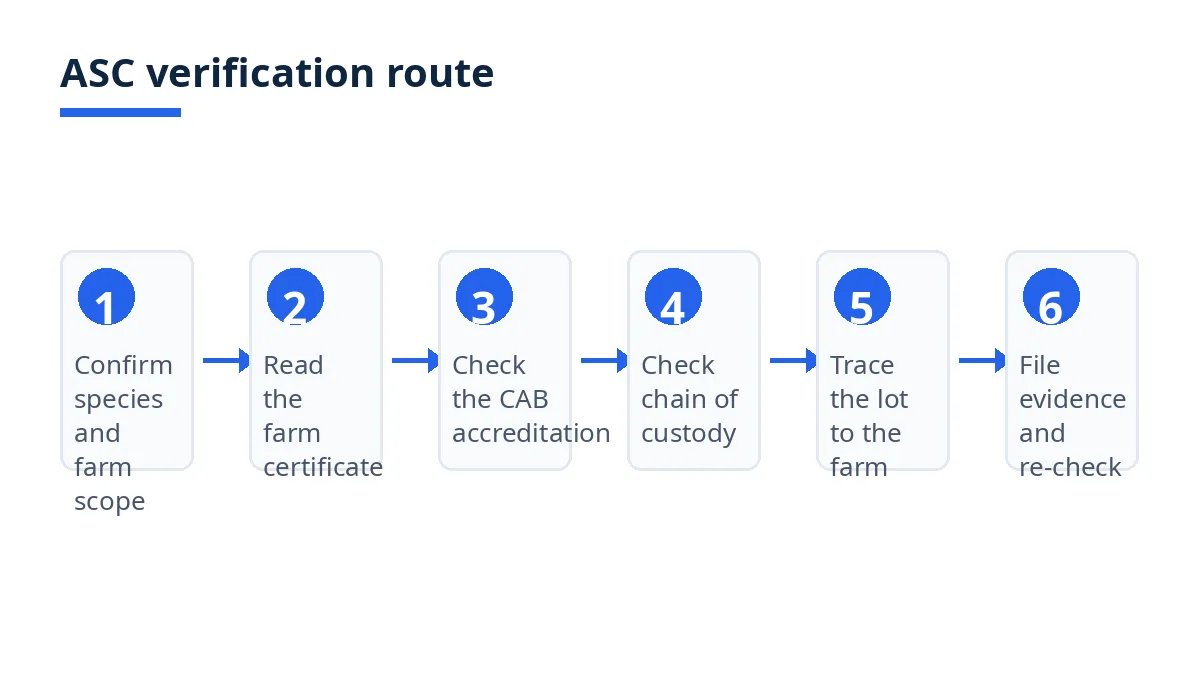
Treat each step as a gate. A species mismatch, site gap, expired certificate, missing chain-of-custody holder, or untraceable lot means the claim is unverified until that step passes in writing.
Costs, timelines and documents
No single public figure fits what ASC certification costs a Bangladeshi farm or how long it takes, so this guide gives cost drivers and questions instead of numbers. Certification is paid for by the farming operation, ASC itself does not receive payment for any part of the certification process, and only the chosen CAB receives a fee.5 The cost will depend on operation complexity, number of sites, production location or type, information availability, stakeholder involvement, and translation needs.5 Ask the farm and the CAB for a written quotation based on the actual scope.
Budget, as items rather than figures, for both sides of the chain. On the farm side, allow for a gap review against the species standard, record systems for water, feed, health, and worker records, any farm changes the standard requires, the CAB audit, and the annual audit cycle.3 On the chain side, allow for the chain-of-custody audit for each owner, staff time for separation and traceability records, and label checks before any ASC label is used.
Timelines follow the same logic. A farm audit runs through application, preparation, an on-site audit, a draft report with independent peer review, a public comment stage, and then a certification decision.6 Certificates are valid for three years, subject to surveillance audits, including observation of critical points such as harvest.6 Do not treat a farm that has only applied, or only completed a pre-assessment, as certified.
The document set is short: the farm certificate with standard, subscope, site, and dates; the audit report reference and public ASC record; the CAB name and accreditation details; each chain-of-custody certificate with ASC scope stated; lot traceability records; and any label wording to be used. If any item is missing, record the gap in writing and decide whether to proceed without an ASC claim.
Bangladesh-specific rules and tips
Bangladesh is a shrimp country first in seafood exports. The Department of Fisheries notes that around 50 to 60 percent of total fishery export volume is composed of shrimp, contributing about 75 to 85 percent of total export value, that shrimp is the major exporting seafood item, and that most of it is of aquaculture origin.7 The same official plan notes that Bangladeshi fish and fishery products reach around 60 countries, with European Union member countries remaining the major export destinations, alongside the United States, China, Japan, and other markets.7 Check destination-market expectations early: a market that asks for ASC will ask for the farm and chain evidence described here.
Do not turn that general picture into a claim about ASC in Bangladesh. This guide makes no claim about how many Bangladeshi farms hold ASC farm certification, how Bangladesh ranks, or which certification bodies operate in Bangladesh, because those figures change and must be checked against the current ASC public record and the CAB concerned. A statement that a district is ASC certified is not evidence for a farm, a species, or a lot.
In practice, ask shrimp suppliers to separate three things often mixed in conversation: the farm and its species, the processor and its chain-of-custody status, and the export and food-safety paperwork for the shipment. ASC covers the first two. It does not replace export registration, food-safety controls, or destination-market import rules. For pangasius, apply the same separation, and match the legal name, site, and species on each certificate to the order. Where a supplier works with several farms, ask for a farm-by-farm breakdown.
Mistakes and red flags
The most common mistake is treating a factory or processor claim as a farm claim. A processor with chain-of-custody certification but no certified farm behind a lot cannot sell that lot as ASC certified, and a farm with a certificate but no certified chain after it cannot deliver an ASC labelled product. Always check both sides of the chain, and match the company name to the species and site.
A second mistake is accepting a logo, label draft, or website badge as evidence. The ASC label is only supported when the farm is certified and the chain is certified and intact. Ask for the certificates and lot trace behind any label, check the public ASC record, and pause the claim if the supplier will not share the certificate, the CAB name, or the audit report reference.
Other red flags include a certificate with no species subscope, no site, or no expiry date; a chain-of-custody scope that does not mention ASC product; volumes shipped that exceed the volumes traceable to the certified farm; and a claim that ASC proves food safety, quality grade, or legal compliance for the whole business. Each has the same correction: go back to the certificate scope, the CAB record, the chain-of-custody scope, and the lot trace, and record any gap in writing.
Checklist
Use this checklist before a first order, and again before any repeat order after a change in farm, processor, species, site, or product form.
Species, product, and form written down and matched to the farm certificate subscope.
Farm or farms named for the exact lot, with site and production system stated.
Full farm certificate received, with standard, subscope, site, legal name, and dates checked.
Public ASC record for the farm certificate checked and the result noted with a date.
CAB identified, with accreditation confirmed for ASC work.
Annual audit status understood, including any non-conformities that affect the lot.
Chain-of-custody certificate received for every owner after the farm, with ASC scope stated.
Lot trace reviewed, showing volumes, separation, and a link back to the certified farm.
Label and claim wording checked against the farm and chain evidence for that lot.
Expiry, surveillance, and renewal dates noted, with a re-check set before shipment.
Any gap, missing document, or unverified claim recorded in writing, with a decision on whether to proceed with or without an ASC claim.
How Exportain helps
Exportain's own supplier checks are a document and photo review, not a farm audit and not a chain-of-custody audit, and they do not replace the ASC checks in this guide. The Trust Center states plainly that supplier verification is a document review, not a factory inspection and not a check against a government database, and that a badge is not a guarantee of production capacity, product quality, or delivery. Use those checks to confirm identity, business registration, export registration, and facility photos, while ASC evidence is checked separately through the route in this guide.
A buyer can use Exportain to describe the species, farm, processor, and product form clearly, request the checklist documents, and keep the correspondence and evidence together for the order. ASC claims fail most often on missing links: a farm name without a species scope, a processor without a chain-of-custody scope, or a lot without a trace.
FAQs
What should I know first about ASC certification?
Know first that ASC is a farm-level responsible-aquaculture standard plus chain-of-custody certification for later handlers, not a factory certification and not a food-safety system. Ask for the farm certificate for the exact species and site, read its subscope and dates, confirm the CAB, and then confirm chain-of-custody certification for every owner after the farm. ASC states that only accredited CABs may audit and certify a unit, and that all certificates are available on the ASC website for verification.1 If any link is missing, treat the product as uncertified for ASC purposes.
What are the typical costs and timelines?
There is no typical figure that fits every farm or handler. ASC itself receives no payment for certification, and only the chosen CAB receives a fee, depending on operation complexity, number of sites, production location or type, information availability, stakeholder involvement, and translation needs.5 Farm certificates are valid for three years subject to surveillance audits, and farms also undergo an annual audit cycle.6 3 Ask the CAB for a written quotation and timeline for the actual scope.
Which documents are needed?
The core set is the farm certificate with standard, subscope, site, legal name, and dates; the public ASC record; the CAB name and accreditation details; a chain-of-custody certificate with ASC scope for every owner after the farm; lot traceability records showing volumes and separation back to the certified farm; and the label wording to be used. Chain-of-custody certification rests on certified supply, identifiable product, separation, traceable and recorded volumes, and a management system.4 File those documents together, with expiry dates noted.
What are the most common mistakes?
The most common mistakes are treating a processor claim as a farm claim, matching the company name but not the species or site, accepting a logo as evidence, and assuming ASC proves food safety or quality. Each has the same correction: read the farm subscope, confirm the CAB, confirm chain of custody for every later owner, trace the lot, and record any gap in writing before deciding whether to use an ASC claim.
Next steps on Exportain
Start by describing the species, farm, processor, and product form precisely, then request the checklist documents and run the verification route before agreeing shipment dates or label wording. Post a free RFQ on Exportain with species, farm scope, chain-of-custody, and product form requirements stated, so suppliers respond with matching certificates rather than general claims. For background on what platform checks do and do not cover, read the Trust Center, keeping in mind those checks are a document and photo review and do not replace the ASC farm and chain-of-custody checks in this guide.
Sources
- ASC Farm Standard. Aquaculture Stewardship Council (accessed )
- Our farm standards. Aquaculture Stewardship Council (accessed )
- What ASC certification means for nearby communities. Aquaculture Stewardship Council (accessed )
- Traceability - Is your seafood really what it says on the tin?. Aquaculture Stewardship Council (accessed )
- Get Certified. Aquaculture Stewardship Council (accessed )
- ASC Certification. SCS Global Services (accessed )
- NPOA-IUU Bangladesh. Department of Fisheries, Ministry of Fisheries and Livestock, Bangladesh (accessed )
About the author
Sourcing from Bangladesh?
Post a request for quotation and suppliers on Exportain can send you their quotes directly.
Post an RFQ