

How to Find Accord / RSC Safety Certified Factories in Bangladesh
Ask for the inspection findings, corrective action plan and remediation status for the exact factory and building, and read the open high-severity items before ordering.
Short answer
The Accord and its successor, the RSC, run a factory safety programme in Bangladesh, not a product certification. Check a factory by its inspection findings, corrective action plan, remediation status for each finding, and safety-committee record, and treat a Letter of Recognition as proof of initial findings only.
On this page
Key takeaways
The Accord and RSC run a factory safety programme, not a product certification: check inspection findings, corrective action plans and remediation status, not a certificate.
The RSC took over the Accord work in Bangladesh on 1 June 2020, carrying over covered factories with their corrective action plan status intact.
Read remediation item by item: in progress, pending verification, or corrected by RSC engineers, and question any open high-severity fire, electrical, structural or boiler items.
A Letter of Recognition recognises completion of initial findings only; it does not cover later follow-up findings or act as a permanent pass.
Match factory legal name, address and building across every document, and confirm any subcontracted unit with its own safety evidence.
Search results often call a Bangladeshi garment factory "Accord certified" or "RSC certified." That wording is common search phrasing, and it is misleading if read literally. Neither the Accord nor its successor, the RMG Sustainability Council (RSC), issues a product certificate. What they run is a factory safety programme: inspections of fire, electrical, structural and boiler safety, monitoring of the fixes that follow, safety-committee training, and a complaints mechanism for workers.1 2 A factory in that programme is a covered factory working through a corrective action plan, not a factory holding a certificate for the goods it makes.
That distinction changes the check. Instead of asking for a certificate number, ask for the safety evidence behind the claim: the inspection findings, the corrective action plan (CAP), the current remediation status for each finding, and the safety-committee record. Where a factory has completed all of its initial findings, the RSC may issue a Letter of Recognition (LoR), which recognises completion of those initial findings only; it is not a product certification and does not end ongoing safety work.1 3
Why this matters for buyers and sellers
For a buyer, a factory safety failure is not only a production risk. It can stop an order, damage a brand relationship, and put workers at risk. The original Accord was created as a legally binding agreement after the Rana Plaza collapse, with independent inspections, public reporting of results, and an obligation on signatory brands to stop doing business with factories that refused to operate safely.4 Its successor arrangements kept the inspection and remediation work going through the RSC, which the International Accord describes as the implementing body for its safety programmes in Bangladesh.2 4
For a seller, the same evidence is a selling point only when it is current and specific. A vague claim such as "we follow Accord standards" tells a buyer nothing about which building was inspected, which findings remain open, or whether the factory named in the evidence is the factory that will actually make the order. A seller that can produce a dated CAP, a status for each finding, and a safety-committee record gives a buyer something a procurement file can hold.
Do not treat one safety programme as a substitute for all other checks. RSC coverage concerns building, fire, electrical, structural and boiler safety in covered garment factories.1 2 It does not by itself prove product quality, labour practices beyond the programme, environmental performance, or financial reliability.
Step-by-step: how it works
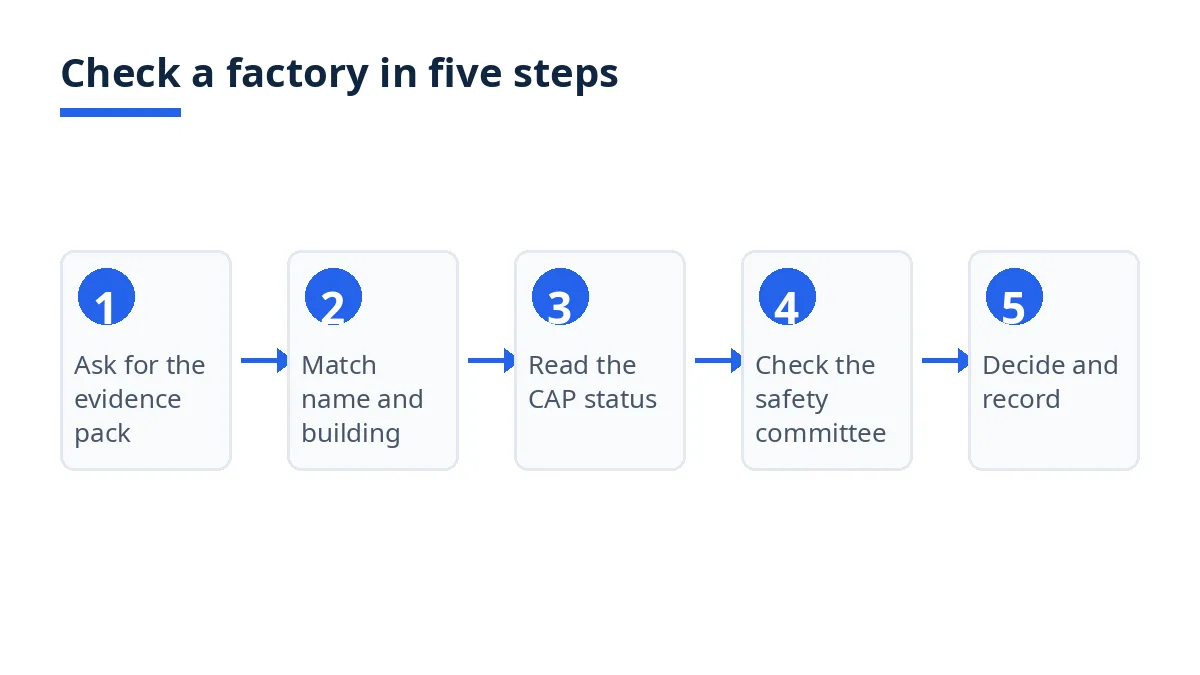
Start with the factory, not the claim. Get the exact legal name of the factory, its full address, and the name of the building if the factory shares a building with other units. Safety findings attach to a building and a factory unit, so a name that is close but not exact is not a match. If the supplier cannot give you the exact factory and building names, stop and clarify before you spend time on documents.
Next, ask for the evidence pack. The pack should contain the initial inspection findings, the CAP built from those findings, the current status of each finding, and any Letter of Recognition if one has been issued. The RSC records remediation in three stages: "in progress" for a finding being worked on, "pending verification" where the factory reports a finding corrected but RSC engineers have not yet verified it, and "corrected" where RSC engineers have verified the fix through a follow-up inspection or testing visit.5 A buyer should read the status of each finding, not only the headline percentage.
Then check whether the factory is covered at all. All factories listed by signatories to the Bangladesh Safety Agreement take part in the inspections, remediation, safety training and complaints mechanism implemented by the RSC, and the International Accord publishes aggregate remediation progress reports for those covered factories.2 The sources opened for this guide do not point to a single public, searchable factory-by-factory directory a buyer can query alone. The practical route is therefore the evidence-to-request route: ask the factory for its inspection and CAP documents, and cross-check them against aggregate programme reporting and, where you have one, the signatory that listed the factory.
After that, read the CAP the way an engineer would. A CAP is built from the inspection findings, with time-bound remedial actions based on the severity of each finding.3 Fire safety items, particularly fire alarm and detection systems and suppression systems, are often the slowest to complete, according to the RSC monthly reporting.1 A CAP with many fire items still open is a different risk from a CAP with only minor items outstanding, even if the two factories show similar overall percentages. Ask which items are open, why they are open, and what the next verification step is.
Finally, check the safety committee. The RSC programme includes training and capacity development for safety-committee members so they can identify and manage workplace safety risks, and covered factories are expected to have labour-management safety committees equipped to monitor safety day to day.1 6 Ask for the committee record: when it last met, what it discussed, and what it raised. A factory with no functioning committee record is a warning sign even if its CAP looks tidy, because day-to-day safety depends on people on the floor, not only on a past inspection.
The diagram below summarises the sequence.
Costs, timelines and documents
No programme fee, fixed timeline, or standard turnaround is stated as a fact in this guide, because none of the sources opened here states one that a buyer can rely on for every factory. Costs and timelines depend on the route into the programme, the findings, and the building. Reporting on factories seeking RSC inspection outside brand nomination notes that brands previously bore the cost for their nominated factories, while factories coming forward on their own would bear the inspection cost themselves.7 Treat that as a cost driver to confirm in writing for your own case, not as a price list.
Timelines work the same way. A CAP sets time-bound actions by severity, so a factory with a small number of low-severity findings will move faster than a factory needing structural work or a full fire suppression system.3 Detailed engineering assessments for structural items can also slow progress, a point the International Accord reporting notes for structural remediation.2 Ask the factory for its CAP dates item by item, and for the date of its next scheduled verification visit, rather than accepting a single promised completion date for the whole factory.
The documents to request are:
Initial inspection report and findings, for the exact factory and building.
The corrective action plan, with each finding, its severity, and its time-bound action.
Current remediation status per finding: in progress, pending verification, or corrected.5
Any Letter of Recognition, with the date and the scope it covers.1 3
Safety-committee training and meeting records.
Evidence of any escalation or warning, if the factory has fallen behind on remediation, and what was done about it.
For a factory outside RSC coverage, the equivalent safety evidence it does hold, such as government inspection records or another audit report, so the gap is visible rather than hidden.
Keep the whole pack in the procurement file, with dates. A CAP status from two years ago is not current, and a Letter of Recognition for initial findings does not cover findings from later follow-up inspections.
Bangladesh-specific rules and tips
The Accord on Fire and Building Safety in Bangladesh was signed in May 2013, in the weeks after the Rana Plaza collapse, which killed at least 1,134 people and injured more than 2,000.8 The Accord ceased operations in Bangladesh on 31 May 2020, and the RSC took over its work on 1 June 2020, after a transition agreement signed in January 2020 between the Accord Steering Committee and the Bangladesh Garment Manufacturers and Exporters Association (BGMEA).8 Factories covered by the Accord were carried over to the RSC retaining their remediation status and any outstanding requirements under their CAP, and the transition agreement kept the Accord's transparency features, including public disclosure of inspection results and remediation activities.6
The RSC is a private tripartite initiative of the Bangladesh industry, global brands, and global and local trade unions.1 Contemporary reporting on the RSC framework described close coordination with the Department of Inspection for Factories and Establishments (DIFE), the government labour inspectorate, including quarterly safety reporting to DIFE and a shared database of factory lists, progress and escalation status.9 Do not confuse the two roles: the RSC runs the safety programme for covered factories, while DIFE is the state inspectorate with its own enforcement role.
Two further Bangladesh points matter in practice. First, coverage is not universal. The RSC programme covers factories in its programme, and a factory outside it will not have an RSC CAP to show you. That is not proof the factory is unsafe, but it is a gap you must fill with other evidence rather than with an assumption. Second, the RSC mandate has widened beyond its original safety core. From 16 November 2025 the RSC began, in a first phase covering 58 brands and 1,185 factories for six months, to monitor employment contracts and separation, wages, leave and other benefits, freedom of association and collective bargaining, and child or forced labour and discrimination, alongside occupational safety and health.10 When you read an RSC document, check which mandate it was issued under, so a safety finding is not mistaken for a finding on one of those newer topics, or the reverse.
Mistakes and red flags
The most common mistake is accepting a logo, a badge image, or a one-line claim as proof. A logo on a website or a sales deck is not an inspection report. Ask for the documents named above, and treat reluctance to share them as information in itself.
A second mistake is matching the wrong factory. Group companies often operate several units at several addresses. If the CAP names a different address, a different building, or a sister unit, it does not cover the unit that will make your order. Match legal name, address and building before you read anything else.
A third mistake is reading a headline percentage as a pass mark. A factory can show a high overall remediation percentage while a small number of high-severity fire or structural items remain open. Read the open items, not only the percentage, and ask what happens if those items slip further. Under the original Accord model, factories that failed to make needed safety repairs faced termination of business from signatory brands.4 Ask whether the factory has ever faced escalation for falling behind, and how it resolved it.
A fourth mistake is treating a Letter of Recognition as a permanent pass. The letter recognises completion of initial findings.1 3 Follow-up inspections can raise new findings, and a building changes over time. Ask for the most recent status, not only the letter.
A fifth mistake is ignoring subcontracting. Confirm in writing which factory and building will make your order, and whether any part will be subcontracted. If so, that unit needs its own safety check, not an extension of the first factory's CAP.
Checklist
Use this checklist before placing an order with a factory whose safety claim rests on the Accord or RSC route:
Exact factory legal name, address and building matched across all documents.
Initial inspection report received for that factory and building.
CAP received, with severity and time-bound action for each finding.
Each finding read at item level: in progress, pending verification, or corrected.5
Open high-severity fire, electrical, structural or boiler items identified and questioned.
Letter of Recognition, if claimed, received with its date and scope, and understood as recognition of initial findings only.1 3
Safety-committee training and recent meeting records received.
Escalation history, if any, disclosed and explained.
Subcontracting plan confirmed in writing, with safety evidence for any subcontracted unit.
Most recent status dated within the current programme reporting cycle, not a single old document.
Gaps for any factory outside RSC coverage filled with other safety evidence, and recorded as gaps where they remain.
How Exportain helps
Exportain helps buyers organise this check rather than replace it. A buyer can use Exportain to contact a seller, ask for the evidence pack described above, and keep the exchange and documents alongside the order discussion. Where a seller cannot produce the pack, a buyer can shortlist a different seller, or set document delivery as a condition before ordering. Exportain does not issue safety findings, run inspections, or certify factories under the RSC programme.
FAQs
What should I know first about Accord / RSC Safety?
Know first that it is a safety programme, not a product certification. The Accord inspected fire, electrical and structural safety in Bangladeshi garment factories, and the RSC took over that work on 1 June 2020, adding boiler safety and safety-committee training and keeping a complaints mechanism for workers.1 8 A factory in the programme works through a corrective action plan. Ask for that plan and its current status, not for a certificate.
What are the typical costs and timelines?
There is no single fee or timeline stated in the sources opened here that applies to every factory. Costs depend on who commissions the inspection: reporting notes that brands previously bore the cost for factories they nominated, while factories coming forward on their own would bear the cost themselves.7 Timelines depend on the findings: a CAP sets time-bound actions by severity, and fire suppression and structural items are typically the slowest.1 3 Confirm both in writing for the specific factory before you rely on them.
Which documents are needed?
Request the initial inspection report, the corrective action plan with severity and dates for each finding, the current status of each finding, any Letter of Recognition with its date and scope, and safety-committee records.1 5 3 Match the factory name, address and building across every document, and file the pack with dates so a later reader can see how current it is.
What are the most common mistakes?
Accepting a logo or a one-line claim instead of documents, matching the wrong factory or building, reading a headline percentage instead of the open high-severity items, treating a Letter of Recognition as a permanent pass, and ignoring subcontracting.1 3 4 Each of these mistakes leaves the buyer with a claim that looks reassuring and proves very little. The checklist above is designed to catch all five before an order is placed.
Next steps on Exportain
Sources
- RSC Monthly Report July 2026. RMG Sustainability Council (accessed )
- Progress at Covered Factories in Bangladesh. International Accord (accessed )
- RSC recognises 46 RMG factories for workplace safety. New Age (accessed )
- International Safety Accord / Bangladesh. Worker Rights Consortium (accessed )
- RSC Monthly Report December 2025. RMG Sustainability Council (accessed )
- Accord, BGMEA sign agreement on transition to RSC. Fibre2Fashion (accessed )
- RMG units not inspected by Accord to go thru RSC inspection. New Age (accessed )
- Bangladesh: Signatories extend Accord by 3 months, under pressure to negotiate new legally binding agreement with unions to ensure worker safety. Business & Human Rights Resource Centre (accessed )
- RMG Sustainability Council – a much needed business platform. The Financial Express (accessed )
- RMG Sustainability Council expands mandate beyond safety. The Daily Star (accessed )
About the author
Sourcing from Bangladesh?
Post a request for quotation and suppliers on Exportain can send you their quotes directly.
Post an RFQ


