ERC Required Documents: Complete Guide for Exporters
Which documents a Bangladeshi exporter needs for an ERC: the core set, extra papers by business type, CCI&E fees, OLM application steps, renewal and mistakes to avoid.
Short answer
The erc required documents are the papers the Office of the Chief Controller of Imports and Exports (CCI&E) checks before it registers a business as an exporter in Bangladesh. Every applicant needs a current trade license, a TIN certificate, a current chamber or trade association membership certificate, a bank certificate, and identity documents. Limited companies add RJSC incorporation papers, and partnerships add the partnership deed.
On this page
Key takeaways
The Export Policy 2024-27 lists obtaining an ERC from CCI&E as step 1 of the export process.
Every applicant needs a current trade license, a TIN certificate, current chamber or association membership, a bank certificate, and identity documents.
Limited companies add RJSC incorporation papers and partnerships add the partnership deed, and the OLM portal list governs each case.
A new General ERC totals BDT 11,500 including VAT and renewal totals BDT 8,050 per year on the current reported CCI&E schedule.
Renewals can run for one to five years, and CCI&E advises applying at least 60 days before expiry.
If you plan to export commercially from Bangladesh, the erc required documents are the papers you must have ready before the Office of the Chief Controller of Imports and Exports (CCI&E) will register you as an exporter. That registration is the Export Registration Certificate, or ERC. The Export Policy 2024-27 lists obtaining an ERC from CCI&E as step 1 of the export process, before product selection, buyer contact or any sales contract.1
This guide lists the documents, explains how the online application works, and shows how to avoid the mismatches that delay approval. The portal shows the document list for your own applicant type as you apply, and that list is the final word for your case.
Why this matters for buyers and sellers
For a seller, the ERC is the legal basis of the business as an exporter. Export policies in Bangladesh are formulated under the Imports and Exports (Control) Act, 1950, and Bangladesh Bank confirms that import and export control runs through CCI&E under that Act.1 2 Registration itself is governed by the Importers, Exporters and Indentors (Registration) Order, 2023, which replaced the Registration Order of 1981, and Bangladesh Bank's consolidated foreign exchange circular states the rule in the same terms: no person can trade under the scheme unless registered with CCI&E or exempted under the 2023 Order.2 3
The ERC connects your trade license, tax identity and bank account to a single recognized registration. Bangladesh Customs lists the ERC among its general export documents, alongside the sales contract or letter of credit, the EXP form, the invoice, the packing list, the transport document and the certificate of origin.4 An expired or missing ERC therefore stops a shipment: the registration is part of the per-shipment document set, not a one-time formality.
Buyers rarely see the certificate itself early in a conversation, but serious buyers do check whether a supplier is properly registered to export. A supplier who cannot ship legally is a risk to a delivery date, however good the product is. A valid ERC does not replace due diligence on quality and capacity, but it confirms the business exists and is registered for export.
Sequence matters too. The ERC comes before you operate as an exporter, not after you win an order. Prepare the documents while you develop products and talk to buyers. If you are still at the selling-readiness stage, read how to sell on Exportain alongside this guide.
Step-by-step: how it works
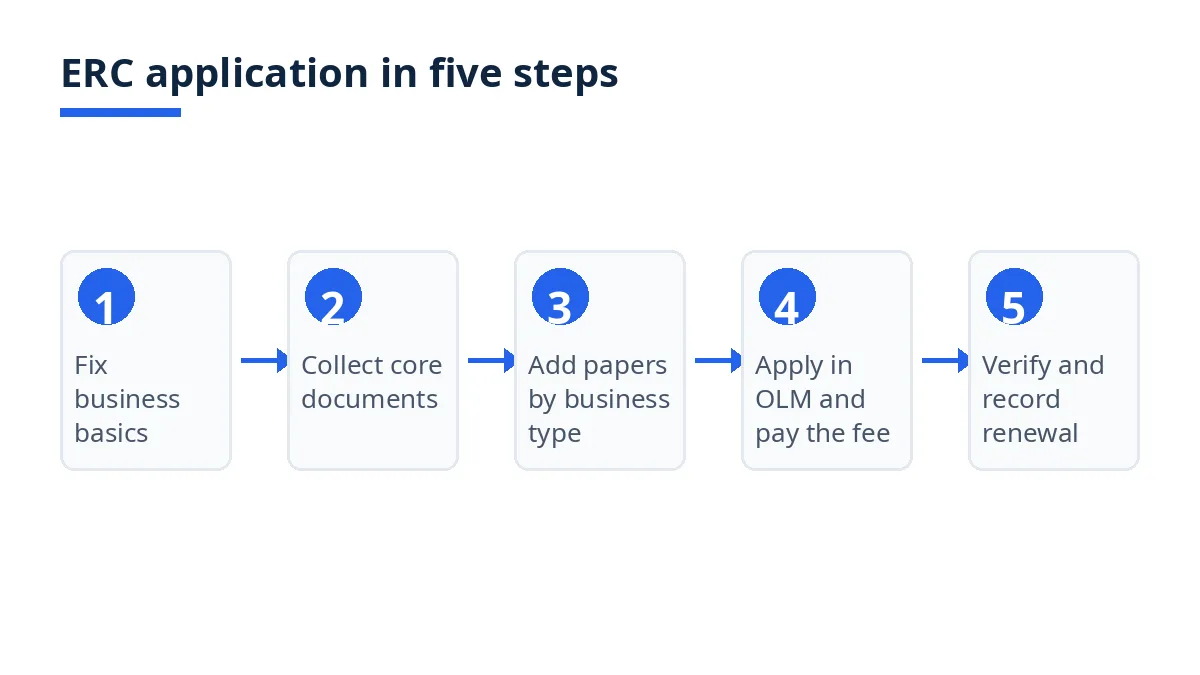
Applications run through the CCI&E Online Licensing Module (OLM) at olm.ccie.gov.bd, and current CCI&E notices say manual challans are not accepted.4 Work through the steps in this order.
Step 1: Fix your business basics first
Make sure your trade license is valid for the current year, with the correct business name, address and activity. Trade licenses are issued by the city corporation, municipality or union parishad for your business address.4 5 If the license has expired or the address has changed, renew or correct it first. Every later document is checked against it.
Step 2: Confirm your tax identity
You need a TIN certificate for the business or proprietor, issued through the National Board of Revenue (NBR).4 5 CCI&E asks for tax documents at registration and an income tax certificate or return slip at renewal, so keep your tax papers current.4 Where a VAT registration or Business Identification Number (BIN) applies, keep that certificate ready too. Customs lists the BIN among its general export documents.4
Step 3: Join a recognized chamber or trade association
Obtain a current membership certificate from a recognized chamber or your relevant trade association, such as a chamber of commerce or a sector body for your product.5 The certificate must be current, not lapsed, and the business name on it must match your other documents.
Step 4: Arrange your bank certificate and nominated bank
Ask the bank where the business holds its account for the certificate CCI&E requires, commonly a solvency or account certificate in the business name.5 In the application you also name a nominated bank branch. That branch is the Authorized Dealer (AD) bank branch that will handle your export transactions and EXP form certification, and an AD bank handles the foreign exchange side of exports, including EXP processing and realization of proceeds.4 5 Use the same bank you will use for export proceeds, and confirm the branch holds an AD license before you select it.5
Step 5: Add the documents for your business type
A sole proprietor relies on the core set plus identity documents. A partnership adds its partnership deed. A limited company adds its certificate of incorporation, memorandum of association and articles of association from the Registrar of Joint Stock Companies and Firms (RJSC).4 5
Step 6: Apply through the OLM portal
Create an account on the OLM portal, select the ERC category, and complete the application.5 Choose the General ERC if you own and ship goods. Choose the Indenting ERC only if you arrange deals between foreign buyers and local manufacturers without handling goods yourself, because indentors are classified separately and pay a higher fee.5 Upload clear scans of the documents the system asks for your applicant type, and keep the originals ready, because CCI&E may verify them or inspect the premises for some first-time applicants.5
Step 7: Pay the prescribed fee as directed
Pay the registration fee through the payment option the portal shows for your application, and keep the payment proof.5 Fees differ by category, so use the amount shown for your own application, not a figure quoted for another category.
Step 8: Respond to queries and collect the certificate
Queries are usually about a missing document or a mismatched detail. Answer with the corrected document, not an explanation alone. Once approved, check the certificate issued through the portal at once: name, address and validity must be exactly right.5
The companion guide is ERC — Export Registration Certificate, which explains what the ERC is and how it differs from other registrations.
Costs, timelines and documents
Which documents are needed?
The erc required documents fall into three groups: the core set every applicant needs, the extra set that depends on your business form, and the supporting papers the portal may request for your case. The portal list governs, because not every supporting paper is mandatory for every applicant.5
Document | Who needs it | Notes |
|---|---|---|
Valid trade license | Every applicant | Current year, matching name, address and activity |
TIN certificate | Every applicant | Issued through the National Board of Revenue |
Chamber or trade association membership certificate | Every applicant | Current membership of a recognized chamber or sector body |
Bank certificate | Every applicant | Solvency or account certificate from the bank |
National ID or passport, and photographs | Every applicant | Proprietor, partners or directors, as the portal requires |
Certificate of incorporation, memorandum and articles of association | Private limited companies | RJSC documents, with director particulars |
Partnership deed | Partnership firms | Covering all partners |
VAT registration certificate (BIN), office rent agreement, tax return papers | Where the portal requests them | Case-specific; check your own checklist |
What are the typical costs and timelines?
Fees follow the CCI&E revised fee schedule effective from 1 September 2022, as reported in current application guidance.5 A new General ERC costs BDT 11,500 in total (BDT 10,000 plus 15 percent VAT), and renewal costs BDT 8,050 in total per year (BDT 7,000 plus 15 percent VAT).5 An Indenting ERC costs BDT 57,500 new and BDT 28,750 on renewal, on the same basis.5 Chamber membership and document preparation carry separate costs, which vary by body and business. Because fees are revised from time to time, confirm the amount in the OLM portal when you apply and pay only through the channel the portal directs.
On timing, the official processing time is listed as around 3 working days after a complete submission.5 A complete application whose documents all match can stay close to that figure. One with an expired license, lapsed membership or mismatched addresses stops until the underlying document is fixed, which can take longer than the ERC step itself. Do not promise a buyer a shipment date that assumes registration is complete.
Renewals can run for one to five years in a single transaction, and CCI&E notices advise applying at least 60 days before expiry to avoid a penalty.4 5 Renewal is normally supported by your updated trade license, current membership, bank documents, tax papers and the existing ERC.4 5 Record the date before expiry. Renewing with an expired trade license simply moves the blockage.
Bangladesh-specific rules and tips
The ERC is separate from the IRC. The Export Registration Certificate covers exporting, and the Import Registration Certificate (IRC) covers importing. Businesses that both import inputs and export finished goods may need both. Both are issued by CCI&E, and neither replaces the other.5
Choose the chamber or association that genuinely fits your product, and keep the membership renewed. A lapse affects both your ERC renewal and your standing in the sector, and a membership in the wrong name or sector is a recognized cause of delay.5 Use one consistent business address across the trade license, bank account, membership and application. If you have moved premises, update the trade license first and let the other records follow it.
The ERC is only the first export document. Registering as an exporter does not by itself ship goods. Each shipment still needs its own commercial and customs documents, and export proceeds must reach Bangladesh within four months of shipment unless Bangladesh Bank authorizes otherwise.4 Before your first order ships, work through export documents from Bangladesh so the per-shipment set does not surprise you.
Keep one physical and one scanned registration file with the ERC, trade license, TIN, BIN where applicable, membership, bank certificate and incorporation or partnership papers.
Mistakes and red flags
Applying with an expired trade license is the most avoidable failure. Renew the license first. An ERC application built on an expired anchor document will not proceed cleanly.5
Mismatched names and addresses cause the next largest group of delays. A trade license in one spelling, a bank account in another and a membership in a third creates verification queries at every step. Standardize the business name and address everywhere before you apply, including the chamber membership, which must match your product sector and company name.5
Choosing the wrong ERC category wastes money and time. A business that arranges deals without owning goods needs the Indenting ERC, not the General ERC.5 Nominating a bank branch that is not an Authorized Dealer branch is a related error, because only an AD branch can handle the export side of the account.5
Treating the ERC as optional for a small first order is a legal mistake, not a shortcut. There is no small-order exception to being a registered exporter.
Letting the ERC lapse after the first shipment completes the set. Put the renewal date in the same calendar as your trade license and membership renewals, and start the renewal at least 60 days before expiry.4
Paying anyone who promises to bypass documents is a red flag. No agent can lawfully substitute for a valid trade license, tax identity or membership.
Checklist
Use this as your pre-submission check:
Trade license valid for the current year, with correct name, address and business activity
TIN certificate ready, in the matching name
VAT or BIN certificate ready, where it applies to your business
Current chamber or trade association membership certificate obtained, in the matching name
Bank solvency or account certificate obtained from your business bank
Nominated AD bank branch confirmed for export transactions
National ID or passport copies ready for the proprietor, all partners or all directors, as applicable
Photographs ready, as the application requires
Limited company: incorporation certificate, memorandum and articles, and current director particulars ready
Partnership: partnership deed ready
All names and addresses cross-checked against the trade license
ERC category confirmed: General or Indenting
Fee amount confirmed in the OLM portal for your own category, and payment proof kept
Scanned copies clear and complete, originals available for verification
Renewal date recorded for the ERC, trade license and membership together
When every box is ticked, your application is a verification exercise for CCI&E rather than a repair job. You can also review Exportain membership while your registration is in progress.
How Exportain helps
Exportain helps Bangladeshi sellers turn registration into orders. Once properly registered, you can present your business to international buyers, list what you make or supply, and respond to inquiries and requests for quotation through one platform. Seller verification on Exportain records document and photo checks. It is not a factory inspection and it is not a guarantee, and Exportain does not issue the ERC. Only CCI&E can do that.
FAQs
What should I know first about ERC?
Know three things first. The ERC is the Export Registration Certificate issued by CCI&E, and a business needs a valid one to export commercially from Bangladesh. It is a registration based on your existing business documents, so their quality decides how smooth the application is. And it must be kept valid through renewal. An expired ERC blocks formalities just as a missing one does.
What are the typical costs and timelines?
Costs are the prescribed CCI&E fee for your category, plus your own chamber membership and document costs. On the current reported schedule, a new General ERC totals BDT 11,500 including VAT and renewal totals BDT 8,050 per year, while Indenting ERC fees are higher.5 Confirm the exact amount in the OLM portal when you apply, because fees are revised. The official processing time is around 3 working days after a complete submission, and most delay comes from renewing a lapsed trade license or membership, or correcting mismatched details.5
Which documents are needed?
The core set is a valid trade license, a TIN certificate, a current chamber or trade association membership certificate, a bank solvency or account certificate, and National ID or passport documents for the proprietor, partners or directors.5 A private limited company also needs its certificate of incorporation, memorandum and articles of association and current director particulars. A partnership needs its partnership deed. Follow the document list the OLM application shows for your applicant type as the final authority.5
What are the most common mistakes?
The most common mistakes are applying on an expired trade license, letting names or addresses differ between documents, choosing the wrong ERC category, nominating a bank branch that is not an Authorized Dealer branch, relying on an out-of-date fee figure, and forgetting to renew the ERC after the first shipment.5 Every one of them is preventable with the checklist in this guide: fix the underlying business documents first, cross-check them against each other, and record renewals together.
Next steps on Exportain
Assemble your document file using the checklist above, then start the application in the CCI&E OLM portal. Read how to sell on Exportain for the seller journey, and keep the ERC certificate guide open alongside this one.
Sources
- Export Policy 2024-2027. Ministry of Commerce, Government of Bangladesh (accessed )
- Consolidated circular on foreign exchange regulations - import transactions (FEPD-1 Circular No. 30). Bangladesh Bank, (accessed )
- Continuous reforms of business laws commendable. The Daily Observer (accessed )
- Start an Export Business in Bangladesh (2026 Guide). Entrepreneurs.bd (accessed )
- Export Registration Certificate (ERC) In Bangladesh: How To Apply. Bizmend, (accessed )
About the author
Sourcing from Bangladesh?
Post a request for quotation and suppliers on Exportain can send you their quotes directly.
Post an RFQ